You and your work group or project team may have come up with a promising solution to a business challenge. You’re ready to start making it a reality.
But you can’t do it alone. You need help—from a variety of people and teams.
For instance:
You want to test the latest version of a product enhancement with several potential customers—and use their feedback to refine it.
You know you need input from colleagues in different departments to be able to pursue a promising new initiative.
You need your manager to reassign some of your current projects so you can focus on an innovative idea.
How do you get others to believe in the value of your innovation as much as you do? Here’s some advice from innovation expert Karen Dillon.
DID YOU KNOW?
DID YOU KNOW? At Toyota’s Innovation Fair, teams from across the company compete for awards, prizes, and funding for new projects. Top teams get the tools, connections, and resources they need to move their innovations forward.
赢得赞同 Mentor Moment Get Their Buy-In
哈佛教授讲授视频逐字稿
Even a top-notch innovator like Steve Jobs or Leonardo da Vinci can't pull off successful innovation without some help. To turn your idea into reality, you'll need support from others. Maybe it's a co-worker getting behind your process improvement proposal, or a group of customers agreeing to test a new product prototype, or a senior manager offering resources from another team. Whoever they are, the key is to have your colleagues believe in the value of your innovation as much as you do.
The question is how? How do you spread your energy and enthusiasm for your innovative idea to others? Here's what I suggest.
First, identify your key stakeholders and influencers. Who controls funds or resources? Who will be directly or indirectly affected by your idea? Who might be a champion for your idea?
Next, think also about the different types of support you'll need and how they might change over time. At one stage, you might need to focus on getting resources. And at another, you might need help to promote your idea in other areas of your organization.
Once you know whose support you need and what type of help they need to give you, then it's time to win them over. You'll need to carefully consider the needs and interests of each person or group so that you can speak to them about your innovation on their terms. Most people respond positively when they understand what's in it for me. And even more so when they feel they're being included in a process.
There are lots of techniques that you can use to win over those around you, no matter who they are. No one can manage innovation entirely on their own. But if you understand that the process of building support is as important as your innovation itself, your project is far more likely to succeed.
Take a Moment
1. Think of a time when you helped a coworker, colleague, or friend pursue an innovative idea. What motivated you to get involved?
第 2 节
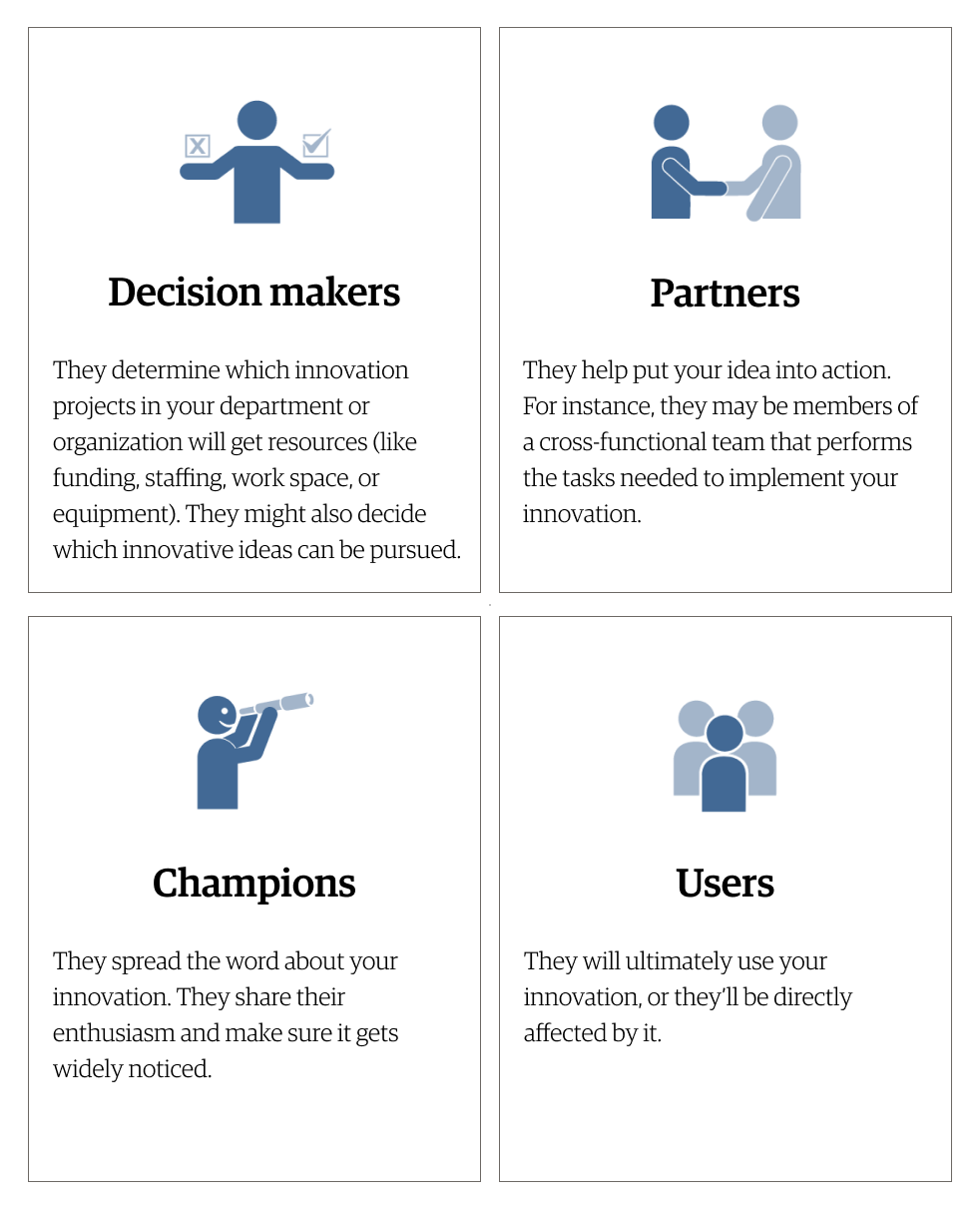
Who could help make your innovation successful? Supporters fall into four categories:
More important than how many supporters you have? Getting the key people you need on board.
DID YOU KNOW?
DID YOU KNOW? Global logistics company DHL regularly brings customers to innovation centers in Germany and Singapore to share best practices and create value together.
This means involving those who are in a position to help—and convincing those who could potentially block your innovation.
Meet Carlotta
Meet Carlotta
She manages a team of call-center employees. Lately, customer complaints and employee turnover have skyrocketed.
Carlotta has an innovative idea for developing a new training program that would use the latest insights on instructional design and adult learning. Her hypothesis is that improved training will lead to better customer service and more engaged and satisfied employees.
Meet Carlotta
Who can Carlotta call on to help make her innovation project successful?
Decision makers
• Her boss
Partners
• Learning and development professionals in the HR department
• Analytics group
• Key call-center employees
Champions
• Her coworkers
• Learning and development professionals
Users
• All call-center employees
• Customers
Keep these points in mind:
These roles aren’t formally designated job titles or responsibilities.
Sometimes one individual may fill more than one role.
You might have several people filling each role.
Try it Out
Think of an innovative project you previously worked on or one you are planning. Identify at least one person in each category.
One size doesn’t fit all when it comes to engaging supporters. Once you’re clear about whose support you need, you’ll want to tailor your approach.
It’s important to think through:
What you need from each person
What’s on their “radar”—what they need to achieve and what barriers might keep them from doing that
How you can frame your request as a “win-win” that meets both of your needs
Communications specialist Brad Holst introduces three strategies for making your case to executives. The same basic principles apply with other supporters too.
赢得高管支持的三项原则 Three Principles to Win Executive Approval
哈佛教授讲授视频逐字稿
I was lucky that early in my career, I learned about the importance of being able to manage up in an organization, to be able to influence the executives that make up that company, because I had a role where my success or failure really depended on doing exactly that.
One of the first meetings I had where I was presenting a recommendation, I brought a really great idea to the table, one that I was confident could just make a great impact on the company. But much to my surprise, it got a really lukewarm reaction. In fact, one of the executives ended the meeting by saying, “I guess we just weren’t really clear what the problem that you were trying to solve was.”
I was little dejected. I met with my boss afterwards, who happened to be in the meeting. She gave me some great advice. She said every executive has their own personal radar. And what’s on it is the objectives they need to achieve and the barriers they might see that’ll keep them from doing that. And if you’re trying to share an idea or make a recommendation, you have to link it to what’s on their radar and show how it can either make them more successful or can eliminate risks.
I loved the advice, so I asked her, “Well, is there anything else I could have done better?” And she paused. And she said, “Well, yes. You are normally a great communicator. You come across confidently. You’re very personable. But when you’re in with our executive group, you’re like a whole different person. You’re hesitant, you’re tentative.” And I interrupted her—I was little defensive—and I said, “Can you give me an example of what you’re talking about?”
She said, “Sure.” She mimicked me and said, “This is how you sounded in the meeting: ‘Um, well, you know, what we could possibly do here might be to…’” I heard that, and I knew she was right. And I realized in that moment that if I was going to be successful in this role, I needed to change. I needed to learn how to be effective with people more senior to myself.
So I adopted three principles that have served me very well right this very day.
The first principle is to first sell the problem. And if you can get them to buy into the problem or opportunity by linking it to what’s on their radar, then they’re very eager to hear your idea.
Which brings us to principle two. In order to do that, you have to understand what’s on their radar. You have to do your homework about them.
And then finally, in some ways—maybe most importantly—when you’re engaging with people more senior than yourself, you’ve got to let your own unique brand of executive presence come out, which means you’ve got to engage with your genuine and authentic personality.
You’ve got to find the courage to talk about the conviction and share the conviction you have in your ideas, because what I found is, if I don’t sound like I believe in my ideas, why should they?
Poll
Poll
How do you compare with others? You’ll learn more about each of these practices below.
第 4 节
What do you need from each of your supporters?
In some cases, it might mean resources—people, equipment, budget, space. In others, it could include access to networks, time, influence on others in the organization, or even full participation in the project.
In all instances,before you make your pitch, have a clear sense of exactly what you need from each person or group.
For example, if you want your boss to provide staffing, specify the number of people, the time commitment, and the areas of expertise needed.
Remember Carlotta? What kind of help does she need from the supporters she identified?
图表
〔图表类内容,图片原件见线上原文〕
Try it Out
For each category of supporter, think of one way they could help advance your innovative idea.
1. Decision makers
2. Partners
3. Champions
4. Users
第 5 节
For all your potential supporters, it’s useful to know what matters most to them.
Why? So you can show them how backing your idea serves their interests, too.
"To get buy-in, you have to make the tie-in."
Supporters respond more favorably to innovations that either solve a problem they face or make them—and their organization—more successful.
To find out what’s on your supporters’ radar:
Talk with managers and key stakeholders about what’s important to them, what they need to achieve, and what’s standing in their way
Listen for what they sound most excited by or concerned about
Dig into your organization’s and business unit’s strategy and priorities
Get to know potential supporters—maybe over lunch or a cup of coffee
Here’s what Carlotta thinks matters most to her boss
Here's what Carlotta thinks matters most to her boss
Reducing costs
Ensuring customer and employee satisfaction
Being viewed as proactive and innovative by others in the organization
Here’s what Carlotta thinks matters most to her boss
第 6 节
You know who you need support from and what form of assistance you need to make your innovation successful. You’ve also thought about how your project ties to their interests.
Now it’s time to get them excited about supporting you.
How? Customize your appeal for each person. Do this right, and you’ll convince them that helping you is a valuable opportunity—not just for you, but also for them.
DID YOU KNOW?
DID YOU KNOW? Once a quarter, LinkedIn employees are encouraged to pitch innovative ideas to executives. If approved, each team gets up to three months to turn that idea into a product or service.
"Real buy-in involves at least some element of co-creation. It invites discussion, debate, and allows everyone to feel even more vested in the outcome."
As you talk with potential supporters about your idea, make it a give-and-take, not a lecture. Nothing turns people off more than being talked at.
Plus, people tend to commit to something they’ve helped influence or shape.
Heather Figallo, vice president of innovation at Southwest Airlines, describes how she got support and buy-in for a major innovation project.
美国西南航空:赢得支持,共创客户体验 How to Get Real Buy-In
哈佛教授讲授视频逐字稿
People ask me all the time, how were you able to get this pushed through? How were you able to bring this to life in the airport? How were you able to take over half of Love Field for this test? And the truth is, it never felt like a huge, big approval. It was always just these little approvals along the way, taking in people's feedback, tweaking and adjusting. It might be something like-- in the case of this particular prototype, we had foam core boards with LED Christmas lights taped to them. And we'd say, oh, this is what it's going to look like when something's going on. Plug this in. Change the color.
When you're taking people through something that's literally cardboard, we call it duct tape and glitter, there's a real vulnerability to showing something like that. It's like a little science project. And what it does is it really opens up the conversation, because they see that we're just so enthusiastic and passionate about something, that we're just trying to throw a mockup together so that they can see what it is, so they can envision it, so they can help us push it through.
What we're also doing when we show them something that we know is fundamentally broken and we know that it's not right is that we are saying to them, I need your help. I know that this is not perfect. I know that the final end product is going to be different, but it can't be different without your feedback. And you are the experts. And you are the people that have a different perspective, more knowledge, more experience. So I'm really offering this to you as something for you to help improve.
So by the time you get to the final product, they see their own fingerprints on this work. They see the influence of the employees. They see the influence of the customers that have seen that work. So at the end, it doesn't feel like you made a big decision. You just made a series of little tiny decisions that got to this really beautiful solution.
Back to Carlotta
Back to Carlotta
Carlotta’s thinking about the key points she wants to cover when she talks with her boss.
Back to Carlotta
DID YOU KNOW?
DID YOU KNOW? Neuroeconomics pioneer Paul Zak found that well-structured stories trigger the release of oxytocin. This hormone promotes connection and empathy—and builds listeners’ trust.
The problem Carlotta's innovation aims to address - and its importance to her boss's interests
“We've been hearing a lot lately about the need to improve customer loyalty and employee engagement. I know this has been on your mind, too, because of the increase in complaints from customers calling into the help desk and the turnover in call-center staff.”
The problem Carlotta's innovation aims to address - and its importance to her boss's interests
Carlotta's innovative idea - and how it could help solve the problem
“I've got an idea that I think could help. It’s about developing new call-center training. I think this could help the call-center staff learn how to respond more effectively to customers who contact the center.
Customers would be happier. That means more loyalty and higher profitability, as we wouldn't have to invest so much in new-customer acquisition. Plus, as the call-center employees start getting better at their jobs, they'll enjoy the work more and feel a greater sense of accomplishment. So, we might see less attrition in the staff.”
Carlotta's innovative idea - and how it could help solve the problem
Carlotta's "ask" from her boss
“I'd like to look into what's needed to make this work. Can I get your help in reassigning a few of my current projects, so I can free up some time to focus?”
Carlotta's "ask" from her boss
The benefits to Carlotta's boss if he helps her
“If I can spend time on the idea, I could do some research on how to design the new training and work up prototypes that we could pilot-test. We might then be able to get the new training deployed in time to see results by the end of next quarter.”
The benefits to Carlotta's boss if he helps her
To engage potential supporters:
Consider telling a story to introduce your innovative idea—especially one that paints a vivid picture of a pain point or opportunity.
Think of key questions to ask—such as, “What are your thoughts on the problem or opportunity?”
Invite supporters to reality-test your work-in-progress to pinpoint any problems or improvements.
Ask for advice and input—"What am I missing? How could this idea be stronger?”
You can’t innovate alone. You need help—from a variety of people.
Potential supporters include decision makers, champions, partners, and users.
Before you make your pitch, know what you need from each person or group.
Understand what matters most to your potential supporters.
Customize your appeal for each supporter to convince them that helping you is a valuable opportunity.
Take Action
1. What will you try on the job to build support for an innovation?
第 7 节
Test your understanding and reinforce what you've learned.
Questions & Feedback
1. You and your work group have come up with a strong idea for updating a process that’s bogged down past projects. You need supporters from within your organization to move forward with the improvement. What’s the best way to get the key people you need on board?
答案与解析
A. Plan a presentation where you deliver a detailed, final plan. As you talk with potential supporters about your idea, make it a give-and-take, not a lecture. Nothing turns people off more than being talked at. Plus, people tend to commit to something they’ve helped influence or shape.
To learn more, see: Build Support for Innovation.
B. Develop a consistent pitch to use with all potential supporters. One size doesn’t fit all when it comes to engaging supporters. Once you’re clear about whose support you need, you’ll want to tailor your approach.
To learn more, see: Build Support for Innovation.
C. Find out what matters most for each potential supporter.(正确) For all your potential supporters, it’s useful to know what matters most to them.
Why? So you can show them how backing your idea serves their interests, too.
To learn more, see: Build Support for Innovation.
D. Don't ask for anything specific from potential supporters-you may undermine their enthusiasm for your idea. Before you make your pitch, have a clear sense of exactly what you need from each person or group. In some cases, it might mean resources—people, equipment, budget, space. In others, it could include access to networks, time, influence on others in the organization, or even full participation in the project.
To learn more, see: Build Support for Innovation.
第 8 节
Reflecting on your learning helps you apply relevant concepts to your job.
Take a Moment
1. 1. What new insights do you have that could benefit you or others in your workplace?
2. 2. What are your biggest opportunities for applying concepts from this Lesson in your workplace?