Coaching
Promote Learning Agility 查看中文版
第 1 节
When you coach, you’ll often focus on something specific—developing a skill, filling a gap, or achieving a goal. But great coaches do something else, too: They support people in developing learning agility.
Learning agility doesn’t mean being the smartest person in the room or doing everything right. It’s being able to:

Why is learning agility important? Executive coach Nina Bowman makes the case for how in today’s ever-changing business climate, being able to adapt to new circumstances is crucial for success.
学习型思维助你应对变化 A Learner’s Mindset
哈佛教授讲授视频逐字稿
Learning agility is vital today. It's critical that we learn how to adapt. I coach an individual named Sarah. Sarah is a marketing sales executive. And in her organization, she's experienced two major reorgs in a very short span of time. And for Sarah, this was also incredibly disorienting.
In my work with her, we had Sarah really think about what her mindset and experience with change was. She wasn't embracing it. She learned to reframe. And in reframing, she began to see some of these changes as not hurdles, but real opportunities--opportunities for growth and development. Sarah began to spend much more time in elevating her skills, so that she could bring to her organization not just the skills that were needed for today. She also took more risk. And in taking more risk, she began to challenge more, to really look at the status quo and be able to see what the organization could do differently, and gain comfort in bringing up those recommendations.
She tapped into her network. And at every step along the way, Sarah embraced a growth mindset. And if you want to be the agile learner that your organization needs you to be, you can also embrace this growth mindset.
When you coach members to be agile and embrace change, you boost your team’s ability to create—and capitalize on—opportunities.
案例
Curiosity, for the win
At an industry conference, product managers Val and Nia hear an expert speak about a new technology. Nia disregards the information because it sounds similar to something the company tried unsuccessfully a few years ago.
But Val is curious. She asks Nia about what didn’t work last time, figures out what additional information might be useful, and seeks out the speaker to find out what else she can discover.
Try it Out
1. Put yourself in Val’s shoes. You believe the expert proposed ideas worth exploring. What can you say to help Nia reframe her assumptions—and strengthen her learning agility?
第 2 节
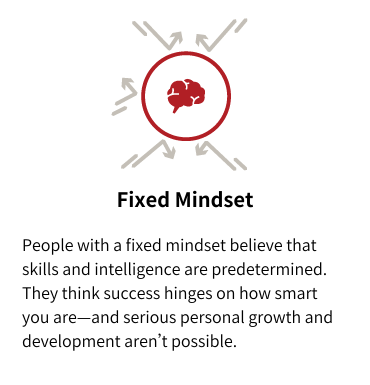
As a coach, you may find yourself working with people who avoid challenges for fear of making mistakes—or who take feedback as a personal attack. These individuals likely have a fixed mindset. Many of us do.
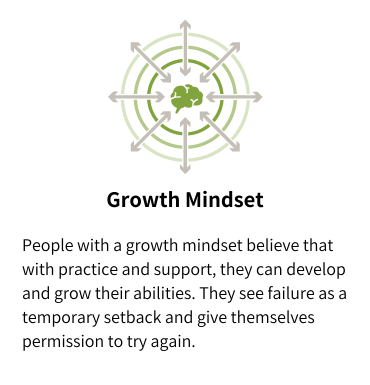
The good news: You can help team members shift to a growth mindset—the belief that with effort and support, they can stretch and grow.
“We like to think of our champions and idols as superheroes who were born different from us. We don’t like to think of them as relatively ordinary people who made themselves extraordinary.”Mindset: The Psychology of Success, by Carol Dweck. Ballantine Books, December 26, 2007.
DID YOU KNOW
DID YOU KNOW Through exposure to the idea of growth mindset, school-age children with learning issues gain confidence that they can improve their skills."Growth Mindset: What You Need to Know" by Amada Morin. Understood For All Inc.
How do you know if someone has a fixed or growth mindset? Listen for hints. For example, people with a fixed mindset:
- Make broad statements
- Blame factors outside their control
- Engage in negative self-talk
“Numbers aren’t really my thing...”
“Numbers aren't really my thing...”
Sarah, a marketing manager, asks Rocco to work on a draft budget, under her guidance, for a new project. He’s the perfect candidate, because he regularly scopes pricing for art, graphics, and printing. Rocco laughs and says, “Um, I’m the creative guy. Numbers aren’t really my thing.”
Despite Rocco’s lack of self-confidence, Sarah knows that he is capable of drafting a budget. Sarah says, “I found budgeting daunting at first, but it’s really just an extension of things you already know how to do. Let’s walk through the process together.”
“Numbers aren’t really my thing...”
What else could Sarah do?
In coaching Rocco on creating a draft budget, Sarah could:
Ask him questions to help him think differently about his expertise.
Talk about her own observations of his abilities.
Share her own similar experiences that had positive outcomes.
Brainstorm ideas about what he could do to hone his skills.
Identify specific and actionable next steps together.
What else could Sarah do?
As a coach, you’ll often face similar situations. It’s your responsibility to help your employee think differently.
Here are examples of ways to challenge a team member’s assumptions and promote creative problem solving:
"I wasn't going to win that account anyway."
You could say: “Losing that account was hard, but what did you learn from the experience that can help you next time?”
"Our product development processes don't allow for creativity."
You could say: “Our product development processes are complex, but let’s think about ways we can improve them.”
"We can't be competitive because marketing sets prices too high."
You could say: “Use the high prices to your advantage. Point out all the product features and mention the high level of customer support our clients will receive.”
"I'm just not a people person."
You could say: “I wonder what your close friends would say are your strengths.”
Make a Connection
1. Think of someone on your team who you believe has a fixed mindset. What could you say to them to help them see that they are capable of growth?
第 3 节
When people have a growth mindset, they see failure as an opportunity for growth.
Don't let good mistakes go to waste -they re great fodder for coaching.
Let team members know you won't penalize them for candidly discussing missteps or missed goals.
Remember to praise effort, not just results. By signaling the value of traits like persistence, innovation, risk-taking, and curiosity, you position people for long-term success.
Make a Plan
Make a Plan To encourage team members to reflect on mistakes, which of these questions have you asked or would you be willing to try?
Share your own mistakes and how you've learned from them! You’ll inspire confidence and trust.
第 4 节
Trust is a game changer in any relationship—especially one where you’ll be encouraging team members to acknowledge shortcomings and open themselves to learning. They need to know they are safe to explore their perceived limitations and missteps.
Watch as organizational development consultant Shai Rasmussen explains how her manager gained her trust during her public moment of failure—and how she did the same with her own employee.
在失败中前行,快速修正 Fail Forward, Fail Fast
哈佛教授讲授视频逐字稿
A couple of weeks ago, there was a moment in working with one of my direct reports that really tested my ability to lead and coach someone that worked for me. It reminded me of a situation that I experienced when I was a young leader. It was my first job, just out of graduate school, and I was tasked with running marketing for our university's football team.
So I had this great idea. Let's create an event around Veterans Day. We had a football game that happened to be occurring simultaneously and we'd produce this great event. We'd have a flyover, we'd roll out a huge American flag at halftime, and part of that work was to produce a whole page spread in the Oklahoma newspaper.
So the day before the game, I get this call on my cell phone from the university president. And he said, Shai, who produced the full page spread for this football game? I said I did. Like, really expecting praise, right? And he said, well, you've misspelled America. I was so embarrassed. I misspelled America. How do you misspell America? I did.
There was a real turning point in this moment where he could have demanded my resignation, and he could have berated me for this embarrassing public mistake. And he didn't. And he said, Shai, it's about learning. It's about failing forward, and failing fast. So, what are you going to do? How are you going to recover? I still had an event to run the next day. I had to get up and go produce a football game.
And he helped me move through that, that experience of failure, to learn from it, and to rise above that, and move forward. And that's great coaching. It's great leadership.
Most recently, I had a direct report who was producing an event for me. We did a dry run, she had her to do list, and I see her go upstairs to set up our studio. 30 minutes before airtime, I go upstairs and can't find her anywhere.
She's not answering her phone, I'm tracking her down, she's just gone. I can't find her. And we just we had to run and I ran it kind of superficially on my little webcam on my laptop, which wasn't ideal. Turns out this young leader had set up in the entirely wrong room. And she came in mortified. And so I used that same language that was offered to me. As a young leader, how are you going to fail forward, and fail fast? And what are we going to do about it?
Because the show had to go on. And we had to keep moving forward. And I think that's what coaching is really all about.
To build trust:
- Follow through on what you say you’re going to do.
- Show appreciation for each team member and their contributions.
- Take shared responsibility for successes and failures.
- Admit when you are wrong and correct your mistakes.
When you are authentic—by using relatable language, talking about your experiences, and giving real examples—you create bonds with the people you are coaching.
Make a Connection
1. Think about a time when you missed an opportunity to build trust with a colleague or team member. What would you do differently if you could?
Research on interpersonal communication shows that when an individual openly shares thoughts and feelings with others, the others are more likely to open up too.
Research on interpersonal communication shows that when an individual openly shares thoughts and feelings with others, the others are more likely to open up too. Research on interpersonal communication shows that when an individual openly shares thoughts and feelings with others, the others are more likely to open up too.*"What I Learned About Coaching After Losing the Ability to Speak," by Mark Rosen. Harvard Business Review, September 20, 2017.
Building trust is hard enough-how do I do it if someone is located in another part of the world?
It is tricky! But you can start by being patient and understanding.
These steps can help reduce uncertainty and foster trust when you're not co-located with the person you are coaching:
Acknowledge how they contribute to the team's success.
Communicate frequently using different methods—calls, instant messaging, and video conferences.
Make time to share thoughts, ideas, and advice.
Ask about their local holidays, customs, and site events.
Building trust is hard enough-how do I do it if someone is located in another part of the world?
Make a Plan
Make a Plan Think about how you can build trust with others. What are you going to start doing or keep doing?
第 6 节
Reflecting on your learning helps you apply relevant concepts to your job.
Take a Moment
1. 1. What new insights do you have that could benefit you or others in your workplace?
2. 2. What are your biggest opportunities for applying concepts from this Lesson in your workplace?
Further reading
走心倾听有多难研究表明,当员工感到自己的声音被倾听时,他们的投入度会提升,工作表现也会随之改善,从而为企业带来显著的收益。然而,对职场…
聪明提问的艺术作为美国芯片制造商英伟达的联合创始人和 CEO,黄仁勋所处的是一个敏捷、创新、高速运转的行业。
在回顾自己领导风格的变…
Top 3 in the source platform's original order
