Pocket Leadership口袋领导力

Career Management

Seek Career Support 查看中文版

第 1 节

It’s easy to get caught up in daily work and forget to develop new connections or respond to someone who is looking to connect with you.

But keeping in touch with a broad network of contacts can lead to new–and sometimes surprising–professional opportunities.

A professional network includes many people representing a wide range of experience.

Each person in your professional network likely plays a different part in supporting your career goals. Some may serve as information sources who keep you up to date on industry trends. Others may be allies who promote your talents to people in their network.

Many relationships evolve naturally—you connect with someone at a professional conference, a former boss becomes a mentor, or someone in your own company outside of your work group becomes your champion.

Just as often, you’ll need to put in some effort to make lasting connections.

As you nurture your current set of connections and reach out to new ones:

Look for diversity Include people with a range of perspectives, expertise, and backgrounds. You want contacts who will help you consider new ideas. Include listeners It’s often easy to find people who will dispense advice. But people who listen while you talk through a problem are often more helpful. Cultivate relationships Don’t call only when you need help: make plans to meet at conferences, get together for coffee, and acknowledge events such as birthdays.

Try it Out

Try it Out

How to Really Use LinkedIn

哈佛教授讲授视频逐字稿
CHRISTINE LIU: I was scrolling through LinkedIn today and I had to wonder, Wait, why am I on this platform? You tell me. Why-- what is this? What am I doing here? It is not really fun. I see someone is following another company. But I'm on it every day, all the time. There's a sponsored ad. Am I using LinkedIn properly? So when I look at my profile, you know, there's some thoughts. I'm not reading this super closely because I think I might-- there's also more that I didn't put on here. I need help with LinkedIn. I need to find an expert who can answer all my questions, because I'm on it, but clearly, I don't understand it. MADELINE MANN: LinkedIn is a place where you reach second and third degree connections and beyond without having a large following. As far as if you're comparing it to other platforms, it is significantly easier to gain traction on LinkedIn. CHRISTINE LIU: This is Madeline Mann. She's a Human Resources Leader and she's the host of Self Made Millennial on YouTube, and she teaches personal brand management and thought leadership techniques on LinkedIn. A disclaimer-- this is not sponsored in any way by LinkedIn. I actually had Madeline audit my profile. How would this thing look to a pro? Give it to me straight. MADELINE MANN: OK, sounds good. The photo with the headline is the true, most important parts that you really want to first get because those are the things that are going to make someone click. The photos that perform the best on LinkedIn, that attract the most opportunities are ones where you're looking directly at the camera and smiling. CHRISTINE LIU: Madeline also strongly suggests checking your privacy settings, especially the visibility of your profile photo. You want it to be visible to the public, not just a subset or just your connections. MADELINE MANN: Your headline is effective in saying what you do currently, but I would love to see a few additional key words. Some key words you could add is the industry you work in, or maybe journalism would be a word, or something else that kind of pertains to what you do. And then what I like to add at the end is a unique value. Maybe it could be that you are the creator or the lead of this programming, right? Or something like that is really unique to you. For your About section, almost every sentence you want it to be where it's impossible that someone else could have written it about themselves. So instead of saying I work best in deep-thinking environments, maybe say when I was at X place, we had a deep-thinking environment where I was able to build out this and that. CHRISTINE LIU: How many experiences do I have under my background? OK, one, two. MADELINE MANN: Oh yeah, you have to click several times to get all the way. Oh my gosh, and you keep going! What an adventure. OK, great. I'm with you, Christine. I have had at least over 15 jobs in my life. I deleted almost all of them from my profile. We want to tell a cohesive narrative and a story. CHRISTINE LIU: Madeline said my profile overall wasn't too bad, but there was, if anything, just too much information. And she told me that the profile is not there to tell your full story, but to tell your best story. OK, I have a lot of work to do. I've taken her advice and I've broken it into eight steps. One, I'll replace my photo with one where I'm actually looking at the camera, and I'll also add a banner image. Something simple. Two, I'll rewrite my headline. Job title, company, key words on my industry, and a specialty. Three, be super specific in the About Me section. You want to write something that not anyone could say. So avoid cliches. I work great in teams. Four, you want to craft your narrative. You want to tell your best story, not just your full story. Five, you want to post at least once a week. And when you do, try to draw from your personal experiences and maybe a little vulnerability to spark discussion and others to share. Six, give, don't ask for, but give recommendations. Seven, review and update your profile quarterly because your goals or focus may change. This is tough. Being on LinkedIn is about opportunities. And if you're not there, it's not going to hurt you, but you may lose out on those opportunities. I'm exhausted. No lie.

Can I rely on social media to develop my network?

Having many social media connections doesn’t necessarily mean you have a strong professional network. And sending generic mass messages won’t establish your professional credibility.

To use social media effectively to grow and sustain your network:

Introduce yourself Use LinkedIn or a similar platform to summarize your work experience. When you seek to connect with someone, explain why. Share a link Perhaps you’ve read a news article or blog post and thought of someone in your network. Drop them a quick note with the link. Promote your personal brand A website, blog, or social media page can help call attention to your capabilities, talents, and vision. Personalize your approach Only send messages that are tailored specifically for the recipient. People are more likely to respond if you take the time to connect with them and their interests.

第 2 节

Do you crave regular input and advice on your professional development? If so, you may want to create a personal board of directors.

A personal board of directors is a group of six to eight people you consult to guide your career choices. Turn to them for feedback when you’re faced with opportunities, challenges, or critical career decisions.

How is a board of directors different from your professional network?
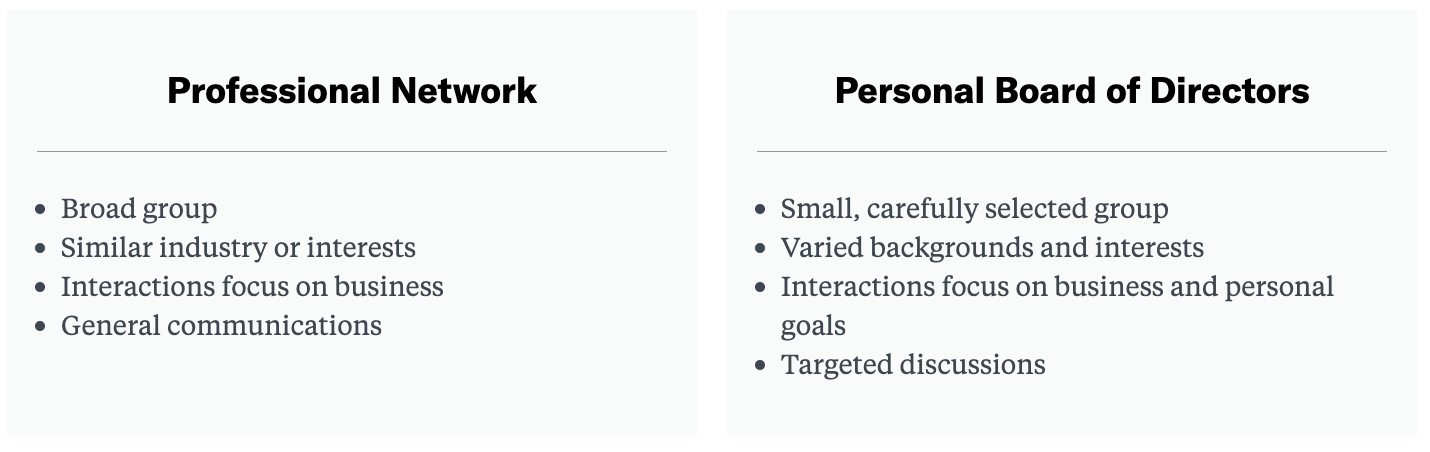
“As with any good board of directors, you need to fill different roles and specialties to optimize its effectiveness.”

As you develop a list of possible board members, keep in mind that the most valuable contributors:

  • Offer different points of view and come from different parts of your work life.

  • Are more skilled than you at something.

  • Are more knowledgeable than you about something.

Including only people who affirm your choices won’t help you grow in your career.

Having a personal board of directors doesn’t have to be a formal process. There’s no need to hold meetings—but do select the right people and stay in touch. The relationship will feel more natural if you choose people you already communicate with regularly.

Take a Moment

Take a Moment

If that person fills three or more of these criteria, they will likely be a great fit for your board.

In the video below, Christine Liu describes a few ways you might consider using your board of directors.

有效运用私人董事会 My Personal Board of Directors

哈佛教授讲授视频逐字稿
If I think about my personal board of directors, they come from all places of my life. It includes people I worked with, people I met through work, and even my friends and friends of friends of friends. So there was a time when my personal board of directors was extremely valuable, because they really helped me during this difficult part of my life. It happened not too long ago when I unexpectedly left my job and my company, and I was feeling a lot of creative unrest, because I was used to working in a very fast environment. And I was itching to get a project going. I contacted a designer I used to work with long ago, Scott. And so the exchange was he would do an original artwork for me, and I would build his new portfolio website. So that was extremely helpful, because, one, I could put something new on my portfolio. But two, it was great to learn new skills and stretch myself a little bit. Another example of someone in my personal board of directors that really helped me through this time was Erin. So I knew Erin from the gym. And I knew that she had recently founded her own small business and was hustling everyday, all the time. I loved the mission of her business, which is to support sustainable food systems. So I was able to do a little consulting work. But more importantly, it was just great to have something to do under my belt with a mission I felt very strongly about. So it's very important to have a strong personal board of directors. It's crucial when you have those big crisis moments, but also for those small, everyday decisions and especially opportunities to learn new things as you go through your career. Take a moment. Reach out to someone. And make sure your personal board of directors is active and engaged.

As Christine mentions, your board can be a particularly valuable resource when you are considering a career transition. Don’t be afraid to ask for help when you need it. The combined efforts of your team of experts might just yield excellent results.

第 3 节

As you navigate through your work journey, you’ll run into many opportunities and lots of change along the way. The key to success is to draw on your connections to help you.

It's common to feel uncomfortable requesting career help.

But by following certain practices, you can make it easy for someone to say “yes” to your request for support on reaching your career goals.

When you ask for help, be sure to:
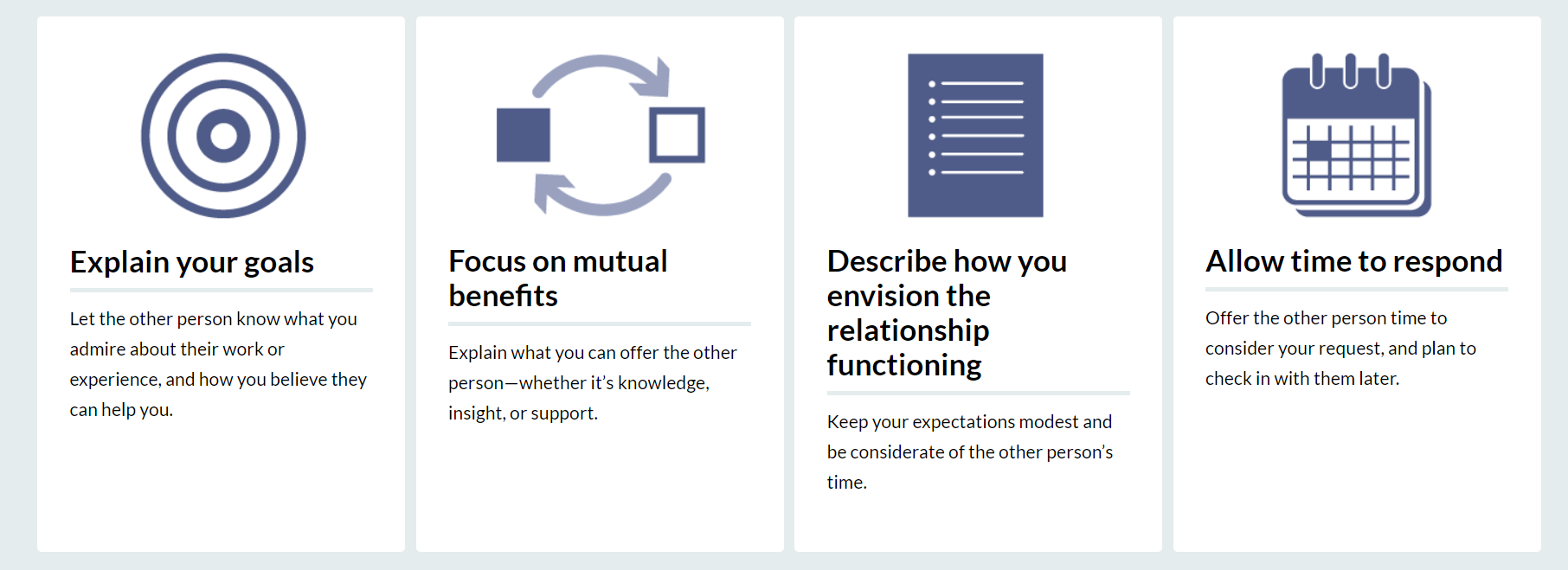
Listen to this story from chef and food stylist Elle Simone about how she connected with a famous chef for career advice.

不要担心自己无法为对方创造价值Develop Your Career Network

哈佛教授讲授视频逐字稿
I love networking. It's one of my absolute favorite things to do. But if you had asked me that 10 years ago, I probably would have given you a different answer. But it's something that you do more over time, and it gets easier, and it gets better. So you don't have to be a pro at it straight out of the gate. But a perfect example of wonderful networking opportunities was when I hosted a panel at the South by Southwest festival in Austin, Texas. I had an opportunity to create a panel or platform that would highlight some women chefs in the industry. And one of the executive directors from the James Beard Foundation—Katherine Miller—was present. She was someone that I knew for sure that I needed to meet, and I wanted to do work with. I waited until the very end of the program to talk with her, and she offered an opportunity to have coffee the next day, and to hear about my vision for SheChef. I was very nervous and very excited and a little uncertain if I had anything to bring to the table to this conversation. But I realized that I was always bringing something unique to the table. Those are my unique thoughts, my unique ideas, and that's something I bring to every single meeting I ever go to. After working with Katherine for a couple years, we've had conversations about that first meeting. And you know, she told me that she could tell that I was nervous, a little apprehensive, because I wasn't really sure what I wanted to do with my business. But she let me know that it was my drive and passion for success that was really most attractive to her. Katherine is now my mentor, and we've done so many amazing things together. And I'm very glad that I took the chance on myself and networked. It could really get you far. My business has grown a great deal from my relationship with the James Beard Foundation. And I've formed a wonderful friendship with Katherine.

Take a Moment

Take a Moment

Ask for Career Help

附件:ask_for_career_help1696834300368.pdf(pdf · 127 KB,本地副本)

第 4 节

  • Make cultivating your network a habit. Be curious about others, stay in touch, and thank them for their advice or perspective.

  • Form a diverse personal board of directors. Turn to these people for advice when you’re faced with opportunities, challenges, or critical decisions.

  • Don’t be afraid to ask for career help. Be strategic and make it easy for that person to say “yes.”

第 5 节

Reflecting on your learning helps you apply relevant concepts to your job.

Take a Moment

1. 1. What new insights do you have that could benefit you or others in your workplace?
2. 2. What are your biggest opportunities for applying concepts from this Lesson in your workplace?

Further reading

传奇歌手迪翁·沃里克:做自己,享受过程
传奇唱片艺术家迪翁·沃里克谈从伴唱歌手到独唱明星的经历、与音乐界传奇人物合作、应对种族歧视及其他职业障碍、投身艾滋病防治…
研究:随着职业生涯变得更长,职业中期的工作方式也需要随之改变
随着职业生涯延长到 70 多岁甚至更久,许多组织发现,他们最有经验的职业中期员工,恰好在步入最关键的领导岗位阶段时,却出…
在每个人都不堪重负时,支持员工的职业发展
随着经济压力、地缘政治不稳定以及 AI 驱动的颠覆不断加剧,许多员工在繁重的工作负担下,很难把职业发展放在优先位置。领导…

Top 3 in the source platform's original order