Time Management
Overcome Time Pressure 查看中文版
第 1 节
Every workplace contains a lot of unspoken signals about time: how we should be spending it, whose time is valuable, and what “dedication” looks like.
Attitudes about time profoundly influence how supported (or stressed) people feel each day.
Feedback
If you mostly choose the first choice, then you need to focus on achieving a work-life balance.
A little urgency is fine, but if there's too much pressure, it can prevent you from performing. The more time people are stressed during the day, the less likely they are to think creatively," says Teresa Amabile, a professor at Harvard Business School.
If you mostly choose the second choice, then you're already great. So, keep it up!
Employees are more likely to feel happy and engaged when they have some freedom to balance the demands of work and life. A Harvard University analysis shows that happy people are 31% more productive than others.
If you mostly choose the third choice, then you need to try to fit in with the atmosphere around you.
If your answer is often "I don't know," find out how your team members are feeling. Do they feel pressured? Or are they supported? Small changes can lead to big results.
Based on your answers, try to:
Keep up the good work!
When people have flexibility to balance work and life demands, they are more likely to be happy and engaged. Happy employees are 31% more productive than their peers, according to a Harvard analysis.“The Happiness Dividend,” by Shawn Achor. Harvard Business Review, June 23, 2011.
Feedback
If we’re in an environment where we’re overwhelmed, we can be tempted to take a drastic step like quitting altogether. Here’s a story of how taking a smaller decision instead transformed the situation, and led to better relationships all round.
小调整缓解大压力 How Small Requests for Time Have a Big Impact
哈佛教授讲授视频逐字稿
When we're feeling stressed out, which happens of course to all of us, when we feel so overwhelmed with everything that's going on, we couldn't possibly proceed, we think about making dramatic changes to our lives. We think about quitting our jobs, foregoing exercise altogether so we can put our head down and get the work done. And my research really suggests that we should instead be thinking about solving these stressors in our lives by making small decisions around the margins.
I was visiting home during the holidays last year, and I came into the kitchen and my mom was sitting at her computer in tears. And I said, "Mom, what's wrong?" And she closed her computer, and she said, "I can't do this anymore. I'm so overwhelmed by my job. I have to quit."
She had in front of her a resignation letter. So I sat down and I helped my mom, instead of quit her job, write an email that told her boss how much she had been working--I've been working a lot of hours, it was more than we had agreed upon, I wasn't able to take my vacation last month.
And we got a near instantaneous reply. Her boss was so apologetic. She said, "I'm so sorry. I had no idea you were working so many hours. I'm going to give you a certificate to the spa. Take the next week off. When you come back, I'll work on hiring someone else for you. We can think about how we can help you manage your hours so that you're not feeling so overwhelmed." And my mom was just so, so relieved. She got to keep her job, she got some paid vacation to spend time with me, and she gained a newfound respect for her boss.
We're often afraid to ask for time because we're worried it will signal that we're incompetent. But as it turns out, on average, just like in my mom's situation, our bosses actually see us as more committed and competent. So when we're faced with a situation in our lives where we feel so overwhelmed that we think we're just going to quit something altogether, I advocate for taking a step back and thinking about what's a smaller decision we can make instead of jumping to an extreme?
Take a Moment
1. How can you improve the time culture around you—by either discussing concerns with team leaders, setting new guidelines, and/or acting as a role model?
第 2 节
Today, one of the biggest sources of stress is feeling “always on”—that you can never truly leave work at the office.
To keep a healthy balance in your team, adopt these habits.
Don't send emails over the weekend.
Even if you draft a message during the weekend, schedule it to send Monday. If it’s not mission-critical, consider delivery for midday, after people have had a chance to focus.
Don't send emails over the weekend.
Use transition days.
Block off the days on either side of your vacation to finish up last tasks and then to catch up. Buffer days allow you to truly relax while you’re off.
Use transition days.
Be flexible.
Communicate deadlines and expectations, but give people as much freedom as possible to manage when, where, and how works gets done.
Be flexible.
It's a myth that only mothers and caregivers want schedule flexibility. The Pew Research Center found that young men particularly prized flexibility, and people without children want it just as much as parents.
It's a myth that only mothers and caregivers want schedule flexibility. The Pew Research Center found that young men particularly prized flexibility, and people without children want it just as much as parents. It's a myth that only mothers and caregivers want schedule flexibility. The Pew Research Center found that young men particularly prized flexibility, and people without children want it just as much as parents."Young People Are Going to Save Us All From Office Life" by Claire Cain Miller and Sanam Yar. The New York Times. September 20, 2019.
If you’re feeling overwhelmed, take a step back to think about how you get your work done. A story from Hollywood’s film industry shows just how valuable that step can be.
重新找回工作热情的方法 Overwhelmed? Change How You Work
哈佛教授讲授视频逐字稿
As a young Hollywood film executive, I was tasked with developing film and television projects based on global brands. I was very excited, but I was a one-man band. It was just me. And the expectation was to sell and to deliver sales on a regular basis.
The reality is when it comes to developing film and television projects is that they take time and there are a lot of components to them and I was finding myself having a tough time giving to each project. The passion that I had going in started to kind of evaporate.
But the expectation was still there. I still had to deliver. So I worked longer. I worked harder. But that didn't make a difference.
So I stepped back and I realized that I can't do it alone. That I need to find a way to live up to the expectations, but also still be connected to the work and move everything forward at the same time. I had to re-evaluate the strategy and identify partnerships, identify individuals, companies, who could help further projects along. So I wasn't developing and handling a dozen projects, but maybe one or two or three.
And so I did that. Whether it was finding the right animation company for an animated series. Or whether it was finding a writer who could help bring the story to life. When I was able to secure partnerships, I saw success. And not only in terms of deals, but in terms of how I felt.
I was excited. I was passionate. I was able to deliver on expectation, but also be fulfilled.
第 3 节
Time is precious. It can be incredibly demoralizing when effort goes wasted, is duplicated, or gets undone without good reason.
There’s a phrase for this: time sinks.
Time sinks happen when you or your team repeatedly and avoidably lose a lot of time on certain tasks.
In the workplace, there are three main types of time sinks:
Bad processes
Inefficient, wasteful, or outdated methods of work
Ineffective relationships
Miscommunications, lack of clarity, or rivalries
Low-value tasks
Work that’s barely used, not valued, or tied to an outdated part of the business
Think of a time sink you’d like to eliminate in your job.
Take a Moment
Take a Moment
After you’ve identified the root cause(s), speak with people whose cooperation you’ll need to make changes.
Your candor on the matter may be a welcome relief, so long as you frame it as an “invitation to improve things” rather than an accusation.
It might sound like this:
- “I’d like to make this process more efficient for all of us. Can we map out how this is working?”
- “I think we’re getting our signals crossed. I’d love to hear how this is going for you and brainstorm ways this work can be easier for both of us.”
- “I’m wondering how this work is being used and whether it would be useful for me to provide other support instead.”
第 4 节
When we feel good-physically and mentally-it's easier to manage time well.
No doubt you’ve heard this advice: eat well, sleep, and get more physical activity each day.
See if you know how good health habits propel you at work.
More than 40% of our actions each day spring from habit rather than conscious choice.The Power of Habit: Why We Do What We Do in Life and Business, by Charles Duhigg. Random House, February 28, 2012.
Healthy habits help you manage your energy. Discover how creating a sense of calm in your life can help you use your energy and time well.
节能增效从保持平静开始 Conserve Energy and Willpower
哈佛教授讲授视频逐字稿
When we think of managing our lives, we often think of time management. Let me schedule myself in better and let me, let me be more efficient. But we forget about something even more important, which is really energy management. If you're able to have more energy throughout the day, you won't be as exhausted and it will be less difficult to get things done, the things that you want to get done.
Willpower has been shown to be like a muscle in the sense that it can drain over time. That's why they say in the morning we have the greatest amount of willpower, and by the time the day ends we have lost some of that and maybe that's why we're more likely to exercise in the morning and then have too much ice cream at night, for example. However, willpower is also something that consumes energy, but there's a different way for you to have willpower that's less energy consuming.
And one way to do that is to remain calm. So in our time and age in our society, we really value high intensity states. We value stress on the one hand. That's why we're pumping ourselves up with adrenaline all the time. And in terms of our happiness, we value excitement. We think we should work hard and play hard, but as a consequence even in our so-called leisure time we're exhausting ourselves.
If you ask Americans to define happiness, they'll define it with words like excitement, elated, enthusiasm. That's what we find in research. However, we've forgotten the value of calm.
And if you're able to have more calm in your life, if you're able to have more time in your life devoted to soothing and calming yourself, you'll find that it'll be less hard to exert willpower. You won't necessarily have to, because you won't be fighting against other tendencies. It will be easier to achieve.
Not to say that you shouldn't have that intensity and excitement in your life and spend a lot of energy, but you should really be saving your energy and spending it when you want to for the big major projects in your life, the big events. This is about conserving your energy, and this is where calmness comes in. And it's something that's not very much valued in American society in particular. We value intensity at all times, whether we're at work or whether we're at play.
Take a Moment
1. Which of your daily habits are healthy? Which would you like to change?
第 5 节
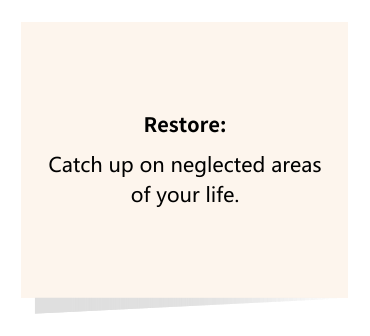
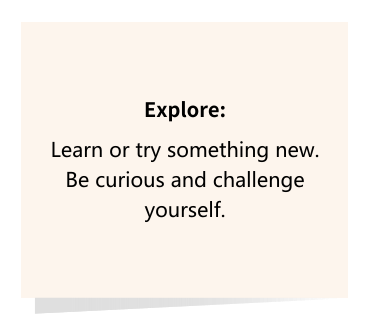
Every work cycle has peaks and valleys. Peaks are for challenging yourself, while valleys offer time to restore and explore new ideas.
When a gap between projects opens in your schedule, instead of immediately reloading your to-do list, take some time to:
Make a Connection
Make a Connection
第 6 节
"How we spend our days is, of course, how we spend our lives."
Time management advice is everywhere; your job is to identify what works for you. Reflection cements the insights that lead to behavior change.
Each day, reflect on how you spent your time:
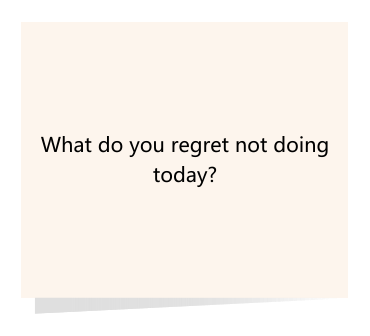
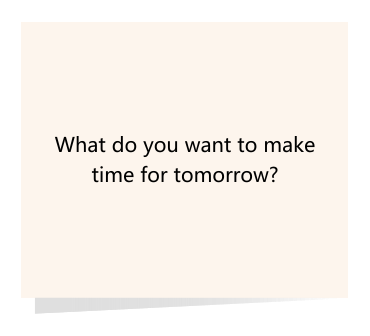
Apply your insights to the priorities you set each day.
第 8 节
Test your understanding and reinforce what you’ve learned.
第 9 节
Reflecting on your learning helps you apply relevant concepts to your job.
Take a Moment
1. 1. What new insights do you have that could benefit you or others in your workplace?
2. 2. What are your biggest opportunities for applying concepts from this Lesson in your workplace?
Further reading
基于数据的方法进行委派委派是管理中极为普遍的难题。许多管理者都清楚自己需要把部分任务交给他人来做,但往往难以准确识别哪些事务真正值得放手。通过…
少即是多,去除公司的“加法病”1940 年 8 月,当英国准备迎接德军一波又一波的空袭时,英国首相温斯顿·丘吉尔也开始迎接另一个敌人:冗长的报告。在长…
Top 3 in the source platform's original order
