
Draw Insights from Your Data 查看中文版
第 1 节
You’re surrounded by data.
Every day, the world is becoming more connected—and more data is being collected—than ever before. As a result, you and your team likely have available a wealth of information about your customers, products, and industry—everything from the time someone spends considering a purchase to the features they're most frustrated with once they own the product.
The question is, do you and your team need to become analysts to take advantage of this massive data influx?
The answer is “no.” We can't all be data experts, and that's okay. The key is to be data literate—that is, to understand enough about data to inform and improve your decisions. With basic data literacy, you can:
- Identify the types of information your team needs and how to retrieve them
- Navigate imperfect or misleading data sets
- Use data to drive smart, informed decisions
- Drive innovation and serve customer needs
Poll
The amount of data being created and stored by companies around the world grows by more than 2.5 quintillion bytes every day.
As a leader, it’s not only crucial to boost your own data literacy—you also need to further your team's understanding. How? Begin by making conversations about data part of your team's routine.
See how you're doing. Ask yourself:
Try it Out
Make a Plan
第 2 节
But wait…what exactly is data? In short, it's the information your team, organization, industry, and customers generate. There are two primary types:
Here are a few examples of data your team might need:
第 3 节
With so much data available, how do you find the exact information that will help your team be more successful? How do you know that you're not using misleading or biased data? And how do you interpret data to guide your decisions?
The answers lie in the three “A's” of data: access, accuracy, and analysis. Let's dive into each of them.Clearing the Digital Blur: How Organizations Can Transform Themselves at the Speed of Digital, by Rajiv Rayaraman. Wiley India, 2019.
数据的“3A”要素 The Three A's of Data
哈佛教授讲授视频逐字稿
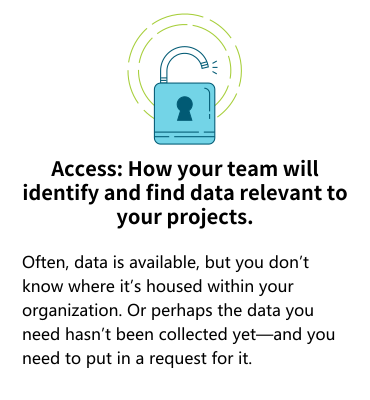
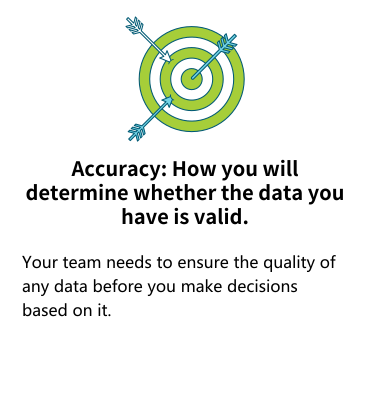
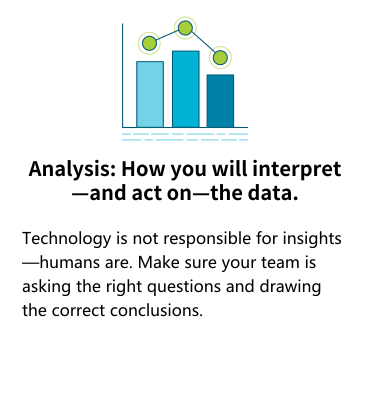
Use these three categories to consider how your team engages with data—not just with a specific set of data, but with all relevant data. Here's an example illustrating how you might start:
Frances needs client data
In the following sections, you'll learn specific strategies within the three “A's” framework for using data effectively and intentionally.
第 4 节
Sometimes, you might not know where to turn for relevant data. Or you might need data that isn't yet being collected. But without access to this key input, your team can't effectively innovate or improve customers' experiences.
Make a Connection
What can you and your team do to find and access the data you need?
- Start by identifying what data might provide insight into the problem you're trying to solve.
- Then consider how to obtain it.
- Finally, unless you're a data scientist yourself, or you have one on your team, determine who outside your team you can work with to retrieve the information you need.
To figure out what data might be useful, get curious. Draft simple questions based on the key business needs or challenges your team is facing.
For example:
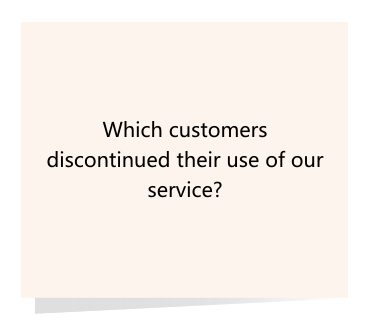

By posing these questions, you'll start down a path of insight. One question will lead to another until you make a discovery that will drive change on your team.
Keep in mind, some questions can be answered once (e.g., why did we just gain a ton of new users?), but others will have to be monitored over time (e.g., which demographic spends the most time with our products?).
Draw Insights from Your Data - tips01
Once you have a sense of what data might be useful, identify how your team can obtain it and who might be able to help you do so.
Here are a few examples of data sets your team might need. Consider who in your organization, or what resources outside of your organization, might be able to help collect or provide access to this information.
Try it Out
What if my team needs to collect its own data?
Surface the Data You Need
第 5 节
In your organization, how many missed opportunities or poor decisions can be traced to inaccurate or low-quality data? The research indicates that it's likely a lot.
The source of the error may be significant, like a bias skewing the whole data set. Or it could be simple, like a typo in a spreadsheet. But even small errors have big consequences: inefficiencies, lost opportunities, mistrust, and lower productivity.
You may not be able to avoid all bad data. But a data-savvy team can guard against inaccuracies. Here, data analyst Elena McGuire outlines how.
确保数据准确且值得信赖 Make Sure Your Data is Accurate-and Trustworthy
哈佛教授讲授视频逐字稿
Consider a piece of data your team is currently relying on. Which of the five questions that Elena raised will you ask to make sure your data is sound?
Ensure Your Data is Accurate
第 6 节
It's important to ensure your data is reliable. But data is only valuable if it has meaning.
Technology is not just becoming more adept at helping us collect data, but also at deciphering it. When it comes to finding patterns in data, some machines have become almost as talented as humans.
Digital tools, though, still struggle to surface the insights from the noise. That's where you come in.
Use these tips to effectively analyze your data:
After conducting your analysis, you're ready to propose a course of action to your team or stakeholders that's driven by data.
Make a Plan
The field of data collection and analysis is expansive, with entire industries dedicated to it. Don't fret if it feels overwhelming. With practice and connection to the right people in and out of your organization, your team will be equipped to start making data a core part of how you work.
How to Analyze Your Data
第 8 节
Test your understanding and reinforce what you’ve learned.
Try it Out
答案与解析
Access: The data wasn’t accessible.
The data was accessible, but it wasn’t accurate.
Accuracy: The data wasn’t accurate.(正确)
The data wasn’t accurate because the two software programs used different units of measure.
Analysis: Humans didn’t come to the right conclusions about the data.
The error didn’t involve analysis but rather accuracy.
Try it Out
答案与解析
Rely on technology to surface insights.
Technology struggles to surface insights from the noise.
Be confident in the validity of your interpretation of the data.
Acknowledge biases and challenge them to avoid misinterpretation.
Notice your preferences and seek to be objective.(正确)
Acknowledge biases and make a concerted effort to challenge them.
第 9 节
Reflecting on your learning helps you apply relevant concepts to your job.