
Act on Promising Digital Opportunities 查看中文版
第 1 节
In today's digital world, it's not enough to stay up to speed on the latest technologies and access insightful data. To add value to your organization, you and your team need to continually spot and take advantage of new digital opportunities.
What's a digital opportunity? It's an opening for your group to solve customer and organizational challenges through emerging technology or data.
These opportunities can vary widely in scope, from improving onboarding for new employees using artificial intelligence to creating a direct line of communication to customers using an app.
See how Felicia Jadczak, co-CEO of She+ Geeks Out, discovered a digital opportunity for her organization during the COVID-19 pandemic.
利用危机升级业务运营模式 Turn Crisis into Opportunity
哈佛教授讲授视频逐字稿
Make a Connection
第 2 节
Before you can take advantage of digital opportunities, you need to identify them and decide which ones to spend resources on.
Digital opportunities are everywhere. Spotting them is a matter of having the right team mindset and infrastructure in place. When you see technology as a means for innovating, solving problems, and creating efficiencies, you increase your chances of surfacing exciting ways to strengthen your organization and make customers happy.
How to find these opportunities? You can:




Act on Promising Digital Opportunities - Tips01
As you and your team consider new applications of technology, you'll need to make decisions about which opportunities to pursue—and which to pass up or leave for another time. Avoid falling into the trap of initiative overload—trying to take on every project or idea you come up with.
One way to decide where to focus your energy and resources is by using a prioritization matrix. See how to apply this useful tool.
如何确定数字化项目的优先级 Prioritize Your Digital Initiatives
哈佛教授讲授视频逐字稿
For your digital projects, start by labeling your axes as effort—how complex and resource intensive they are—and impact—how significant the outcome will be for your team and organization.
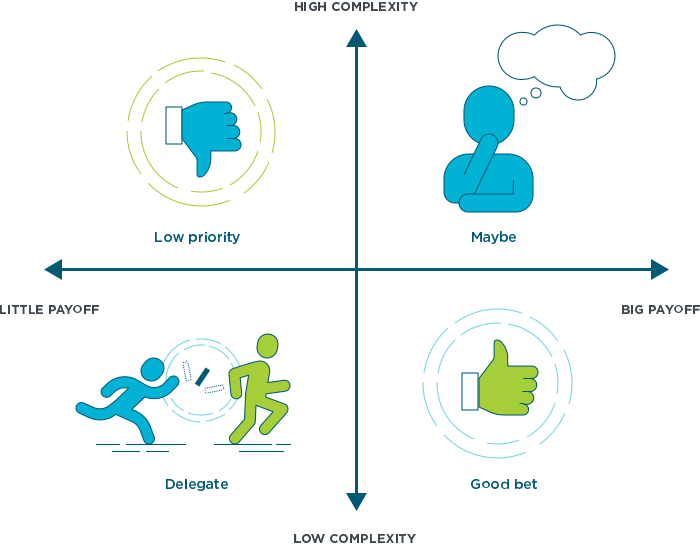
A few tips on using a prioritization matrix:
- Define the values on the axes, if possible. For example, for "Impact," specify what constitutes high impact versus low impact.
- Customize the axes as needed. For example, to help your team decide where to spend its time, you might want to compare "Urgency" and "Importance."
- Beware of labels that don't include some measure of impact. For example, labeling the axes "Cost" and "Time" reduces the focus to day-to-day operating issues. The team might miss opportunities for high-value action.
Prioritizing your digital initiatives is a team sport. Make a point of facilitating discussions about your matrix with your team and other stakeholders before you make concrete decisions and plan specific actions.
Take a Moment
第 3 节
Has the time come to act on the opportunity you and your team selected?
Not quite yet. To get the best results, adopt an experimental approach. Conduct pilots or trials that you can implement quickly. The goal is to test and learn so you can adapt as you go. You also avoid pitfalls, such as getting mired in the planning stage or failing to improve your project through feedback.
For example, let's say your team is excited about giving customers the option to pay for your products with cryptocurrencies. Rather than fully committing the time and resources to make this a reality, you could start by gauging interest through customer surveys. Or, if it's easy to implement, you could set up a pilot for accepting these new currencies and then pause to reflect on how the integration is going.
Make a Connection
To take an experimental approach to your digital opportunity:
- Come up with a hypothesis about your initiative—for example, "We believe that crowdsourcing ideas for our product name over new social media channels will increase our engagement with a younger demographic."
- Take quick, targeted actions—for example, "We can pilot this idea with a few individuals in our team's network."
- Evaluate the initial results against your hypothesis and make changes as needed—for example, "We got initial feedback that customers would be excited to participate, but some may not take it seriously. Strict submission requirements might help eliminate unproductive suggestions."
By starting with simple experiments and sharing the results, you can make the case for larger investments of time and resources. You and your team will also build skills for implementing future digital projects.
What if my team has limited resources?
第 4 节
Not matter how big or small the opportunity you're acting on, you need a concrete way to evaluate its impact. Having clear metrics and setting performance goals enables you to document progress and share learnings across the organization. It also allows your team to connect with other groups doing similar projects and gather feedback about ways to improve your approach.
The metrics you use will vary depending on your specific opportunity. Some examples include customer feedback, the time your team spends to complete a task, and the amount of revenue gained from a project. Without concrete measurements, failing projects may continue far longer than they should, and successful projects won't receive the recognition they deserve.
Jason Wong, founder of JWong Works and former senior director of engineering at Etsy, shares how his team learned this lesson the hard way.
目的明确地开展试验 Experiment with a Purpose in Mind
哈佛教授讲授视频逐字稿
After you've acted on your opportunity, analyze the data you've collected. Then look back at your original hypothesis and assumptions and ask:
- Did the opportunity pay off? Were your assumptions proved or disproved?
- What might you change going forward based on what you learned?
- Do you need to conduct further tests?
- Were there unexpected learnings or surprises that you should document and share with others in your organization?
If your digital project turns out to be a dud, remember that innovation is all about learning. The insights—and the experience—you gain along the way are certain to be invaluable as you look toward your next exciting opportunity.
Rogelio guides the way
Try it Out
答案与解析
Productivity of team members(正确)
He can find out if team members are still less productive due to customer issues by the productivity of the team.
Weekly profit of the store
While Rogelio's experiment may affect store profits, there are so many other variables at play to make it not a reliable indicator.
Website traffic of the store
The opportunities Rogelio is trying to capture are related to in-store technology improvements, and website traffic, while also very important to monitor, is unlikely to be a good indicator of the success of the experiment.
第 6 节
Test your understanding and reinforce what you’ve learned.
Try it Out
答案与解析
The values on the axes are always “Effort” and “Impact.”
You should customize the axes as needed.
Prioritizing digital initiatives is best done as a team.(正确)
Facilitate discussions with your team to make decisions and plan actions.
A prioritization matrix is useful for planning how to pursue all of the opportunities you’ve identified.
A prioritization matrix is useful for deciding where to focus your energy and resources.
Try it Out
答案与解析
Come up with a hypothesis about the outcomes, take quick, targeted actions, analyze the results, and make changes based on what you’ve learned.(正确)
By starting with simple experiments and adapting as you go, you avoid pitfalls like getting stuck in the planning stage.
Develop mandatory evaluation criteria for ensuring the new platform meets your standards.
It’s vital to conduct small-scale tests rather than committing fully upfront.
Request support, feedback, and a measure of success from management.
While management feedback is important, piloting with small experiments is critical.
第 7 节
Reflecting on your learning helps you apply relevant concepts to your job.