Pocket Leadership口袋领导力

Ethics at Work

Apply Ethics Across Borders 查看中文版

第 1 节

Ethics get even more complex when companies do business across borders. What's perfectly acceptable in one country can, for cultural reasons, be considered unethical in another.

For example:

  • In some countries, it's respectful for businesspeople to exchange gifts. In the other countries, lavish gift giving is viewed as bribery.

  • Very low wages may be considered unethical in wealthy developed countries. But developing nations may accept those wages if they encourage investment and improve living standards.

  • Managers in some countries may have a higher tolerance for bribery than those in other parts of the world. But they consider taking credit for a subordinate's achievement a nearly unforgivable sin.

Such differences—in history, cultural traditions, and level of development—can make it difficult for managers to know how to behave.

Poll

Poll

Make a Connection

1. Think about what you know about collaborating with international stakeholders. What are some practices that are culturally acceptable to stakeholders in one location but not in another?

第 2 节

Managers doing business internationally often take one of two routes when faced with ethical dilemmas:

  • Either they stick rigidly to what's done at home (i.e., "ethical imperialism")

  • Or they embrace the foreign country's norms (i.e., "cultural relativism")

Balancing Two Ethical Strategies
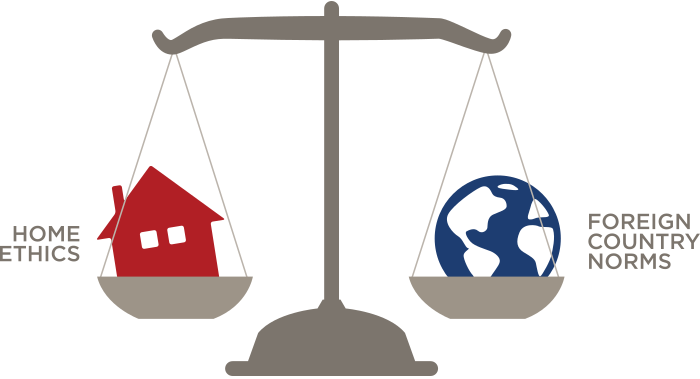
Neither of these strategies is ideal because:

  • If you always do elsewhere exactly what you do at home, you might be at a competitive disadvantage. Showing respect for local customs is an important part of forging business relationships.

  • However, if you adopt wholesale a different country's ways of doing business, you may inadvertently condone unscrupulous practices—such as bribery or child labor.

Instead, it's crucial to find a balanced approach. To do so, adopt the following guiding principles:

Honor core human values

Puffer, Sheila M. and Daniel J. McCarthy. "Finding the Common Ground in Russian and American Business Ethics." California Management Review 37 2 Winter 1995. Donaldson, Thomas. "Values in Tension: Ethics away from Home." Harvard Business Review Sept.-Oct. 1996.

Although business norms differ around the world, research has shown there is strong global consensus about what's fair and right.Paine, Lynn Sharp et al. "A Global Leader’s Guide to Managing Business Conduct." Harvard Business Review Sept. 2011.

Three core human values form an ethical foundation you can rely on no matter where you do business—or what profession you're in:

core_human_values_table

core_human_values_table

Underlying these three values, there's one time-honored guideline: treat others the way you would like to be treated. This one rule appears in some form in every major religion and global tradition.

通过行善实现企业成功 A Brief History of Doing Well by Doing Good

哈佛教授讲授视频逐字稿
SARAH GREEN: Welcome to The Idea. I'm Sarah Green. I'm here today with Nancy Koehn, Harvard Business School historian. Nancy, thanks so much for coming in. NANCY KOEHN: A real pleasure. SARAH GREEN: So there's a lot of talk right now about companies doing well by doing good, about them really putting ethics and social responsibility at the core of their strategy. Is this a new phenomenon? Put this in some context for us. NANCY KOEHN: It's not a new phenomenon, Sarah. The arc of history in business is all about companies that had social ambitions and aspirations as well as commercial benchmarks and interests. And if we go all the way back to some of the earliest companies in the lexicon of industrialization, we can think of a company like Josiah Wedgwood's china company in the 18th century and his interest in providing housing for his workers, and training for his workers, and an adequate food supply for his workers, and, in effect, building what was really one of the first company towns. We can fast-forward to Henry Heinz, a food producer, who did the same thing in the late 19th century and really took what he thought of as his responsibility, not only to his workers, but to the community of Pittsburgh, to quite a high level. Both of these gentleman and many more like them—Estée Lauder, in the middle decades of the 20th century, and her company—all of these entrepreneurs would get very, very, very high marks today on a CSR index. But it's important to remember that they weren't doing it for those kind of reasons. They were doing it because they thought that the kind of business they had and its role in society were very much interconnected. And so what was doing well by society was very good for their business. So it came very much of their own sense of responsibility and aspiration. SARAH GREEN: So what should some companies today learn from some of these companies in the past? NANCY KOEHN: Well, I think the first lesson is that, more often than not, a company's social footprint is very much related, in a positive way, to its financial performance. And there's beginning to be extremely good data on this, qualitative and quantitative. And so unpacking the relationship between one's social metrics—one's social footprint, be it good or bad or neutral—is really the first step. And the second step is to understand, I think, that right now, the beginning of the 21st century, all kinds of stakeholders—from the media to consumers to global activists to even certain parts of the financial market—are looking at companies and saying, what are you doing? How do you make your products or your services? What is your relationship to the relevant constituencies and communities that you touch? And they're making judgments about that. And increasingly, the judgment and the expectation is that business has a responsibility and an obligation to, in a sense, deliver on social metrics as well as financial ones. SARAH GREEN: So what's the role of the leader in this context and in this type of organization? NANCY KOEHN: The leader is everything. He or she will hold the vision. He or she will have to eliminate obstacles to act on the vision. And he or she will have to execute against the vision, all the time relentlessly talking about what they're doing, why they're doing it, why a social footprint of a particular kind is so important, and communicating that to a variety of folks—not just analysts and not just employees, but all the different communities and constituencies that a particular business touches. If you go back to those examples I used a few minutes ago, all of those examples were first and foremost the product, the offering, the dream of the entrepreneur or the leader. And it's no different in an established company. It has to come from the person who holds the reins and holds not just the strategy, but the culture and the ethics of the organization. SARAH GREEN: Nancy, thanks so much for coming in. NANCY KOEHN: A real pleasure. Thank you.

Respect tradition

When you respect local traditions, you'll forge relationships faster and create trust. In turn, that goodwill can help you tackle sensitive ethical dilemmas.

Apply Ethics Across Borders

In Japan, it's a sign of respect for a businessperson to give a business partner a gift. When Western businesspeople first started doing business in Japan, many thought that accepting these lavish gifts was akin to taking a bribe. But as Western companies became familiar with Japanese customs, many understood it was potentially offensive to decline a gift or to come empty-handed to an important meeting. Accordingly, many companies decided to set different limits on gifts in Japan than they do elsewhere. Apply Ethics Across Borders

Even though it is important to respect local traditions, do nothing that conflicts with the laws that apply to your company at home. Companies—and the managers who work in them—should not violate their own country's laws to fit in with the norms of those they're doing business with internationally.

Consider the context

Practices that may be wrong in one country may be logical and even necessary in another. As you weigh an ethical decision, consider the issue's background and the reasons the behavior is accepted where you're doing business.

For example, consider the following practices:

  • Use of pollutants. In places where people are starving, using pesticides, chemical fertilizers, and other pollutants may be acceptable because they help produce larger crop yields needed to feed the population.

  • Nepotism. In some countries with high unemployment and widespread poverty, companies guarantee jobs for employees' children. This practice is not seen as unethical; it is considered a cherished employee benefit that brings hardworking families stability.

Tips for adopting a global ethical perspective

Donaldson, Thomas. "Values in Tension: Ethics away from Home." Harvard Business Review Sep.-Oct. 1996
Network with colleagues from your home country who work for trusted companies abroad. How have they resolved ethical conflicts? Seek advice and examples. Support efforts to decrease local institutional corruption. Suggest that your company join coalitions of businesses, government officials, and others who are working to combat corruption. Be innovative in ethics, just as you are in your products and services. For instance, if your company risks losing business because it's turning down requests for bribes, think of other ways to gain political support and public trust—such as sponsoring a project to plant trees or funding local schools. Tips for adopting a global ethical perspectiveDonaldson, Thomas. "Values in Tension: Ethics away from Home." Harvard Business Review Sep.-Oct. 1996

Worksheet for Resolving a Cross-Cultural Ethical Dilemma

附件:worksheet_for_resolving_a_cross_cultural_ethical_dilemma(docx · 1104 KB,本地副本)

第 3 节

Test your understanding and reinforce what you’ve learned.

Try it Out

1. 1. A company assigns four of its managers to work in an overseas subsidiary. Each manager is supervising local staff members who have a very informal and relaxed approach to work. Their hours, dress, and customs are more casual than the managers are used to. Which person took the most appropriate route when managing affairs in the overseas office?
答案与解析

George insisted on adherence to a nine-to-five workday.
George is displaying “ethical imperialism” by trying to organize employees’ work hours to suit his own expectations, without regard for their cultural norms.

Frank allowed flexible work hours to suit local norms but insisted that employees follow formal business practices.(正确)
Frank is showing a balanced approach by displaying sensitivity to his employees’ way of doing business while not completely altering his own approach.

Barbara told staff they were expected to wear more formal attire whenever they were meeting with local clients.
Barbara is showing “ethical imperialism” by trying to impose her own cultural norms.

Trevor decided to adopt local customs and norms in all matters, even if it made him uncomfortable.
Trevor is showing “cultural relativism” by totally embracing local norms without regard for the values his own culture can add to the business process.

Try it Out

1. 2. Companies A, B, C, and D all operate in underdeveloped countries that experience widespread poverty and unemployment. Which company’s actions failed to display the core human values of respect for human dignity and basic rights?
答案与解析

Company A paid lower wages in order to hire additional people.
Company A did display core human values. In some countries where poverty is rampant, paying lower wages can be acceptable if it means an improvement in the overall standard of living.

Company B used pesticides and chemicals to increase crop yield.
Company B did display core human values. In places where people are starving, use of pesticides and chemicals can be acceptable in order to produce larger crops that will feed the population.

Company C ignored working conditions to increase its head office profits.(正确)
Company C did not display core human values. Poor working conditions that endanger workers’ health and safety are ethically unacceptable. They should never be used to increase a company’s bottom line.

Company D guaranteed jobs for its employees’ children.
Company D did display core human values. In some countries with widespread poverty and unemployment, nepotism is seen as a cherished benefit that brings hardworking families some stability.

第 4 节

Reflecting on your learning helps you apply relevant concepts to your job.

Take a Moment

1. 1. What new insights do you have that could benefit you or others in your workplace?
2. 2. What are your biggest opportunities for applying concepts from this Lesson in your workplace?

Further reading

最优秀的领导者如何应对违规行为
当工作场所的某项规则被打破时,领导者的第一反应往往是迅速采取行动。企业通常的应对方式似乎很明确:惩罚违规者,然后继续推进…
你公司的 AI 噩梦是什么?
当前主流的负责任 AI 管理方法存在根本性问题。在生成式 AI 时代,这种方法既缓慢、又模糊,而且难以传达。与其把重心放…
个人数据安全管理的 5P 准则
对数据进行编码、储存、分析和共享的能力能够给公司创造巨大的机遇。 这也是为什么各大公司在经济充满不确定性的时代,仍热衷…

Top 3 in the source platform's original order