Ethics at Work
Why Good Managers Behave Badly 查看中文版
第 1 节
Managers often think their inherent integrity is enough to protect them against unethical actions—but it isn't. Many honest, smart people make immoral choices in the workplace.
Your moral strength can be eroded by tough situations or by an unethical office culture. This erosion often happens so gradually you don't even realize it.
Also, your emotions can cloud your ability to think rationally. Be aware of how you may be motivated by:
-
Pressure to fit in. You may feel you have to conform to a group's tacit acceptance of misbehaviors. It's easy to adopt the same actions because "everybody else is doing it." It can even seem, over time, that this behavior is correct.
Unethical behavior: A surprising blind spot
Prentice, Robert A. "Good Directors and Bad Behavior." Business Horizons 55 2012: 535-541.
Unexpected but true: overconfidence about your inherent morality can lead to unethical behavior.
People think because they usually act ethically that all their decisions are sound. They assume that a past record of integrity means they don't have to scrutinize their decisions. In fact, studies show that people who've recently done a good deed may unknowingly give themselves permission to cheat elsewhere.
Unethical behavior: A surprising blind spotPrentice, Robert A. "Good Directors and Bad Behavior." Business Horizons 55 2012: 535-541.
Take a Moment
1. The next time you’re in this situation, how will you overcome your confusion so you can make good choices?
第 2 节
Your brain has a natural tendency to deceive itself—to think that what benefits you is also ethical. Managers who behave unethically usually do so based on four mistaken, but commonly held, beliefs:
"This isn't really illegal or immoral."
Not All Legal Decisions Are Ethical
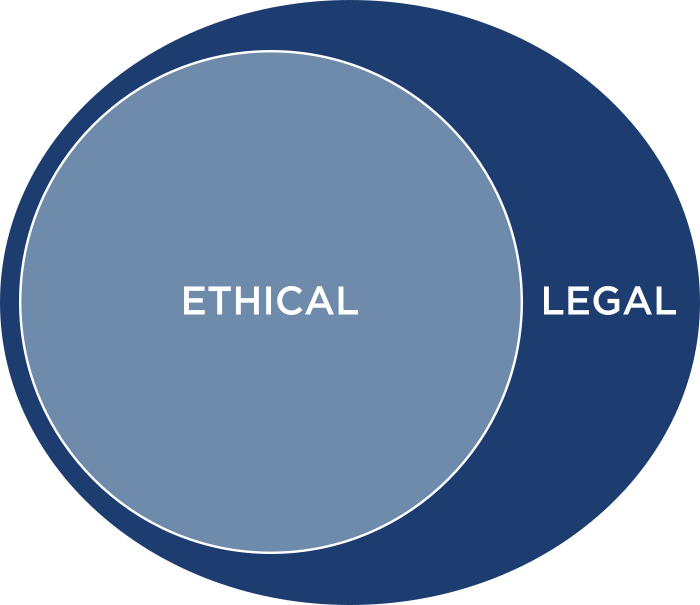
Just because actions are technically legal doesn't mean they're ethical. Relying strictly on the law is especially risky when it comes to online business, where regulation lags behind the public's perception of right and wrong.
Why Good Managers Behave Badly
Managers at a brokerage house bilked the company's banks by initiating small overdrafts that they then covered after enjoying interest-free use of the money. The individual sums were small. But cumulatively, the savings on interest that the brokerage would otherwise have owed to the banks was substantial.
The brokerage hadn't specifically proscribed overdrafts or spelled out their illegality, so managers decided that this tactic wasn't wrong. And all the while, their bosses assured them that what they were doing was clever. But the practice came to the attention of government investigators—who didn't agree. The brokerage was eventually fined millions for fraud.
Why Good Managers Behave Badly
"I'm doing what's best for my company."
Profits don't justify unethical actions. Don't just focus purely on potential profits—examine the long-term implications of your actions on others.
Why Good Managers Behave Badly
During a housing boom, banks set ambitious goals to grow mortgage lending. They rewarded loan officers for the number of deals made, regardless of risk. As a result, loan officers wooed borrowers with subprime loans that started with modest payments but then ballooned to higher interest rates. Borrowers often didn't understand the loans' complex terms and weren't warned about the financial consequences.
Loan officers pursued this strategy until the housing market collapsed. As a result of these questionable actions, thousands of people lost their homes to foreclosure. Lenders faced huge losses and even bankruptcy.
Why Good Managers Behave Badly
"My behavior will be condoned."
http://www.npr.org/news/specials/enron/
Some employees act unethically with tacit protection from managers. However, when missteps are exposed, you are unlikely to remain safe.
Why Good Managers Behave Badly
Financial executives at an energy firm performed complicated and deceptive accounting maneuvers in order to hide large financial losses on its balance sheet. Senior management protected and rewarded these financial executives. Eventually, the losses became too large to hide. The company went bankrupt, and thousands of people lost their jobs.
Why Good Managers Behave Badly
"My actions won't be made public."
Just because unethical actions might not be immediately exposed doesn't make them right. Given how easy it is for information to spread today—through technology and social media—it's more and more unlikely that unethical actions will remain permanently hidden.
Why Good Managers Behave Badly
A small group of executives and corporate medical directors at an asbestos manufacturer suppressed research showing that the company's product caused a fatal lung disease in its employees. They rationalized their conduct because they thought no one would ever find out. Because this information was not revealed for decades, many people suffered.
Why Good Managers Behave Badly
是否应为了保全公司而撒谎?Should You Lie to Save Your Company?
哈佛教授讲授视频逐字稿
A big question that managers or CEOs have to face is how far they would go to protect or save their company. And a big question is whether you'll lie to save your company. There's a CEO of a company that remanufactures jet engines, who I spoke to and wrote about. And he is going through the annual audit for his company and he's about to sign the document that says, "I know of no circumstances that will affect the financial condition of my company." He's about to sign that when he gets a phone call, and he learns that several planes have been grounded at airports as a result of what might be problems with parts he made for the engines in those airplanes that had been grounded. He doesn't know if they are or not, but they might be. And he's agonizing: "Do I sign these documents?"
Obviously, if it's us, it could have a major effect on the financial condition of the company. He gets some more calls. More planes have been grounded. All told, about 11 planes have been grounded that may or may not be grounded as a result of a part that he made for these engines.
So, he has to decide what to do: "Do I sign these documents?" And he consults a first lawyer, trying to find some legal advice on what to do. That lawyer says, "By no means should you sign this. If it turns out it's your fault and you sign these documents and you haven't disclosed it, you've got a problem on your hands."
So he does what every panicked CEO might do and he consults another lawyer. And that lawyer says, "No, you don't know if it's you. You have no responsibility to do that. Your responsibility is to protect the company. And if you say that something's wrong or may be wrong, the banks may panic. They may pull their loans. People may lose their jobs."
So, there's a real dilemma he's facing: "Do I sign the papers? Do I not sign the papers?" Now, as a consumer I think there are some products that the CEO has a moral responsibility not to take any chances with, and as someone getting on an airplane, if I'm getting on that airplane and the CEO has any inkling that there may be something wrong with a part in that engine, I want him to say, "Don't get on that airplane." By not disclosing it, he runs that risk.
He's faced with this decision, and he decides, ultimately, that he's going to sign the documents that say he doesn't know anything. So, essentially, he is basically lying to save his company. It turns out that the discovery is that it's inconclusive; that they can't determine whose fault it was. And within a year he sells his company out of the guilt that he feels over having signed the documents.
第 3 节
Most managers want to create an ethical culture. Yet many become so focused on short-term business goals that they inadvertently encourage misbehavior.
Common mistakes to avoid include:
Why Good Managers Behave Badly
A retail manager has a goal to reduce employee turnover in the region's stores. To keep employees happy, the manager ignores when vendors give the staff free items.
Why Good Managers Behave Badly
- “Arm's-length blindness”. Feeling you're not responsible for unethical work outsourced to others.
Why Good Managers Behave Badly
A public relations team is hired to promote a new store that's opening in the region. In addition to promoting that news, they fabricate negative reviews about your competitor on social media sites.
Why Good Managers Behave Badly
- A gradual descent into unethical behavior. Your failure to address small ethical missteps may set the conditions for greater misbehavior.
Why Good Managers Behave Badly
Retail staff occasionally "forget" to let customers know they can apply for a manufacturer's rebate on certain items. Over time, they stop mentioning the rebate entirely because it reduces their commission.
Why Good Managers Behave Badly
- "The ends justify the means."
Why Good Managers Behave Badly
A manager promotes an employee who generated record-setting sales in the previous month, even though he achieved his goal by offering a two-for-one deal on a brand that has strict policies against such discounting.
Why Good Managers Behave Badly
道德淡化 Ethical Fading
哈佛教授讲授视频逐字稿
A major theme of "Blind Spots" is that when we think about ethics in organizations, we need to move away from the model of "We're trying to deal with a few bad apples." From the perspective of "Blind Spots," while there are some bad apples who are engaging in intentional corrupt behavior, what we really need to do is to look at how so many of us do engage in unethical behavior without knowing that we're doing so, and how we see unethical behaviors around us and yet we simply fail to act on those unethical behaviors.
From our perspective, what we need to do is treat ethics as a broader topic than the conscious deliberation of a few bad apples, and start thinking about, "How do we create an organization where people are doing the right thing and they're aware of how their actions could lead to harm to both the organization and the broader society?" There are a number of tactics that organizations and individuals can use.
One is to simply audit your decisions, to take a look at the nature of your decisions rather than simply the nature of your intentions. Another tactic that executives can use is to do a much better job of thinking about how the incentives and how the culture that they're creating will affect the behavior of employees throughout the organization. So often, executives are creating incentives that can predictably lead to bad behaviors, and yet they're unaware that they're doing so.
One of the examples that we talk about in the book comes from Major League Baseball. From the late 1990s into the early part of the new millennium was the peak of the steroid crisis. And it's pretty clear that many baseball players, including many star baseball players, were using steroids. And they may well have engaged in cover-up behaviors and denials, and there maybe a wide variety of legal issues associated with this.
But from our perspective, the fascinating part of the steroid scandal isn't the fact that players with a limited career span would use steroids; it's the fact that Major League Baseball, the players' union, and the team owners did a phenomenal job of creating an environment where it was very predictable that players would be using steroids, where players who didn't use steroids were at a competitive disadvantage because so many other players were doing so. So you have an environment in which it's easy to predict that wrongdoing will occur.
And it was the executives who were creating this environment where this was so predictable. From the perspective of the owners, I think what we saw was what we refer to as "ethical fading" in the book. They were focusing on ticket receipts and revenue. And at the same time that the steroid scandal was occurring, things were going just fine in terms of the revenue side of sports, because the more home runs that were hit, the happier the fans were, and everything seemed just fine. And the ethical dimensions of what they were doing through their lax enforcement and their implicit encouragement to the use of steroids faded from perspective.
Make a Connection
1. Consider the common mistake or mistakes you chose. How did this manager’s behavior affect you and others on the team?
第 4 节
Your "ethical compass" is your guiding sense of right and wrong. Here are three ways to keep it in working order:
-
Be rigorous in difficult situations. When everything's going well, it's easy to hold yourself to high standards. But when circumstances are challenging, you may consider shortcuts—particularly if you tell yourself it's "just this once." Instead, ask, "Am I proceeding in ways I approve of? If not, what changes do I need to make?"
Try it Out
Think about a situation where the temptation to make an unethical choice existed. Describe how you maintained your ethical compass.
1. I communicated my beliefs by
2. I maintained high standards by
3. I looked for positive and negative examples from others by
第 5 节
Reflecting on your learning helps you apply relevant concepts to your job.
Take a Moment
1. 1. What new insights do you have that could benefit you or others in your workplace?
2. 2. What are your biggest opportunities for applying concepts from this Lesson in your workplace?
Further reading
最优秀的领导者如何应对违规行为当工作场所的某项规则被打破时,领导者的第一反应往往是迅速采取行动。企业通常的应对方式似乎很明确:惩罚违规者,然后继续推进…
你公司的 AI 噩梦是什么?当前主流的负责任 AI 管理方法存在根本性问题。在生成式 AI 时代,这种方法既缓慢、又模糊,而且难以传达。与其把重心放…
个人数据安全管理的 5P 准则对数据进行编码、储存、分析和共享的能力能够给公司创造巨大的机遇。
这也是为什么各大公司在经济充满不确定性的时代,仍热衷…
Top 3 in the source platform's original order
