Ethics at Work
Resolve Ethical Dilemmas 查看中文版
第 1 节
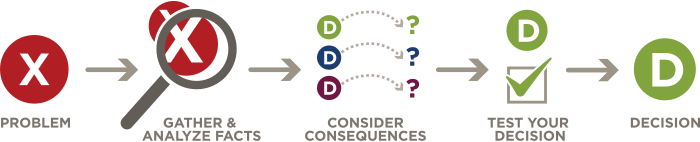
A structured approach helps you resolve ethical dilemmas in a fair and effective manner. When you systematically weigh your options and consider the consequences, you're most likely to choose the best course of action.
This ethical decision-making framework consists of three steps:
Using the proposed framework may seem time-consuming at first. However, if you practice using this approach, ultimately you'll become so familiar with it that you'll be able to work through it automatically.
第 2 节
You can't make a solid decision without accurate information. You need to gather and analyze the facts.
As you collect information, focus equally on how a proposed course of action affects you and others. You also need to consider how the issue arose (context) and how similar situations have been handled previously (precedent).
Define the problem accurately
When you accurately define the ethical dilemma you're facing, you defuse emotions that can create bias. And you boost your chances of making an informed decision later.
To define the problem:
-
Describe what you know about the situation. Lay out all the relevant facts in neutral language.
-
Accept that you can't know all the facts. Note any facts you don't know—but think you should—for later research.
Resolve Ethical Dilemmas
Manufacturer Principle Tools wants to expand to remain competitive in a tough industry. However, the company is struggling financially, in part because its biggest customers, large discount retailers, have pressured it to lower prices. Principle Tools wants to find a cost-effective way to expand.
Executives are contemplating setting up a new manufacturing plant in a developing country where materials, construction, and labor costs are low. A cross-functional task force of managers, representing finance, human resources, sales, and operations, is asked to explore the ethical ramifications. The executive team will use the special task force's findings to make a decision.
First, the task force considers the relevant facts and establishes the following potential benefits:
Building the new plant overseas would enable Principle Tools to save at least 25% on materials, construction, and labor.
These savings would improve profit margins, thus likely enhancing shareholder value.
Setting up a plant in the new country would give Principle Tools entry into a new market for its products.
Construction would create jobs in the developing nation.
Resolve Ethical Dilemmas
高估自己贡献的普遍现象 Overclaiming Credit
哈佛教授讲授视频逐字稿
One of the examples of a blind spot that we talk about in the book "Blind Spots" is a propensity to overclaim credit. The classic example of this, by Professors Ross and Sicoly, is if you ask husband and wife what percent of the household work do you do, and you add up the two numbers, it seems that rather than coming in at about 100 percent—which would be right if a husband and wife are doing all the work—on average, the two people report that they do 130 percent of the work.
And when we look at coauthors of academic papers, so when we look at academic papers written by four professors, and we ask each one of the four professors, "What percent of the work did you do?" When we add up the four percentages, we seem to come in at about 140 percent.
So this propensity to overclaim credit is a very robust phenomenon. But we also know that part of that occurs because people think about what they do without doing a good job of thinking about what other people do. So, instead of asking person A, "What percent of the work did A do?" when we ask them to tell us what percent of the work did A, B, C and D do, the amount that they claim for themselves actually goes down.
By individuating the other three people, we are prone to recognize the contributions of others and to be somewhat less self-serving in our propensity to overclaim credit.
Tips for making ethical decisions as a group
Hold the meeting in neutral territory—such as an off-site location, a conference room—so all group members can participate freely.
Articulate your company's values and the meeting's objectives at the start. These can provide reference points for the group's discussion and eventual decision.
Enlist an impartial facilitator who can speak to your company's values. She can help the group address discrepancies between core values and proposed actions.
Set a defined point in the process at which the discussion moves to resolution—whether it's a vote on a proposed course of action, adoption of a new policy, or timetable for next steps.
Tips for making ethical decisions as a group
Consider the problem from others' perspective
How do various stakeholders feel about the action you're considering? Reflect on the wider implications of your potential actions. This helps you reduce the temptation to choose the action that's most expedient for you. And you'll more likely select the most responsible course of action overall.
Resolve Ethical Dilemmas
Tech Innovators' task force has gathered facts about how the company and local residents would benefit from the new office. Now, it considers how local residents might be harmed:
Building the new office would increase pollution
The office would increase traffic and noise for residents who live nearby.
It could increase the cost of living and displace long-time residents.
Resolve Ethical Dilemmas
Trace the problem's origin and history
After you've defined the problem and considered how a decision would affect other stakeholders, ask yourself: "How did this situation come about?" and "What have we done in similar situations?"
These questions can yield new insights—and even generate better potential courses of action.
Resolve Ethical Dilemmas
Next, the task force comes up with the following observations:
The desire to build a new plant in a developing country came about because Principle Tools is struggling financially and wants to expand in the least costly manner possible.
When Principle Tools has had financial problems in the past, it has always expanded production capacity in an effort to grow sales.
Expanding capacity always carries risk. For example, what if there's less demand for the new plant's products than expected? In fact, previous investments in new capacity made on domestic soil did not achieve desired results, worsening Principle Tools' financial performance.
After reviewing these facts, task force members discuss whether expanding capacity may have become a reflexive solution for Principle Tools—one that could be problematic in the long term. Several members suggest that management should brainstorm different ways to improve sales—such as introducing new designs or coming up with new sales strategies.
Resolve Ethical Dilemmas
Identify conflicting loyalties
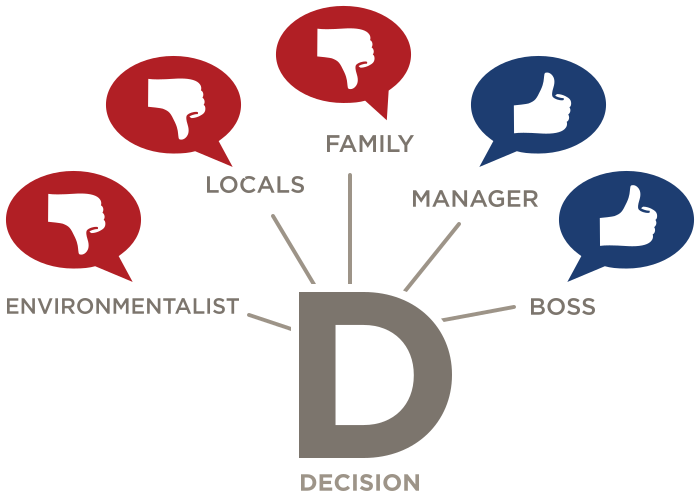
In any ethical dilemma, you face conflicts of loyalty that force you to put one value ahead of another. For instance, should you do what's best for your company? For the environment? For your unit and boss? For you? And finally, you might wonder, what's best for your race or gender?
When you identify conflicting loyalties, you uncover ethical nuances. The resulting insights help you make a decision.
Resolve Ethical Dilemmas
Finally, Principle Tools' task force lists potential conflicting loyalties inherent in the proposed plant project:
"We're obligated to increase returns to Principle Tools' shareholders. But building the new plant in the proposed location might cause hardship for the communities in which we do business. Noise and traffic will increase, and the environment will be adversely affected."
"Constructing the new plant would create local jobs. We would feel good about helping those people improve their standard of living. But shouldn't our first loyalty be to create jobs in our own country?"
"To ensure that the new plant operates effectively right away, we'd want to staff the facility with experienced managers from our domestic facilities. These managers would get valuable new global experience. But it would create hardships as well: Managers would have to move their families to an unfamiliar place. And local citizens seeking managerial jobs might resent that those jobs have been given preferentially to foreigners."
"The new plant would encroach on native wildlife habitat and introduce new pollutants to the area's water and air. In our public relations communications, we claim to be a company that cares deeply about the environment."
"While some people would be happy to get jobs at our factory, others might not like to see foreign consumer products being sold in local markets. People in the proposed location have a strong cultural identity and may view our presence there as an intrusion."
When the task force identified conflicting loyalties, they also recognized the values underlying those loyalties. For example, they acknowledged the company's desire to do right by shareholders, communities, employees, and the environment.
At this point, they must begin to determine which of these values mean the most to the company. They'll need to engage in lengthy, intense, and probably painful debate. But the process is essential for determining how they will resolve the "gray areas" that characterize all ethical dilemmas.
Resolve Ethical Dilemmas
Try it Out
Think of an ethical dilemma you had to resolve at work or in your personal life.
1. How did I define the problem?
2. What were other people’s perspectives on the issue?
3. What had you or others previously done in similar situations?
4. Did you experience any conflicting loyalties?
第 3 节
After you've gathered and analyzed facts, examine the potential consequences of your decision.
Compare your intentions with likely results
What are your intentions? What do you want to happen following this decision? What results would most likely emerge? Is there a large gap between what you want to happen and the probable outcome? If there is, you likely have further ethical "gray areas" to explore.
Resolve Ethical Dilemmas
The task force compares Principle Tools' intentions in building a new plant with the likely results of going ahead. Some excerpts from the discussion:
Maria: "We have multiple intentions. The primary ones seem to be to grow our business in the least costly way possible, help raise standards of living for people wherever we can, and be a steward for the environment. These intentions are reflected in our mission and value statements."
Joan: "Well, that's all true. But given the realities in the country we're considering for our new plant, our cost-saving intentions might fall flat. Sure, materials, construction, and labor costs are cheaper there. But there are other costs of doing business—like penalties for pollution and fees for setting up operations—that could ultimately offset any cost savings."
Frank: "And I'm wondering whether our intention to help raise standards of living can really be met. I guess it depends on whose standards of living we're talking about. Every time we set up operations in other countries, we take away potential domestic jobs. And this is during a time when we're already struggling economically! Don't we have more of an obligation to create jobs at home than to create new jobs abroad?”
Resolve Ethical Dilemmas
Identify potential harm
Seglin, Jeffrey L. "How to Make Tough Ethical Calls." Harvard Management Update Apr. 2005.
Part of making an ethical decision is doing the greatest good and the least harm. Identify who and what your decision could hurt. It's helpful to divide your analysis into three categories: money, people, and the common good.
Consider how your action might negatively affect:
-
Your company's financial well-being (money)—such as cash flow, profitability, revenues, and market capitalization
-
The individuals who'd have a stake in your decision (people)—including investors, employees, customers, suppliers, and business partners
-
Larger societal concerns (the common good)—such as the environment or the communities in which your firm does business
Resolve Ethical Dilemmas
Next, Principle Tools' task force identifies the potential harm to money, people, and the common good:
Money. Principle Tools might face unexpected costs in doing business in the proposed country. The plant might lose money if there isn't enough local demand for Principle Tools' products.
People. People living near the new plant would experience increased noise and traffic. If the plant is staffed heavily with managers from headquarters, local citizens hoping to be hired as managers might be resentful.
Common good. The environment near the plant site would be damaged. Cultural changes brought on by an influx of foreign nationals might not be welcomed.
Resolve Ethical Dilemmas
Discuss the issue with affected parties
Who would be affected—positively and negatively—by the action you're considering? It's important to consider all stakeholders.
If possible, gather feedback from affected parties. Invite them to present their concerns, questions, and perspectives.
Resolve Ethical Dilemmas
Finally, the task force schedules meetings with:
Stakeholders—employees of Tech Innovators and managers who may be asked to transfer to a new city to start the new office
Local residents—potential employees, prospective customers, and community leaders
Interest groups—environmental and health advocacy groups
Resolve Ethical Dilemmas
告诉对方决策依据,更易获得支持 Share What’s Behind a Decision
哈佛教授讲授视频逐字稿
In 2003 and 2004, we started planning for the possibility of a new infectious disease outbreak, with a new kind of influenza. This was called the bird flu. Most people may remember we called it H5N1 in the medical community. But it was a very scary time. This kind of influenza was different than the normal seasonal flu, and more than 50% of people who got it were dying—a very, very serious illness. We tried to think of how we would respond as a community, and one of the choices was to give anti-viral medications, these prescription medications that could limit how many people died.
One of the greatest challenges is, we didn't have enough. And so when we were looking at how we would allocate those medicines that we didn't have enough of, we were really trying to think of who should get them. Here in Boston, among the hospitals in the city, what we did is, we had an exercise. And we all discussed our allocation strategies.
What we found is that one hospital planned to use their limited supply only for people in the first two days of symptoms, when the science says they're most likely to be effective. A different hospital planned to use them only for the sickest patients in intensive care unit, because they thought those patients were at highest risk of dying. A third hospital wanted to use them for the doctors and nurses to make sure they protected their staff, and they have staff who could show up to work and take care of all the patients who were presenting.
I don't think there is a clear right answer among those strategies for what definitely should be done. As a city and as a community, I think what we faced was this ethical challenge of the possibility that the public would see different hospitals, different doctors, different systems making different choices. And I really could lead to chaos, where patients would choose a hospital based on where they thought they were most likely to get care. It would actually be an inefficient use of resources and potentially lead to much worse outcomes than if we all did the same thing.
So we had a number of discussions, some pretty uncomfortable discussions but talked about how we would make these decisions in a coordinated fashion. And this happened not just in our city but actually on a national level as well. I think we thankfully have some principles on how we can better support ethical decision-making in times of crisis.
First and foremost, I think it's important to be fair, that you can't favor one group over another; there has to be that perception and actually the reality of fairness in whatever you do. There also has to be transparency. It's really important to say why you're making the choice you're making and tell what choice you're making.
There is some science behind this. People have looked at how likely the public is to buy into very hard ethical decisions. And the more transparent you are, the more likely they are to actually believe that you've made the right choice.
But the last is really to be coordinated. Again, I think if there is inconsistency in a system, I think the providers and the public have less confidence in the system if doctor A is making one choice and doctor B is making a different choice.
I think this principle applies outside of just infectious disease and medicine, that when you face tough ethical challenges, you have to be fair, you have to be transparent, you have to be honest with both your staff and with the public.
And I think that the staff is more likely to act in concert to follow the guidance that's being given centrally when they understand the principle behind it, that actually everyone acting in one manner is much more efficient and much more likely to do good than each person making his or her own ethical choice.
Make a Connection
1. Think again about the ethical dilemma you had to resolve. How did you examine the potential consequences of your decision on your company, the individuals affected by your choice, and the common good?
第 4 节
After you've gathered the facts and considered potential consequences, test the decision you're considering
Test long-term validity
A decision that remains ethically sound over time is better than one that doesn't. Ask, "Will our decision be as valid in the future as it seems now?"
Think about how your decision will be perceived in six months. A year? Longer? A course of action that seems perfectly ethical today may pose problems later if circumstances change.
Resolve Ethical Dilemmas
Tech Innovators' task force assesses the pros and cons of staffing a new office with managers from its company headquarters. They discuss whether this decision will remain valid over the long term:
Maria: "Staffing the new office with our managers could help us ensure that the office runs efficiently right away. It would also give our managers valuable experience."
Viktor: "Sure, but as we discussed earlier, it could backfire on us if local residents end up resenting not having the chance to apply for managerial jobs themselves."
Joan: "Some resentment on the part of a few locals aspiring to managerial work seems fairly harmless to me."
Samir: "Unless the political scene there changes. Say a new regime comes in and lobbies for higher-level employment opportunities for locals. Then we'd have to be able to explain why we employ only managers from headquarters at the office—yet we claim we want to increase standards of living for people in the new city."
Frank: "We'd be facing a trade-off between trying to ensure efficiency and develop our managers—and trying to create better job opportunities for people."
Resolve Ethical Dilemmas
Test your "qualm meter"
Before you take action in an ethical dilemma, ask, "Could I disclose this decision to respected parties without any qualms?"
Think about telling your company's CEO, your manager, your family, or even society as a whole. Imagine the news hitting social media, a newspaper, or TV news.
Do you feel uncomfortable about disclosing your decision to others? This may be a signal that your potential course of action has ethical problems.
Resolve Ethical Dilemmas
Tech Innovators' task force imagines the general public reading an article in a major daily newspaper about the company’s policy of putting only staff from headquarters in managerial positions in its new office.
Members feel uneasy about the likelihood that some people would object to this policy on the grounds that it closes the door of professional advancement to local residents.
So they brainstorm ways Tech Innovators might address the ethical concerns the policy raises. They decide to reserve some managerial positions for local applicants and create a managerial track for residents with special training for management roles.
Resolve Ethical Dilemmas
Test perceptions of your intent
Another way to test your possible course of action is to ask, "Could the intent behind our action be misperceived?"
Actions often have symbolic meanings. How that symbolic meaning is perceived in actuality is just as important as how you intend it to be perceived.
Resolve Ethical Dilemmas
Tech Innovators' task force has been discussing the fact that building a new office will contribute to air pollution. Members talk about the possibility of renting office space instead.
An excerpt from the task force members' conversation:
Viktor: "This would strongly signal our commitment to reducing air pollution and pomoting sustainable practices in the community."
Joan: "Yes, but what if our action is misunderstood? People migth see it as increased competition for jobs and resources, as well as higher rents and property prices."
Maria: "And local leaders might see the move as an attempt to gentrify the area."
With these possible problems in mind, task force members discuss ways to ensure that people see the decision to rent office space instead of building a new office for what it is: a genuine desire to do right by the environment.
Ideas include talking with the local community to describe the proposed change and gauge their responses. The task force decides to put together a presentation about its long history of commitment to sustainability to reassure audiences about the genuineness of its intent.
Resolve Ethical Dilemmas
Test your openness to exceptions
Finally, ask, "Under what conditions would we make an exception to our corporate values and ethics?"
Exceptions Can Weaken Your Corporate Values

If you can think of many exceptions, you might not have as firm a commitment to ethical behavior as you think. You might want to consider practical ways to alter your proposed course of action so you can uphold it without compromise.
Resolve Ethical Dilemmas
Tech Innovators' task force members discuss the conditions under which they might rethink certain long-held company values. Excerpts from their conversation:
Maria: "If the economy weakens, could we really afford to continue investing in research and development? And would we want to risk operational inefficiency by opening up some managerial jobs to locals who’d need time to learn the job?"
Joan: "You've got a point there. But not making those moves would prove that we’re not taking those values—improving standards of living—seriously."
Samir: "I know that. So what could we do to stay true to our values?"
Frank: "Well, we could invest in research and development more strategically or see if there are other ways to cut costs."
Viktor: "And when it comes to the question of managerial jobs for locals, we could reduce the risk of operational inefficiency. We could match locally hired managers with mentors from our own company. The mentors would be there only on short-term assignment and could help get the locally hired managers up to speed quickly."
The task force did not make a quick decision. Instead, they worked hard to gather information, consider the consequences, and test their decision’s soundness. They asked tough questions to arrive at the best possible decision.
Resolve Ethical Dilemmas
管理灰色地带 Manage Through Moral Gray Zones
哈佛教授讲授视频逐字稿
Gray zones are areas where workers and supervisors engage in "forbidden" activities, yet these activities are tolerated. And there are many examples of such gray zones. One example I found in some research I did in automotive plants happens when workers would actually produce side artifacts on top of official productions.
Think, for instance, of the automotive plant. In that plant, you're supposed to produce maybe cars or trucks. But at the same time, these workers would actually produce some toys for their kids, maybe knives for their kitchens, and also frames for their windows. And that seems really off the charts. So the gut reaction of any manager discovering this would be to say, "I need to clamp down on it, and let's stop that kind of behavior."
That's perhaps true. But I would encourage that person to pause and think, "What's happening in these gray zones?" So gray zones are wonderful windows into the life of employees and their desired identities.
In this plant, for instance, people who engaged in these side productions were doing so because they were craftsmen. They wanted to enact their craft's identity. And they couldn't do this anymore in their official job because there was much less craft work to actually engage in.
So the first takeaway is, you need to pause and see what's in it for the employees. That's really important. The second takeaway: when you look at what's happening, managers actually can gain a lot from tolerating gray zones because there's a lot of room for discretion. They can allow some workers who go the extra mile to engage in them and others not to.
And if you think of gray zones in factories, I'm sure you can find many examples in your own work settings. So we can think of journalists also writing books on the side at work. We can think of even doctors in hospitals who might be treating patients on the side or maybe family members and who are maintaining their skills.
So let's continue in this automotive plant. Imagine the worker was allowed to do a side project at the end of the week. When the next week hits and there's actually a rush order, he might come in late at night to actually engage in that rush order. And that's really something that is beneficial to the entire plant and to the workforce.
So, again, think twice. Look at what's involved, both for the workers and managers, before clamping down on them.
Make a Connection
1. Based on your responses above, what would you do next time before finalizing an ethical decision?
Take Action
1. What action will you take next to practice handling ethical dilemmas?
第 5 节
Test your understanding and reinforce what you’ve learned.
第 6 节
Reflecting on your learning helps you apply relevant concepts to your job.
Take a Moment
1. 1. What new insights do you have that could benefit you or others in your workplace?
2. 2. What are your biggest opportunities for applying concepts from this Lesson in your workplace?
Further reading
最优秀的领导者如何应对违规行为当工作场所的某项规则被打破时,领导者的第一反应往往是迅速采取行动。企业通常的应对方式似乎很明确:惩罚违规者,然后继续推进…
你公司的 AI 噩梦是什么?当前主流的负责任 AI 管理方法存在根本性问题。在生成式 AI 时代,这种方法既缓慢、又模糊,而且难以传达。与其把重心放…
个人数据安全管理的 5P 准则对数据进行编码、储存、分析和共享的能力能够给公司创造巨大的机遇。
这也是为什么各大公司在经济充满不确定性的时代,仍热衷…
Top 3 in the source platform's original order