Pocket Leadership口袋领导力

Ethics at Work

Understand Workplace Ethics 查看中文版

第 1 节

What is workplace ethics?

Ethics is based on morals—personal values that help individuals determine right and wrong.

Workplace ethics is how a person applies morals to professional situations.

Workplace ethics has a practical focus—ethics in action—as opposed to general philosophical inquiry into "what is good." As such, workplace ethics can be learned.

第 2 节

Why ethics matters

An ethical workplace relies on each employee's ability to distinguish between right and wrong. A solid ethical foundation rests on two actions:

  • Obey the law

  • Follow your company's published code of conductHeineman, Ben W., Jr. "Avoiding Integrity Landmines." Harvard Business Review Apr. 2007.

When employees make correct right-versus-wrong choices, everyone benefits. For example:

  • The company builds a good reputation for fair employment practices, social responsibility, and fiscal integrity. Customers (whether individual consumers or other businesses) want to buy from companies with good reputations. And suppliers want to do business with them.

  • The company avoids the high costs—lengthy government investigations, staggering financial liabilities, loss of morale—that come with getting caught in serious wrongdoing.

  • Investors benefit because the more customers buy from the company, the better its financial performance—thus the greater the return on investment.

  • Employees take pride in working for a reputable company. They also trust one another to "do the right thing," so they share more information and ideas—which drives innovation.

  • Society is better off, because economies thrive on trust.Elkington, John. Cannibals with Forks: The Triple Bottom Line of 21st Century Business. Hoboken, NJ: Capstone Publishing Ltd., 1997.

Make a Connection

1. How does your organization communicate its ethical standards to employees?

第 3 节

What is an ethical dilemma?

In right-versus-wrong situations, the correct and incorrect actions are evident. For example, it's obviously wrong to steal from your employer. Unfortunately, the resolution to many workplace problems isn't as clear.

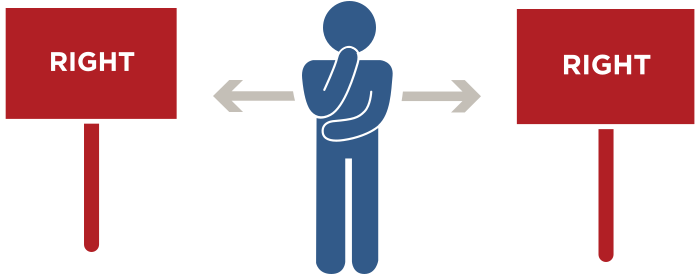
An ethical dilemma is a situation in which a manager has to decide between two or more correct courses of action, each of which could harm someone or something (such as the organization, the environment, or society at large).

These quandaries are known as "right-versus-right" dilemmas. They are difficult to resolve because the particular situations:

  • Have no rules or codes of conduct spelling out what to do and what not to do; thus there are no clear right and wrong answers.

  • Require you to choose between several potential courses of action that all seem ethically valid.

  • Force you to weigh options and potentially sacrifice one value for another.

  • Are complex—you need to consider potential consequences for many different stakeholders. It's difficult to identify and weigh all the possibilities. And it's nearly impossible to please everyone.

As a manager, many of your toughest situations will involve right-versus-right decisions.

道德选择的灰色地带 Ethical Ambiguity

哈佛教授讲授视频逐字稿
There's a story about a Harvard Business School professor who's trying to figure out how teach business ethics. She's standing up in the front of the class and starts to talk about this legendary case of Johnson & Johnson and the Tylenol case, where in the early '80s somebody had tainted bottles of Tylenol with cyanide, resulting in the deaths of seven or eight people through absolutely no fault or responsibility of Johnson & Johnson. Johnson & Johnson is faced with the decision of what to do. And she's telling this case to the students and the students are getting agitated as she's saying that. It's clear that they don't think this is an ethics case. And she says, "Why don't you think this is an ethics case?" The students say, "That resulted in such goodwill for Johnson & Johnson. People loved the company because they pulled all the bottles off the shelf as a result and spent hundreds of millions of dollars doing that." And as she's talking to them she realizes that the perceptions that the students have and that most people have is for something to be ethical, it has to cause pain. And that couldn't be farther from the truth. When you talk about ethics, [you're talking about] the place we all find comfort, the place we can agree on how we best behave in a particular situation. And the challenge for ethics is that most situations we face are not cut and dried and not clear-cut. They are complex. We all know what to do when there's a stark right and wrong answer such as, "Do I murder someone? Do I not murder someone?" Typically we'll all say, no, we don't murder someone. But those aren't the types of decisions we face on a day-to-day basis when we're at the workplace, when we're living our lives. The choices we have to make are between multiple right choices. We have to decide among those multiple right choices: "What's the best right choice I can make?" So that's the reason that when you make an ethical choice, when you make an ethical decision, you can't just rely on gut instinct. Because there are multiple right choices you can make and you need to think through what the implications of your choice are: "If I make this right choice, who does that affect? If I make that right choice, who does that affect?" So it's navigating the grey area among the various right choices you have to come up with the best right choice you can arrive at.

Ethical dilemmas: What's at stake?

When faced with an ethical dilemma, consider how your action could: Violate someone's rights—such as a right to safety, privacy, or equal treatment in the workplace Erode conditions that are important for the common good (everyone's welfare)—such as environmental health or opportunities for education​​​​​​​ Call into question your own virtue—your ability to act according to the highest potential of your character and on behalf of your deepest values Ethical dilemmas: What's at stake?

Making Right vs. Wrong Decisions

附件:making_right_vs_wrong_decisions1696838234314.pdf(pdf · 138 KB,本地副本)

Try it Out

Think about a situation where you faced a right-versus-right ethical dilemma.
1. What was the ethical dilemma?
2. How did I choose between the options?
3. In retrospect, did the choice I make cause any unintended negative consequences?
4. Would I make a different choice if I could do it over?

第 4 节

Right versus right

John, a team member who cares for both young children and aging parents with health issues, is falling behind in his work during a time when your department is facing a critical deadline with an important customer. Your manager wants you to fire John and replace him with someone who has an excellent track record.

Do you…

  • Take this step so your team can meet the deadline?

  • Refuse, citing your company's core values, which include "family-friendliness"?

As in any ethical dilemma, there is no one right answer. Any choice comes with both positive and negative consequences.

For instance, if you:

Decide to… The benefits might be… But the risks could be… Fire John and replace her with your manager's candidate You've pleased your manager, ensured your important client's needs will be met, and protected an important source of revenue for your department. You've contradicted a core value of "family-friendliness." In doing so, you may damage morale among other employees. Keep John on staff and find ways to adjust her workload. You've protected a core company value. And you've retained a worker who has a solid track record and is familiar with the client. You may have put important business at risk, and you're acting against your manager's advice. Also, if you adjust Monica's workload, other employees may resent taking on extra responsibilities.

Poll

Poll

第 5 节

Gut feelings are not enough

Paine, Lynn Sharp. "Ethics: A Basic Framework." Harvard Business School Note 9-307-959. Rev. 15 May 2007. "A Framework for Thinking Ethically." Markkula Center for Applied Ethics. Santa Clara University.

Since ethical dilemmas are complex, many managers rely on instinct and emotion to resolve them. If they use reason at all, they do so after the fact—to justify their instinctual response rather than test their decisions before acting.

Relying exclusively on your first instinct can be problematic. Monica's dilemma illustrates some of the perils:

  • People's instincts differ. What feels like a sound judgment to you might feel otherwise to someone else. Your manager's instinct is to put a major client's needs first; your instinct may be to preserve an employee's job.

  • Few people can see all the ramifications of a business decision. It's impossible to consider all the possible choices if you are relying on instinct—much less all the consequences. For instance, if you replace Monica close to a major deadline, how quickly can the new employee learn the role?

  • You may be swayed by emotion. You may be loyal to Monica because you understand her personal circumstances. Since you've worked with her successfully in the past, you may be willing to overlook her current underperformance.

  • You may be drawn to "the path of least resistance." It's very tempting to choose the option that's easiest, or will create less immediate conflict. If you let Monica go, you will immediately satisfy your manager. But this choice may have long-term impact on your team's morale.

Instincts are unreliable. To effectively resolve right-versus-right dilemmas, you need to follow a structured decision-making process.

领导者要勇于承认错误 Good Leaders Admit Mistakes

哈佛教授讲授视频逐字稿
There are plenty of mistakes I've made as a leader, but one specific story comes to mind. We were about 20 employees at the time, and I was traveling—it was, I think, on Thursday—and I had the management team call me. Somebody in the company had posted a reaction to a blog post. And it was, in fact, a little embarrassing for the company because foul language was used. And so we got on the phone as the management team. And I supported the decision to dismiss this employee. I came—I flew back to the company on Friday. And we were still a small company at the time, so I had announced and apologized to everyone that it felt bad that we were losing someone. It was the first time somebody was leaving the company. And in that weekend, I just—I couldn't sleep. I just felt like it was the wrong decision on so many levels—for the person, for the company, and what we represented in terms of putting fear into the employees for such a small infraction. It was serious, it was against our values, but on balance it just didn't feel like the right decision. So I came back in on Monday, we rehired the person. He's back in the company. And then I went in front of the company that Monday, and I worried less about popularity, and I expressed to everyone that I was sorry and I'd made a wrong decision. I don't know how many CEOs turn around and rehire someone, but I felt like it was the right decision for the company. He's still with us. And looking back, I think that it emphasized the values of how we respected each other and individuals.

Take Action

1. What action can you take the next time you face an ethical dilemma to ensure you make a sound decision?

第 6 节

REFLECT

Reflecting on your learning helps you apply relevant concepts to your job.

Take a Moment

1. 1. What new insights do you have that could benefit you or others in your workplace?
2. 2. What are your biggest opportunities for applying concepts from this Lesson in your workplace?

Further reading

最优秀的领导者如何应对违规行为
当工作场所的某项规则被打破时,领导者的第一反应往往是迅速采取行动。企业通常的应对方式似乎很明确:惩罚违规者,然后继续推进…
你公司的 AI 噩梦是什么?
当前主流的负责任 AI 管理方法存在根本性问题。在生成式 AI 时代,这种方法既缓慢、又模糊,而且难以传达。与其把重心放…
个人数据安全管理的 5P 准则
对数据进行编码、储存、分析和共享的能力能够给公司创造巨大的机遇。 这也是为什么各大公司在经济充满不确定性的时代,仍热衷…

Top 3 in the source platform's original order