
Understand Negotiation 查看中文版
第 1 节
What is negotiation?
A negotiation is an interactive process through which two or more parties seek to come to mutual agreement. You typically negotiate when you want something from someone and when someone wants something from you. A negotiation may be a formal affair in which you debate the terms of a contract. Or it may be less formal, such as a hallway discussion between you and another manager about an employee's work assignments.
如何突破现有规则 Winning Your Exception to the Rule
哈佛教授讲授视频逐字稿
Poll
第 2 节
Managers as negotiators
As a manager, you probably spend a significant part of your day negotiating with people inside and outside of your organization. Through negotiation, you:
-
Balance competing interests and resolve conflicts. By working through people's different motivations, needs, and perspectives, you reach agreements, find solutions, and keep projects moving.
-
Work with people over whom you have no control. When you rely on team members from various departments and vendors from around the globe, you can't tell them what to do. Instead, you need to collaborate to get things done.
-
Build and maintain relationships. By successfully making agreements with others, you form connections based on trust.
-
Achieve your goals. Effective negotiation helps you get what you need and want for yourself, your department, and your organization.
Effective negotiators are made, not born
People are not born as good or bad negotiators. Negotiation is a learned skill. Approach every bargaining situation—in and out of the workplace—as an opportunity to practice your skills. By doing so, you will create value for your organization and benefit from satisfying outcomes.
Even if you are an experienced negotiator, you can continue to learn strategies that will strengthen your ability to successfully negotiate complex issues.
Skills of successful negotiators
Many of the skills and methods that successful negotiators use are developed over time. To increase your effectiveness as a negotiator, learn to:
-
Align your negotiating goals with your organization's goals. Any terms you agree on must support your organization's strategic interests.
-
Prepare. Collect and analyze as much information as possible before any deliberations. Use each negotiation phase to prepare for the next.
-
Separate personal issues from negotiating issues. Remain objective so you can produce the best possible outcome.
-
Actively listen. Spend more time listening than talking. You'll learn information that can help lead you to potential areas for compromise.
-
Develop a reputation for reliability and trustworthiness. Earn trust by practicing ethical behavior and following through on all promises.
-
Recognize the value of relationships. Work to retain long-term relationships with coworkers, key suppliers, and others. Communicate openly, admit to and address mistakes, and ask for feedback.
约书亚·张伯伦:战斗前夜的谈判 Negotiation on the Eve of Battle
哈佛教授讲授视频逐字稿
Try it Out
Make a Connection
第 3 节
Negotiation as an organizational capability
People in every profession depend on negotiation to solve problems and get things done. Unfortunately, few organizations think systematically about their negotiating activities or consider negotiating to be a core competency. Instead, they handle each negotiation as a separate event with its own goals, tactics, and measures of success.
Most organizations would benefit by teaching their employees how to negotiate. Consider how much better off your organization would be if its negotiations with vendors, customers, partners, and employees were even 10% more effective than they are today. Your organization would benefit from lower costs, stronger and more profitable relationships with partners and customers, and improved collaboration among employees.
To help employees improve their ability to negotiate, organizations can:
-
Provide training and resources
-
Clarify organizational goals and expectations regarding agreements
-
Capture and share lessons learned from previous negotiations
-
Develop performance measures for negotiations and link them to rewards
第 4 节
The negotiation process
phases_of_negotiation_whats_involved
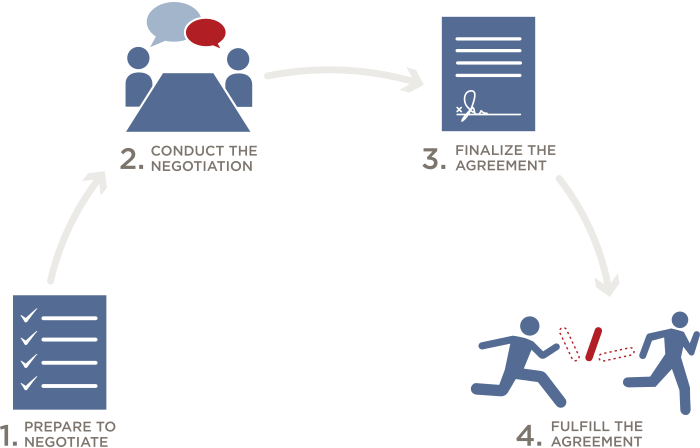
Every negotiation involves different players, interests, and goals. Despite those differences, most negotiations follow the four phases shown here. Once you understand the process and strategies for each phase, you can adapt your approach to individual situations.
第 5 节
APPLY
Test your understanding and reinforce what you’ve learned.
Try it Out
答案与解析
You keep each negotiation phase completely separate from the next.
When negotiating, you should use each phase to prepare for the next.
You admit to your mistakes and address them appropriately.(正确)
You should communicate openly and admit your mistakes. By doing so, you build and maintain long-term relationships.
You enhance the outcome by becoming emotionally involved with the issues.
You should not become emotionally involved with the issues. Remain objective to produce the best possible outcome.
You make your position clear by doing most of the talking.
You should not spend most of the time talking. By actively listening, you will gain information that can help lead you to potential areas for compromise.
第 6 节
REFLECT
Reflecting on your learning helps you apply relevant concepts to your job.