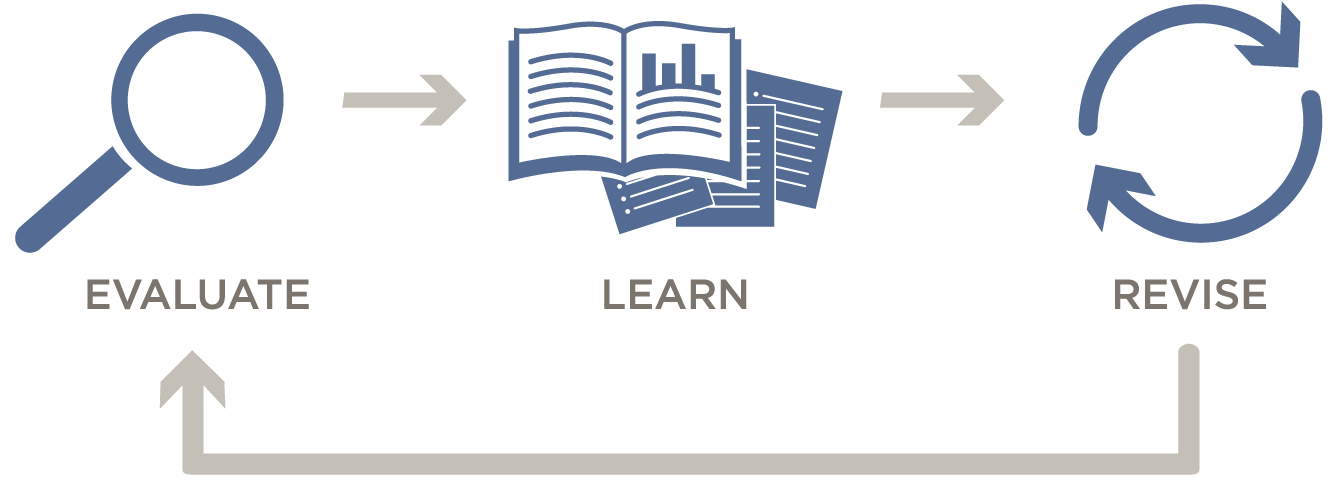
As you and your team work toward achieving goals, you will find yourselves caught up in the rush of day-to-day tasks. As important as it is to check items off your daily to-do lists, you always need to know whether you’re on track in achieving your goals.
EXAMPLE
Is the sales team ahead of or behind on its sales targets? Is the website task force moving forward according to plan, or is it stuck on an unexpected technical problem?
EXAMPLE
Continually Evaluate Goals
To monitor progress, try these tips:
Review upcoming tasks and required resources related to the goal. Make sure everyone’s prepared to tackle those tasks according to the plan for achieving the goal.
Update everyone involved as you make progress toward a goal. Listen to and address any concerns raised.
Revise completion dates if something changes; for example, delivery is delayed for a resource needed to complete a task. Review the impact of these changes on later tasks, and adjust the plan accordingly.
Make a Connection
1. Think about a recent project. How did you and your team update stakeholders on progress toward your goal? What would you do differently on your next project to surface and address any concerns?
第 2 节
In addition to routinely monitoring progress toward your goals, take time to step back periodically, look at your goals, and ask whether they’re still creating value for and important to your group or organization.
You may decide that your goals still support your group’s or organization’s strategy or mission. But perhaps priorities have changed, and reaching the goal will no longer create value. In this case, you’ll need to adapt your goals to reflect these changes.
EXAMPLE
A software development team had set a goal of completing the programming for a new product by the end of Q3. As the team is working toward this goal, Jason, the team leader, learns that manufacturing challenges will require a redesign of the product. The team puts the programming goal on hold and makes completion of another task a priority.
EXAMPLE
If you need to modify a goal that’s in progress, think carefully before acting. Changing a goal abruptly can create confusion for everyone who’s working toward achieving it. Make sure to get buy-in from your team, upper management, and other key stakeholders before proceeding.
Additionally, don’t change a goal in reaction to typically manageable obstacles such as personnel changes or delays. If you experience such problems, meet with your team to decide how to overcome them so you can get back on track with your goal.
应进行目标评估的三大原因 Three Reasons to Evaluate Your Goals
哈佛教授讲授视频逐字稿
When we talk about goals, normally the conversation is about setting them or achieving them. But actually an overlooked but critically important part is evaluating our goals to make sure that we’re even focused on doing the right things. I’d like to suggest that there are three frames, three questions that we can ask ourselves to enable us to make smarter decisions about our goals.
The first one is that sometimes your goals may actually turn out to have adverse consequences. I experienced this myself when I had what I thought was a great idea. I decided that three days a week, I was going to be playing squash with a friend of mine. It seemed perfect. We’d be getting in exercise. I’d spend time with him. But the only problem was that the time he could do it was six o’clock in the morning.
And I realized after a year of doing it that I had to stop. I had to quit, because I was so exhausted, it was ruining my productivity for the rest of the day. So that goal, while virtuous, actually did have adverse consequences that I needed to look at. And ultimately, it led me to abandon it.
Now second, you can actually look at whether your goal may be somehow hindering your very objective. I had a goal of trying to have more work-life balance in my life. I decided that I would spend several hours a week meticulously planning out my schedule to ensure that I was spending my time in equal proportions so I would have work-life balance. But after a couple of months, I was completely sick of it because I was so over-scheduled, I wasn’t able to enjoy any of the time that I was spending. So once I understood that, I ended up abandoning that goal.
Now third, a situation that many of us have probably faced is that you may in fact have outgrown your goals. There have been numerous times when I’ve received offers of jobs or consulting contracts, things that I would have killed for a few years before, but they were no longer appropriate for me for where I was in my career or where I was headed. And so I had to say no, because it just wasn’t right anymore and it would have taken me off track.
第 3 节
You and your team have reached a goal and are ready to move on to the next one. But before you do, evaluate whether the goal you’ve achieved had the impact that everyone intended.
To do so:
Determine whether everyone involved agrees that the goal was accomplished. If you can’t get agreement on this, consider how you might have expressed the goal in more specific terms when you initially set it; for example, by using the SMART test.
Assess the goal’s impact on your team, the organization, and others affected by it. If the goal did not have the expected impact, decide whether you overestimated its potential benefit.
Examine how the goal was achieved, seeking insights into what led to successes or to disappointments.
Identify what worked well as you and your team set and progressed toward achievement of the goal, and what you would do differently in the future.
If you and your team fall short on accomplishing a goal, look at the process used to work toward it and evaluate the outcome. Identify the obstacles you encountered, and consider how they affected the project and how you and your team resolved them. Share what you learned with others. By doing so, you will help your team and the overall organization improve how they approach goals in the future.
EXAMPLE
A team in a consulting firm completes a survey for a client on schedule, but the client complains that the final report is riddled with typographical and grammatical errors. In reviewing how they executed the project, team members realize that they didn't include an editing step in the project specifications or timeline. The team leader adds "Editing" as a line item on the planning checklist for future projects.
EXAMPLE
衡量绩效的五类定量指标 Five Ways to Measure Performance
哈佛教授讲授视频逐字稿
Managers often have a love-hate relationship with performance measurement. They appreciate the results but detest the act of measuring. That's why I'm glad I can bring 20-plus years of statistical expertise into my performance measurement coaching. A little bit of statistical rigor helps managers to avoid cutting corners, measuring the wrong things, and generating the wrong outcomes.
A good performance measure is defined as objective evidence of the degree to which a performance result is occurring over time. So you need to make sure that your KPIs are giving an accurate picture. For example, I consulted with Bridget, who works in a software company. She saw that the number of bugs reported by customers was on the rise. But when she started to measure the number of bugs per 100 hours of software development work, she realized that the rate at which the team was producing bugs had actually declined.
Let's look at five methods to measure performance. Each has pros and cons, and you'll need to decide which is the best for what you're trying to measure.
First, counts. Counting is the easiest way to quantify something you're observing, like the number of satisfied customers or products sold. But that only works when your population size doesn't change.
When your population size is changing, it's best to use the next method, percentages. Percentages are great when you're interested in how much of a dynamic target population exhibits a particular feature over time. But they assume your result is black or white. Either customers are satisfied or they aren't. They don't tell you the degree or extent to which the particular feature you're measuring is happening.
Third is sums and totals. These are continuous measures, such as the total cost of employee leave due to injuries or total time spent making sales calls. But like counts, they can also be misleading if the size of the scope or opportunity varies.
Next is averages. These are great when you're interested in understanding the degree or extent to which a particular result is happening across your population and not just whether or not it's happening.
Finally, ratios. Ratios are a great way to measure productivity. Keep in mind, though, that it's very easy to make your measures unnecessarily complex when you use ratios. Make sure that they tell you something sensible, like Bridget's measure of the ratio of software bugs to software development hours. So take a close look at your performance measures and ask which is the best way to quantify what you're trying to evaluate.
Whether you and your team successfully reach your goals, it’s important to capture any lessons learned from setting and working toward goals. You can then apply these lessons as you set new goals and modify existing ones.
For instance:
If you and your team achieved a goal too easily, make future goals more challenging.
If a goal took too much effort, make new goals a little easier.
If a goal proved unrealistic, make sure that new goals better reflect available resources, including time.
If individuals lacked needed skills while pursuing a goal, make strengthening or acquiring those skills a priority for the future.
If team members lost motivation, find ways to engage them in setting new goals and determining how to achieve them. In addition, continually communicate new goals’ value to your group and the organization.
When you and your team learn from achievements and failures, you will pursue future goals more successfully. With your group, think about how you can prevent “lessons learned” from becoming “lessons lost.”
案例
To apply what he and his team learned from working toward one goal, David documented their experience in a “best practices” folder in the team’s database and updated the project checklist to include a revised process for achieving future goals.
从失败中汲取教训 Distinguish Good Failures from Bad Ones
哈佛教授讲授视频逐字稿
No one likes to fail, but not all failures are bad. In fact, some are very good, because they present learning opportunities for individuals and for organizations. I’ve spent years researching failures, from the Columbia shuttle disaster to medical mistakes in hospitals. And I now teach business leaders to think of their own organizational mistakes in three categories.
First are preventable failures in predictable operations. Most of these can indeed be considered bad, because we know the process works. So what’s wrong is inadequate employee training or support, inattention, or lack of ability. The good news is these problems are easy to diagnose and fix—for example, by using a checklist.
The second type of organizational mistakes are unavoidable failures in complex systems. These happen because of the inherent uncertainty of complex work. They can often be averted by following best practices for safety and risk. But small process failures are inevitable, so considering them bad is counterproductive. Instead, you need to focus on quickly identifying and correcting small failures so as to avoid serious ones. For example, most accidents in hospitals result from a series of tiny mistakes in patient care that go unnoticed.
The third kind of failures are the best ones—intelligent failures at the frontier. These provide valuable knowledge that can help you get ahead of the competition and ensure future growth. Discovering new drugs, creating a new business, designing a product are all tasks where you need to produce good failures quickly. Unintelligent failures happen when you conduct experiments at a larger scale than necessary.
There are good failures and bad failures. It’s important for you and your organization to understand which is which, to anticipate bad ones, and help produce good ones.
After Action Review
Adapted from Darling, Marilyn, Charles Parry, and Joseph Moore, "Learning in the Thick of It." Harvard Business Review July 2005
Evaluating outcomes can be challenging because no one wants to be responsible for failure. The U.S. Army addressed this challenge by developing the After Action Review (AAR) in the 1970s as a judgment-free way for troops to learn from successes and failures. Since then, many organizations have used this tool for assessing goal achievement.
In an After Action Review, team members ask questions such as:
What were the desired outcomes?
What were the actual outcomes (based on facts, not opinions or judgments)?
What went well and why?
What can be improved and how?
Used regularly, this kind of review process can strengthen your team and improve outcomes. Reviews often focus on failures. Be sure to evaluate and learn from success as well.
After Action ReviewAdapted from Darling, Marilyn, Charles Parry, and Joseph Moore, "Learning in the Thick of It." Harvard Business Review July 2005
Identifying and acting on lessons learned is an important part of the goal evaluation process. In this activity, see if you can spot the lessons to be learned.
Try it Out
1. Which of the following statements about Rhana’s goal is true?
答案与解析
A.Rhana has achieved her goal. Not the best choice. While Rhana fulfilled the narrow metric she set (number of meetings), Alex’s performance indicates that the broader goal of teaching him the software has not been achieved.
B.The metric Rhana selected is not the best measure of progress toward the defined goal.(正确) Correct choice! Because the goal is instructional in nature, a more relevant metrics might be reducing errors by a certain percentage per week of training.
C.Rhana cannot achieve this goal. Not the best choice. Although not everyone is a natural teacher, it’s premature to arrive at this conclusion. Rhana may simply be using an ineffective approach to the training.
2. Which of the following statements about the goals for Randy’s team is true?
答案与解析
No celebrations are in order for the team. The team members failed to meet one of their goals. Not the best choice. Cutting costs by 15% (5% more than the goal), while still finishing a project on time, is a significant achievement in any organization.
The goals that Randy’s boss set were incompatible with each other. Not the best choice. The goals were not necessarily incompatible. The team might have been able to achieve both goals.
Randy should have prioritized goals for his team.(正确) Correct choice! Prioritizing goals allows trade-offs to be made. Randy might have been able to speed up the project by allocating the 5% extra savings to adding another team member. Thus, the team might have been able to both cut costs by 10% (rather than 15%) and finished the project early.
3. Which of the following statements about Wei’s personal goal is true?
答案与解析
Wei’s boss doesn’t have confidence in his abilities. Not the best choice. As with all organizational decisions, Wei’s boss probably weighed many different factors in making her choice. Wei’s best strategy is to let his boss know that he would be interested in leading similar initiatives in the future and to ask what skills he should focus on developing.
Wei prioritized his goal sufficiently to achieve it, regardless of his other responsibilities.(正确) Correct choice! Wei does seem to have prioritized his goal by seeking out a mentoring relationship and building his network of contacts.
There is now no reason for Wei to continue developing his cross-functional network. Not the best choice. His network will be a valuable asset as he continues to pursue his goal and perhaps lead a similar initiative in the future.
Make a Connection
1. Once you’ve achieved a goal, how does your team capture lessons learned? As a group, how do you ensure that you apply learnings from one project to the next?
第 5 节
Achieving a goal is not a stopping point. Once you and your team have celebrated an accomplishment, make a plan for periodically revisiting it as time passes. You want to ensure that everyone’s efforts had the desired impact and make any necessary adjustments.
Ask:
Did the goal accomplish what was intended in the short term? In the long term?
Has achievement of this goal resulted in any unintended negative consequences? If so, how can we alleviate them?
What else can we learn from how we approached setting and working toward this goal?
1
A hospital set a goal of improving patient satisfaction ratings by 20% by the end of the year. In support of that organization-wide objective, the maternity department identified improving the information that patients receive on discharge as a unit goal. A small taskforce worked on new guidelines and asked for input from other members of the department. Once the material was complete, nurses received training in the process and started using it with patients. The department had accomplished its goal.
Three months later, the maternity department task force reviewed the new discharge policy. Members interviewed nurses and patients to find out if it was working as intended and to ask for ideas for improvement. They revised the discharge process based on the suggestions.
1
从成功中学习 Learn from Successes
哈佛教授讲授视频逐字稿
You know, we all talk in leadership about learning from failure, learning from adversity. And I totally grant you that we should learn from our mistakes. Right? This is the age-old adage that you learn from your mistakes. But I think there’s another side to the story here: learning from our successes.
I find there is very little reflection that leaders undertake to learn from their successes. If something worked out; Why did it work? What did we do right? Did we luck out? Or are there some systematic lessons we should take away that we can use in the future?
Sometimes, people don’t realize that their success is pure luck, and they haven’t even internalized it. So I’m going to give you a quick story on that.
Lobster fishing is a big industry here in New England. And lobster traps are pretty standard. They’re these rectangular-looking boxes that have, you know, bait that is hung in the middle of them. And there’s a hole going in, wide on the outside, narrow on the inside.
No rocket science—lobster goes in because he sees the bait. Can’t swim out because the hole is narrow on the inside. And so, we’ve been catching lobster like this for a long time.
Just recently, somebody had a crazy idea to put a video camera down there to see how this actually works. Remarkably, what they found was, these things don’t work. Lobsters routinely swim in and out of these traps. The only way we catch lobster is luck, if you happen to pull up the trap when the lobster is swimming in there and the poor guy didn’t get to swim out.
So all these years we’ve had success lobster-catching by luck. And I think we need to learn about, from this example, is the idea that—you know what?—when we have success, let’s diagnosis it. Let’s understand why did it work. Was it luck? Or was it something systematic we did that we can learn from that we can apply later?
So I think, yes, we should learn from our mistakes. But we should also learn from our successes.
Revisiting goals you have accomplished helps foster a culture of ongoing improvement and achievement in your group and organization. It demonstrates that you and your team know how to get things done and how to learn from your experiences. It can also inspire you and your team: If momentum slows while everyone’s working toward a particularly challenging goal, you can reenergize and reassure your people by reminding them of previous successes and the effort it took to achieve them.
第 6 节
Test your understanding and reinforce what you’ve learned.
Try it Out
1. 1. You manage a team responsible for opening new restaurants for a large fast-food chain. Your team goal is to open eight restaurants during the course of a year. You are currently evaluating progress toward that goal. What is a good principle to keep in mind as you conduct your review?
答案与解析
If you think the goal needs to be changed, do it immediately, before the team wastes any more time. Changing goals abruptly can create confusion.
Changing the goal is a decision that you alone as manager must make. Make sure to get buy-in from your team, upper management, and other key stakeholders before modifying a goal in progress.
If you encounter unexpected obstacles, modify the goal rather than risk falling short of it. Don’t change goals in reaction to obstacles such as personnel changes or schedule slippage.
Even though your team carefully chose the goal, regularly question whether it’s realistic.(正确) Step back periodically to look at your goals and ask whether they are still realistic.
Try it Out
1. 2. You have almost completed a project to introduce a new line of fashionable watches to retail stores across the country. You are planning to identify the impact of your goals and capture lessons from the project. What is a good way to do that?
答案与解析
Use your own metrics to determine if the goal was accomplished. Only you can decide. Confirm that others agree the goal was accomplished and the expected impact was achieved.
If you fail to meet your goals, don’t dwell on it; just resolve to do better next time. Evaluate the process and the outcome if you and your team fall short.
Don’t be afraid to identify obstacles that made the goal hard to reach.(正确) Evaluate obstacles, how they affected the project, and how they were resolved. Share what you learned with others to improve future projects.
If the goal was too difficult, don’t give up; try again with something equally challenging. If a goal took too much effort, make new goals a little easier.
第 7 节
Reflecting on your learning helps you apply relevant concepts to your job.
Take a Moment
1. 1. What new insights do you have that could benefit you or others in your workplace?
2. 2. What are your biggest opportunities for applying concepts from this Lesson in your workplace?