
Accomplish Goals 查看中文版
第 1 节
Once you and your team set goals, it’s time to execute them.
Focus initially on a few small, specific goals. These give team members a clear sense of direction. They’ll also have the opportunity to score quick wins that will keep them motivated as they work toward attaining larger goals.
EXAMPLE
实现远大目标需要转变思维 Ambitious Goals Require a Shift in Mindset
哈佛教授讲授视频逐字稿
Make a Connection
第 2 节
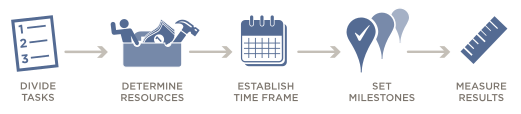
To achieve a goal, you have to complete a series of tasks. Breaking a goal into those tasks can provide further direction and motivation to work steadily toward attaining it. For each constituent task, you can identify criteria such as the time frame for completion, resources you’ll need, and results you expect to generate.
EXAMPLE
将目标化整为零 Chop Goals Down to Size
哈佛教授讲授视频逐字稿
Worksheet for Breaking Goals into Tasks
第 3 节
As you strive to achieve goals, it’s inevitable that you’ll encounter obstacles. For instance, a key resource becomes unavailable, or an important task takes much longer to complete than you anticipated.
It’s easy to get frustrated or demoralized when you run into obstacles while working toward attaining a goal. But these strategies can help you surmount the hurdles and sweeten the odds of reaching your goals:
- Share your goals with colleagues and friends. In addition to being supportive, they may have ideas for how you can accomplish your goals despite the inevitable setbacks.
- Adjust goals that turn out to be incompatible with one another. Conflicting goals will only compete for your attention and other resources.
- Focus on completing tasks related to your most important goals. Ignore any temptation to concentrate on tasks that seem urgent but that aren’t important.
- Keep the future in sight. When you hit snags, remind yourself of the benefits you’ll garner by reaching your goal.
- Be flexible about how you accomplish your goals. If changes arise that are out of your control, revise your plan for achieving the goal, to reflect the new circumstances.
- Ask for help if you need it—from upper management, direct reports, or other stakeholders. When goals are reached, everyone benefits.
Worksheet for Identifying Obstacles and Solutions
Try it Out
Take a Moment
第 4 节
As you and your team work toward achieving goals, take care to avoid these common pitfalls:
- Neglecting priorities not related to the goal. When people focus too narrowly on reaching a specific goal, they may overlook issues that aren’t linked to that goal but that are equally important.
EXAMPLE
- Engaging in unethical behavior. When people have too many competing priorities with too little time to accomplish them, they may be tempted to engage in unethical behavior to reach their goals.
EXAMPLE
- Taking unacceptable risks. The goals that an organization sets send a message about what its leaders value—and what they don’t think is important. By emphasizing financial goals, an organization may unintentionally communicate that other factors, such as safety and reputation, are lower priorities.
EXAMPLE
- Overrelying on incentives and rewards. Most people find a sense of accomplishment in a job well done. Goals that rely too heavily on financial and other rewards can take away from a team’s inner motivation. Incentives can also erode morale if they’re not designed carefully.
EXAMPLE
- Focusing only on the short term. Goals that focus on short-term performance may energize your team and produce immediate returns, but may harm your organization in the long run. Once team members have met their short-term targets, they may choose to focus on other priorities until the start of the next task or business cycle.
EXAMPLE
为目标设限 Limit Your Goals
哈佛教授讲授视频逐字稿
Make a Connection
第 5 节
To maintain momentum, your team members need to feel a sense of ownership over the goals they’re working toward. Try these tips for helping them do so:
- Involve your people in determining how to achieve goals. They’ll feel committed to success—and will hold each other accountable for the end result.
- Talk with them about how your group can help realize the organization’s goals. Explain why selecting challenging goals and meeting them is important for both the organization and your team. Make sure people see a personal benefit to achieving goals, too.
- Clarify who is responsible for each task related to a goal. If team members assume that others on the team are responsible for certain tasks, those tasks may not be done and progress toward your goal will stall. Team morale may suffer as well.
第 6 节
Each time your team accomplishes a goal, use the resulting momentum and lessons learned to set slightly more challenging goals for the future. Over time, setting and achieving challenging goals will become skills in your group.
EXAMPLE
第 7 节
Test your understanding and reinforce what you’ve learned.
Try it Out
答案与解析
He describes his goals and then breaks down each goal into discrete work tasks.
This part of Conrad’s plan doesn’t need improvement.
He determines which key tasks will have measurable outcomes and which will not.(正确)
Conrad needs to describe measurable results or outcomes for each task.
He determines what resources will be needed to carry out each task.
This part of Conrad’s plan doesn’t need improvement.
He schedules regular reviews to assess completion against milestones.
This part of Conrad’s plan doesn’t need improvement.
Try it Out
答案与解析
Manuel ordered his team to forget everything else and focus on meeting the deadline for the magazine redesign.
Manuel is neglecting non-goal areas.
Deondra told her staff they would probably experience setbacks along the way to accomplishing their goals.(正确)
It is important to keep in mind that the process of accomplishing a goal has natural stops and starts. There are also periods when the tasks become difficult or tedious.
Brigid said the top salesperson of the year would win a new car. The second-place finisher would get dinner for two at a local restaurant.
If not handled carefully, incentives can lead to lower morale.
Maurice told his team he would judge their performance primarily on how well they met their short-term goals.
Short-term focus may energize the team and produce immediate returns, but may harm the organization in the long run.
第 8 节
Reflecting on your learning helps you apply relevant concepts to your job.