Pocket Leadership口袋领导力

Goal Setting

Set Goals 查看中文版

第 1 节

You set many different goals in your work. In a typical day, you probably think about how your group could operate more smoothly, what new responsibilities you could take on, and how your direct reports could work better as a team.

Your challenge is to sort through all of these concerns and set goals that will create the most value for your group and your organization when they are achieved. Here are some ways to begin.

Brainstorm with your team

With your team, explore questions such as:

  • What initiatives do we need to accomplish to support our organization’s goals?

  • How could we make the biggest difference in our group’s performance?

  • What do our customers want from us?

  • How is the marketplace changing? How could we take advantage of new opportunities and manage new threats presented by these changes?

Use your networks

Talk with others throughout your organization about what they see happening in the competitive environment and what they're hearing about the organization's strategic priorities. Talk with key suppliers and customers to learn how outsiders view your organization's reputation and products. Use the insights you gather, along with your own ideas, to set goals for your group.

EXAMPLE

Sia is an operations manager at a large industrial goods company. By drawing on her networks, she learns that many companies in her industry are using digital technologies to provide attractive new services to customers, such as predictive maintenance. She uses these insights to set goals for her group that include running pilot projects to see whether new data collection techniques and predictive maintenance would reduce costly downtime for customers. EXAMPLE

基于协作设定目标 Collaborative Goals

哈佛教授讲授视频逐字稿
Goal setting is not a solo activity. Goal setting can only be as good as your network of relationships. If you’re not talking to the right people, you will not have the right information about your company or the competitive environment to set the right goals, and to adapt those goals as necessary in a very dynamic and complex business environment. A manager who understood this very well was Taran Swan. Taran was the startup manager for Nickelodeon Latin America. When she went into that role, she understood that they could not afford to make many missteps because, frankly, the company was rather skeptical about whether their operations would work in Latin America. So she felt it was important that the whole company operate like a crabwalk—her whole company that she had in Latin America, that is. To do that, she wanted to make sure that they collaborated. So when everyone was setting their goals for their particular function or their particular area, she always encouraged them to make sure they thought through how what they were doing was going to impact others. She thought that they needed to really work like a crab walking across the beach; they really needed to be able to do a crabwalk. So she was constantly asking people, “Ray, have you checked to see how that’s going to affect Valerie? Valerie, have you spent any time asking Stephanie what that will mean to her operation?” Taran held herself to the same standard. So when she was developing goals for the groups and adapting them—and that had to be done frequently because all kinds of things were happening in various countries in their region—she found herself setting up a “cc:” list of peers and superiors to whom she sent the list of goals and their progress on the goals, so she could get feedback and keep them informed about what she was doing. She did this because she knew she had to make a number of very bold moves and use up valuable resources in the organization. She felt it was important in that she really establish transparency with all the relevant parties so that they would understand what she was up to and would trust her. She also really depended on and thought it was very important to get their collective thinking about the difficult judgment calls she was making. So she held a quarterly meeting in which she invited a subset of these individuals to come and meet with her and her team and go over where they were and what the new goals were going to be. Because, again, they were being adjusted continually; because when business plans hit reality, you discover that things are quite different. Some people worried that she was overcommunicating or that she looked like she was indecisive. Taran didn’t worry too much about that; and in the end, Nickelodeon Latin America was very successful. And in fact, she became a person who was known as having a reputation for being a team player, for being a very clear thinker, and also for delivering on her goals, even in very trying circumstances.

Prioritize your goals

Nick Tasler, "Explain Your New Strategy by Emphasizing What It Isn’t," Harvard Business Review, May 18, 2015

As you brainstorm with your team and use your networks, you may start generating ideas for many different potential goals for your group. You’ll need to prioritize them—that is, determine which ones you’ll pursue, and in what order.

To prioritize your goals, ask which ones would:

  • Generate the most value for your organization (such as new efficiencies or new strategic advantages)
  • Deliver the biggest improvements in your group’s performance, such as its productivity, efficiency, or profitability
  • Best position your team to achieve even more success in the future

An organization or team that has too many conflicting goals will struggle to achieve the most important and valuable ones. One way to prioritize goals is to compare them side-by-side to decide which ones to focus on now, and which to leave for later. Set aside goals that are not an immediate priority, but are still valuable, on a waitlist for future attention.

EXAMPLE

Nadiyah leads the product development division of a home appliance manufacturer. With her team, she has identified several potential strategic goals for the coming year. These include improving supply chain efficiency, cutting costs, increasing employee engagement, designing and launching new product lines, and enhancing the quality of existing products. To prioritize, Nadiyah and her team consider the goals side-by-side. Since their core products are currently selling well, they decide to put the launch of new products on a waitlist to revisit in six months. They will focus in the near-term on the improving the quality of existing product lines. This clarifies the team’s direction, indicating that quality and innovation are key values in both the long and short term, but that the immediate focus will be on core product lines. EXAMPLE

The A-B-C of prioritization

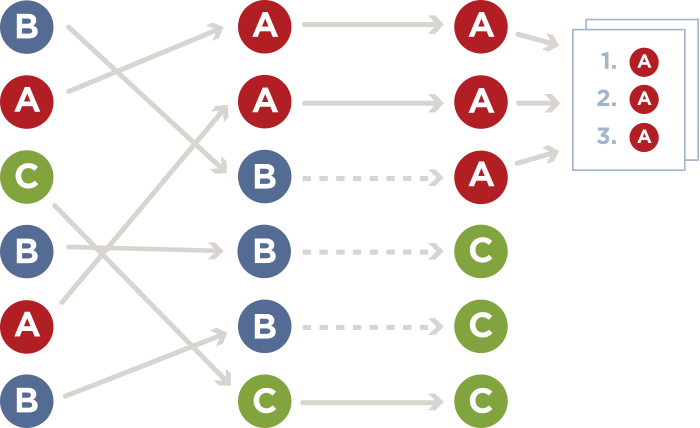
You can also review your list of goals and rank each as A-, B-, or C-level priority. You’ll use two criteria to rank a goal’s priority level:

  • Value: The benefits that achieving the goal would deliver for your group and/or organization.
  • Importance: The degree to which achievement of a particular goal would support your group’s or organization’s objectives.

EXAMPLE

Alicia's organization has just defined a strategy focused on entering several new geographic markets on an accelerated timeline. The goals she has been considering for her group include creating an overseas assignment program. Alicia gives this goal high priority because it supports a strategy that her organization wants to execute soon. EXAMPLE

With these criteria of value and importance in mind, follow these steps:

1. Look at each goal on your list and decide whether it’s A-, B-, or C-level priority.

  • Priority A goals have high value and primary importance.
  • Priority B goals have medium value and secondary importance.
  • Priority C goals have some value but not much importance right now.

2. Put Priority C goals aside for now, delegate them, or cross them off your list.

3. Look at your Priority B goals again. Reassign them as Priority A if you think they’re worth your time—and Priority C if they’re not. Disregard or delegate any goals you’ve just reassigned as Priority C.

4. Designate the goals that are now on your Priority A list as your top-priority goals.

5. Rank your Priority A goals according to their relative importance. Don’t assume that just because a goal is short term that it automatically has greater importance over a longer-term goal.

6. Write down your final Priority A list of goals, ranked by importance.

7. Commit to reviewing your list periodically to ensure that it still reflects your group’s and organization’s priorities.
Making room for new goals

Elizabeth Grace Saunders, "Before You Set New Goals, Think About What You’re Going to Stop Doing," Harvard Business Review, February 5, 2018
To free up time and energy for new goals you want to set, you may have to cut other activities from your schedule. For example: Question all your work commitments. Some tasks and projects may no longer be important, and you could remove them from your list of responsibilities. Others could be delegated to someone who’s just as qualified as you are to handle them—and who may appreciate the opportunity to build new skills or knowledge by taking on the delegated work. Still other projects could be postponed with no ill effects. Reassess your work style. If you initiate or attend too many long meetings or you let yourself get interrupted throughout the day, find ways to eliminate or minimize these time thieves. For instance, set standing one-on-one sessions where you make yourself fully available to your direct reports, and define other times when you’ll shut your door to all but truly urgent issues. Making room for new goals Elizabeth Grace Saunders, "Before You Set New Goals, Think About What You’re Going to Stop Doing," Harvard Business Review, February 5, 2018

Worksheet for Prioritizing Goals

附件:worksheet_for_prioritizing_goals(docx · 1128 KB,本地副本)

Align employee goals with unit and organizational goals

Each of your direct reports needs to set individual goals that support the group’s goals, which in turn support the organization’s goals. Your role is to help employees with this process. Each of them should be able to say:

“Our organization’s goal is to _____________. My department’s contribution to that goal is to _______________. And my part in this effort is to ____________.”

To provide this support:

  • Ensure that all team members are clear about the group’s goals, their individual roles, and your job expectations for each.
  • Ask them to draft or modify their individual goals and express them in clear terms.
  • Negotiate the details on commitments to particular goals, including your role in supporting them in achieving each goal.
  • Describe what team members are expected to do. Confirm that everyone knows who is responsible and accountable for each goal.
  • Tie performance evaluations to accomplishing goals.

Helping team members set individual goals

Give as much control and input as possible to your direct reports in developing their individual goals. Be especially sensitive to their suggestions on time frames. Give your employees adequate resources and authority to do the job. Encourage your employees to consider goals that require additional training. Follow through on providing training. Involve your employees in deciding how to recognize goal achievement. Helping team members set individual goals

Try it Out

Try it Out

Make a Connection

1. For any statements you didn't select, what will you do differently in the future to align employee goals with unit and organizational goals?

第 2 节

The most effective goals have several defining characteristics:

Worksheet for Setting Effective Goals

附件:Worksheet for Setting Effective Goals1752226942160.docx(docx · 986 KB,本地副本)

Challenging

Effective goals inspire you and your group to “stretch”—without making anyone feel overwhelmed or sapping their motivation.

EXAMPLE

Zoe, the customer services manager for an office cleaning company, has set a goal of sharply increasing customer satisfaction scores within a short time frame. To support this goal, she sets up a task force to come up with ways to better solicit and respond to customer feedback. She also works with the training department to design a new program that will familiarize all customer service representatives with industry best practices. EXAMPLE

Stretch goals can be characterized by:Sim B. Sitkin, C. Chet Miller, and Kelly E. See, "The Stretch Goal Paradox," Harvard Business Review, January-February, 2017

  • Extreme difficulty: They go beyond a group's or organization's current capabilities and performance.
  • Extreme novelty: They require brand-new approaches to achieve.

Even if they are a stretch, goals must be realistic. As you set challenging goals, make sure you have a solid plan and the resources needed for reaching them. If goals are unreasonable, failure to meet them could be demoralizing and frustrating for everyone involved. One study of stretch goals in organizations identified two factors that consistently seem correlated with success at reaching such goals:

  • Recent performance. If your group has just surpassed an important benchmark in its own history, it's better positioned to tackle a stretch goal. Why? Winning affects attitudes and behaviors positively. When facing an unusually challenging task, employees in a group that has had a recent major success will be more likely to see an opportunity, show optimism, and demonstrate flexibility as needed to score another success.
  • Surplus resources. If your group has more funds, knowledge, skills, expertise, people, equipment, and other resources than it needs, the extra resources can be used to experiment with new ways of doing things so as to achieve a stretch goal and to recover from any failures.

设定延伸目标的艺术 The Art of Stretch Targets

哈佛教授讲授视频逐字稿
When setting goals, stretch targets are seen as an important element of creating a high-performance culture. Stretch targets are targets or goals that are a stretch, slightly difficult to achieve. By setting these targets at a stretch, it causes employees and associates to think more creatively about how they will achieve them, to be energized, to be motivated, to move the organization forward. Setting stretch targets is an art. Stretch targets are a process. They emerge as a process of negotiation between the employee and the manager. The manager is trying to understand what are the possible objectives that the employee could achieve? The employee is a little hesitant to give a very high stretch target number because, naturally, it causes a little bit of anxiety about whether in fact this performance would be met. A lot of research shows that a little bit of anxiety is actually a good thing. It causes people to perform at a level that they might otherwise not have. We can probably relate to this as we often do when we are studying for an exam, for instance. It causes us to put in that little extra effort because we don't want to fail. On the other hand, stretch targets that are arbitrary, that are not the process of careful negotiation, that are not participative can be very difficult because they are often so badly stretched that employees do not have confidence that these are reasonable targets. If that were to happen, employees will not believe that these targets are achievable, and therefore are not motivated to achieve them. Stretch targets are an art. When done well, they create a lot of energy and momentum in an organization. And when done badly, they serve no purpose and do not achieve the goal of motivating employees and helping them achieve better performance, as they are designed to do.

Balanced

Some goals can be measured quantitatively; that is, by using numbers. Examples include increasing sales in a region by 10% in the next quarter, or lowering manufacturing costs by 20% within six months.

You may find it tempting to set mostly quantitative goals because they are easy to measure. But many important goals are qualitative—not so easy to express in numbers. Examples include employee morale, job satisfaction, and performance on skills such as making presentations.

Though it can seem difficult to measure how well a group has achieved its qualitative goals, be sure to include such goals as you go through the goal-setting process. When you do, think about how you might assess progress toward these harder-to-measure goals.

EXAMPLE

André wants to help his team members get better at presenting project updates to audiences outside the team. He encourages them to set a goal of conducting three such presentations in the next six months. André and his team then create a form for providing feedback on the presentations and assessing their effectiveness on specific criteria—such as accuracy, clarity of project information, and ability to answer questions from the audience. After each presentation, André and the team member who gave the presentation complete the form. André also discusses their progress in mastering presentation skills and explores ideas for how they might improve next time. EXAMPLE

Clearly expressed

Effective goals are expressed in clear, unmistakable terms. Such clarity encourages shared understanding of exactly what the group plans to accomplish. Clarity therefore strengthens the group's commitment to achieving the goal. It also reduces the chances of disagreement over whether the group has met the goal.

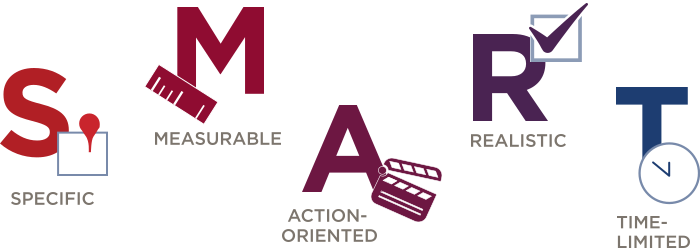
The “SMART” acronym can help you express your goals in clear language:

  • Specific. Clearly defines what will be accomplished.
  • Measurable. Gauges success using quantitative or qualitative measures.
  • Action-oriented. Can be attained through specific behaviors or processes.
  • Realistic. Can be achieved given existing constraints, such as time and resources.
  • Time-limited. Will be accomplished within a specific time frame.

However, keep in mind that the SMART test can't tell you whether the goal itself is a good idea. It's how you approach the process of identifying and prioritizing your goals that really helps you gauge which goals are worth pursuing.Dick Grote, "3 Popular Goal-Setting Techniques Managers Should Avoid," Harvard Business Review, January 2, 2017

Also, take care that the acronym doesn't tempt you or your team to set low goals. The best way to use the SMART acronym is to check whether the goals you create are clearly stated—not to determine which goals you should be focusing on.

以通俗易懂的语言表述目标 Setting Your Goals Without Jargon

哈佛教授讲授视频逐字稿
Most of the training that I'd had in my career as a measurement specialist was technical. It was about statistics and about graphing and about all the hard things to do with measurement. But I attended a training course at the recommendation of a colleague that had nothing to do with any of those sorts of things. And it really was a turning point in my approach to measurement. It was a course about personal development and achieving life goals and things like that. One of the techniques we learned was called “sensory-specific language.” Sensory-specific language consists of words that describe what we would see, what we would hear, what we would touch or taste or smell if something was happening. That language doesn't come naturally to us. And we can see it evident in business. We use management jargon. We don't use sensory language. We use words like efficient and effective, sustainable, reliable, quality, enhanced, engage, capable. There's gazillions of these words. None of them are sensory-specific. And when I look back at the goals that my clients always struggled to find meaningful measures for, they were filled with weasel words, filled with this vague language and no sensory language anywhere. So I thought, “Wow! Here's an opportunity to test, to see if we can find measures faster by changing the way we write our goals.” And that's what we started doing. So instead of a goal that would originally read, “We transform the performance of our customers,” we would have a conversation about that goal before we even thought to look for measures for it. And the conversation would be, “What do we mean by transform? What do we mean by performance?” We'd target the weasel words and try to describe them in sensory language. Well, to transform the performance of our customers, we might say, “What we really mean is that when our customers work with us, they can achieve their business targets much sooner or with much less money.” And that's a lot more tangible. It's very sensory-specific. And straightaway you can see how you can get to measuring that: “Well, what is the average time it takes for them to achieve that targets? What percentage of their targets do they achieve by the target dates they set?” When we use sensory words to express our goals, we feel so much more committed to them. We can really feel them. We can see them. We can visualize them in our minds so we know what they're going to look like when they're achieved. And then with the very powerful performance measures we can come up with for those goals, we can track our progress as we are achieving them, as we are pursuing them. And that just fuels the excitement. And it makes the achievement of goals much more fulfilling.

Worksheet for Writing SMART Goals

附件:worksheet_for_writing_SMART_goals(docx · 1007 KB,本地副本)

SMART GOALS

附件:SMART GOALS1752227300536.pdf(pdf · 123 KB,本地副本)

Try it Out

1. Which one of the following attributes is this objective missing?
答案与解析

A. Specific
Not the best choice. This objective clearly defines a specific percentage goal and geographic territory.

B. Realistic(正确)
Correct choice! This objective isn't realistic. Kwame's company has just entered an industry that requires significant infrastructure. His organization will need to build or acquire storage facilities. His company is unlikely to have the infrastructure necessary to win 70% of the U.S. market in one year.

C. Time-limited
Not the best choice. The objective clearly establishes a one-year deadline.

2. Which one of the following attributes is this objective missing?
答案与解析

A. Measurable
Not the best choice. Shannon will be able to measure whether forms have been completed by comparing them to cash register receipts for canceled orders or returned products.

B. Achievable
Not the best choice. Completing a form is achievable, well within the job description and abilities of sales staff.

C. Specific(正确)
Correct choice! Shannon's objective isn't specific. It doesn't state whom the sales staff should give the forms to or a deadline for receipt of the completed forms.

3. Which one of the following attributes is this objective missing?
答案与解析

A. Measurable(正确)
Correct choice! The objective isn't defined in a way that can be measured. Measures are usually either financial or in units of output.

B. Time-limited
Not the best choice. The objective includes a deadline.

C. Realistic
Not the best choice. It's likely that Neela's operations staff has resources with which to increase performance and that the objective is realistic.

第 3 节

As a manager, you're responsible for supporting your employee's professional and personal growth, as well as furthering your own. That calls for setting development goals. Such goals enable people to build their knowledge, skills, and effectiveness in their work, personal, and community lives.

When people set and achieve development goals, they grow in their professional and personal lives, becoming increasingly effective, increasingly satisfied by their achievements, and increasingly valuable to their organizations.

Help your employees set development goals

When you help your team members set professional and personal development goals, you make it clear that you care about what they want for themselves as well as how they can contribute even more to the organization. As a result, you:

  • Enhance their job satisfaction. You keep your people motivated and engaged.

  • Boost job performance. When team members learn new skills as part of their professional development, they can do their jobs more effectively and efficiently.

  • Reduce turnover. Talented and ambitious people are more likely to stay with the organization if they have opportunities to further their development. When you retain valuable employees, you build a stronger workforce for your organization. You also minimize the costs associated with recruiting and training replacements for employees who have left to find organizations that offer more developmental opportunities.

  • Increase innovation. When employees have opportunities to achieve personal development goals, they often bring fresh ideas into their work lives.

EXAMPLE

Maura manages a finance team in a large organization. During a casual discussion, she learns that Roberto, one of her team members, is interested in getting more involved in environmental responsibility efforts. Maura offers a few ideas for how he could work toward this goal. As a result, Roberto starts volunteering for a local group focused on the possibilities presented by solar energy. He uses knowledge gained from his volunteer work to make a compelling case for installing solar panels on several of the company's facilities. The company accepts Roberto's idea. It significantly reduces its energy expenses and wins kudos in the industry for its sustainable business practices. Roberto, meanwhile, feels even more satisfied with and stimulated by his work, and his commitment to the company is stronger than ever. EXAMPLE

find meaning at work

哈佛教授讲授视频逐字稿
I remember when I first became a CEO. My head of HR came in and asked me, “Why would anyone want to work here?” And we were going through some difficult times, and I thought, “Boy, that's a really good question that a CEO should be able to answer.” And as I stepped back and thought about that question, I realized that the underlying question was, “Where do people find meaning at work?” And the question, really, underneath that was, “Where do people find meaning in life?” Because people actually spend most of their life at work. So I happened to come across a book called “Man's Search for Meaning,” by Viktor Frankl, who was a concentration camp survivor, who wrote a very moving book about who fought to live, and why, in that incredibly difficult environment. And he had three observations that I took away from him. The first was that people fought to live because there was some important difference that they were meant to make in life, and that they were going to find a way to make that difference, one way or another. Another group of people fought to live because they had this sheer joy of life, enjoying each other, their family, their friends, sunshine, etc. And a third group fought to live for some principle, for some value, for some ideal worth fighting for. And so as I reflected about my role as a CEO, I came to the conclusion that if I could create an environment where all three of those things were true, I could, in fact, answer my head of HR's question and do it with some conviction. So we went about systematically trying to create actions that would bring each of those to life. So when it came to helping people see the difference they could make at work, we created very specific, powerful, high-level goals, and then found ways for every single employee to connect to those higher-level goals and see exactly how they connected. And then we rewarded and incented and did other things to help them feel that connection. The second thing we did, in terms of enjoying the journey, was that we made a real point to celebrate victories, to celebrate each other's anniversaries, to celebrate holidays. And so it was a real...trying to find joy in life at work, as well. And the third issue was in terms of values, and some principles. We had a very clear set of values. We shared it throughout the organization. We linked it to performance reviews. And people had a sense that it was real. It wasn't just lip sync. And by doing all of those three things together, we, in fact, were able to tap into a great degree of people's emotional and psychic energy. And so we got 100% of their contributions. And as a result of that, we were able to create both substantial economic value as well as social value.

Set development goals for yourself

Friedman, Stewart D. "Be a Better Leader, Have a Richer Life." Harvard Business Review April 1, 2008. Christensen, Clayton M. "How Will You Measure Your Life?" Harvard Business Review July 2010

When you set development goals for your work, personal, and community life, you achieve a healthy and balanced life and become more effective and satisfied in each of those domains. You also set an example for your direct reports, further encouraging them to set development goals for themselves.

Just as you support your employees in setting their development goals, you can work with your manager to set development goals for yourself. That includes building a shared understanding of the expected outcomes of achieving these goals and securing the support you need to attain them, such as training or new job experiences.

How do you set your professional development goals? Consider identifying unique skills, knowledge, and expertise that you bring to your group's efforts. Examples include:

  • Deploying specific skills, such as creating budgets or determining staffing needs.

  • Supporting team members' work, such as providing data to be included in proposals or coaching individuals on certain tasks.

  • Communicating your group's activities to the broader organization, such as securing resources that your group needs to accomplish its goals and integrating your group's goals with other groups' goals.

To set professional development goals, think about which of these skills or forms of expertise you'd like to strengthen, which new skills or expertise you'd like to gain, and how you might do so. Work with your own manager to craft plans for achieving these goals.

Use a similar process to set personal development goals. For example, ask yourself what you'd like to achieve with your family or friends, how you'd like to better manage your own health, or what skills or knowledge you might contribute to your community.

第 4 节

Test your understanding and reinforce what you’ve learned.

Try it Out

1. 1. As a new manager, you want to make a good impression and bring positive changes to your department. There is so much to accomplish, and you want to spend your time wisely. What is a good practice when setting your goals?
答案与解析

Brainstorm which goals you think you can accomplish most easily.
Don’t constrain your brainstorming by worrying about how you’d accomplish challenging goals—you'll have time to consider how realistic or achievable they might be later.

Keep your goals to yourself to avoid interference from others with competing priorities.
It’s better to build trust by being open about your plans and concerns. When you do, other managers are likely to be equally transparent with you.

Investigate what other departments are doing that could affect your goals.(正确)
It’s a good idea to learn what other groups are doing that will influence progress on your team’s goals—and find out how work toward your goals will affect other groups.

Prioritize your goals and work on all the short-term ones first.
Don’t let short-term goals automatically take precedence over long-term ones.

Try it Out

1. 2. Huma is drafting goals for her team at a small appliance manufacturer. As her supervisor, you told her to draft SMART goals. You see that only one of her goals fits that description. Which one is it?
答案与解析

“By next January, we will reduce costs by implementing time-saving assembly-line upgrades."
While the goal is Time-limited and Action-oriented and may be Realistic, it is too vague to be Specific or Measurable.

“We will work to significantly increase the number of coffee makers produced over the next year by scheduling one additional weekend shift.”
While the goal is Specific, Time-limited, Action-oriented, and may be Realistic, it is not Measurable.

“We will eliminate workplace accidents in six months' time by conducting safety training with all assembly line workers."
While the goal is Specific, Measurable, Action-oriented, and Time-limited, it is not Realistic.

“Over the next quarter, we will use statistical methods to reduce rejects from 15% to 10%.”(正确)
This goal is Specific (reduce error rates), Measurable (the percentage rate is specified), Action-oriented (the use of statistical methods), Realistic (the improvement rate is reasonable), and Time-limited (it will be accomplished in the next quarter).

第 5 节

Reflecting on your learning helps you apply relevant concepts to your job.

Take a Moment

1. 1. What new insights do you have that could benefit you or others in your workplace?
2. 2. What are your biggest opportunities for applying concepts from this Lesson in your workplace?

Further reading

你的战略规划目标是否定得过高,还是不够有挑战性?
你的战略规划应该有多大的雄心?如果目标定得太低,你可能会只是获得一些渐进式的提升;如果目标定得太高,则有可能让整个组织感…
新年新决心
涉及完成任务的策略时,我会做出不同尝试。2020 年,我短暂做过子弹笔记,开始但没完成的有《创意,是一笔灵魂交易》(Th…
成功的宗旨宣言有何不同
遗憾的是,在许多组织中,宗旨宣言往往只是空洞的口号。这些企业并未兑现宣言中那些崇高的承诺。但贝恩公司(Bain & Co…

Top 3 in the source platform's original order