
Why Set Goals? 查看中文版
第 1 节
What is goal setting?

Goal setting is a process through which you define targets that create value for yourself, your team, or your organization. When you set goals, you commit to accomplishing certain outcomes—and make a plan for doing so.
Setting and accomplishing goals is an important personal and organizational skill. By learning how to establish clear goals, and then having the discipline to reach them, you help to instill a culture of achievement within your team and organization.
Make a Connection
第 2 节
Why goals matter
Goals are crucial to personal and professional success. In contrast to New Year’s resolutions—which seldom include a plan for how to accomplish them—goals give a sense of purpose to your activities. They also make you accountable for certain outcomes.
Through goal setting, you and your team decide where you want to go and what you need to do to get there. When you work with your direct reports to define specific, challenging goals, you help yourself and them achieve high levels of performance.
Setting goals drives performance and boosts motivation in you and your team in several specific ways:Jeff Boss, "5 Reasons Why Goal Setting Will Improve Your Focus," Forbes, January 19, 2017
- Goals motivate behavior change. When you define a clear and compelling goal, you feel motivated to adopt the new behaviors required to reach it.
- Goals provide direction. When you set a goal, you naturally direct your attention toward the next step you’ll be taking. Consequently, you mentally lead yourself in the right direction—and your actions follow your thoughts.
- Goals sustain momentum. When you make progress toward reaching a goal, it feels rewarding. That feeling releases a brain chemical called dopamine, which elevates your mood and energy—and can be addictive.
- Goals generate feedback. When you change your behavior while trying to reach a goal you’ve defined, you get feedback showing that you’re making progress toward the goal—or not. You can use that feedback to make midcourse corrections as needed.
- Goals build character. The process of defining your goals helps you gain insight into what’s truly important to you. And as you achieve your goals, you boost your efficacy, which in turn builds character.
目标促进个人和职业发展 The Importance of Setting Goals
哈佛教授讲授视频逐字稿
Try it Out
Make a Connection
第 3 节
Types of goals
As a manager, you play a role in setting many types of goals:
Organization-focused goals
Organization-focused goals define what will be done to bring value to the unit and organization. They include:
-
Unit goals: What your group as a whole will try to accomplish.
EXAMPLE
- Individual goals: How each employee will contribute to achieving the unit goals.
EXAMPLE
Personal development goals
To grow as individuals, you and each of your employees need to set personal development goals. These goals can relate to your personal life as well as your professional life.
EXAMPLE
EXAMPLE
Short- and long-term goals
Different goals have different time frames. Some goals you aim to achieve within one or two months; others, in many more months or even years. Often, achieving short-term goals can help you score small wins that energize and encourage you to work toward a more ambitious, long-term goal.
EXAMPLE
Visionary goals
第 4 节
Goal alignment
When individual, unit, and organizational goals are aligned, they support one another rather than work at cross-purposes. Goal alignment helps an organization execute its strategies and reap the business value those strategies promise—such as increased market leadership, innovation, or profitability.
EXAMPLE
In many large organizations, the high-level corporate strategy is influenced by ideas and knowledge flowing up from lower levels. Through their everyday work, managers on the front lines learn about changes in customer needs, technology, and competitors’ moves. They share their knowledge with each other and with higher-level executives. Information from all levels in the organization thus contribute to shaping the organization’s strategy.
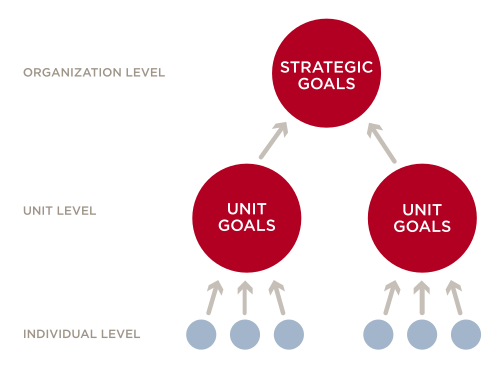
Once managers and employees at all levels understand what the high-level strategy is, they can define goals supporting that strategy. What’s more, individuals and units can explore how the goals they’re setting affect one another, so they can help each other achieve the goals. Understanding such interdependencies is vital. For instance, what information will one unit need from another unit to attain its newly defined goal? What tasks will one unit have to perform for another?
Every employee needs to understand how their work-related goals support the unit's goals, and how achievement of the unit’s goals will help the organization reach its strategic objectives.
成功人士如何实现目标 How Successful People Reach Their Goals
哈佛教授讲授视频逐字稿
Poll
第 5 节
REFLECT
Reflecting on your learning helps you apply relevant concepts to your job.