
Build Your Team's Financial Intelligence 查看中文版
第 1 节
Members of your team can make smarter decisions if they know something about the financial implications of what they do every day. For instance:
-
Should they rework a damaged part—or use a new one?
-
Should they work fast to get as much done as possible—or work more deliberately to make fewer mistakes?
-
Should they spend their time developing new services—or cultivating and serving existing customers?
Some level of financial literacy can also help your people understand the logic behind the goals set for them. For instance, your employees would understand that they have different goals for this quarter not because some executive randomly picked those goals—but because the company's financial situation has changed.
If employees know the reason for changes in goals, they'll likely be willing to adapt to the new situation. If they don't understand the reason, they may wonder if management really knows what it's doing.
破除恐惧才能收获成长 Face Your Fear
哈佛教授讲授视频逐字稿
Poll
Make a Connection
第 2 节
To foster financial literacy in your employees, you need to weave it into the culture of your team. Sponsoring a one-time workshop or handing out an instruction booklet won’t be enough.
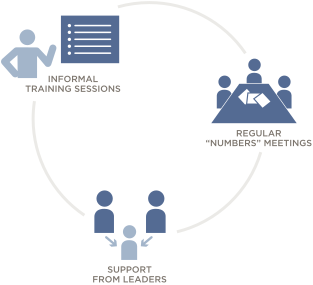
Three strategies—applied on a regular basis—can help you build your people’s financial intelligence:
-
Informal training sessions
-
Regular “numbers” meetings
- Support from leaders
Informal training sessions
Put together three short, informal training sessions. They don’t have to be elaborate: even a PowerPoint presentation with some handouts works fine. Make each session 30-60 minutes long. Focus on one financial concept per session, depending on your situation and what’s most relevant to your team’s work.
案例
Offer these classes on a regular basis, such as monthly or quarterly. Let people attend two or three times if they want. It often takes that long for people to grasp the key concepts. Encourage 100 percent attendance among your direct reports.
Eventually, ask some of your employees to teach the class. That’s a good way for them to learn the material. Plus, their teaching styles might be different enough from yours that they’ll be able to reach people whom you can’t.
Regular “numbers” meetings
What are the two or three numbers that measure your group's performance week after week and month after month? Sales? Correct shipments? Hours billed? New customers acquired?
Those numbers probably relate in some way to your organization's financial statements. Thus they ultimately affect the company's results.
So start sharing those numbers with your team in regular meetings, including tracking the trend lines over time. Explain to your employees:
-
Where the numbers come from
-
Why they're important
-
How everybody on the team affects them
Sharing the numbers with the team gets people invested in their work. They can see the connection between their efforts and business results. Soon people will start talking about the numbers themselves. And they'll figure out ways to meet or exceed them.
When you see this happening, take it to the next level—by working with your team to forecast where the numbers will be in the coming month or quarter. Once people help develop a forecast, they feel a sense of ownership of that number. And they work hard to meet or exceed their forecast.
Support from leaders
Your financial training initiatives will likely require support from the top. The stronger that support, the more people throughout the organization will commit to the idea.
In fact, organizations that get the greatest impact from financial intelligence training are often those where C-suite executives believe it's essential. Those companies educate people year after year. And some individuals take the classes every year as a refresher. Some organizations even add new classes to advance their leaders' and managers' knowledge.
Support from the top also encourages others in the organization to contribute to financial training initiatives. With C-suite support, people in your organization's finance department can help you and other managers develop financial intelligence workshops tailored to your group's needs.
38%.That's the dismal average score of U.S. managers on a financial literacy test.
38%.That's the dismal average score of U.S. managers on a financial literacy test.http://hbr.org/2009/10/are-your-people-financially-literate/ar/1
38%. That's the dismal average score of U.S. managers on a financial literacy test.http://hbr.org/2009/10/are-your-people-financially-literate/ar/1Try it Out
Take Action
第 3 节
Studies demonstrate a strong connection between an organization's performance and employees' understanding of what drives business results. How well does your group understand how their actions drive business results? To build your team’s financial literacy, consider discussing important numbers with your team in regular meetings. Use the questions and suggestions below to think through the discussion you would have with your team.
1. What are the two or three numbers that measure your group's performance week after week? For example, the numbers could be sales, correct shipments, hours billed, or new customers acquired.
2. Where do these numbers come from? For example, they might come from quarterly reports. Or from a team "dashboard" that is updated monthly.
3. Where do these numbers come from? For example, they might come from quarterly reports. Or from a team "dashboard" that is updated monthly.
4. How does each member of the team influence these numbers? For example, discuss how the daily tasks of individual team members have a direct impact on the combined team numbers.
5. When can you regularly share results and talk about numbers with your team? For example, at regular team meetings? Or—to emphasize the importance of the information—at special and regular "numbers" meetings.
5. How might you enlist the support of senior management? For example, you might invite senior managers to attend "numbers" meetings to share financial information with your team.
第 4 节
Reflecting on your learning helps you apply relevant concepts to your job.