Pocket Leadership口袋领导力

Finance Essentials

Track Financial Performance 查看中文版

第 1 节

When you evaluate a new investment, you're planning for the long term—typically a year or more. But in the real world, things change and plans go awry. And estimates can quickly become obsolete.

So you need to track your projections about the investment's revenues and expenses and compare your projections to actual revenues and expenses. It's a good idea to do this every month, so you can spot potential problems early on.

If your investment isn't tracking according to budget, and if it looks like the pattern of unexpectedly high costs (or unexpectedly low revenues) is going to hold, you may need to rethink the initiative—or even discontinue it.

案例

Consider the projections for a new line of serving carts launched at Kitchen Storage Solutions. Management ended up using Theodore’s optimistic profit projections. Here’s where things stand early in the first quarter:
Item Budget: January Actual: January Variance ( ) = unfavorable Serving cart revenues $39,000 $38,725 $(275) Cost of goods sold $19,500 $19,200 $300 Gross profit $19,500 $19,525 $25 Marketing $8,500 $10,100 $(1,600) Administrative expense $4,750 $4,320 $430 Total operating expense $13,250 $14,420 $(1,170) Operating profit $6,250 $5,105 $(1,145)

The new line is doing reasonably well in terms of revenues and cost of goods sold. The only really large negative variance is in the marketing expense line. If managers look at just the first month's figures, it's hard to know if this is just a one-time variation, or if KSS is going to have to spend more on marketing than Theodore had anticipated.

After further investigation, managers determine that the higher-than-expected marketing costs will continue. They conclude that Theodore's prediction about the serving carts “selling themselves” will not be borne out.

However, the revised forecast confirms Sherman's estimates about marketing costs and an annual profit stream of $60,000. The new line of serving carts still seems to be economically viable. But it's not the huge success that Theodore anticipated.

第 2 节

Once you get your operating budget for your group approved, it’s important to track what actually happens in your group against what you anticipated in your budget. Budget reviews give you the opportunity to compare estimates to actual results, to investigate reasons for any differences, to solicit feedback from management, and to revise estimates.
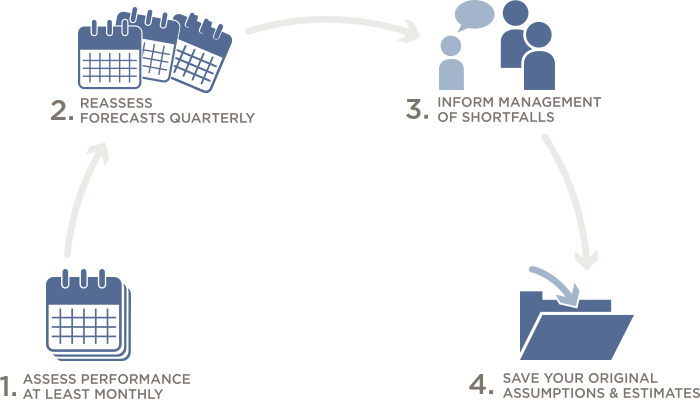
To track your budget:

  1. Assess performance at least monthly. Pay special attention to large positive and negative variances. Figure out what's causing them. Is it a matter of timing—a cost or expense not having been booked at the time the budget update was prepared? Or is it a seasonal or one-time variation? If it's one of these, you probably don't need to change anything. But keep monitoring such variances regularly over subsequent months to make sure that they do indeed diminish. If it's not a matter of timing or some one-time aberration, you probably need to modify your assumptions.

  2. Reassess forecasts quarterly. Budgets are made annually, but estimates are often inaccurate. It's not unusual to be off base with your estimates from time to time. Reassessing quarterly is a good way to check your forecasts against reality. Updating your forecasts regularly ensures that you and senior management always have the latest and most accurate information to base decisions on.

  3. If it doesn't look like you're going to make your annual budget goals, inform senior management. That way, they can adjust the overall company budget accordingly. They may also advise you on whether and how to address the shortfalls. Also inform senior management if your group’s performance is turning out better than expected. Typically, your organization will hold regular budget review sessions. Still, if you know that things are looking markedly different from how they were budgeted, don't wait for the review session to let senior management know.

  4. Save your original budget assumptions and estimates. They'll help you improve your forecasting ability for next year’s round of budgeting.

Your company may already have in place a rolling forecast or budgeting process, in which it updates budgets with actual figures on an ongoing basis.

从数字中挖掘效率提升的机会 Create Efficiencies

哈佛教授讲授视频逐字稿
Being a finance manager, you always have to look at numbers. Numbers can give you information on many things, things that sometimes you don't realize that are going on, but by looking at the numbers you can fix a problem or a situation. I was checking out [the activities of] all the workers—they fill out the paperwork every day to track what they have done—and I was noticing that we had huge amount of hours that were spent cleaning; people cleaning the area where they work, because some factories have furniture, others have metal, so things have to be kept quite clean. When we looked up the numbers, we realized that, but before—just looking at the workplace—nobody had noticed it. We decided that instead of having the people cleaning the workplace, we would hire two people to do that all day long. That way we saved such a great amount of money just taking off their task of cleaning their work area. And that was a good contribution to the company's finances and economy, which nobody had really noticed because everybody was really busy just doing what they wanted to do and not taking a look at the numbers to see what was going on.

Annual Budgeting and Tracking Worksheet

附件:Annual Budgeting and Tracking Worksheet1749545738728.xls(xls · 417 KB,本地副本)

Poll

Poll

Try it Out

Try it Out

Make a Connection

1. What additional steps can you take to regularly monitor your group's operating budget and communicate your findings to others in the organization?

第 3 节

If the surprises in your budget are in fact a short-term aberration, don't be too concerned—the situation could straighten itself out. Nevertheless, keep a close eye on those particular line items during subsequent monthly comparisons of your budgeted figures against actual figures.

But if the cause of the variance is not an aberration, reexamine your assumptions and adjust your budget accordingly. Try to uncover what other reasons may lie beneath your faulty projections.

案例

It turns out that expenses for the current quarter are higher than you budgeted because sales have increased sharply. In this case, expense overruns are good news rather than bad. But what if the expense increase is due to an unexpected and sizeable hike in fuel costs? Cost increases will hit your budget directly and indirectly: directly, in the form of heightened travel costs for your sales team and higher shipping costs for your finished goods; and indirectly, in the manufacturing and shipping costs of all the raw materials that go into making your products.

In many cases, you'll have to find some way to make up an unexpected jump in expenses or drop in anticipated revenues. Perhaps you can reallocate money from other line items to compensate for line items that went over budget.

In any case, having accurate records and transparent assumptions will help you and your managers make more informed financial decisions, whether about ongoing operating costs or an investment.

追踪和编制预算时要保持坦诚 Use Bad News to Your Advantage

哈佛教授讲授视频逐字稿
Let me tell you the story of a pharmaceutical generics manufacturer that was forecasting sales. One of the sales managers forecast a sales growth of 25% from the previous year. This was terrific news, the senior management was ecstatic, they loved it. What this manager did not share with the senior management was that one of their main competitors had their factory shut down by the FDA because they failed an audit. And if they had known this key piece of information, they would have budgeted a sales growth of not 25% but 100%. They had the opportunity to literally double their sales because a key competitor was out of business because the FDA shut down their plant. Now, it is not just the lost opportunity for that one year. They had another bigger opportunity that they lost. They could have cemented their relationship with a key customer for having come through when one of their main competitors had let the customer down. This lost opportunity to cement a relationship with a big retailer for many, many years to come was the biggest loss as a result of this sandbagging activity by this manager who did not share this key piece of information about the competitor's factories being closed for one year's time. Similarly, on the other end of the spectrum, there are situations where managers incubate, or sit on, bad news and are not willing to share it with the senior executives in the budgeting process. Let me give you an example where a manager is looking around the table and all the other divisions are forecasting sales growth of 10% to 15%. This manager knows that they are in the process of losing a key account and their sales will actually probably decline by 20% until they find a replacement for this key account. But not wanting to lose face in the company of his colleagues, he says, "Oh, we can probably also manage a 10% to 15% sales." And that's what the organization uses in the budgeting process. Six months into the year, they realize that they're not going to make the 10% to 15% sales growth, but in fact, revenues are declining. But the organization could have responded very differently if they knew this right from the beginning. They could have increased their marketing campaign, they could have found revenue sources in other divisions, other geographies. But all those opportunities were lost because this manager was not willing to share this bad news early enough. So in both these examples, we learn lessons about human failings. And the lessons are really the same. You should be forthright in the budgeting process and neither selectively reveal good news or selectively hide bad news. And it's not just the performance of the organization that suffers. The reputation of the managers suffers, and this takes much longer to recover. So, as young managers, I'd highly recommend that to be forthright in the budgeting process for the good of the organization and for the good of your own careers.

Take Action

1. What action will you take next to help track your team's financial performance and address any problems?

第 4 节

You need to track the financial performance of all your efforts and address any problems. How well do you track the operating budget you create for your group?

2 Improvements

Select two items above for which you answered NO. What specific measures could you take to improve how you track your budget?

1.
2.

第 5 节

Reflecting on your learning helps you apply relevant concepts to your job.

Take a Moment

1. 1. What new insights do you have that could benefit you or others in your workplace?
2. 2. What are your biggest opportunities for applying concepts from this Lesson in your workplace?

Further reading

实现 ESG 目标,挂钩财务业绩至关重要
近年来,对于衡量公司在环境、社会和治理(ESG)标准上表现如何的指标,在对其进行标准化和量化方面已经取得了巨大的进展。对…
为何我们需要更新财务报表以适应数字化时代
现在,苹果(Apple)、Alphabet(谷歌母公司)、亚马逊(Amazon)和微软(Microsoft)这四家企业的…
如何战略性地削减成本
我们都经历过迫在眉睫的成本削减项目。对许多人来说,这不是一个美好的回忆。 在过去十几年,企业采取了多少削减成本的举措?…

Top 3 in the source platform's original order