
Develop a Budget 查看中文版
第 1 节
A budget is the financial blueprint or action plan for an organization, division, business unit, or department. It translates strategic plans into measurable expenditures and anticipated returns over a period of time.
Organizations use different types of budgets for different purposes:
-
An operating budget reflects day-to-day expenses and depreciation (the current portion of capitalized expenses). It typically covers a one-year period. Department, division, and unit managers are usually asked to develop an operating budget for their part of the business.
-
A capital budget shows the planned outlays for investments in plant, equipment, and product development. It typically covers longer periods—3, 5, or 10 years. Managers throughout an organization may be expected to prepare or contribute to this type of budget.
-
A cash budget addresses expected cash flows during the given forecast period, based on information from the operating and capital budgets. The company’s finance department typically prepares this. This type of budget is essential for ensuring the company has enough cash and credit (liquidity) to meets its expected cash outlays.
This topic focuses on the operating budget, since it affects managers the most.
The operating budget captures how an organization plans to carry out its overall strategy day to day. So to create a useful operating budget, you need to understand that strategy.
If your company is among those that communicate their strategy, you’ll know what objectives, initiatives, and activities executives have planned to serve that strategy. If not, you’ll need to learn about your organization’s strategy and how it affects your unit.
To gain insights into your organization’s strategy:
-
Talk with your boss and peer managers.
-
Examine the company’s annual reports and other publications.
-
Pay close attention to announcements from top executives.
5
第 2 节
Budgeting involves a number of activities, including:
-
Forecasting future business results, such as sales volume, revenues, capital investments, and expenses
-
Reconciling those forecasts to organizational goals and financial constraints
-
Obtaining organizational support for the proposed budget
-
Managing subsequent business activities to achieve budgeted results
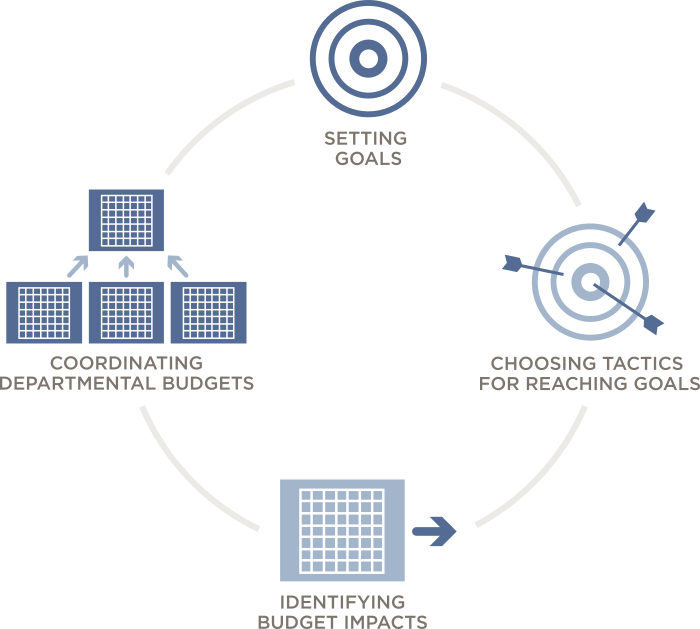
There are four key activities in the budgeting process:
-
Setting goals. Some organizations mandate overarching goals, such as "Increase net profits by 10% during the next year." Individual departments then translate these directives into financial goals in their budgets.
案例
- Choosing tactics for reaching these goals. Consider which tactics will most likely help you reach each goal—tactics that will also be supported across the organization.
案例
- Identifying budget impacts. You use your decisions about strategic goals and tactics to develop assumptions about future costs and revenues.
案例
- Coordinating departmental budgets. Individual unit and division budgets are combined into a single master budget. The master budget expresses the organization's overall financial objectives and strategic goals.
Make a Connection
第 3 节
There are two basic approaches to budgeting:
-
Top-down budgeting
-
Bottom-up budgeting
The approach that an organization takes often depends on how explicitly it defines and manages its strategy.
Top-down budgeting
If your organization does top-down budgeting, senior management sets specific objectives for such things as net income, profit margins, and expenses. Companies that cascade their strategy down throughout the organization are more likely to use top-down budgeting. That’s because they’ve defined the strategic objectives that must be funded to carry out the strategy.
案例
If such financial objectives are explicitly linked with the corporate-level strategy, then each unit or department may have also already identified its own strategic objectives that align with the overall strategy. In that case, developing a departmental budget will be easier. That’s because there’s already a strategic blueprint in place to guide it.
What if your organization does top-down budgeting but doesn’t articulate or document a strategy for the entire organization? You can talk with your boss to learn more about the strategy. In addition, look at your organization’s overall plans for sales and marketing, as well as its cost and expense plans. These will reveal the corporate-level strategic objectives, which in turn will help you create your budget.
Poll
Bottom-up budgeting
With bottom-up budgeting, senior executives don’t give managers specific targets. Instead, managers develop budgets they think will best support their department’s goals.
These budgets are then "rolled up" to create an overall company budget. The finance department incorporates departments’ proposed budgets into the preliminary corporate-level budget, sending requests for adjustments back down to the individual departments. Department heads who disagree with these high-level requests must then negotiate to get approval for any changes that were initially rejected. The organization’s budget committee—generally the top managers and the CFO—have final say.
Since budgets are finite, managers often compete for resources. If you know that your request for money was rejected to free up more money for another department’s initiative, you may need to work closely with your peer manager to see if you can negotiate more resources. Some deal making may be required.
4
第 4 节
To prepare a budget, you:
-
Set goals
- Define budget scope
Set goals
As a manager, you’re expected to put together a budget for your department each year. Your compensation may depend in part on your ability to stick to that budget. So you’ll want to be realistic about your goals.
Start by listing a handful of goals you'd like to achieve, with specific milestones such as:
-
Increase gross sales by 5% by June 30
-
Decrease administrative costs by 3% by the end of the fiscal year
-
Reduce inventories by 2% by the end of the quarter
Your budget—including all the numbers—will become your plan for achieving these goals.
Define budget scope
Know the scope of the budget you're supposed to produce. Scope implies two things: the part of the organization the budget covers, and the level of detail the budget includes.
- When your group is small. The smaller the part of the organization you oversee, the more detail you need.
案例
- When your group is large. If you move up the organizational ladder and start overseeing a larger part of the organization, your budget scope broadens.
案例
Here are two other issues to consider when you’re determining the scope of your budget:
-
Term. Is the budget just for the current or forthcoming year, or the next five years? Most budgets are for the upcoming year, with quarterly or monthly reviews.
-
Overview. Does your budget need to be accompanied by an overview of your strategic plan for your group? If so, be prepared to defend your plan.
第 5 节
A budget takes current data, adds assumptions, and creates projections. So take a hard look at your assumptions for your budget for the coming year.
案例
In articulating your assumptions, start by asking yourself what events you want to see happen over the time frame covered by your budget. Then identify the revenues and expenses associated with each.
1
Answers to many other questions will influence the assumptions affecting your budget. Examples of such questions include:
-
Will you keep prices the same, lower them, or raise them? Higher prices could compensate for fewer sales, assuming they don’t depress sales even further by turning customers away.
-
Do you plan to enter new markets, target new customers, or use new sales strategies? How much additional revenue do you expect these efforts to bring in? How much will these initiatives cost?
-
Will your salary expenses change? For example, do you plan to cut down on temporary help and replace these resources with full-time employees? Will you reduce salary costs by automating some processes? If so, how much will automating cost?
-
Will your suppliers likely raise or lower prices? Are you planning to switch to lower-cost suppliers? Will there be a drop-off in quality of supplies? If so, how will it affect your sales?
-
Will your product have to be enhanced to keep your current customers?
-
Will your staff need training?
- Are there other special projects or initiatives you’re planning to pursue that would require additional resources?
确保预算假设的合理可行 Realistic Budgets
哈佛教授讲授视频逐字稿
第 6 节
Translate each of your assumptions into monetary figures.
案例
Some costs and revenues can be hard to project because of all the variables and options involved. These would include such things as global marketing costs and online sales to a new market segment. Your colleagues and direct reports might have valuable experience in these areas, so get their suggestions. Also, trade publications and industry association websites can provide industry averages for a range of costs.
Once you've translated your budget assumptions into numbers, incorporate those numbers into budget line items. Your budget will be compared with and combined with others. So your company will probably provide you with a standard set of line items to use.
In some cases, your quantified assumptions will comprise the entire line item.
案例
In other cases, your quantified assumptions will be incremental.
案例
第 7 节
As you put your budget into its required format, document your assumptions. It's easy to lose track of them when you’re translating assumptions into monetary amounts. You’ll want to be able to explain your assumptions easily to those reviewing your budget—and change them if necessary.
After compiling your budget, look it over. Ask yourself if it supports your group’s goals. It's all too easy to overlook your overall goals as you get into the line-by-line detail of your budget.
Also ask yourself if your budget is defensible. You may be perfectly happy with it, but not everyone else on the budget committee may be. Reexamine your assumptions, with an eye toward how you might defend them.
案例
Try it Out
第 8 节
The easiest way to get started with a budget is to take a look at your group’s most recent budget.
The head of Kitchen Storage Solutions’ hanging rack division does this. She looks at last year’s budget—and explores opportunities for budgeting differently this year. See her notes in the division budget shown below.
Take Action
第 9 节
A budget takes current data, adds assumptions, and creates projections. To make sure your budget is as realistic and accurate as possible, you need to take a hard look at your assumptions. Use this activity to challenge your assumptions for your current or upcoming budget. For the purpose of this exercise, tackle only two assumptions.
Think about your current or upcoming budget. Think about which parts of that budget depend on assumptions you have made. Below, describe two assumptions that you have made. For example, your budget might have a number of assumptions about expenses. Or you may have predicted that sales will rise 10% in the coming year.
1. Assumption #1:
Articulate your assumption:
What is an event you want to see happen over the time frame covered by your budget that will help you achieve your group’s goals? What are the revenues and expenses associated with this event? For example, if you want a 10% increase in sales (the event), what additional sales and marketing costs, or new hires, might be associated with this goal?
Quantify this assumption:
Translate your assumption into monetary terms. What are the specific revenues and costs associated with the event? How might you verify your projections by consulting colleagues or trade publications? For example, for a sales goal, what training costs might you incur? What would it cost to train one salesperson? How many salespeople need to be trained to achieve your goal?
Defend this assumption:
When you present your budget to senior management, how will you defend your assumptions and numbers? Can you document your assumptions? What questions might you anticipate? How can you answer them? For example, if the sales increase the previous year was only 5%, how can you defend a projection of 10%?
2. Assumption #2:
Articulate your assumption:
Quantify this assumption:
Defend this assumption:
第 10 节
Reflecting on your learning helps you apply relevant concepts to your job.