
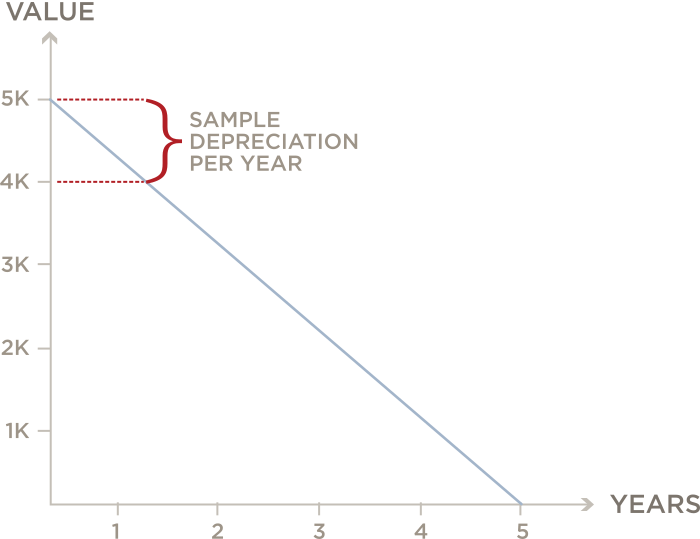
Most capital investments other than land are depreciated: Accountants try to spread the cost of the expenditure over the useful life of the item.
Understand Financial Statements 查看中文版
第 1 节
Why financial intelligence matters
If you work at a for-profit company, your job is to help the company make money—preferably, more money each year. If you work for a nonprofit or a government agency, it's still vital that you monitor how much money comes into the organization and where it gets spent.
You can help your organization make money and spend it wisely by reducing costs, increasing revenues, or both. But to do that, you need to strengthen your financial intelligence. And that starts with understanding the basic tools organizations use to depict their financial condition: financial statements.
When you understand your organization's financial statements, you find answers to questions like:
-
Does my employer have enough cash to make payroll?
-
How profitable are the products or services I work on?
-
Will a proposed capital expenditure—an investment in property, plant, or equipment— generate the intended returns?
- Is my company manipulating financial performance data to look like it's doing better than it really is?
6
A big telecommunications company has an ongoing strategy to grow through acquisitions. But it’s not generating enough cash for the acquisitions it wants to make. So it uses stock as its currency and pays for the businesses it acquires partly with company shares. That means it has to keep its share price high. Otherwise, the acquisitions would be too expensive. And to keep its share price high, it must keep its profits high.
The company has also paid for the acquisitions by borrowing from banks. This is another reason to keep its profits up; otherwise, the banks will stop lending it money.
Severe pressure to report high profits compels the company to resort to fraud. It artificially boosts profits through accounting tricks like understating expenses and treating operating costs as capital expenditures. When analysts, investors, and regulators learn that the business isn’t as profitable as it has claimed, the whole scheme collapses. But even if the company hadn’t resorted to fraud, its ability to generate cash was out of step with its growth-by-acquisitions strategy. It could live on borrowing and using stock as a currency for a while—but not forever.Berman, Karen, and Joe Knight, with John Case. Financial Intelligence: A Manager’s Guide to Knowing What the Numbers Really Mean, rev. ed. Boston: Harvard Business Review Press, 2013: 18-19.
6
把专业知识与财务知识结合起来 Tackle Finance with Curiosity
哈佛教授讲授视频逐字稿
I think many people find finance very inaccessible and, frankly, very intimidating. And it's for good reason. I think numbers hurt that. I think people in finance like to try to intimidate other people. And I see people in my classroom who are intimidated. And I see people from finance who are trying to intimidate them.
And I think what I've learned over the years is that finance is fundamentally very accessible and very intuitive. You just have to disabuse yourself of that idea that you can't do these things.
My favorite example of this relates to my father, who spent his career in the pharmaceutical industry and fundamentally on the marketing side—never touched finance—and loved it. He really believed in the pharmaceutical industry. And he loved the process of selling and marketing life-saving drugs.
In his late 50s, he began a second career. He became an equity research analyst. And it was wonderful to see that transformation. He was hired because he had deep knowledge about drugs and the approval process and what drugs would be successful. But he had to marry that with financial knowledge to make predictions about stocks. And what was wonderful to see is how he approached it almost like a child and just wanting to learn.
We would have long conversations talking about finance. And it was wonderful. He would ask me questions, simple questions like, “What is goodwill?” And we would talk about it for a long time. He would ask, “How do you think about whether R&D is productive? And is it a good investment?” Questions that he had kind of seen from the inside, but never thought about from a financial perspective.
He grew enormously during that time. Of course, he had all the knowledge he needed—he just needed the confidence and time to invest in the material. And ultimately, he became a very successful equity research analyst because he put aside that fear. He put aside that sense of “I don't think I can do this,” which I see in so many people in my classroom. He was able to conquer that.
And that, I think, is the combination that I wish for many people, which is take your specific domain knowledge, take your functional expertise outside of finance, marry that with an open mind to finance, and you will find a world that will reward you, a world of ideas that will reward you. But you have to invest. And you have to actually be courageous to get over that fear. But ultimately, that combination that I saw in my father and I see in my students is, I think, a really a rewarding one, and one that can propel you in your career beyond specific silos into the real fundamental role of a general manager.
第 2 节
Accounting methods
Before you can understand the financial statements your organization uses, you need to understand the accounting methods companies use. But this and other aspects of financial intelligence are hard to talk about without examples and data.
So, throughout this topic, the Kitchen Storage Solutions (KSS) case will be used to illustrate financial concepts. KSS manufactures hanging racks for pots and pans, spice racks, and racks for storing kitchen tools. It sells mostly to retailers but also directly to some other companies, such as custom kitchen design firms.
There are two accounting methods that are important to know about:
-
Accrual accounting
- Cash-basis accounting
Accrual accounting
Most companies use accrual accounting. Income and expenses are booked when they’re incurred, regardless of when payment from customers has actually been received or suppliers’ invoices have actually been paid.
案例
At KSS, the revenue for a customer order is booked as each rack ships—not when the customer pays for the order. Similarly, if KSS receives 2,000 brass hooks from a supplier, those hooks are not all expensed at once. Rather, they are expensed on a per-unit basis, as each rack made with hooks is shipped out to a customer.
With accrual accounting:
-
Revenues are recognized during the period in which the sales activity occurred.
- Expenses are recognized in the same period as their associated revenues.
Cash accounting
Some companies, usually very small ones, start out using cash accounting. With this method, a company records transactions when cash actually changes hands.
This practice is less conservative when it comes to recognizing expenses. That is, more items can be counted as expenses than under accrual accounting. But cash accounting can be more conservative than accrual accounting when it comes to recognizing revenue. The differences in expense and revenue recognition between the two methods have tax implications.
As companies grow in size and complexity, it becomes more important to match revenues and expenses in the appropriate time periods. So companies tend to switch from cash accounting to accrual accounting.
That’s because accrual accounting records revenues and expenses in the same time period based on their causal relationships. This enables managers to measure the business’s performance without including mistimed transactions that distort the reported figures.
案例
A business that uses cash accounting spends $20,000 to make products intended for sale. The entire sum is recorded as a one-time expense once the cash changes hands to pay for the production of the products, even if the products are sold piecemeal across eight subsequent months. If the business used accrual accounting, it would account for the initial production as an exchange of cash for products intended for sale. It would then treat acquisition costs as expenses as each unit is sold and the deduction is made from the asset account.Li, Alan. “Cash vs. Accrual for Large Companies.” Houston Chronicle Small Business. http://smallbusiness.chron.com/cash-vs-accrual-large-companies-25125.html
现金才是王道——请勿轻易支出 Cash Is King—Don't Give It Away
哈佛教授讲授视频逐字稿
The business headlines are full of stories about once-promising companies that simply ran out of cash. Despite innovative products and compelling service offerings, they fell into a common trap—sudden success, rapid expansion, and then total disaster. I saw this happen many times in my years as a strategy consultant and executive. And now, as an adjunct professor and author, it's something I warn students about. A surprising number of business failures are not the result of a lack of good ideas, loyal customers, or talented employees. They're often simply due to ineffective cash management. Successful companies avoid this unsustainable growth trap by focusing on four fundamentals.
First, understand how operating costs and working capital requirements change as your business grows. Rapid growth stresses margins as you try to keep your customers happy with things like faster fulfillment, a broader product mix, or more generous payment terms. Even when your borrowing costs are low, you cannot underestimate your day-to-day cash needs.
As a cautionary tale, I often point to a theme restaurant that had a splashy New York opening in the early '90s. Initial sales were strong, and the company expanded aggressively, adding 50 more venues that generated over $300 million in annual sales in a short period of time. But that wasn't enough to outpace the accumulating debt. Within three years, the chain declared bankruptcy.
Second, once you have anticipated your cash requirements, you need to carefully prioritize your cash use and take steps to reduce your working capital requirements. This might mean purchasing on consignment, offering customer discounts for prepayment, testing suppliers' terms, adjusting production to better match demand cycles, or offloading buffer inventory. Any number of steps can be taken to improve the working capital situation. Reinforcing a company culture focused on active cash management is critical to the effort.
Third, don't obsess over values on your income statement, because they're not the only index of your firm's health. Your balance sheet and cash flow statement are just as important, so look beyond the top line at three or more metrics, such as cash on hand, accounts receivables, inventory levels, and new orders. The mistake that '90s theme restaurant made was opening bigger, fancier restaurants that would pull in higher sales but also required much more capital to operate. The healthiest companies are profitable ones with good cash flow, not necessarily those with the most impressive income statements.
Fourth, don't be afraid to take action based on what your metrics are telling you, even if it means upsetting some of your customers. Payment terms that push your accounts receivables balance too high need to be reined back in. Remember, making every customer happy is not the objective. Sustainable growth is. Sometimes letting a customer go is the right answer.
Cash is king. Don't give it away. Financial health is about profit and cash generation, not market share. If you focus on these four fundamentals, you'll be better positioned for long-term success.
Make a Connection
1. Does your organization use accrual accounting, cash accounting, or a combination of both? If you don't know, how can you find out?
第 3 节
Three financial statements
Regardless of whether your organization uses the accrual accounting or cash accounting method, or whether it's in the private or public sector, it likely uses three financial statements.
These statements offer three different perspectives on the organization's financial performance:
-
Income statement. This statement shows “the bottom line.” It indicates how much profit or loss your organization generates over a period of time—a month, a quarter, or a year.
-
Balance sheet. This statement shows a snapshot of the organization's financial position—its assets, liabilities, and equity—at a specific point in time. It tells you how efficiently it's using its assets and managing its liabilities.
-
Cash flow statement. This statement tells where the organization's money is flowing in from, and where it's flowing out.
Income statement
Your organization’s income statement tells you if the company is making a profit—that is, whether it has positive or negative net income. For this reason, the income statement is also called a profit-and-loss statement.
An income statement shows an organization’s profitability throughout the year—typically, by presenting monthly, quarterly, and year-to-date summaries of its operations. In addition, it tells you how much money the organization is spending to make that profit—that is, what its profit margins are.
To present this profitability picture, the income statement starts with a company's revenues: how much money has come in the door from its operations. Various costs—making and storing its goods, depreciating plant and equipment, interest and taxes—are then deducted from the revenues. The bottom line—what's left over—is the net income, or profit.
Below is Kitchen Storage Solutions’ income statement.
KSS Income Statement
Retail sales
$2,200,000
Corporate sales
$1,000,000
Total sales revenue
$3,200,000
Cost of goods sold
$(1,600,000)
Gross profit
$1,600,000
Operating expenses
$(800,000)
Depreciation expense
$(42,500)
Earnings before interest and taxes
$757,500
Interest expense
$(110,000)
Earnings before income tax
$647,500
Income tax
$(300,000)
Net income
$347,500
Key Financial Terms
Balance sheet
Organizations prepare balance sheets to summarize their financial positions at a given point in time.
A balance sheet uses double-entry accounting—a system that ensures that each transaction balances. This system relies on the following basic equation:
Assets – Liabilities = Owner's equity
Assets are the things an organization owns so that it can conduct business and run its operations. Examples include:
-
Property, such as the land where operations are located
-
Buildings
-
Equipment—from machinery to file cabinets
-
Cash and cash equivalents, such as checking accounts, and Treasury bills or government notes
-
Investments, such as stocks and bonds
To acquire such assets, a company often borrows money from creditors. Monies owed to creditors are called liabilities.
Owner's equity, also known as shareholders' equity, is what's left over after total liabilities are deducted from total assets. Thus, a company that has $3 million in assets and $2 million in liabilities would have owner's equity of $1 million.
Balance sheet data is most helpful when you compare it with information from a previous year.
案例
In the KSS balance sheet below, compare the figures for Year 2 against those for Year 1. You’ll see that KSS is moving in a positive direction. Although its total liabilities have increased by $74,000, its assets have increased by $174,000. That has resulted in a $100,000 net increase in owner's equity.
The balance sheet "balances" your organization's assets and liabilities. Promises and agreements made with customers are balanced against promises and agreements made with vendors, lenders, and stockholders.
The balance sheet thus shows how much, and where, the organization has made investments (its assets). It gives you an idea of how efficiently it's utilizing its assets and how well it's managing its liabilities. The information is broken down into how much of this money comes from creditors (liabilities) and how much comes from stockholders (equity).
Year 2
Year 1
Increase/(Decrease)
Assets
Cash and marketable securities
$652,500
$486,500
$166,000
Accounts receivable
$555,000
$512,000
$43,000
Inventory
$835,000
$755,000
$80,000
Prepaid expenses
$123,000
$98,000
$25,000
Total current assets
$2,165,500
$1,851,500
$314,000
Gross property, plant, and equipment
$2,100,000
$1,900,000
$200,000
Less: Accumulated depreciation
$333,000
$290,500
$(42,500)
Net property, plant, and equipment
$1,767,000
$1,609,500
$157,500
Total assets
$3,932,500
$3,461,000
$471,500
Liabilities and owner's equity
Accounts payable
$450,000
$430,000
$20,000
Accrued expenses
$98,000
$77,000
$21,000
Income tax payable
$17,000
$9,000
$8,000
Short-term debt
$435,000
$500,000
$(65,000)
Total current liabilities
$1,000,000
$1,016,000
$(16,000)
Long-term debt
$750,000
$660,000
$90,000
Total liabilities
$1,750,000
$1,676,000
$74,000
Contributed capital
$900,000
$850,000
$50,000
Retained earnings
$1,282,500
$935,000
$347,500
Total owner's equity
$2,182,500
$1,785,000
$397,500
Total liabilities and owner's equity
$3,932,500
$3,461,000
$471,500
Cash flow statement
Cash is an asset account on an organization's balance sheet representing:
-
Paper currency and coins
-
Negotiable money orders and checks
-
Bank balancesDownes, John and Jordan Elliot Goodman, Dictionary of Finance and Investment Terms, 2nd ed. Woodbury, NY: Barron’s, 1985: 56.
A cash flow statement gives you a peek into the organization's checking account. Like a bank statement, it tells how much cash was on hand at the beginning of the period, and how much was on hand at the end of the period. It then describes how the organization spent its cash. As with a checkbook, spending of cash is recorded in negative figures, and the receipt of cash is recorded in positive figures.
If you're a manager in a large organization, changes in its cash flow won't typically have an impact on your day-to-day functioning. Nevertheless, it's smart to stay up-to-date with your organization's cash flow projections. That's because these projections may come into play when you prepare your budget for the upcoming year.
If cash is tight, you'll probably be asked to be conservative in your spending. If the organization has a lot of cash, you may have opportunities to make new investments for your group—such as hiring new people or buying needed equipment.
Cash matters for other reasons too:Berman, Karen, and Joe Knight, with John Case. Financial Intelligence: A Manager's Guide to Knowing What the Numbers Really Mean, rev. ed. Boston: Harvard Business Review Press, 2013: chapters 15, 16, and 18.
-
Cash is a reality check. The income statement and balance sheet, however useful, contain biases resulting from the assumptions and estimates built into them. The cash flow statement doesn't contain such biases. It tells you in objective terms whether your organization has cash to pay employees, pay its bills, and even invest in equipment. Shortage of cash can be an early warning sign of trouble.
-
Cash doesn't equal profit. Since profit starts with revenue, it always reflects customers' promises to pay. Cash flow, by contrast, always reflects actual cash transactions. Meanwhile, expenses on the income statement don't reflect cash going out. But the cash flow statement does.
-
Cash connects with everything else. Cash transactions ultimately affect the income statement and balance sheet. And accountants use both statements to calculate cash flow. Your organization's cash situation reflects what's going on now, where the enterprise is headed, and what senior management's priorities will likely be. Also, no matter where you work in your organization, you have enormous power to affect its operating cash flow—through everyday, on-the-job decisions. Managers who show they understand cash flow and who affect it positively get noticed positively.
Four ways you affect your company's cash
Accounts receivable. If you’re in sales, are you selling to customers who pay their bills on time? Do you have a close enough relationship with your customers to talk with them about payment terms? If you’re in customer service, do you offer customers the kind of service that will encourage them to pay their bills on time? Is the product free of defects? Are the invoices accurate and sent to customers on a timely basis? All these things influence how customers feel about your company—and thus how fast they pay their bills.
Inventory. If you’re in engineering, do you request special products all the time? If you do, you may be creating an inventory nightmare. If you’re in operations and you like to have lots in stock, just in case, you may be creating a situation in which cash is just sitting on the shelves, when it could be used for something else.
Expenses. Do you defer expenses when you can? Do you consider the timing of cash flow when making purchases? Your decisions about when to spend money directly affect your company’s cash.
Credit. Do you give credit to potential customers too easily? Alternatively, do you withhold credit when you should give it? Both decisions affect your company’s cash flow.
Four ways you affect your company's cashBerman, Karen, and Joe Knight, with John Case. Financial Intelligence: A Manager's Guide to Knowing What the Numbers Really Mean, rev. ed. Boston: Harvard Business Review Press, 2013: 148-151.
Here's Kitchen Storage Solutions' cash flow statement:
Net income
$347,500
Accounts receivable
$(43,000)
Inventory
$(80,000)
Prepaid expenses
$(25,000)
Accounts payable
$20,000
Accrued expenses
$21,000
Income tax payable
$8,000
Depreciation expense
$42,500
Changes in operating assets and liabilities
$(56,500)
Cash flow from operations
$291,000
Sale of property, plant, and equipment (PP&E)
$267,000*
Capital expenditures
$(467,000)
Cash flow from investing activities
$(200,000)
Short-term debt decrease
($65,000)
Long-term borrowings
$90,000
Capital stock
$50,000
Cash dividends to stockholders
$(0)
Cash flow from financing activities
$75,000
Increase in cash during year
$166,000
管理者应如何阅读财务报表 How Managers Should Read Financial Statements
哈佛教授讲授视频逐字稿
What I’d like to do today is talk about some critical skills that every manager should have as it relates to understanding finance and accounting. Let’s go over them.
First, accounting is adding and subtracting and dividing. Now, I do a lot of finance and accounting training, and a lot of times the engineers I work with and some of the technical people—they’re a little disappointed. They say, “Is the math really that simple?“ Most of the time, it is.
Second, accounting has a lot of jargon and acronyms in it. One of the ways we can make it seem confusing and sophisticated is by using a lot of different terms, acronyms, and jargon for the same thing. For example, we call the primary statement in accounting the income statement. It’s also called the statement of operations. Sometimes we call it a P&L, or a profit and loss statement, or an earnings statement. So you can come into a meeting and have the accounting people say, “Hey, I’m really worried about our income statement this last quarter. If our P&L doesn’t look any better, management is going to be very concerned when we report it to the statement of operations.“ And what they said is the same thing three different ways. That can be kind of confusing.
Third, there’s always estimates and assumptions in a statement. It turns out that the data never fits perfectly in a neat little box, and so we always have to make estimates and assumptions to complete a statement for a quarter, for a month, or a year.
And finally, related to that same topic, when you see those estimates and assumptions, you should get involved in the numbers. You should ask questions about the assumptions, especially on cost centers that you might manage, because you might have a better way of allocating or making those estimates, than the accounting group does. And a good financial analyst will appreciate operating people who get involved in their reports, because our goal is to make accurate indications of whether we’re profitable or not, and the better we make those estimates and assumptions, the more accurate the actual statement will be.
I hope you can take this information and use it to become a better manager. Because one of the key things that we all need to be able to do in business is understand how to read the financial statement.
Understanding the Purpose of Different Financial Statements
Take a Moment
1. What are your organization's key assets and liabilities? If you don‘t know, how can you find out?
第 4 节
Assumptions, estimates, and biases
To really understand your organization's income statement, balance sheet, and cash flow statement, you need to know the assumptions, estimates, and biases behind the numbers in those statements.
Three areas to focus on are:
-
Accruals and allocations
-
Depreciation
- Valuation
Accruals and allocations
An accrual is the portion of a revenue or expense item that is recorded in a particular time span. Product development costs, for instance, will likely be spread out over several accounting periods. So a portion of the total cost will be accrued each month. The purpose of accruals is to match costs to revenues in a given time period as accurately as possible.
Allocations are apportionments of costs to different departments or activities within a company. For example, “overhead” costs such as the CEO's salary are often distributed across the company’s operating units.
To determine accruals and allocations, the people in your organization’s accounting department have to make assumptions and estimates.
7
You worked in June on developing a new product line that was rolled out in July. Sarina, the accountant determining the allocations, has to estimate how much of your salary should be matched to the development cost, and how much should be charged to the product cost (the costs associated with manufacturing a product that is on the market), since you also spent time on the product after its introduction. Sarina must also decide how to accrue for June versus July.
Depending on how Sarina answers such questions, she can dramatically change the appearance of the income statement. Product cost goes into cost of goods sold. If product costs go up, gross profit goes down. And gross profit is a key measure for assessing a product’s profitability. Development costs, however, go into R&D, which is included in the operating expense section of the income statement—and therefore doesn’t affect gross profit at all.
Suppose Sarina determines that all of your salary should go into the development cost in June, rather than the product cost in July. She assumes your work was not directly related to the manufacturing of the product, and therefore, it shouldn’t be categorized as product cost. A twofold bias results from her decision:
Development costs look large. An executive who analyzes those costs later on may decide that product development is too expensive and that the company shouldn’t take that risk again. If that’s what happens, the company might do less product development. And that could jeopardize its future.
Product cost looks small. Product costs affect key decisions such as pricing and hiring. If product costs appear low, the company might be tempted to lower the price. Or it might hire more people to put out what looks like a profitable product—even though the profit numbers reflect some dubious assumptions.
Maybe Sarina needs to find a better way to divide up your salary between the two categories. Whatever the case, it’s clear; how you allocate costs has big ramifications. Bias isn’t inherently wrong; everyone just needs to understand the assumptions. In this case, counting your salary purely as a product cost understates the development costs, and vice versa. It’s important that the rationale underlying the allocations is transparent to decision makers.
7
Depreciation
Accountants use depreciation to allocate the cost of equipment and other assets to the total cost of products and services on the income statement. Depreciation is based on the same idea as accruals: Accountants want to closely match the costs of a company’s products and services with what was sold.
Depreciation
案例
Your company has bought some expensive machinery it expects to use for several years. The accountants think that a machine will last three years. So they record (“depreciate”) one-third of the cost per year. That’s a better way of estimating the company’s true costs in any given year than if they recorded the cost of the equipment all at once. Furthermore, it better matches the cost of the equipment to the revenue that the equipment is used to generate.
Accountants have a good deal of discretion as to how they depreciate equipment. And that discretion can have a considerable impact.
案例
Some years back, airlines realized that their planes were lasting longer than anticipated. So the industry’s accountants changed their depreciation schedules to reflect that longer life. As a result, they subtracted less depreciation from revenue each month. The industry’s profits rose significantly, reflecting the fact that the airlines wouldn’t have to buy planes as soon as they had thought. That, in turn, affected a wide range of decisions—such as whether investors wanted to buy more stock in an airline, and whether airline executives thought they could afford to give out better raises.
Valuation
Valuation entails figuring out how much a company is worth. Publicly traded companies are valued every day by the stock market: They're worth whatever their stock price is times the number of shares outstanding. The resulting figure is known as their market capitalization, or “market cap.”
Companies are bought and sold on the basis of these valuations. They get loans based on them. And employees base decisions about whether or not to hold stock in their company on them.
But market cap doesn't necessarily capture a company's value in certain circumstances. For instance, a competitor seeking to acquire a company might decide to pay a premium for the company's shares. That's because the target business is worth more to that competitor than it is on the open market. If a bidding war starts, the share price could get pushed up far beyond the levels of industry peers.
When it comes to valuation, different methods produce different results. That means each method injects a bias into the numbers.
8
Your company wants to acquire a closely held manufacturer of industrial valves. How much should your company pay? To determine this, executives could:
Look at the valve company’s earnings (profits), then go to the public markets and see how the market values similar companies in relation to their earnings.
Consider how much cash the valve company generates each year, and figure they’re buying that stream of cash. Then they could use some interest rate to determine what that stream of future cash is worth today.
Examine the company’s assets—plant, equipment, inventory, reputation, customer list—and estimate what those assets are worth.
Each method entails numerous assumptions and estimates. To illustrate, executives might assume that the stock market is somehow rational and that the prices it sets are therefore accurate. But of course the market isn’t wholly rational; if the market is high, the value of the target company will be higher than when the market is low. Besides, the numbers involved are estimates.
So executives might ask, “What’s the right interest or ‘discount’ rate to use when we’re calculating the value of that stream of cash?” Depending on how the executives set that rate, the price could vary enormously.
8
Valuating companies during the dot-com era
In the dot-com boom that came at the end of the twentieth century, ambitious young internet companies were springing up all over, funded by enthusiastic venture capitalists (VCs). But when VCs put their money into something, they like to know what their investment—and hence what the company—is worth. When a company is just starting up, that’s tough to know. The business has no earnings or operating cash flow, and negligible assets.
In ordinary times, that’s one reason VCs shy away from early-stage investments. But in the dot-com era, they got caught up in all the excitement. So they relied on unusual methods of valuation. They looked at the number of engineers on a company’s payroll. They counted the number of visitors a company got every month on its website. One energetic young CEO raised millions of dollars based almost entirely on the fact that he had hired a large staff of software engineers. Less than a year later, a “For Lease” sign appeared in front of this company’s office.
The dot-com methods of valuation look foolish now. But back then, they didn’t seem so bad, because no one knew what was coming in the future.
Valuating companies during the dot-com era
Take Action
1. What action will you take next to understand how well your organization is performing financially?
第 5 节
REFLECT
Reflecting on your learning helps you apply relevant concepts to your job.
Take a Moment
1. 1. What new insights do you have that could benefit you or others in your workplace?
2. 2. What are your biggest opportunities for applying concepts from this Lesson in your workplace?