
Communicate the Assignment 查看中文版
第 1 节
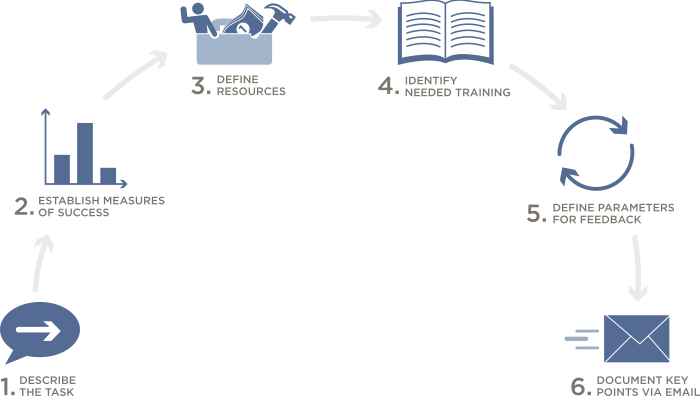
Once you've identified the right person for the delegated work, communicate the proposition. If at all possible, do this in a face-to-face meeting. If that's not possible, use video- or web conferencing technologies so you and your employee can see each other and review materials relevant to the delegated assignment together.
When explaining a task, open communication and trust are critical. To achieve both:
1. Clearly describe the task, project, or function you're delegating.
-
Define the purpose and importance of the assignment.
-
Review the scope of the employee's responsibilities.
-
Identify other personnel who will be involved, if applicable, and describe their roles.
-
Discuss feasible deadlines for completion.
-
Pass along any information the assignee needs to get started.
2. Establish agreed-upon standards of performance and measures of success.
-
Set firm benchmarks for such things as quality, time, and cost.
3. Define the resources and support that will be available.
-
Identify any materials, equipment, space, tools, and other resources needed to complete the assignment, and confirm their availability.
-
If necessary, allocate additional staff to assist in meeting the assigned goals.
-
Ask the employee what support he thinks he may need from you throughout the assignment.
4. Identify the need for any special training or coaching, and describe how it will be given.
-
If the assignment requires the staff member to develop new skills, agree on an appropriate plan for training.
-
Discuss the need for coaching, and set up a schedule agreeable to both parties to provide the needed support.
-
Agree on a date to review progress, and assess the need for additional training or continued coaching.
5. Agree on parameters for follow-up and feedback.
-
Establish a system for reporting progress regularly—such as monthly reports, or weekly or monthly meetings.
-
Agree on parameters for providing ongoing feedback as needed. Your feedback will be seen as less intrusive if you and your staff member concur ahead of time about when and how you will provide it.
-
Determine how and when you will become involved if the expected goals of the delegated work are at risk or if other major problems arise.
6. Document the key points.
-
Follow up the meeting by documenting key points in writing.
Granting Decision Making Authority
Try it Out
Make a Connection
第 2 节
As your employees carry out delegated tasks, projects, or functions, they'll encounter situations that require decisions. You need to determine how much decision-making authority you'll grant them. That depends on two things: their capabilities and your confidence in them.
To determine the level of authority to grant an employee, ask yourself:
-
"Does this person have a history of making good decisions?"
-
"What are the consequences of wrong decisions for the delegated work? How willing am I to take the risk that these consequences could happen?"
-
"What level of decision-making authority would best enable this person to complete this assignment successfully?"
Depending on your answers to these questions, you may choose one of the following levels of decision-making authority for the employee:Keller Johnson, Lauren. "Are You Delegating So It Sticks?" Harvard Management Update, July 2004.
-
Level 1. Employee makes and implements decisions as needed without consulting you first.
-
Level 2. Employee makes decisions as needed and notify you before implementing them.
-
Level 3. Employee recommends a decision, which you must then approve.
-
Level 4. Employee suggests several alternatives, from which you choose one as the final decision.
-
Level 5. Employee provides you with relevant information; you develop alternatives and then make a decision with input from the staff member.
Level 1 is the highest degree of decision-making authority the person can have: You grant this level when a direct report is highly capable and when you have full confidence in his abilities and judgment.
Cultivate independent thinking in your team
freedom to act
哈佛教授讲授视频逐字稿
Poll
Take a Moment
Take Action
第 3 节
Test your understanding and reinforce what you’ve learned.
Try it Out
答案与解析
Send her a detailed memo and encourage her to respond with questions or suggestions.
If at all possible, do the delegating in a face-to-face meeting. If that’s not possible, use video- or web-conferencing technologies to ensure that communication is as clear as possible.
Give Meg flexible measures of success so she can recover from minor mistakes.
You should set firm benchmarks for such things as quality, time, and cost.
Tell Meg to update you on progress whenever she feels she has something new to report.
You should establish a system for reporting progress regularly—such as monthly reports or weekly meetings.
Tell Meg you’ll step in to help if she has questions or if the project is at risk.(正确)
You should determine how and when you will become involved if the expected goals of the delegated work are at risk or if other major problems arise.
第 4 节
Reflecting on your learning helps you apply relevant concepts to your job.