
Document Your Marketing and Operations Plans 查看中文版
第 1 节
Your marketing plan serves as a roadmap for describing how you intend to sell your product or service—that is, how you will motivate customers to buy. Developing a well-conceived marketing plan helps you and your team:
- Test ideas, explore options, and determine effective strategies for creating awareness about your product or service
- Convince readers of your competency
- Show investors how the business will make money
The plan should reflect your organization's mission and basic business philosophy. It should also incorporate the results of your market analysis.
项目开始前,先定义什么是成功 Define Success Upfront
哈佛教授讲授视频逐字稿
Poll
Develop your marketing plan
Start by looking at the key factors affecting the marketing of your product or service. To develop a coherent marketing plan:
- Concentrate on the opportunity. Focus on the customer problem that your product or service is solving. For example, you may be capitalizing on a weakness in your competitors' services by offering guarantees that others don't offer. As you develop specific marketing strategies, keep viewing the opportunity from the perspective of the customer.
- Review your marketing objectives. For example, your objective might be to reach the breakeven point in six months from the time of initial sales, to increase sales by 10% per year, and to capture 20% of the target market in five years. Identify marketing strategies you can use to fulfill these objectives.
- Focus on customers' buying behavior. Consider when, where, why, and how consumers will buy this product or service. Also look at the factors that are important to them in choosing this type of product or service, such as price, quality, value, or benefits. For a busy customer, service and time savings may be more important than the lowest price.
- Determine a customer's value to your business. To help you decide on the appropriate marketing strategies, compare the cost of acquiring a customer to the long-term value of that customer. For example, if each customer is worth winning and keeping, then you might want to employ relationship-oriented direct sales—a relatively expensive marketing strategy. If, on the other hand, you are trying to reach a wide range of customers, then less expensive strategies, such as mass email promotions, may be more effective.
Tips for determining customer value
Define your marketing mix
Your marketing mix describes the way you will achieve your marketing objectives. Your choices define how you will:
- Make the target market aware of your product
- Motivate customers to purchase your product or service
- Build customer loyalty
- Achieve the projected return on sales
The strategies in your marketing mix determine the way you position your product in the market relative to your competitors' products.
Define your marketing mix
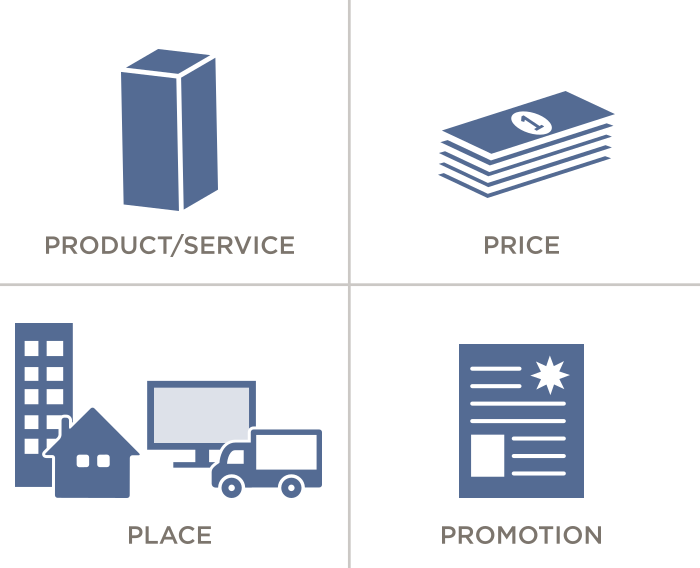
The most effective mixes reflect the classic "four P's" of marketing:
- Product/service. Make sure that your product or service is consistent with your company philosophy and target market's needs. For example, if the company philosophy is to provide the highest-quality accounting services, then those services must be the most accurate and comprehensive available. You might define your target market as business owners who require precision and thoroughness from their financial service providers.
- Price. Determine the price point for your product or service. Your pricing decision needs to balance your market's price sensitivity and perceived value of your product with your total costs and required profit margin.
- Place. Look at how the product will be transported from one place to another—from the source to the end user. Your decision regarding distribution channels will depend on the type of product, the costs of distribution, and customers' needs or demands. You should make these choices in conjunction with other operating and marketing considerations.
- Promotion. Consider how you will make consumers aware of your product. Most businesses use a mix of advertising, personal selling, referrals, sales promotion, and social media to promote their products or services. The methods you use will depend on your target market.
Tips for promoting your product or service
TechEx: Sample marketing plan excerpt
Take a Moment
第 2 节
The operations plan explains how you will actually make your product or perform your service. It will vary according to the type of business you're in. For example, for a product, you need to document how you are going to produce it, store it, and then ship it out to customers. For a service, you include details such as who is providing it, where you are providing it, and how.
You should include enough information to show readers that you have planned for the daily execution of the business. But the plan should not be so technical or comprehensive that readers are unable or unwilling to plow through it. The primary purpose of the operations plan section is to show that you are focused on the critical operating factors that will make the business a success.
Understand operations
Typically, the operations plan section describes your business's physical requirements, such as the location, facilities, and equipment. Depending on the type of business you're in, it may also include information about inventory and suppliers, and a description of the manufacturing and distribution processes.
The operations plan has to be flexible so you can update it as you learn how to be more efficient or as technology or other factors change.
Identify key success factors
While describing the day-to-day operations of your organization, highlight the critical success factors that create value for stakeholders. Depending on the type of business you have, key success factors might include:
-
Advantages in sourcing materials. For example, you may have acquired the rights to inexpensive raw materials or discovered a cheap way of transporting the goods to your facilities.
-
Technological innovations. Technological improvements in manufacturing, in transferring information and data, or in organizing distribution systems can lower costs or increase productivity.
-
Favorable geographical location. Depending on the type of business, proximity to customers, competitors, suppliers, or labor may be critical variables. For example, a good location for a computer game store might be near a local high school.
-
Effective pricing strategy. You may be able to adjust pricing to the needs of individual market segments or justify high prices by offering unique features.
Include personnel planning
As part of your operations plan, explain your organizational structure. This is usually done using an organizational chart that illustrates how the main functions are divided and the lines of authority. If your organization is small, describe the organizational structure in words.
You may also want to include a personnel plan that lists titles or roles and monthly costs. You can organize the personnel plan by department and show estimates for the total people per department and the average salary per department. This approach can help show projected staffing growth and labor expenses.
TechEx: Sample pricing strategy excerpt
Make a Connection
第 3 节
Your business plan needs to include a milestones plan that lists the major events in the business's development. This gives readers a perspective on the timeline and helps you implement your plan by documenting what you need to achieve by when.
Milestones Timeline
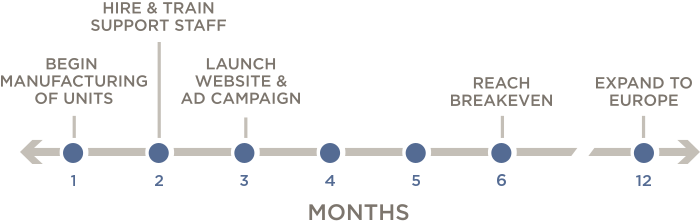
To create your milestones plan:
-
Include only major events, not each individual step.
-
Choose specific and measurable activities—for example, "installation of computer system" or "first customer sale."
-
Use generic dates, such as "month 6" or "year 1", rather than actual dates.
-
Assign a person to be responsible for each milestone.
-
Include a budget for each milestone, if appropriate.
-
Give yourself time for the unexpected. You never know when a problem will occur that slows you down.
-
Develop an ambitious schedule that you can meet. This will impress investors and improve your reputation.
The milestone plan is often included as an attachment to the business plan.
第 4 节
Test your understanding and reinforce what you’ve learned.
Try it Out
答案与解析
An explanation of how the company will make the new product.(正确)
This information belongs in the operations plan, not the marketing plan.
A discussion of the helpful role of fish oil in the human diet.
Because a good marketing plan focuses on the customer problem being solved, Olga should include a discussion of the health benefits.
An emphasis on the high fat content in some competitors’ products.
Because Olga’s plan is about a line of healthy products, she should point out the unhealthy fat content in competitors’ products.
An analysis of when, where, and how consumers will buy the products.
A good marketing plan should take customers’ buying behavior into account.
Try it Out
答案与解析
"Include each detailed step in the development of the new business."
It is better to include only major events, not each individual step.
"Use specific, actual dates for when you expect us to reach each milestone."
It is better to use generic dates, such as "month 6" or "year 1," rather than actual dates.
"Make the schedule ambitious while ensuring that we can meet it."(正确)
To impress investors, it is a good idea to develop an ambitious schedule that you can meet.
"Don’t assign responsibility for each milestone until the business plan is approved."
It is better to assign a person to be responsible for each milestone.
第 5 节
Reflecting on your learning helps you apply relevant concepts to your job.