The industry background section provides readers with information to understand the shape, size, trends, and key features of the industry. It also helps them to recognize how your product or service will fit into that industry.
The important questions that this section addresses fall into four categories:
Existing products and services
What industry are you entering?
What is the range of products or services encompassed by this industry? For example, is it a food industry or an ice-cream industry?
Size and shape of industry
What are the industry’s production capacity, unit sales, and overall profitability?
Is the industry spread out geographically, or is it concentrated near the sources of raw material or near the end user for efficient distribution?
Important trends emerging in the industry
What is the predicted growth rate?
What new patterns of growth are emerging?
What factors might contribute to future growth?
Is the industry fragmented, consisting of many small competitors? Or are a few major competitors controlling the industry?
Is it on the edge of technology, or is it a traditional industry offering stable products or services?
Potential barriers to entering this industry
What resources, knowledge, or skills does it take to enter this industry?
Are there restrictive federal or international regulations, large capital requirements, or areas of sophisticated technical knowledge associated with providing the products or services?
Be sure to explain both the present state of the industry and its future outlook. Include information on other new products or developments that will benefit or adversely affect your business.
TechEx: Sample industry background excerpt
TechnoExercise Corporation, or TechEx, is a fictitious company that has created a multipronged approach to fitness and weight loss for busy professional women. Take a look at an excerpt from the industry background section in TechEx’s business plan.
The global weight loss and obesity management market—which is estimated to be worth $265 billion—includes a wide variety of products and services in three main categories: over-the-counter consumer goods, such as diet beverages, low-calorie packaged meals, and nutritional supplements; weight-loss services, such as structured diet plans; and fitness equipment and medical interventions. Within this industry, TechEx competes as a weight-loss service.
Market growth: Obesity rates are rising around the world, but the United States—which has the sixth-highest rate of obesity in the world—remains the leading market for diet and exercise companies. The global increase in obesity and associated chronic diseases, namely diabetes and heart disease, is accelerating the growth of the industry. Other key factors driving growth include rising disposable income, a pronounced stigma against excess weight, policy initiatives to raise awareness about the importance of health and fitness, and technological advancements that enable simple, expedient tracking of diet and exercise. In 2012, the weight-loss industry as a whole grew at a steady 3% in the United States.
TechEx: Sample industry background excerpt
Think about a project you’d like to propose. Describe various aspects of your industry that may affect your product or service.
1. Existing products and services
2. Size and locations
3. Emerging trends
4. Potential barriers to entry
第 2 节
By understanding who and what your competitors are, you can reduce the risk that your business might fail. In a competitive analysis, you identify your competitors and analyze how difficult it will be to move into the market alongside of them. You look at their strengths and weaknesses, what sets your business apart from theirs, and the threats they pose.
Identify your competitors
Competitors can be organizations within the industry that produce similar products or services. Or they can be companies that produce products or services that fall into another industry category, but solve the same consumer problem as your business. When identifying your competitors, include all organizations that solve the same problem that you intend to solve.
案例
If you are producing an electric motorcycle as a low-cost alternative to owning and driving a car, then other motorcycle manufacturers are obviously competitors. But bicycles and public transportation are also competitive solutions to the same problem and need to be analyzed as well.
For each competitor, gather information on:
Products and services
Strengths and weaknesses
Market share
Marketing strategies
Key success factors
Distinguish your business from others
Once you've discussed who your competitors are, you need to specifically show what differentiates your product or service from their offerings. Explain how you are responding to a customer need in a new and unique way. For example, your competitive advantage may be that your product is much easier to use than similar offerings currently on the market. Or your service may help client firms save more money or achieve greater efficiencies than your competitors' services do.
你发现的商机,对手也发现了 Why a Good Idea Isn't Enough
哈佛教授讲授视频逐字稿
I was CEO of a software company. And as the CEO, when I first started, I had to go around and meet with all of our key clients. And they were all effectively in the same industry. And so I traveled, actually around the world, it was a pretty grueling situation in terms of the travel. But it was a great opportunity for me to sit down with our largest clients and get a sense of them and try to develop a relationship.
My first stop was Asia. And I sat down and visited with the senior leadership team of this insurance company. And we had a nice talk. And I had come from the insurance industry before I became CEO of the software company, so one of the executives said, "Would you mind listening to our strategic plan for next year? We'd love to get your feedback. You're sort of an industry guy and maybe it would be helpful for us to hear what you have to say." So I said, "Absolutely. I would love to do that."
So I sat down and I went through their presentation with them, and it was very interesting. And they had decided there was a wonderful opportunity to go after companies that were on the smaller side or small businesses. They saw that as an underserved niche in their marketplace, and that they were really going to be committed, and they saw a real opportunity for their company to grab significant market share. And so we went through it. It made a lot of sense. They had a lot of data. It seemed like it was well researched. I left them and I said, "Wow! These guys really have their act together."
And then I got on a plane and I went to Europe. And I met with several insurance companies there. And, lo and behold, the same thing happened. The executives asked me to stay, and they wanted to sort of go through their strategy with me. And so we did. And wouldn't you know, they said they were going to target small businesses. And they gave me effectively all the same reasons for why they were doing [it] and going into this market as I had heard at prior stops.
And so when I got back to the United States and started visiting some of our clients in the United States, I started to ask if I could listen or learn about the strategy of the clients that I was visiting. And, of course, they thought, "Oh, that's great. He's showing a real interest in the firm!" And so I sat down with them and, lo and behold, the clients in the United States said the same thing. They were going to go after the small-business segment. They saw it as underserved. And again, all of them had incredible reports, had great data, PowerPoint presentations—it was all really well packaged.
So what was the lesson for me? The lesson for me is, when I'm working with a team or when I'm thinking on my own about opportunities, and when I think about a strategy to go after a new market or even to innovate in a specific market, one of the assumptions I'll make [is]—because I tend to get very excited, or when you have data that supports your position and you've done a lot of research and spend a lot of time and energy—it's a unique idea.
And my takeaway is, it probably isn't. And so, when you go down this path, I think you have to take one additional step. And that's what I do now. And that is: I assume that whatever we figured out, somebody else has figured out [who's] a competitor.
So what we do is we scenario plan for how we're going to enter the market and what our specific execution steps are going to be. So it really becomes a function of, "Great, you have a strategy. Great, it's well researched. But now, how do you make sure you execute so that if somebody else has come up with the same idea, you don't lose, but actually you're able to grab a good part of the market share that you thought you were going to have a chance to grab at the outset?"
Assess threats from the competition
As part of your competitive analysis, assess potential challenges from your competitors.
For each competitor, answer these questions:
Does your competitor enjoy strong brand recognition of its products?
Will it aggressively block the entrance of a new rival?
Will it recognize your special differentiating attributes and appropriate them for its own products or services?
When you understand how much of a threat your competitors are to your venture, you can develop strategies for dealing with them. You can also figure out how to win business from weak competitors and protect your business from strong ones.
TechEx: Sample competitive analysis excerpt
The companies listed below represent some threat to TechEx, but none offers the same cognitive behavioral approach to exercise, while also providing crucial emotional and community support.
E-Fitfab: TechEx’s closest rival is a full-service program in which customers wear a monitor that tracks their exercise patterns. Its advantage is that customers have access to a behavior coach. Its biggest drawback is that E-Fitfab lacks any element of community, which research indicates is important to busy professionals. TechEx offers a wide range of online social support through its community of fellow exercisers via message boards, chat rooms, and video conferencing software.
Fitness Community: Fitness community is based on accountability and community support. Its main strength is that members attend support meetings with fellow exercisers. However, Fitness Community does not offer online meetings and provides limited internet-based support. Its system is inconvenient for busy customers who cannot attend meetings regularly. Finally, Fitness Community does not offer custom exercise services, which is what many professionals desperately need. By contrast, TechEx’s cutting-edge technology enables customers to engage when it’s easy and convenient for them.
TechEx: Sample competitive analysis excerpt
Take a Moment
1. Who are your organization’s key competitors? What differentiates your offerings from those of your competitors?
第 3 节
The market analysis focuses on your target market—the people or companies that will choose to purchase your product or service because you meet a need for them better than your rivals do. Here is where you answer the questions: Is there an opportunity within this market? Can we capitalize on this opportunity?
Assess the market’s size and growth
Indicate how large the market for your offering is and how fast it is growing. These are two key considerations for any business looking to enter a market or market niche. After all, there isn't any point to starting or expanding a business unless you have identified a market for it.
The questions you need to answer are:
Is there room for your presence in that market?
Can the market expand to include you?
Will market demand for your products or services grow?
Support any claims you make about market growth and demand with realistic and verifiable information.
Define your target market
Your next step is to define your target market: the individuals or companies that will purchase your offering. Describe:
Who they are
Where they are from
What characteristics describe them
Consider the target market from different points of view, including:
Geographic location or segmentation (national, state, suburban, city, neighborhoods)
Demographic features (age, gender, race, income level, occupation, education, religion)
Behavioral factors (customers’ attitudes and responses to types of products)
案例
You are producing a line of clothing designed for teenagers. In thinking about your target market, you need to consider who your customers are. Are you selling a product directly to teenagers? To their parents? To clothes retailers selling to teens?
TechEx: Sample target customers excerpt
Target customers: While Fitness Community, which relies on a group meetings model, has long been the go-to company for fitness, it is steadily losing its appeal. Increasingly, many professionals are turning to technology-based fitness plans, including exercise apps, because they are more convenient for their busy lives.
Against this backdrop, TechEx offers a uniquely effective experience for two target end users:
Busy professionals who are not physically fit: A general characteristic of this group is that they lack time to make it to regular group meetings, let alone the gym. They are knowledgeable about, and have experimented with, most of the popular exercise plans, but find them impractical for the realities of their lives. The people in this category seek a solution that is convenient and has a measurable impact on their fitness goals. As a group, they tend to be highly motivated and tech-savvy; when faced with a decision, they are moved by hard data and scientific evidence. They trust health professionals and regularly seek expert opinions. (For example, they trust fitness advice from a reputable and well-researched magazine rather than a late-night infomercial.) Because of their hectic work and home lives, they have experienced a sense of isolation. They crave emotional support and a community with which to share their struggles.
Busy professionals who are physically fit but want to mix up their routines: The people in this group are looking for ways to maintain their fitness levels, but also to improve their bodies. They are highly motivated to make adjustments to their routines for the benefit of their health. They may work long hours or need to balance work with caregiving responsibilities. Either way, they are unable to make it to the gym and instead need a program they can do at home or on the road. They are looking for a program that will tailor a fitness regimen to their specific concerns (such as untoned biceps), and one that will produce real results.
TechEx: Sample target customers excerpt
Articulate your value proposition
Your value proposition is the unique set of benefits your customers will get if they choose to purchase your offering over competitors' offerings. Customers will subconsciously compare your value proposition to those of your competitors when deciding where to take their business. Therefore, you need a strong and convincing value proposition.
When formulating your value proposition:Richards, Daniel. "Writing a Business Plan—Business Concept and Value Proposition." About.com Entrepreneurs. 3 Dec. 2013.
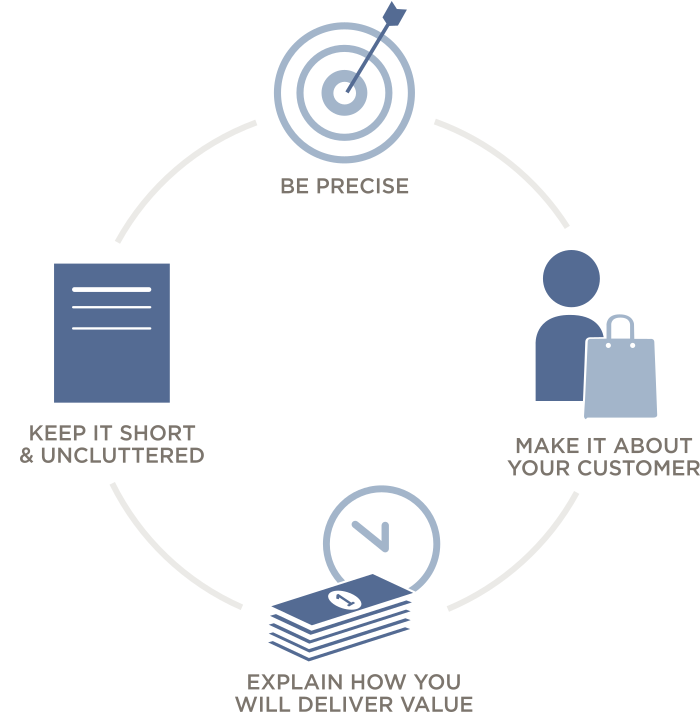
Keep it short and uncluttered. You should be able to sum up why customers should choose your product or service in one concise sentence.
Be precise. Your customers have specific needs—your value proposition should offer targeted solutions.
This is about your customer, not you. Discuss only what matters to your customers and the value you can bring to them.
Value comes in numerous forms. Explain how you deliver value to your customers. Keep in mind that you can offer value in various ways, including money, time, convenience, and superior service.
Make a Connection
1. Think again about a project you’d like to propose. How will you deliver value that matters to your most important customers?
第 4 节
Test your understanding and reinforce what you’ve learned.
Try it Out
1. 1. Transpotrol Inc. provides systems for managing subway and bus transportation. It’s now trying to get backing to build and market a new road-traffic management system. Fabiana is writing the competitive analysis section of the business plan. After reviewing her work, you advise her to delete one sentence from her analysis. Which one is it?
答案与解析
"Our competitor, Freeway Science, has the strongest brand-name recognition in the industry." A competitive analysis should include information on your competitors’ strengths and weaknesses.
"Another firm, Controlcom, has built its success on a policy of strong customer service." A competitive analysis should include information on your competitors’ strengths and weaknesses.
"Freeway Science could use its industry dominance to try to keep us out of the market." A competitive analysis should assess how difficult it will be to move into the market alongside your competitors.
"Our product is just as good as any other, and the market is big enough for another player."(正确) This statement does not show what differentiates the product from competitors’ offerings—something that is key to a competitive analysis.
Try it Out
1. 2. Rashon is working on a market analysis for your company’s new line of backpacks. He asks you to help by writing the value proposition. Which one of these approaches would you take?
答案与解析
Write two to three pages highlighting the advantages of the new backpacks. A value proposition should be short and uncluttered.
Focus on what matters to your customers and the value your company can offer them.(正确) The value proposition is about your customer, not about you.
Cover a wide range of customer needs to attract as much interest as possible. It is better to be precise.
Explain the value that your company places on its customers. A value proposition is the unique set of benefits your customers will get if they choose your product.
第 5 节
Reflecting on your learning helps you apply relevant concepts to your job.
Take a Moment
1. 1. What new insights do you have that could benefit you or others in your workplace?
2. 2. What are your biggest opportunities for applying concepts from this Lesson in your workplace?