
Develop an Operating Budget 查看中文版
第 1 节
The Seven Steps of Creating an Operating Budget
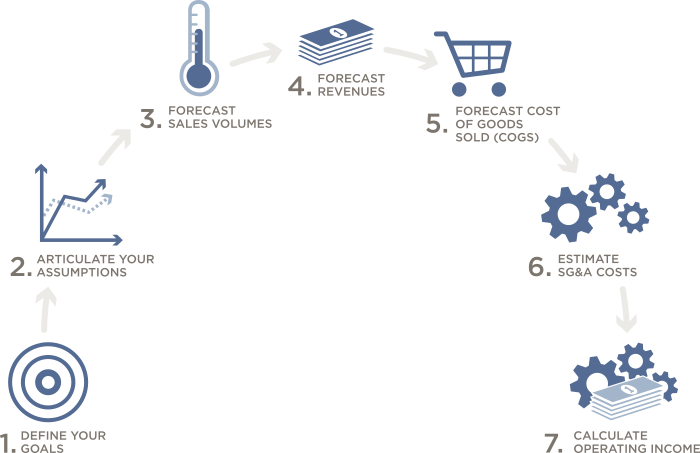
If you lead a group that’s involved in making or selling a product or service, you’ll follow these steps to create your operating budget:
-
Define your goals
-
Articulate your assumptions
-
Forecast sales volumes
-
Forecast revenues
-
Forecast cost of goods sold (COGS)
-
Estimate selling, general, and administrative (SG&A) costs
-
Calculate operating income
If you lead a group that’s not involved in making and selling a product or service, you obviously won’t be involved in forecasting and tracking sales and revenues. But you will follow some of the seven steps in order to budget costs.
Poll
The Seven Steps of Creating an Operating Budget
第 2 节
In your organization, senior management may set some or all of your group’s goals. Or perhaps the managers of individual groups determine their own goals. Regardless, these goals will reflect both your organization’s larger strategic priorities and your group’s objectives.
Here are examples of questions you can ask to help define your group’s goals:
-
What are our organization’s strategic priorities?
-
What technological changes are affecting our industry?
-
How can our current business processes be improved?
-
What longer-term initiatives could position us for future success?
Achieving these goals requires choosing courses of action from multiple possible options. Your choices affect your group's operating budget—and perhaps other groups' budgets as well.
Emile is a marketing manager. His company has defined a goal to increase revenues by 10% in the coming year. To support that goal, he considers several options:
Make a Plan
第 3 节
Whenever you prepare an operating budget, you have to make assumptions about what could happen in the future, and how those developments could affect your group. For example, senior management might communicate key assumptions to be used throughout your organization, such as a 5% salary increase or a 10% increase in sales volumes.
Or maybe assumptions are specific to each department’s activities.
案例
You can use different types of data and approaches to articulate your assumptions, including:
-
Historical trends (internal, if available, or industry benchmark data)
-
Purchasing surveys
-
Industry projections
You can also talk with other managers about their expectations regarding issues relevant to your budget—such as customer response, supplier performance, and financial market fluctuation.
To articulate your assumptions:
-
Start with historical data. Even in rapidly changing business environments, information about past performance can establish a starting point.
-
Trust your own experience and intuition. Make educated guesses about what's likely to happen. Even though you can't verify "gut feelings," you can still take them into account.
-
Conduct due diligence. You may have to do your own research, read trade journals, collect industry statistics, and so on.
Document all of your assumptions and the sources you've used to formulate them. And be prepared to defend them—especially if you'll be evaluated based on achieving sales and revenue forecasts in your budget.
确保预算假设的合理可行 Realistic Budgets
哈佛教授讲授视频逐字稿
Make a Connection
第 4 节
Sales volume forecasts for a given period are developed by groups directly involved in a company’s products or services. If you’re forecasting product or service sales volumes, consider whether it’s appropriate to base your forecasts on current sales trends.
In addition to overall demand trends for the products or services in question, consider these factors:
-
The history of sales growth for your company’s offerings
-
Competitive products or services that have been or may be introduced in the market
-
Price sensitivity of customers
-
Percentage of customers who are repeat purchasers
-
Planned changes in sales and promotional activities
Also carefully consider the following factors:
-
Order fulfillment cycle times. In general, if it takes your company many months to execute on orders, forecasting sales for the next month or quarter should be relatively easy. You may have more difficulty if lead time from order to fulfillment is just a few days. However, the ease (or difficulty) of forecasting in a long-cycle company depends on forces shaping the industry.
Time from order to fulfillment for a clothing manufacturer could be about nine months, so forecasts from quarter to quarter wouldn’t vary much. For a company that builds multifamily homes, managers already know the next quarter’s projects. However, new home starts are hard to know: They depend entirely on the health of the economy. A slowdown could easily postpone orders by one or more quarters.
-
Key drivers of sales. Sales drivers can vary by industry. Capacity constraints, price volatility (for example, related to intense competition), and sudden large shifts in commodity prices can all be key drivers.
If a company needs to import raw materials to manufacture a product, availability of these materials constitutes a major driver of sales. In a mortgage company, interest rates constitute the biggest driver of sales (generally, when interest rates fall, lenders sell more mortgages).
-
Your industry’s maturity versus stability.Some mature industries, such as utilities and higher education, are stable. Managers find it relatively easy to forecast sales because they have huge volumes of historical data.
Other mature industries operate under considerable instability. Banking is one example, because of the impact of volatile interest rates. Oil drill bit manufacturing is another example, because sales hinge tightly on the price of oil—which can fluctuate greatly and frequently.
Fast-changing industries (such as consumer electronics) and emerging industries with innovative business models tend to operate in unstable conditions as well.
案例
If you use historical sales data as a base for your forecasts, determine whether it’s appropriate to use either of the following:
-
Annual data. Annual data may be most appropriate for forecasting one-off product sales.
-
The run rate. The run rate is the extrapolation of current financial results over a future period of time: If December's sales are $75,000, the annual run rate ($75,000 multiplied by 12 months) is $900,000. Choose the run rate if you’re forecasting revenues for services sold under long-term contracts or for recently launched products.
If your group is directly involved in sales of your company’s products or services, get sales forecasts from your own salespeople. If not, ask regional sales managers for their input. They’ll have the best idea of what sales might be in the next period.
Driver-based sales forecasting
第 5 节
Revenues are a function of units sold and price. So document the quantity and price assumptions you use in developing your revenue forecast.
In forecasting revenues, be aware that production constraints may affect revenue. Suppose you expect sales demand to exceed capacity. In this case, you’ll need to adjust the revenue budget to match the production constraints rather than actual market demand.
To estimate how volume of new sales might be distributed during the budget period, consider using:
-
Historical data
-
Existing order backlogs
-
Information about the sales pipeline
For example, companies that sell software-as-a-service rely on a ratio known as LTV/CAC (lifetime value of the customer/customer acquisition cost), which compares the cost of acquiring a customer to their lifetime value. This helps companies understand how profitable their sales are and track the payoff of their marketing investments. The analysis includes historical sales patterns and customer "churn" (attrition), which directly affects revenues.
If necessary, create a monthly schedule to clarify how you expect sales volumes and revenues to fluctuate during the year. Doing so will help prevent overly optimistic forecasts.
第 6 节
The cost of goods sold (COGS) is an expense calculated by companies that make tangible products they must hold in inventory, such as manufacturers. COGS includes:
-
Materials
-
Labor
-
Other direct product costs
-
Manufacturing overhead
A COGS estimate is based on the units of product (or hours of service) needed to maintain inventory for that period, so you must determine expected volume of sales as well as any planned changes in inventory. If inventories are depleted at the beginning of the budget period, the company will need to produce more to bring inventories up to normal levels. That will increase total direct production costs. Conversely, excess inventory will be sold during the period, reducing forecasted production costs.
In estimating COGS, also be aware of break points in production capacity that signal the need for additional outlays.
案例
Typically, service-based companies don't need to forecast COGS. Some, however, like hotels and airlines, sell gifts or packaged snack foods, which they must inventory. Their COGS is the wholesale price of goods they resell. (Your company's finance or accounting department will guide you on accounting regulations regarding COGS in different countries.)
第 7 节
Selling, general, and administrative (SG&A) costs are additional costs beyond those directly associated with producing a product or service. They can include costs related to:
-
Research and development
-
Product design
-
Marketing
-
Distribution
-
Customer service
-
Commissions
-
Administrative processes
-
Overhead
To estimate SG&A costs, some companies consider how much they can afford: for example, "How much are we willing or able to spend on marketing, R&D, and so forth?"
SG&A is also where companies tend to make spending cuts during tough economic times. A business might cut SG&A in the first or second quarter of the forthcoming budget period; for instance, by outsourcing marketing work or reducing the number of television advertisements it airs. It may then make up the cuts in a later quarter if business revives.
SG&A costs can vary depending on a company's growth stage. For a startup, spending on marketing is more of a priority than it is for a mature company.
Still, there are some recognizable patterns that can help you estimate SG&A. For example, R&D as a percentage of SG&A cost tends to vary less than marketing or advertising expenditures do. That’s because R&D work is often done over a long time horizon and remains a stable percentage of a company’s sales. By contrast, decisions about how much to spend on marketing and advertising tend to change more quickly in response to changes in market opportunities.
第 8 节
Total revenues minus COGS equals gross margin. Gross margin, in turn, minus operating expenses (such as R&D and SG&A) equals operating income (also known as earnings before interest and taxes, or EBIT).
Here’s a more general way of stating this: to calculate operating income, subtract expected costs from expected revenue. For instance:
Calculating operating income is important because it isolates the items that are under an operating manager's control. Such items as taxes and interest received and paid are outside of an operating manager's purview; senior management incorporates these as part of the master budget.
接受不确定性 Embrace Uncertainty
哈佛教授讲授视频逐字稿
Worksheet for Negotiating Your Team's Budget
第 9 节
To develop your team's budget:
-
Understand your organization’s budgeting process. What guidelines must you follow? What is the timing of the budget process? How is the budget used in the organization?
-
Know what real concerns are driving decision makers. The people who have final authority over your budget have a wide range of concerns, so be sure to address them. Put yourself in the position of a senior manager with limited resources and many funding requests: What would persuade you to agree to fund two new staff members or additional office space?
-
Understand every line item in your budget. If you don't know what something means or where a number comes from, find out. Talk to people on the manufacturing line. Call or email a regional sales manager. Find out what their expectations are. Do they expect demand to increase or suppliers to raise prices?
-
Step back from the status quo to consider new possibilities. Consider raising sales projections for products that exceeded sales expectations over the past year. Or think about eliminating products or services (especially ones that are costly to produce) to redirect resources to newer offerings. Ask yourself, Should you raise or lower prices? Will your staff need additional training?
-
Communicate often with the controller or your department’s finance person. Ask questions about points you don’t understand. Get that person’s advice about the assumptions your team is making.
-
Get buy-in from decision makers. Spend time educating the finance person or decision maker about your area of the business. That will lay the groundwork for implementing changes later.
-
Have an ongoing discussion with your team. Throughout the budget period, keep communication open. Things change, so the more you plan, the more you’ll be able to respond to unexpected contingencies.
-
Avoid unpleasant surprises. As actual figures become available, compare them with the budgeted amounts. If you see a significant or unexpected variance, find out what led to it. And be sure to notify the finance person who needs to know.
Remember: Budgets have standard line items, which helps decision makers compare and combine them. But if any items necessary for your unit are not listed, ask your accounting or finance department how to classify them. You need to be sure that your budget doesn't shortchange your unit's goals. At the same time, you should be sure it's defensible. Budgets should be ambitious, but also realistic.
了解成本才能建立竞争优势 The Upside of Understanding Unit Costs
哈佛教授讲授视频逐字稿
Try it Out
Take a Moment
第 10 节
Test your understanding and reinforce what you’ve learned.
Try it Out
答案与解析
Use historical data despite the rapid growth.
It is good to start with historical data, even when things are changing quickly. Information about past performance helps establish a starting point.
Listen to your intuition and “gut feelings.”
Even though you can’t verify intuition or “gut feelings,” you should take them into account.
Use driver-based sales forecasting.(正确)
Driver-based forecasting is not possible in this case because it requires adequate and reliable data, including historical sales numbers and other factors like customer preferences.
Perform due diligence.
It is good to conduct due diligence by researching, reading trade journals, and collecting industry statistics.
Try it Out
答案与解析
Included data from existing order backlogs.
Including data from existing backlogs is a good idea to estimate how new sales might be distributed during the budget period.
Used information about the sales pipeline.
Including pipeline information is a good idea to estimate sales distribution.
Examined historical data.
Examining historical data is a good idea to understand sales distribution patterns.
Adjusted the revenue budget to match actual market demand.(正确)
If demand exceeds capacity, the budget should be adjusted to match production constraints, not actual market demand.
Try it Out
答案与解析
Insurance.(正确)
Insurance is an indirect cost benefiting the company as a whole. COGS includes only direct production costs like materials, labor, and manufacturing overhead.
Materials.
COGS includes direct costs such as materials.
Labor.
COGS includes direct costs such as labor.
Manufacturing overhead.
COGS includes direct costs such as manufacturing overhead.
第 11 节
Reflecting on your learning helps you apply relevant concepts to your job.