A budget is a document that translates a group’s or organization’s strategic and operational plans into the expected resources required and anticipated returns over a certain period.“Budgeting: Seeing the Future.” Manager’s Toolkit: The 13 Skills Managers Need to Succeed. Harvard Business School Press, 2006: 3.
There are many types of budgets. For example:
Operating budgets reflect a group’s or organization’s day-to-day revenues and expenses. They typically cover a one-year period.
Capital budgets show planned outlays for investments in plant, equipment, and product development. Capital budgets may cover periods of three to 10 years.
Cash budgets plot the expected cash balances an organization will experience during the forecast period, based on information provided in operating and capital budgets.
Budget vs. forecast: What's the difference?
A budget estimates expected revenues and expenses for a given future period. A financial forecast projects an actual outcome, such as quarterly revenues, based on historical data.
While organizations assess their budget on a regular basis—typically, once a year—they revise forecasts when a change occurs in operations, inventory, or the business plan.
Think of the budget as a plan for taking the business where it wants to go, and a forecast as a reflection of where the business is actually going.
Budget vs. forecast: What's the difference?
第 2 节
Your role
As a manager, you may need to prepare operating budgets for your group every year. Your organization’s finance department “rolls up” your operating budget and those created by your peers into a master budget for the entire organization.
You may also create capital budgets for investments you're considering making for your group. As with your operating budgets, the finance department combines your capital budgets with other managers' capital budgets to further build the master budget. The operating and capital budget information goes into the balance sheet and the company's cash flow statement.
You probably won't be preparing cash budgets unless you work in your organization's finance department. That's because this kind of budget is typically created by finance professionals. For that reason, this topic focuses on operating and capital budgets.
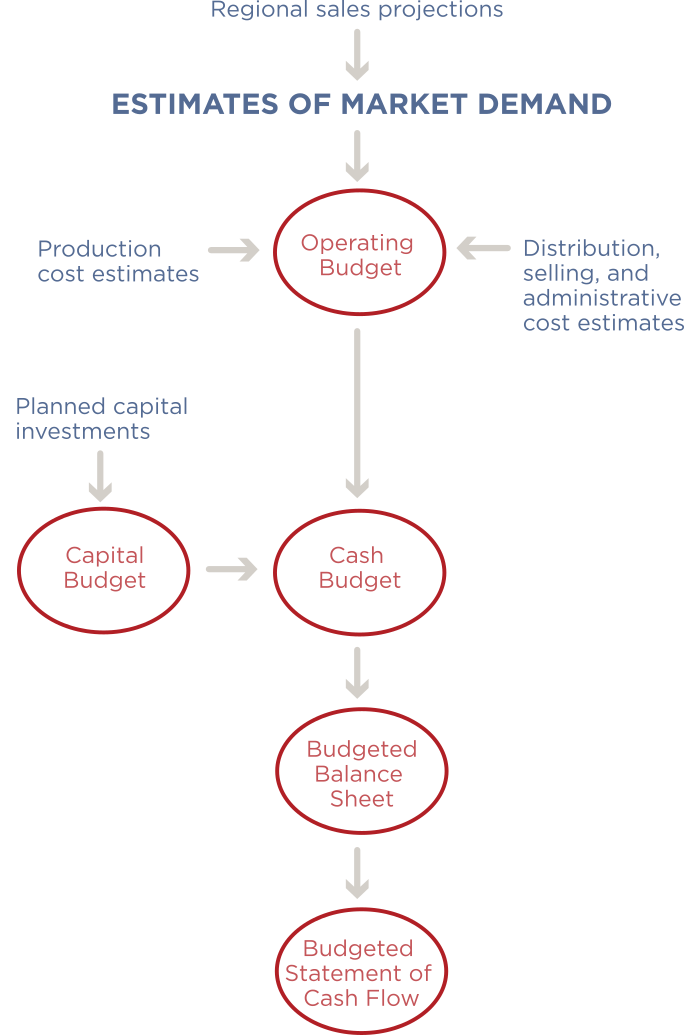
Here's a diagram showing the information sources for various organizational budgets—and how the different budgets are connected. In a typical manufacturing company, for instance, the VPs of sales, procurement, and manufacturing, along with CFOs, country unit heads, and sales and marketing heads, contribute estimates for the operating budget. The CEO, CFO, division and business—unit heads, and plant managers and product managers provide estimates of planned capital investments for the capital budget.
Image source:Preparing a Budget. Pocket Mentor. Boston: Harvard Business School Publishing, 2009.
How Departmental Budgets Coordinate with the Master Budget
How Departmental Budgets Coordinate with the Master Budget
A budget functions as financial blueprint or action plan that a group or organization uses to ensure that it has enough resources to achieve its goals. The budget also helps ensure that achieving those goals generates the desired benefits.
So a group or organization uses a budget to:
Put all of its financial components into one coherent picture that shows its strategic and operational goals along with its financial health
Align individual teams, departments, and business units behind the organization's goals (for example, a company would budget more for sales and marketing teams charged with expanding the customer base in their region)
Allocate resources wisely
Communicate financial expectations
Evaluate and motivate managers' and employees' performance (for example, managers and employees receive a bonus when their group meets the goals laid out in its budget)
Communicate goals to external stakeholders. Many companies declare their strategic and operational goals publicly to capital markets and then put those goals in their budgets
案例
Karl's company's investor relations team might tell analysts, "We expect earnings per share of $1.30 to $1.35"; "Our capital expenditures won't exceed 10% of our revenues"; or "We plan to invest 5% more in R&D over the next three years."
Take corrective action when actual business results don't match the budgeted target results; this might mean allocating more money to boost an effort or cutting funds if an activity or initiative is no longer worth pursuing.
用预算串联组织的运行 Budget Impacts
哈佛教授讲授视频逐字稿
The budget is the glue that holds together the different parts of the organization. You might have individual pockets of excellence in different parts of the organization, but they‘re not going to be coordinated with each other. So I liken this to each department being a pearl, but you really need the string to make a necklace—and the budget is the string that creates a necklace for you. So you want your sales and your production departments to be coordinated with each other? Well, they‘ll be coordinated only if they‘re working off the same budget.
The second rule for the budget is resource allocation. You’re going to determine how much capital budgets I’m going to have, how much I’m going to spend on operating expenses, and those decisions involve tough priorities and tough choices to make. And if you did not have a budget, you would not make those tough choices and there would be a lot of inefficiency in the organization.
The third reason why you should pay a lot of attention to an effective budget is that that‘s what sets you up for a very effective performance evaluation at the end of the period. If you have some targets, which is what budgets are, then you have something to compare actual performance against, and you know whether someone did a good job, whether they should be promoted, whether they need to be given a bonus, whether they need to be sacked. So lots of personnel decisions, whether you have the right person for the right job, get decided around a budget.
So getting the budget right is very important for resource allocation decisions, for personnel decisions, and coordination of the whole organization.
A budget is like a thermostat
The budgeting process works much like a thermostat does. You use the thermostat to set a room’s target temperature. A thermometer within the thermostat measures the actual temperature. If there’s a difference between the temperature you’ve set and the actual temperature, the thermostat triggers corrective action to eliminate the difference.
For instance, if the room is colder than what you’ve set, the thermostat activates the heat. If the room is warmer, it activates the air conditioning. If things change, you might set the thermostat at a different temperature entirely. For instance, suppose you have the flu: You set the thermostat at a higher-than-normal temperature so you can stay warm while you’re sick.
Budgeting works in a similar way: You set targets in your budgets for things like costs and revenues. At the end of that budget period, you review actual results and compare them to your targets. If you see differences, you take corrective action—such as increasing your marketing outlay if actual sales came in below target. If business conditions change, you might change the targets laid out on your budget. For instance, suppose a lot of new competitors have entered your market. In this case, you might set lower targets for sales volumes in your budget. That’s because you assume that with the entry of new competitors, you may not be able to boost sales as much as you had hoped.
A budget is like a thermostat
Try it Out
Think of the last budget you created, in your personal or your work life. Describe:
1. The type of budget
2. The information you used to create the budget
3. Any pitfalls you encountered
第 4 节
Overview of the budgeting process
"Budgeting: Seeing the Future." Manager’s Toolkit: The 13 Skills Managers Need to Succeed. Boston: Harvard Business School Press, 2006: 4.
Typically, formulating a budget is an iterative process: Different groups prepare preliminary budgets. They then come together to identify and resolve differences. Coordination and communication between people at different levels of the organization and across functions are critical for arriving at useful budgets.
In an organization in which upper management defines strategic and operational goals, senior managers must communicate those goals to managers at all levels. Functional-area managers, business unit heads, and team leaders need to communicate their particular needs, assumptions, expectations, and goals to those who evaluate the departmental and functional budgets.
In addition, the different groups within the organization must listen to one another. For instance, if one division wants to achieve certain sales goals, then the production department needs to know that, so it can prepare to increase production capacity. If the company wants to introduce a new service, then the marketing department has to know about this early in its planning process. That way, marketing can include funds in its budget for developing effective advertising campaigns for the new offering.
Make a Connection
1. Think about your organization’s budgeting process. How do different groups share their plans so other teams can budget accordingly?
第 5 节
Traditional and alternative approaches
There are many different approaches to the budgeting process. Some of them are traditional; others are designed for changing business needs (e.g., the need for real-time information or greater flexibility) and newer ways of working (more agile, less hierarchical):
Budget parameter
Traditional approach
Alternative approach
Goal setting
Top-down: Senior management sets budget goals such as revenue and profit targets, and imposes them on the rest of the organization.
Participatory: Those responsible for achieving the budget goals are included in setting them.
Time period
Static budget: The budget period is a specific time period—usually coinciding with the organization’s fiscal year.
Rolling budget: The budget is continuously updated so the time frame remains stable while the actual period covered by the budget changes. For instance, as each month passes, a one-year rolling budget is extended by one month, so there's always a one-year budget in place.
Forecasting process
Incremental budgeting: Managers use the previous period's budget and actual results, as well as expectations for the future, to determine the budget for the next period.
Zero-based budgeting: The budgeting process begins from the ground up and ignores all previous budgets, as though the budget were being prepared for the first time.
Traditional budgets are generally easier to build, and they simplify the coordination of assumptions across departments. On the downside, their timing is frequently off: The periods they cover are either too long or too short to reflect real conditions. Moreover, traditional budgets can be simplistic or overly complicated, or inflexible or political.
Alternative budgets try to deliver greater accuracy and functionality. But creating them and embedding them into company practice is a major undertaking. It can distract managers’ attention away from their critical activities.
Traditional & Alternative Approaches to the Budgeting Process
Whether your organization takes a traditional or alternative approach to budgeting, you need to distinguish between several types of costs when you build your budget: fixed, variable, and corporate overhead.
Fixed costs
Fixed costs remain fairly constant within a wide range of production or sales volumes during the budget period. Examples include:
Rent
Basic utilities, including electric and telephone service
Equipment leases
Depreciation
Interest payments
Administrative costs
Marketing and advertising
Indirect labor, such as salaried supervisory employees
如何制定备选方案 Opportunity Vs Cost In A New Market
哈佛教授讲授视频逐字稿
I was serving as an executive director for a large consumer goods international American company. It was fairly early in my career, and we were at a financial discussion meeting about how could we lower our costs of goods and still be very mindful about the investments as we were making different investments around the world. My boss said, “You know what? We're going to start sourcing from China, and we'd also like to learn how to sell into the Chinese market.” It was very early that the Chinese market was starting to open up. And he said, “Blythe, go over to Hong Kong and establish an office so that we'll have a place for sourcing, but also so we'll have an image that will enhance our reputation and our ability to sell into the market.”
So I said, “OK, but I've never been to Hong Kong. How am I going to do this?”
And I ended up calling a commercial realtor and I spent a week with this realtor learning the market, learning whether I wanted to be on the Kowloon side or the Hong Kong side. Where was it important to have image of a successful, reputable, large company that was going to stay for the long term, and also being sensitive to the investment, the cost. And at this time, the Hong Kong real estate market was just going gangbusters, so the rents kept on changing.
I came back, did a net present value of three options. I presented them to my boss. I said, “You have one week to make the decision, because after a week the rents will change.” I gave him my best recommendation. Then I gave him one that would be a little bit more expensive from the investment side, and another one that would be a little less costly. He chose the middle road.
It worked out beautifully. It was a great spot from an image perspective, but it was also not the most expensive property to establish our beachhead in Hong Kong. We found that by having this office, we had the relationships with our customers as well as we were able to find the suppliers to lower our cost in our business. It was a Berlitz week where I learned a lot—immersion in Hong Kong commercial real estate. But at the end of the day, it worked out for us. Today, that office is still there and it's growing just as the Chinese market is growing.
Variable costs
Variable costs change in direct proportion to changes in activity during the budget period. Examples include:
Raw materials
Direct labor
Packaging
Energy (electricity, gas) used in manufacturing or production
Shipping
Sales commissions
Income taxes
Your estimates of variable costs that will be incurred during the budget period will depend on your group’s or organization’s plans. By understanding those plans, you can anticipate the need for resources (such as expanded capacity) and include them in your budget requests.
Anna is the head of production for a book publisher.
Anna is the head of production for a book publisher. Her organization wants to increase sales volumes significantly. Anna includes in her budgets the expected costs for leasing additional computer equipment, renting more warehouse space, hiring extra administrative help in her group, and purchasing extra paper.
Anna is the head of production for a book publisher.
Corporate overhead costs
Operating budgets may include corporate overhead costs—costs associated with operating the company that aren’t tied to individual products or departments. This figure typically includes the office rent for the building occupied by corporate headquarters, and salaries and expenses associated with corporate management.
How these costs are attributed to individual departments varies from one company to another. Some organizations may allocate overhead only to certain departmental budgets—such as those that generate revenue.
Try it Out
1. Depreciation is a:
答案与解析
A. Fixed cost(正确) Fixed costs remain constant, regardless of production or sales volumes during a budget period. Depreciation recurs in the same amount per period throughout the useful life of an asset; therefore, it’s a fixed cost.
B. Variable cost Depreciation recurs in the same amount per period throughout the useful life of an asset; therefore, it’s a fixed cost, not a variable cost.
C. Corporate overhead cost Depreciation recurs in the same amount per period throughout the useful life of an asset; therefore, it’s a fixed cost, not a variable cost.
2. Product packaging is a:
答案与解析
A. Fixed cost Packaging costs change in direct proportion to shifts in production or sales volume during the budget period; therefore, they are variable costs, not fixed costs.
B. Variable cost(正确) Variable costs, such as product packaging, change in direct proportion to shifts in production or sales volumes during the budget period.
C. Corporate overhead cost Packaging costs change in direct proportion to shifts in production or sales volumes during the budget period; therefore, they are variable costs, not corporate overhead costs.
3. A company contracts with an outside firm to do legal work. These charges should be treated as:
答案与解析
A. Fixed costs Legal charges not tied to individual products or departments are considered corporate overhead costs, not fixed costs.
B. Variable costs Legal charges not tied to individual products or departments are considered corporate overhead costs, not variable costs.
C. Corporate overhead costs(正确) Legal charges not tied to individual products or departments are considered corporate overhead costs.
第 7 节
Fixed vs. flexible budgets
There are two basic kinds of operating budgets: fixed and flexible. A fixed budget is used where there are few or no variable expense elements. The manager must stick to the original amount budgeted for the particular budget period (barring a major unforeseen event, like a labor strike or a weather catastrophe).
A flexible budget allows the organization to adjust budgeted revenues and costs based on actual levels of activity, which can vary—sometimes greatly. For example, a manager with a flexible budget would be authorized to incur additional production costs to meet unanticipated demand. Flexible budgets are useful where managers have no control over the volume of output; they can spend what they need to meet customers' needs without being penalized for the higher costs.
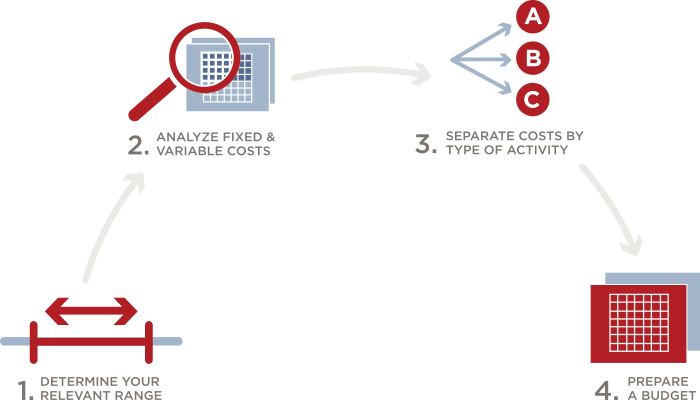
How To Build a Flexible Budget
To build a flexible budget, you:
Determine the relevant range of the activity that is expected to fluctuate during the coming period: the number of widgets manufactured, deliveries run, hours of contractor labor needed, and so forth.
Analyze the fixed and variable costs that will be incurred over that relevant range.
Separate costs by type of activity, such as market research (for expanding to a new market) or distribution.
Prepare a budget showing what costs will be incurred at various points throughout the relevant range.
案例
Diya, a marketing manager for a furniture retailer, is planning a marketing campaign for the next year's new fall line. She'll include in her budget the cost of an advertising agency's services, the fees for freelance writers, and the labor costs for additional call center representatives to handle expected increases in call volume.
Flexible budgets are especially valuable for organizations operating in volatile business environments.
案例
Tom is a supply chain manager for a steel manufacturer. Among other things, he is responsible for maintaining inventory at levels that support the sales plan. His company faces numerous uncertainties that could cause actual revenues and costs to differ markedly from those originally budgeted, including:
Fluctuations in the supply and cost of raw materials, electricity, and natural gas
Sudden changes in market demand for steel products, owing to a volatile global economy
Intensifying competitive pressures from imports
Changes in foreign trade policy affecting imports and exports
New government regulations increasing environmental compliance costs
For this reason, when preparing his annual budget, he includes ranges for the quantity of raw materials needed for production, as well as for shipping and logistics costs for inbound materials and customer orders.
不确定市场中的预算策略 Budgeting in an Uncertain Market
哈佛教授讲授视频逐字稿
An organization that faces extreme uncertainty is saddled with the challenge of, “How do I do budgeting in this context?” The solution is not to abandon budgeting altogether, but to modify to the context of heightened uncertainty.
So let me tell you the story of Leader Bank, a small community bank in the greater Boston area. A big portion of their net income was driven by the refinancing business. And when the interest rates drop, the refinancing business would boom. And if the interest rates went up, the refinancing business would die down. And these swings in the refinancing business [were] causing extreme swings to its income week to week, month to month. So they responded to the increased uncertainty in the following ways.
The first thing they did was start measuring the profitability of the refinancing or the mortgage origination business separately from the traditional banking and have separate P&Ls. So isolating the uncertainty was a critical first step.
Second, having isolated the uncertainty, they [could] now track the performance of the mortgage business on even a weekly basis. Certainly, on a monthly basis we would track how this bank's origination business was doing and split it up between refinancing and new purchase transactions. So more frequent observations and isolating the uncertainty are responses.
The third thing that we did was track how the bank's market share was related to its competitors. If interest rates drop, it drops for every one, including Leader Bank and its competitors. So it can't all be explained by: Interest rates went down, that's why you did well. You did well not just because interest rates dropped, but also because you outperformed your competition. So benchmarking relative to competition becomes a very key factor in the context of heightened uncertainty.
Another thing that you can do is change your cost structure. So one of the things that Leader Bank does is make sure that many of its originators have a very high percentage commission as part of their compensation. So when times are good and interest rates drop, they originate a lot more mortgages, they make a lot of money, sometimes maybe even more money than the CEO of the bank.
But in other settings, when the interest rates go up and the refinancing dies down, they're not left saddled with a whole lot of operating costs. So changing your cost structure to be in tune with the increased uncertainty is another key response of managers.
And the last step that we did at Leader Bank was have more hedging of our loan pipeline. If interest rates go up, you know that many of the mortgage originators might abandon their applications, so you want to hedge for this contingency by writing a hedge contract. And these days, the cost of these hedging transactions [has] declined dramatically [so] that it's affordable even for small community banks.
Activity-based costing and budgeting
Some organizations use activity-based costing (ABC) to allocate costs. ABC doesn't allocate overhead costs to products based on broad measures such as revenue or production volume. Instead, it starts with the cost of resources, allocates these costs to activities (such as purchasing), and then allocates the cost of activities to products or services.
The idea behind ABC is to come up with a true unit cost of production that accounts for all inputs. Traditional costing relies on averages, which can paint a misleading picture. For instance, the cost of producing a lower-volume product may appear low because it doesn't factor in the costs of setting up and breaking down equipment to manufacture that particular product.
To use ABC, managers often need to estimate how much time they and their employees spend on particular activities.
Organizations that use ABC may also adopt activity-based budgeting (ABB). To be effective, ABB has to be adopted by and embedded into the whole organization. It starts with forecasting the planned sales volume for each product. Managers then use historical data from the ABC system to estimate the activities required to produce that volume, the resources required to support those activities, and the cost of those resources. Organizations adopt ABB to achieve more realistic budgets that are more precise and accurate. However, ABB can be costly and complex to establish.
Activity-based costing and budgeting
第 8 节
Limitations of budgets
Like any other management tool, budgets have limitations. For instance:
They can be rigid. Startups as well as companies in fast-changing industries find budgets somewhat rigid. That’s because such enterprises can’t readily adapt their budgets to changes in their internal and external business environment.
They’re time-and labor-intensive. The budgeting process takes considerable time and effort. One survey showed that budgeting consumes 20%-30% of senior executives’ time.Pfeffer, Jeffrey. “The Real Budget Crisis: Stop Rewarding Forecasting and Negotiating Instead of Real Performance.” In What Were They Thinking? Unconventional Wisdom About Management. Boston: Harvard Business School Press, 2007. Because budgeting requires so much time, managers often must start developing new budgets before enough time has passed for them to assess the impact of budgetary changes on the last period’s results.
They can have unintended consequences. When managers’ performance against budgets is tied to their compensation, the practice might trigger the wrong behaviors; for example, budget padding (deliberately underestimating revenue or overestimating costs) and channel stuffing (shipping unfinished products to distributors to record more sales).
Caren, a marketing manager for a toy manufacturer,
Caren, a marketing manager for a toy manufacturer, intentionally understates demand for the company's products for an upcoming major holiday. That way, the revenues targeted in the budget will be low and easy to beat—and she can get a bonus. The company ties its production to this biased forecast and runs out of products to sell during the height of the holiday season.Shim, Jae K. Joel G. Siegel, and Allison I. Shim. “The What and Why of Budgeting.” In Budgeting Basics and Beyond, 4th ed. Hoboken, NJ: Wiley & Sons, 2011: 25.
Caren, a marketing manager for a toy manufacturer,
They can foster counterproductive decisions. If budgets aren’t linked to an organization’s strategy-related spending, they can end up encouraging actions that undermine goals.
A cost-reduction mandate that results in across-the-board cuts can hurt important strategic initiatives or operations that contribute disproportionately to the company's profits. As a result, high-performing units are penalized and underperforming ones are propped up.Gary, Loren. "Breaking the Budget Impasse." Harvard Management Update May 2003.
They can encourage a use-it-or-lose-it mindset. Managers fear that if they don’t spend what’s left over in their budgets at the end of the year, their funding for next year will be reduced.Gary, Loren. "Breaking the Budget Impasse." Harvard Management Update May 2003. So they find something to spend the surplus on, instead of channeling those funds to resource-starved operations or projects elsewhere in the organization.
Once you understand the limitations, you can adjust your budgeting practices and expectations accordingly and derive more value from the budgets you create.
麻省总医院:找到合理配置预算的方法 How Not to Lose Sleep Over Your Budget
哈佛教授讲授视频逐字稿
I have responsibility for emergency preparedness and response at Mass General Hospital in Boston, and one of the hardest decisions or processes that often we go through is trying to figure out how to allocate personnel time—budget time—to all the different needs that we have for emergency response. We are preparing for infectious disease outbreaks, for mass casualty events, for radiation release, for chemical hazards, for violent events. The list goes on and on and on. It can be completely overwhelming, especially when you realize that preparedness is very expensive, and if there's not a disaster, it looks very ripe on a budget to cut because it looks like something that's not adding value to the bottom line. So within whatever the resources are that we have, we have to come up with a good strategy for using our resources.
The hazard vulnerability analysis actually is a tool that helps us try and figure out each of those elements individually and score them. So we look at the probability of an event: How likely is it to happen? We look at the consequence: What would happen in terms of either economic or human toll? We look at how ready we are for that kind of an event and score where our current preparedness is.
And only when you put those elements together of likelihood, consequence, current readiness, and mitigation strategies available can you come up with some rational way of using your resources against very, very, very different threats.
One good example is, frankly, our preparedness for chemical hazards. It's, thankfully, quite unlikely that someone's going to release a chemical in Boston or even that there would be an industrial release, but the consequences are very, very significant. And so we've chosen an approach where we have personal protective equipment. We have gear for our staff to wear that is appropriate for almost all hazards.
Each year, we reevaluate where we are. We look at the likelihood of the hazard. We look at the consequence. We look at how much better our preparation is and what the cost of new mitigation strategies is.
Although I lose a lot of sleep every night about all those different possibilities of risk, I sleep a teeny bit better knowing that at least I have a methodology that underlies the approach to those different kinds of risk, and helps me figure out what I can do with the staff and the budget at my disposal.
Advances in budgeting practices
Technological advances in such areas as enterprise software applications, data-gathering and -distributing capabilities, and business analytics have opened the way for significant advances in budgeting practices. Many organizations are reforming their budgeting process. In particular, they are incorporating budgeting into a suite of management processes and evolving toward more real-time planning. As more companies adopt software development—inspired "Agile" ways of working—such as iterating their product or working in multidisciplinary teams—budgeting and finance practices and processes are changing to be more transparent, more flexible, and more responsive.
Some of the newer practices include:
Rolling forecasting. As each month’s actual results are finalized, the forecast is updated to provide an additional month’s forecast. Thus the resulting budget—a rolling budget—always covers a standard period of time (such as 12 or 18 months).
Dynamic forecasting. Similar to rolling forecasting, but with no set frequency or fixed time horizon. Managers forecast as conditions change, and not according to the calendar.
Driver-based planning. An approach to creating budgets and forecasts using models of the underlying business activities that drive financial data. This method of planning integrates the assumptions about activity levels that drive revenues, variable headcount and expenses, and capital. Because the drivers and assumptions are transparent, plans can be more widely understood and more readily modified.
Advances in budgeting practices
第 9 节
REFLECT
Reflecting on your learning helps you apply relevant concepts to your job.
Take a Moment
1. 1. What new insights do you have that could benefit you or others in your workplace?
2. 2. What are your biggest opportunities for applying concepts from this Lesson in your workplace?