Pocket Leadership口袋领导力

Team Management

Measure and Boost Team Performance 查看中文版

第 1 节

In a fast-moving world, what causes a team to excel? Motivating goals? Accountability? The right metrics?

Yes—all those things matter

But more than anything, for a team to reach its full potential, members need to have a secure foundation."Research: What Do People Need to Perform at a High Level?" by Zorana Ivcevic, Robin Stern, and Andrew Faas. Harvard Business Review, May 17, 2021


That means as a leader you must:

  • Be clear about what you expect of them

  • Connect them to the purpose of their efforts

  • Encourage them to ask questions, even tough ones

  • Give them autonomy to shape their work

  • See and support them as human beings

Whenever you’re concerned that your team’s performance may be faltering, make sure you’ve established a good foundation.

Take a Moment

Take a Moment

Make a Connection

1. What can you do to strengthen your team’s foundation so all members can perform at their best?

第 2 节

In many organizations, teams are often asked to set goals to simply “do more” of what they already do. For instance, they may be instructed to make more sales or process orders faster.

In the short term, such goals can improve the business’s bottom line. However, if they are the only goals your team hears about, these “just do more” goals lose effectiveness over time.

What might be a motivating challenge at first (“Can we hit this number?”) may eventually become a liability.

Continually upping the stakes may cause people to feel like what they do is never enough. They may cut corners or burn out.

If you frequently receive “just do more” goals from leaders above you, find ways to transform them to support your team’s growth, curiosity, and mastery.

Paxton refines his team’s goals

Paxton refines his team’s goals This quarter, Paxton and his team need to increase the number of customer problems they successfully resolve by 2 percent. Instead of simply pushing people to work faster, Paxton creates goals that will help members develop insight into the issues callers face and better anticipate caller needs. These goals are: Research and discuss news events that might affect our customers Predict the issues customers are likely to call about Identify frequently asked questions and develop simple, effective responses Paxton’s group focuses on these goals and achieves its 2 percent target. Paxton refines his team’s goals

Note that Paxton’s additional goals don’t undermine the business objective. Instead, they build people’s motivation by increasing the team’s performance and providing opportunities for learning and career growth.

Did you know?

Did you know? In a study, managers who showed the connection between people’s performance goals and the organization’s goals increased the percentage of high performers from 44 to 60 percent.*

Take a Moment

1. Think of a team goal that involves “doing more.” How can you modify this goal to act like a springboard to excellent team performance and learning?

第 3 节

To improve, your team needs to know how it’s doing. Specifically, members should understand how its work compares to:
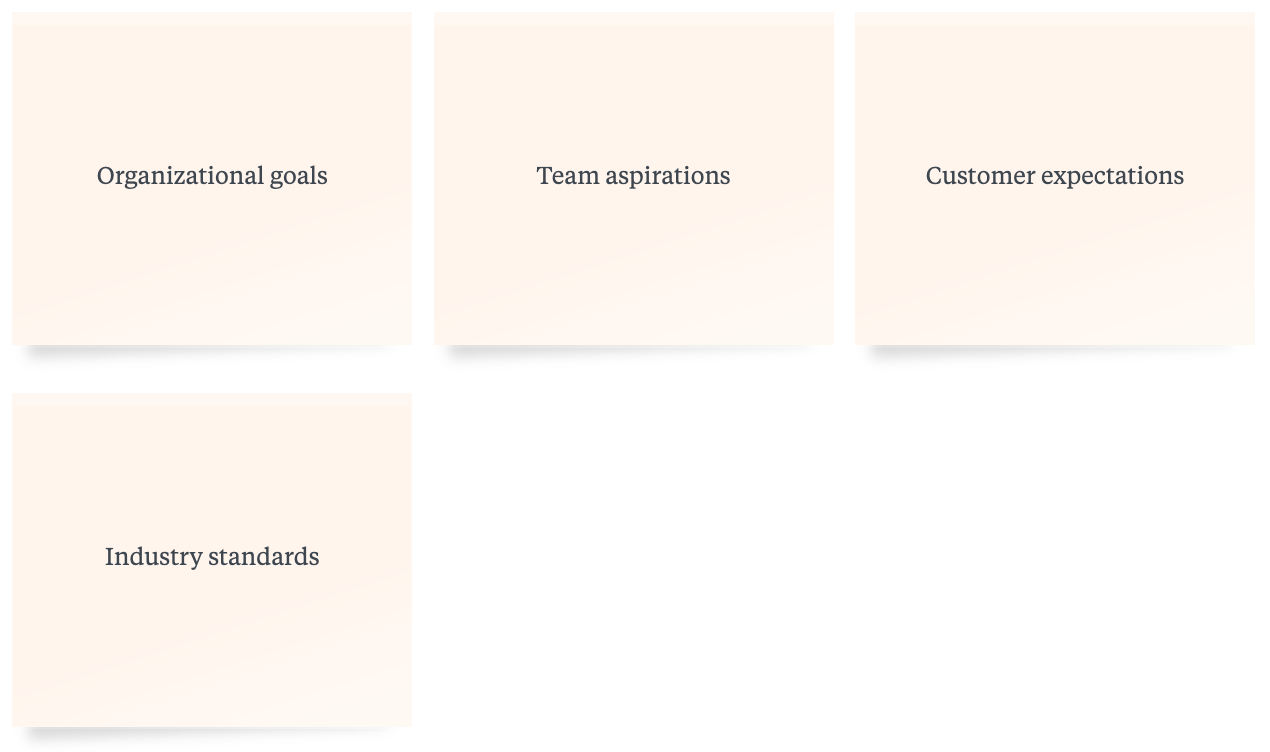
With this information, you and your team can gauge whether your actions are having the desired impact or if you need to change what you’re doing.

But there’s a common hurdle with measurement:

Teams often measure what’s easiest to track, not what’s most useful for improving performance.

A common example is a sales team measuring the number of calls placed to prospects rather than tracking how many prospects become customers. The difference is profound: In the first situation, the team focuses simply on volume. They are rewarded even for negative outcomes, like placing calls to people who have no need for the product or service.

With the other metric, which focuses on making the sale, the team uses data to become more effective and efficient.

As a team, ask:

  • How can we measure what we’re trying to achieve? Discuss what you need to accomplish, what data provides the most useful information, where that evidence would show up, and how to collect it.

  • How often do we need to collect that data? You don’t want to drown in numbers. Decide which intervals will give you a sense of how you’re progressing toward your goals.

Regardless of what you measure, you always want to surface:

Good news Where are we excelling? How can we build on it? Bad news Where did we stumble? What corrections are necessary? Unexpected information What’s changing? What are the implications?

You need all three kinds of information—the good, bad, and surprising—to make the smartest decisions about what the team needs to do next.
Take a Moment

1. What one or two actions can you take to get a more complete picture of your team’s performance?

第 4 节

Once your team has a strong set of goals—and ways to measure progress on those goals—members need to take responsibility for meeting them. Accountability means team members deliver on the commitments they make. "The Right Way to Hold People Accountable," by Peter Bregman. Harvard Business Review, January 11, 2016


Within a team, accountability comes from:

  • Understanding how people’s work is connected

  • Wanting to do the best for each other and the team

  • Having a willingness to uphold a set of standards

测验

1. Do you know which kind of accountability is especially powerful for teams? *
答案与解析

A. Leader-to-peer accountability
Good guess, but no. On high-performing teams, everyone holds each other accountable. No one is exempt, even leaders.

B. Peer-to-peer accountability
Yes! On high-performing teams, members hold each other and their leaders accountable for keeping their commitments.

To hold someone accountable, encourage team members to calmly and clearly summarize: The standard expected “Jordan, clients expect a full itemization of all fees.” What happened “This invoice is missing details in the highlighted columns.” The impact “If we sent this, we would immediately get a concerned call about what we’re charging.”

These conversations should happen in real time, not as a last resort after multiple errors. When a coworker immediately raises a concern, they allow for an exchange of information; for instance, Jordan might respond that a supplier has not furnished the details as it usually does. Jordan and the teammate can then decide on a next step.

One tool for creating ongoing accountability is an “at-a-glance” summary of key projects, including who is responsible for what, where each project stands, and what’s coming up. Make sure every team member has access to the summary, and regularly update and review it as a team.

第 5 节

Yes, feedback is hard. Often, no one wants to give or receive it. But on high-performing teams, people see feedback as essential for driving improvement and growth.

Here, author Liane Davey offers tips for giving constructive feedback.

在团队中打造反馈文化 Create a Culture of Feedback on Your Team

哈佛教授讲授视频逐字稿
Feedback is a gift. You've probably heard that expression. And maybe you've even said it to your own team. And I genuinely believe it. Feedback is so important for understanding how our behavior affects others which is critical for performance, growth, and development. So, feedback really is a gift. So, as a manager, you have this wonderful opportunity to do a reset on what good feedback looks like to create more positive experiences of feedback for your team and get all the benefits that come with it. I'm going to give a real situation that has happened to me. I was giving a presentation on a video group meeting. And just as I started to give my presentation I noticed that Sally turns off her video. Completely threw me off my game, distracted me, and I thought, what is going on? How rude. She's turned off her camera right as I'm starting my presentation. I had concocted a whole story for myself about what was going on in Sally's head. So this is a situation where I really need to give Sally that feedback. When we get on the call I want to say something like, when I started my presentation, you switched off your camera. It's as simple as it needs to be. Because the new information in feedback should not be about Sally. She shouldn't be learning something new about herself. She should be learning something new about me. And that's where I can share with her that it really threw me off. Good feedback is giving her new information about me. And giving her the chance, then, to say, what was going on. Now, in this story, turns out the real answer was Sally said, Oh, I'm so sorry. My bandwidth is terrible. My kids are homeschooling so I just turned off the video so that I could make sure I could hear the audio really clearly. Oh, her truth was so different from my truth. So we get something very constructive when we tell somebody about their behavior and the impact it's had on us rather than evaluating or judging them. The second thing we want to do is we actually want to make sure that it comes quickly. And so that our feedback is frequent and low impact. If I had sat on that, if I hadn't told Sally, if I gave myself some great story about, Oh, I'll just pick my battles. I'm not going to say anything. Then likely, my resentment towards Sally could have grown. And that's what causes situations on our team to get worse and worse until finally there's a blow-out or some very uncomfortable confrontation. So as a manager, use the end of the meeting to take a few minutes to say, anybody have any feedback? How were you experiencing this meeting? What stories were you telling yourselves? You get this incredible improvement in performance. But not only that. You get enhancements to trust in engagement on your team. That's when you'll realize what a gift feedback truly is.

The more regularly team members give and receive feedback, the easier it gets to have these exchanges. If someone blindsides a coworker suddenly with, “Can you give me feedback?” they may get a polite but restrained response. Instead, encourage them to get the ball rolling in a lower-stakes way.

Here are some conversation starters:

Give me a score “On a scale from 1-10, what score would you give my presentation?” followed by, “What could I do next time to bring my score up?” One thing “What’s one thing I could improve about this presentation/document/design/pitch?” "So I can learn" “Could you share your thoughts with me so I can learn? Can you walk me through why another recommendation was selected instead of mine?” Stop/start/continue “Please tell me one thing I should stop doing, one thing I should start doing, and one thing I should continue doing.”

The best way to get team members comfortable with feedback is to lead by example. Ask for input and receive it thoughtfully, without becoming defensive. Remember: You don’t have to agree with or act on every piece of feedback you receive, and you should thank the person who took the time to share their perspective.

How can you give feedback more effectively?

One strategy is to “clarify and contrast” (“What I mean is X. What I don’t mean is Y.”). This may be especially useful if you’re giving feedback to a team member over a video call and are concerned they‘ll come away from the conversation feeling worried or undermined. For example, “What I am saying is that you need more practice and coaching on your negotiation skills, and I can help you with that. What I am not saying is that you’re failing at your job or that you’ll never become a fantastic vendor liaison.” You can even ask the person to repeat your feedback back to you to make sure they truly heard the praise as well as the critique. How can you give feedback more effectively?

TOOL:Ask for Feedback

附件:ask_for_feedback_worksheet1696657900430.docx(docx · 1107 KB,本地副本)

第 6 节

Praise, appreciation, and gratitude are powerful tools for teams. They help lower stress, build goodwill, and strengthen resilience during challenging times.

As a leader, your recognition of both individual and team efforts and accomplishments goes a long way. Here, professor and executive coach Monique Valcour shares tips for rewarding your team’s efforts.

认可并奖励你的团队 Recognize and Reward Your Team

哈佛教授讲授视频逐字稿
Most of us don't feel like we're adequately recognized. And if you think about it, most of the ways that we recognize people at work happen at the level of individuals. So it's really important to think not only about how do I make sure I'm rewarding my individual performers, but how do I focus attention at the level of the team? Team rewards can help to build each member's commitment to the team, to provide a powerful group identity, a sense of pride, a sense of cohesion with other people. And it can also help to promote the team to others outside your organization and beyond. So as a person who leads a team, you don't need to have a ton of resources, but use your creativity to find ways to highlight all the positive things that your team is producing. What is it that my team is doing that's really great? What are they accomplishing and producing together? And how is it that they're going about achieving those things? So encourage your team members to talk a little bit about what they see as the top strengths or the unique qualities of your team. And when you have that sense of what is our group identity, what's something that really resonates for people, that's a wonderful thing to promote even outside of the team as well, so that others in your organization can see what a high-performing, coherent team that you have. And customers as well love to have a sense of the kind of collaborative muscle that goes into providing excellent solutions for them. Another great thing to do is to encourage people to recognize each other. You might not be fully aware of the ways in which team members contribute and support each other. And it's wonderful to cultivate a culture of recognition wherein people are focusing on and recognizing the ways in which individuals helped to produce those great team outcomes. It's usually pretty easy to come up with individual rewards. Think of any awards dinner you've ever attended before. So continue to do that, but also really think about, what is it that helps this team to thrive and perform? And how can I recognize that more frequently and more formally such that it becomes visible to everyone else?

If you can’t deliver praise right away, write yourself a reminder to reach out. There’s no expiration date on gratitude or appreciation.

Did you know?

Did you know? The brain processes compliments like it does financial rewards.“What Not to Do When You're Trying to Motivate Your Team," by Ron Carucci. Harvard Business Review, July 16, 2018.

When you want to motivate team members and praise them in ways that boost performance, here are three strategies to use:

Get the story Say, “Troubleshooting that process was impressive. Can you tell me how you approached it?” Put the contribution in context Say, “Thank you for fast-tracking the approval process. We were able to put in the first bid.” Acknowledge the cost Say, “I appreciate your efforts to merge data into this new system. It was a tedious task at a time when you had many other things to juggle, but now we are in a position to make a stronger decision.”

Also encourage team members to express their appreciation to their peers for a job well done. "What Not to Do When You're Trying to Motivate Your Team," by Ron Carucci. Harvard Business Review, July 16, 2018

When workers understand which actions matter most to their teammates and why, they’re more likely to make them habitual.

Make a Connection

1. Which strategy will you use to show appreciation to a team member?
  • For your team to reach its full potential, you need to provide a secure foundation, including clear expectations, connection to the work’s purpose, and autonomy.

  • Goals focused on simply “doing more” lose effectiveness, so find ways to transform them to support growth, curiosity, and mastery.

  • Measure what’s most useful for improving performance, not necessarily what’s easiest to track.

  • Team members should help each other stay accountable for delivering on the commitments they make.

  • On high-performing teams, people see feedback as essential for driving improvement and growth.

  • Praise, appreciation, and gratitude are powerful within teams; they lower stress, build goodwill, and strengthen resilience.

Take Action

1. What will you do in the next week to improve your team’s performance?


第 7 节

Reflecting on your learning helps you apply relevant concepts to your job.

Take a Moment

1. 1. What new insights do you have that could benefit you or others in your workplace?
2. 2. What are your biggest opportunities for applying concepts from this Lesson in your workplace?

Further reading

当工作量超过团队能够承受的范围时
当工作要求不断增加、资源却在减少时,领导者不能简单地把多出来的工作揽到自己身上,也不能逼已经不堪重负的团队再加把劲。这两…
AI 能够提升团队协作的每个阶段——前提是满足两个条件
AI 采用正在加速,但大多数组织忽视了大量工作发生的场所:团队。管理者经常使用 AI 处理个人任务,却很少把 AI 引入…
无形工作,正在耗尽你最优秀的员工
大多数领导者评估工作量时,关注的往往是工时、截止日期和产出,但这些衡量标准忽略了员工所承担的心理负荷—&md…

Top 3 in the source platform's original order