
Navigate Team Transitions 查看中文版
第 1 节
In the last few years, have you experienced a lot of change on the teams you work with? "Learn to Get Better at Transitions," by Avivah Wittenberg-Cox. Harvard Business Review, July 5, 2018
For many of us, the answer is, “Yes! So much change.”
The COVID-19 pandemic accelerated workplace transformations to a breathtaking degree. Some industries scaled down staff suddenly—and then rehired rapidly. People shifted in and out of the workforce because of layoffs, illnesses, caretaking responsibilities, and other adversities.
Even under ordinary circumstances, teams regularly go through transitions. People leave and new members join. Work changes. A project concludes. A new group forms.
During these kinds of transition, as a leader, your role is to help your team:

Take a Moment
第 2 节
When your team is going through a transition, what do you pay the most attention to: logistics or emotions? "Learn to Get Better at Transitions," by Avivah Wittenberg-Cox. Harvard Business Review, July 5, 2018
The common response is logistics. During times of change, you need to handle organizational issues quickly and competently. But it’s a mistake to place so much focus on tasks that you neglect people’s emotions. If anxiety or frustration bubble up within your team, logistics often become thornier than they need to be.
When you stay attuned to how people feel about change, you help them stay clearheaded and resilient during the transition—which makes them better able to handle all of the organizational challenges.
Bottom line? During periods of change, logistics matter, but also stay aware of people’s emotions.
Be ready to address:
Remember, change hits people differently. What might be a thrilling opportunity for some team members may cause deep distress for others.
What should you do if your whole team is unhappy about the change?
Paying attention to team members’ emotions is a smart investment of your time and energy. When they feel heard throughout a transition, they’ll be more likely to embrace the new reality.
第 3 节
Three things help teams successfully navigate the most challenging part of a transition: the “messy middle”"3 Tools to Help Leaders Steady Their Teams During a Transition," by Victoria M. Grady. Harvard Business Review, March 30, 2021

Choice helps people adjust faster to new circumstances. People adapt to change more fluidly if they’re actively involved in smaller decisions along the way.
Encourage people to shape the transition. As much as you can, let team members decide on:
-
Schedules
-
What work to tackle first
-
Who else to include on the team
-
Working arrangements, such as hybrid vs. in-person
Even small choices, like which conference room to turn into a “project headquarters,” can be meaningful.
In addition, use purpose as a guiding star during a transition.
A compelling purpose is particularly important if the change feels like it was imposed on the team.
Help the team define its objective by asking questions like, “What do we stand to gain?” or “How can we make a positive difference?
The last strategy for managing the “messy middle” of a transition is to create a bridge. A bridge is a way to help your team leave behind “what was” and cross over to “what’s next.”
A bridge could be:
Try it Out
第 4 节
If your team’s workload expands, you may frequently bring in new people, including:
-
Full-time employees
-
Temporary or gig workers
-
Interns
-
Employees on loan from other groups
When you’re designing a job posting (internal or external), work as a team to define what you really need. Categorize skills as:
This exercise helps team members go beyond cloning their own skill sets or trying to replace the exact qualifications of a team member who left.
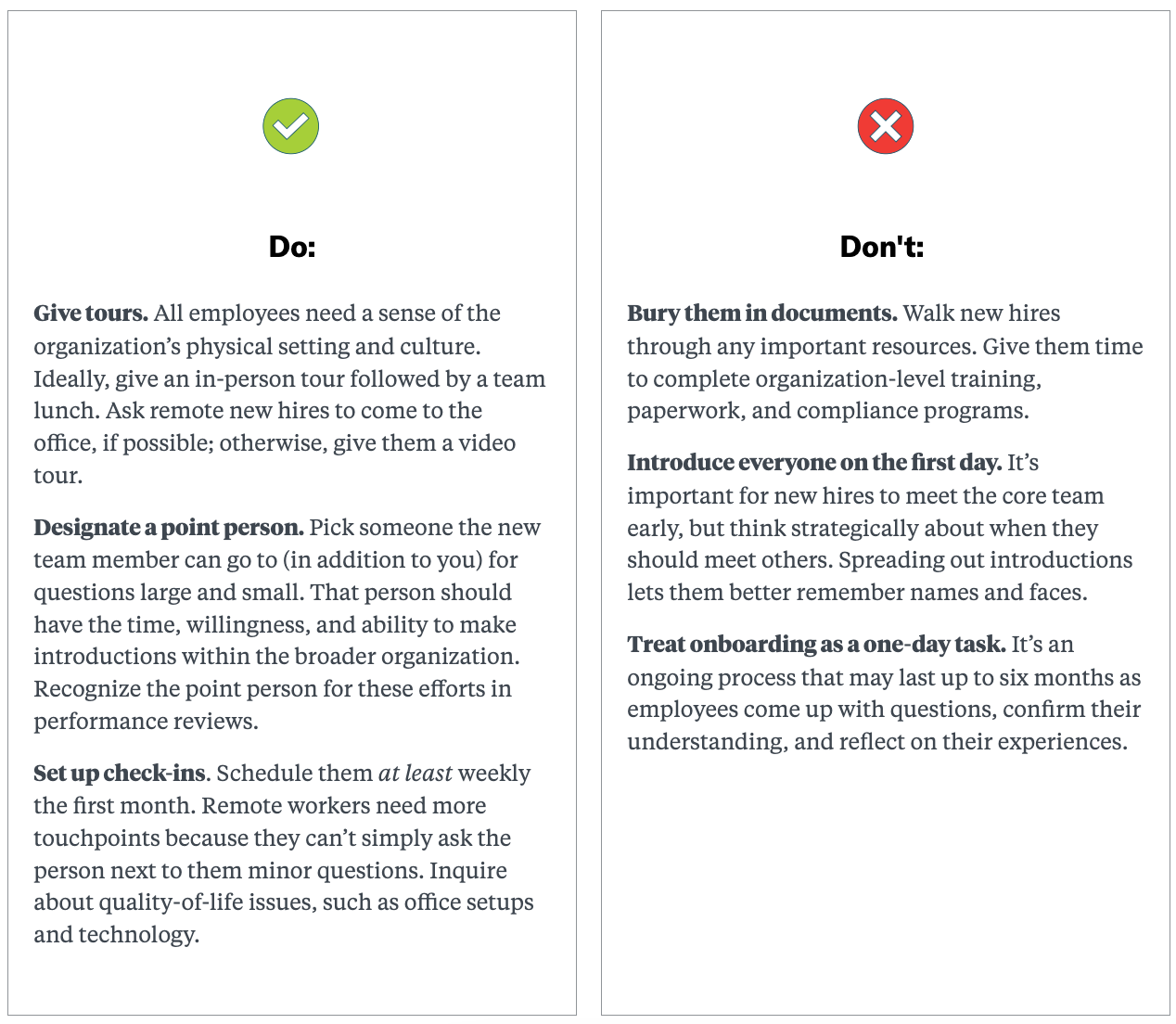
Once you’ve recruited a new team member, design an onboarding process based on whether they’ll be working in the office or remotely.
Tip
Do's and Don'ts for Onboarding New Team Members
第 5 节
People come and go from teams. Whenever you have a departure, address logistics and emotions. Also be sure to:
Meet with the person who’s leaving and make a list of their projects and tasks. Don’t assume you know everything they’re working on.
Then plan for how to reallocate this work. Give remaining team members a say in what additional work they take on. Offer them a chance to take on more desirable projects, and share the burden of less desirable work across the team.
In addition to arranging the logistics, support your team’s need for closure by planning a way to say goodbye. It’s important that people don’t simply vanish and that you take the time to thank and recognize them.
A send-off doesn’t need to be elaborate, expensive, or long.
A last lunch with the team might be perfect for one employee, while allocating 15 minutes at the end of a video call might be a great fit for another. Consider asking a colleague who knows the departing person especially well to organize the event or advise you on it.
第 6 节
Some departures are unplanned and downright unpleasant. People get fired or laid off, which often blindsides teams.
Did you know?
Even if no one in your group loses their position, tension and uncertainty ripple through organizations after layoffs. Assume your group will feel some impact.
After layoffs, it’s common to see morale and productivity drop.
But managers can prevent or mitigate such struggles. Workers who described their managers as “visible, approachable, and open” after a layoff were much less likely to have their productivity decline.
Talk candidly with your team about layoffs and answer any questions you can.
Explain:
-
Why these cuts were made
-
What other options were considered
-
What support laid-off employees received
-
Why team jobs remain secure
If your group has been directly affected, continue to check on team members’ well-being, workload, and morale in the months following.
第 7 节
In a fluid, fast-paced environment, it’s critical for teams to disband in an organized fashion so important institutional knowledge isn’t lost.
To disband a team, debrief members by asking:
-
How did we do?
-
What did we learn?
-
What were the high and low points?
-
What insights did you gain that you can apply to other projects?
Provide these prompts in advance and ask team members to think about them before the meeting.
Afterward, follow up with a summary that integrates points from the group discussion and any feedback submitted by chat. This way, you capture insights from both quieter and more vocal team members.
Tip
Preserve information and make it accessible. Ensure that others in the organization can easily find a team roster and project outcomes and artifacts. The team roster is helpful because it lets others know where to go with questions. Also, leaders can staff new teams quickly because they can easily see who has relevant experience.
Poll
Here, consultant and author Scott Anthony shares his tips for capturing knowledge at the end of a project:
Encourage team members to update their internal bios and resumes to include the work they did for the team. It’s a step that’s often missed but is vital for career development.
Finally, give back! Recommend team members who did an outstanding job for new opportunities within your organization.
Capture Lessons Learned
-
All teams go through transitions, with people leaving, new members joining, and projects concluding.
-
As a leader, help your team let go of what was and embrace what’s next.
-
During change, logistics matter, but leaders must also be aware of people’s emotions.
-
In the “messy middle” of a transition, give people choice, purpose, and a “bridge” between the past and the future.
-
Design an onboarding process for new hires based on whether they’ll be working in the office or remotely.
-
When someone leaves the team, reallocate the work and thank the person.
-
If your organization has layoffs, talk candidly with your team and take questions.
-
When a project ends, take steps to preserve institutional knowledge.
Take Action
第 8 节
Reflecting on your learning helps you apply relevant concepts to your job.