Pocket Leadership口袋领导力

Team Management

Lead Your Team Through Conflict 查看中文版

第 1 节

Conflict within teams is inevitable—and that’s okay. People don’t always agree with each other, nor should they.

In fact, on high-performing teams, people aren’t afraid to disagree. They know that productive tension improves results by generating more ideas, challenging the status quo, and increasing accountability. When managed well, conflict also helps team members learn from each other and forge stronger relationships.

测验

1. In general, how do you view conflict among team members?
答案与解析

A. I avoid it; my instinct is to smooth things over.
Much of teamwork involves compromise and consensus building, so your instinct for harmony is useful. However, don’t let your discomfort with disagreement cause you to shut down debate, gloss over valid concerns, or penalize people who create healthy tension.

B. I’m okay with conflict. It’s part of life.
This is a great perspective. Even so, be alert for friction on your team. When you see reason for concern, check in, facilitate productive debate, and encourage accountability.

C. I like to use conflict as a tool; otherwise, we might get complacent.
Clashes can foster creative sparks and spur people to perform better. But if you’re pitting people against each other or encouraging rivalry, you’re doing damage. When team members feel stressed and unsafe, they’re less likely to do good work and more likely to cut corners.

So how do you know when conflict is healthy?

Good conflict is…

A respectful debate of options People are looking for the best solutions together, not trying to tear each other down. About the work What’s to be done, how, when, where, why, etc. When conflict becomes personal—which might be expressed as finger-pointing or attacks—people get defensive and hold firm to their positions. That makes it difficult for them... Direct The conversation should occur directly between the parties involved, whether in meetings, emails, or informal discussions. Communications shouldn’t involve complaints to others or passive-aggressive sabotage. Resolved Resolution doesn’t mean finding a perfect solution. It means airing differing views, discussing the options, and jointly moving forward. The dispute can even conclude as an agreement to disagree, but with a common path forward.

Here, author Liane Davey talks about how to turn productive conflict into team success.

管理团队的良性冲突 When Conflict Is Constructive and When It’s Not

哈佛教授讲授视频逐字稿
Conflict is a notion that strikes fear into the heart of many managers, and I understand. You can probably think of situations where there's been really nasty arguments or hurt feelings, but as a manager, conflict is something that you want to create on your team and manage because conflict is really inevitable. There are often, opposing wishes and demands and needs. The key is to make sure, as a manager, that you're promoting productive conflict. Productive conflict, I like to think of it as tension. Tension is a stretch, something that makes us think differently about an issue than we've ever thought before. Maybe we have to think about a different angle on a problem or a different stakeholder that we don't normally think of. That tension between different individuals on your team, between opposing interests is how we optimize decisions. So tension is productive conflict, but what's unproductive conflict? It's friction, and friction is where we don't listen to one another, we wear each other down by being aggressive, being personal in our points, not flexing and changing what we're thinking based on how the conversation is going. That friction, you'll know it's happening on your team because people won't be listening well, there'll be lots of interrupting, and very little time in between each person speaking. When that happens, we often see emotions start to get more involved. Sometimes, those emotions even sort of overflow when we get someone yelling or pounding the table or in tears. When that happens, it's important to remember that emotions are not unproductive or unprofessional. They're just the way humans interact with our world. So don't fear emotions but do find a way to work through them. Don't stop and say, “OK, we'll take this offline” just because you've seen emotion, but do say something like, “This is important. What do we need to understand?” That's a great phrase because it doesn't have judgment. It doesn't risk speaking on someone else's behalf like you would if you said, “I see you're very upset.” Usually, within a very short period of time, the person will be talking about a path forward. If they don't get there, you have a few options. You can say something like, “What do you need?” for somebody who's really getting wrapped up in feeling very emotional, but not being clear what would make things better. You could also use the line, “Where from here?” That's really great if somebody keeps talking about what's gone wrong in the past, but isn't doing anything to help you figure out what you do in the future. Finally, if you're getting a lot of, but this won't work or that won't work or but, but, but, but, but, you're getting a lot of that, it can be really helpful to say, “What do we still need to solve for?” Get them to actually be specific about what the problems and issues are. When you keep conflict focused on the productive tensions between different expertise and different perspectives and different stakeholders, and you avoid letting it become friction with poor listening and personal statements and too much aggressiveness, when you manage through emotions out to the other side, you'll find productive conflict becomes the secret to your team's success.

Take a Moment

1. As a leader, how can you help your team make the most of productive conflict or tension?

第 2 节

The benefits of good conflict disappear if a dispute turns personal or disagreements devolve into attacks. This unhealthy conflict often shows up in the form of:

  • Turf wars over who is in charge or has seniority

  • A rehashing of past mistakes

  • Comparisons of workload

  • Repeated complaints

  • Passive-aggressive behaviors

Unless the conflict is addressed, resentments can build up and ultimately affect a team’s effectiveness, motivation, and well-being.

If you find team members embroiled in unhealthy conflict and unable to resolve it on their own, help them move forward by following these steps:

Find the root cause What are the underlying reasons for the conflict? For example, are there stark differences in personalities or personal values? Struggles over shared resources? Once you understand what’s causing the conflict, you can better support team members in resolving it. Facilitate a resolution Avoid dictating what the parties should do. Instead, facilitate a resolution by scheduling time for them to talk. Make sure everyone feels heard. Encourage people to stick to the facts and focus on behaviors instead of character judgments. Promote forgiveness Once the conflict has been resolved, encourage the people involved to move past it. Conflict can ultimately be a learning experience and contribute to stronger team relationships in the future.

Choose when to get involved. Instead of refereeing every squabble between team members, help them learn to handle some friction on their own. Before jumping in, ask questions such as, “Have you talked to each other directly?” or “What else have you tried?”

Some conflict is downright toxic and must be addressed immediately.

Symptoms of toxic conflict include: Derogatory language (used in public or behind the person’s back) Threats Lies Deliberate sabotage For your workplace to be safe for everyone, you need to confront these behaviors. Before you address these issues with the parties involved, get advice from human resources. Some conflict is downright toxic and must be addressed immediately.

第 3 节

Conflict during team discussions can be invigorating, clarifying, and extremely useful. But debates often fracture when people:

Want to prove they're right Remind your team that the goal is to find solutions together, not to compete or determine whose point of view is “correct.” Try saying, “Let’s take a step back and remind ourselves of our shared goal, which is …” Stray off track When people feel strongly about their opinions, they may derail the debate by resorting to logical fallacies or bringing in irrelevant information. As a team, agree on norms for how to act during debates, which could include the following: stick to facts, don’t raise your voice, and be ready to validate your assertions. Get personal If people feel attacked, their emotions kick in and the conflict becomes unhealthy. Encourage your team members to depersonalize arguments by choosing their words carefully. For example, suggest they swap out, “How could you think that?” for, “What makes you feel that way?”

Here, leadership author Scott Anthony gives advice on using a simple phrase to defuse conflict.

善用创造性冲突激发创意 Disagree Without Being Disagreeable

哈佛教授讲授视频逐字稿
It was getting heated. We were working as a team to try and figure out what should we advise to a client about how quickly they should grow a new business they were working on. We're having a really contentious discussion. We each believe really strongly in our opinion. Temperatures are rising in the room. You can feel the conflict there. What do you do in circumstances like this? You know that there's lots of benefits in getting different opinions, different viewpoints on the table. But how do you remove some of the emotion? How do you remove some of the tension? You make one very simple change. You move from "I think" to "I assume." What does that mean? When you're discussing different options, it's very easy to say, "I think we should do this." Someone else says, "I think we should do that." Immediately, you're creating a battle between the two people. This is kind of like religion or politics or your favorite sports team. No one wins these discussions. When you start with "I assume" -- "I assume that we should expand rapidly, for these reasons." "I assume we should go slowly, for those reasons." All of a sudden you create space where those assumptions can have a battle without anyone getting hurt. We could disagree without being disagreeable. It's as simple as that. Move from "I think" to "I assume." Encourage the creative abrasion that ultimately leads to great ideas.

Make a Connection

1. What are some words and phrases you can use to help people stay positive and constructive during discussions?

第 4 节

A team needs to function as a whole. On high-performing teams, information circulates freely so everyone has access to the best available knowledge.

Did you know?

Did you know? Employees who withhold information from their peers are 17 percent less likely to thrive at work. Hiding information takes a mental toll and makes it difficult for people to develop meaningful relationships.span class="citation">“Why Withholding Information at Work Won't Give You an Advantage," by Zhou (Joe) Jiang. Harvard Business Review, November 14, 2019.

But that’s not always the case on teams. Sometimes, people withhold information from each other. They may do this for a variety of reasons, but in general, it’s because they fear they’ll:
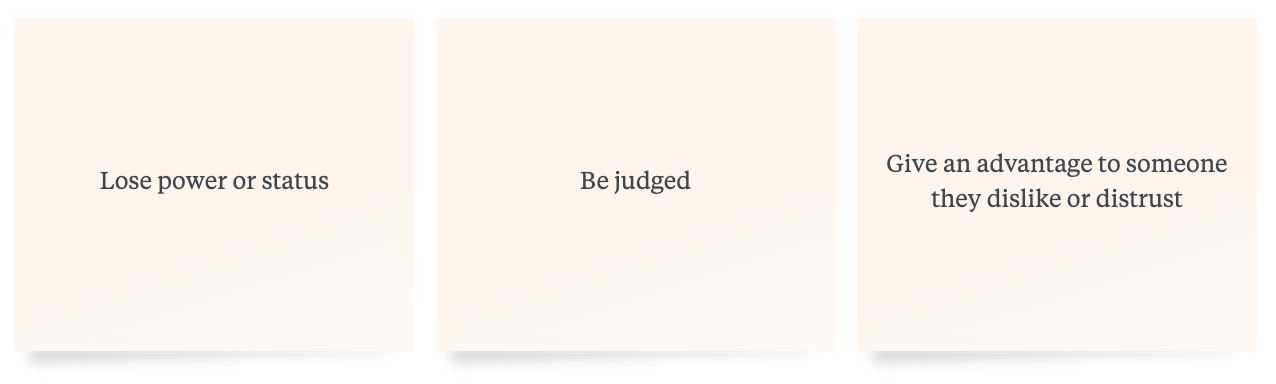
To intervene with someone who is withholding information from team members: Flag the issue Meet privately with the individual and describe the behavior you observed. For example, you might say, “I noticed that you consistently left Daniel off the list when you circulated the draft contract. Do you have reservations about his participation in the review?” Rather than blaming or judging, be curious. You may discover an underlying problem. Set standards Be clear about what you expect and why. For example, you might say, “While it’s new to us to have a project auditor, Daniel’s job is to make sure our costs and contracts are in line with industry standards. We need to include him in every step of planning.” Follow up Make sure the changes you requested have happened. For example, check who is copied on emails and invited to meetings. Create safety Team members often withhold information because they feel insecure, so build a sense of security. Reaffirm the value people bring to the team, and reward and praise individuals when they are forthcoming and collaborative.

If you suspect team members aren’t sharing what they know, ask questions to draw out more information. For example, say, “I noticed you hesitated there. Was there more you wanted to add?” or “We haven’t heard your take yet. I’m curious about the strengths and weaknesses you see in this proposal.”

第 5 节

Real or perceived differences in the way people are treated can be key sources of resentment, something that can lead to team conflict. As a leader, you can make your team feel included and secure—or not.

Try it Out

Try it Out

Take a Moment

1. What changes can you make to improve in these areas?

One example of how questions of fairness can affect a team involves the rise in hybrid work. Team members who work in the office may resent what they perceive as the flexibility and comfort afforded to their peers who work from home.

On the flip side, those working from home may feel left out. They may believe their peers who are on site get better opportunities and are privy to more information.

To reduce frustration within a hybrid team, consider:

Are the arrangements fair for everyone? Do all team members have the choice to work from their preferred location and, if not, are the reasons for the disparity clearly understood and driven by business needs? Do we operate under common guidelines? There should be one working standard for everyone on a hybrid team. Create guidelines around practices such as “high-availability” hours, and establish norms for when and where meetings are held. How can we make people’s contributions more visible... Team members need to see other’s work so they know everyone is contributing equally. Create a shared dashboard and have regular meetings so team members can share what they’ve been working on and how their work adds to the...
  • Conflict within teams is inevitable—and that’s okay. On high-performing teams, productive tension improves results.

  • The benefits of good conflict disappear if disagreements devolve into attacks.

  • If you find team members are unable to resolve unhealthy conflict on their own, help them identify the root cause, facilitate a resolution, and promote forgiveness.

  • On high-performing teams, information circulates freely. Intervene if someone is withholding knowledge from others.

  • Treat everyone on your team fairly to avoid sparking conflict and resentment.

Take Action

1. What can you do this week to prevent or manage conflict on your team?

第 6 节

Reflecting on your learning helps you apply relevant concepts to your job.

Take a Moment

1. 1. What new insights do you have that could benefit you or others in your workplace?
2. 2. What are your biggest opportunities for applying concepts from this Lesson in your workplace?

Further reading

当工作量超过团队能够承受的范围时
当工作要求不断增加、资源却在减少时,领导者不能简单地把多出来的工作揽到自己身上,也不能逼已经不堪重负的团队再加把劲。这两…
AI 能够提升团队协作的每个阶段——前提是满足两个条件
AI 采用正在加速,但大多数组织忽视了大量工作发生的场所:团队。管理者经常使用 AI 处理个人任务,却很少把 AI 引入…
无形工作,正在耗尽你最优秀的员工
大多数领导者评估工作量时,关注的往往是工时、截止日期和产出,但这些衡量标准忽略了员工所承担的心理负荷—&md…

Top 3 in the source platform's original order