
Set Your Team Up for Success 查看中文版
第 1 节
Think about all the group effort that powers your organization—the problems solved, services launched, and products developed. In most cases, these aren’t outcomes that individuals can accomplish on their own.
Instead, complex projects require teams: groups with a shared identity, complementary skills, and the ability to collaborate well around a common purpose.
Whether employees are in the same location or thousands of miles apart, teams work best when their members:
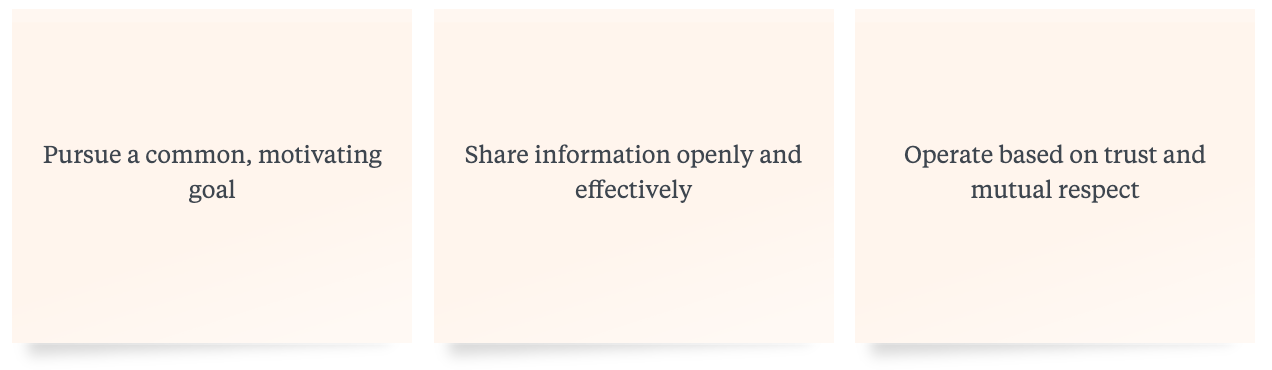 But these are just the basics. Research shows that high-performing teams also have other qualities that allow them to excel.
Take a Moment
第 2 节
Some groups excel in managing themselves. Most, though, thrive under the guidance of a leader who knows how to bring out the best in team members and in the team as a whole.
Did you know?
Some groups excel in managing themselves. Most, though, thrive under the guidance of a leader who knows how to bring out the best in team members and in the team as a whole.
That’s where you come in. You may have been assigned to lead an established team or are pulling together a group to address a pressing organizational need. In either case, you’ll succeed as a team leader when you’re able to:
-
Foster collaboration
-
Increase team productivity
-
Manage conflict
-
Navigate team transitions
-
Boost performance
This is true even if you don’t have formal authority over some—or all—of the people involved.
Whatever your team’s makeup or purpose, it’ll inevitably go through certain stages as people get familiar with the project and become more comfortable working together. Learn more about this process, so you can help members navigate through rough spots and move quickly to performing at full speed.
团队发展的五个阶段 Lead Your Team to Peak Performance
哈佛教授讲授视频逐字稿
Make a Connection
第 3 节
Unless you’re assuming responsibility for an existing group, your first step will be to bring together a team.
As you begin to form a team:
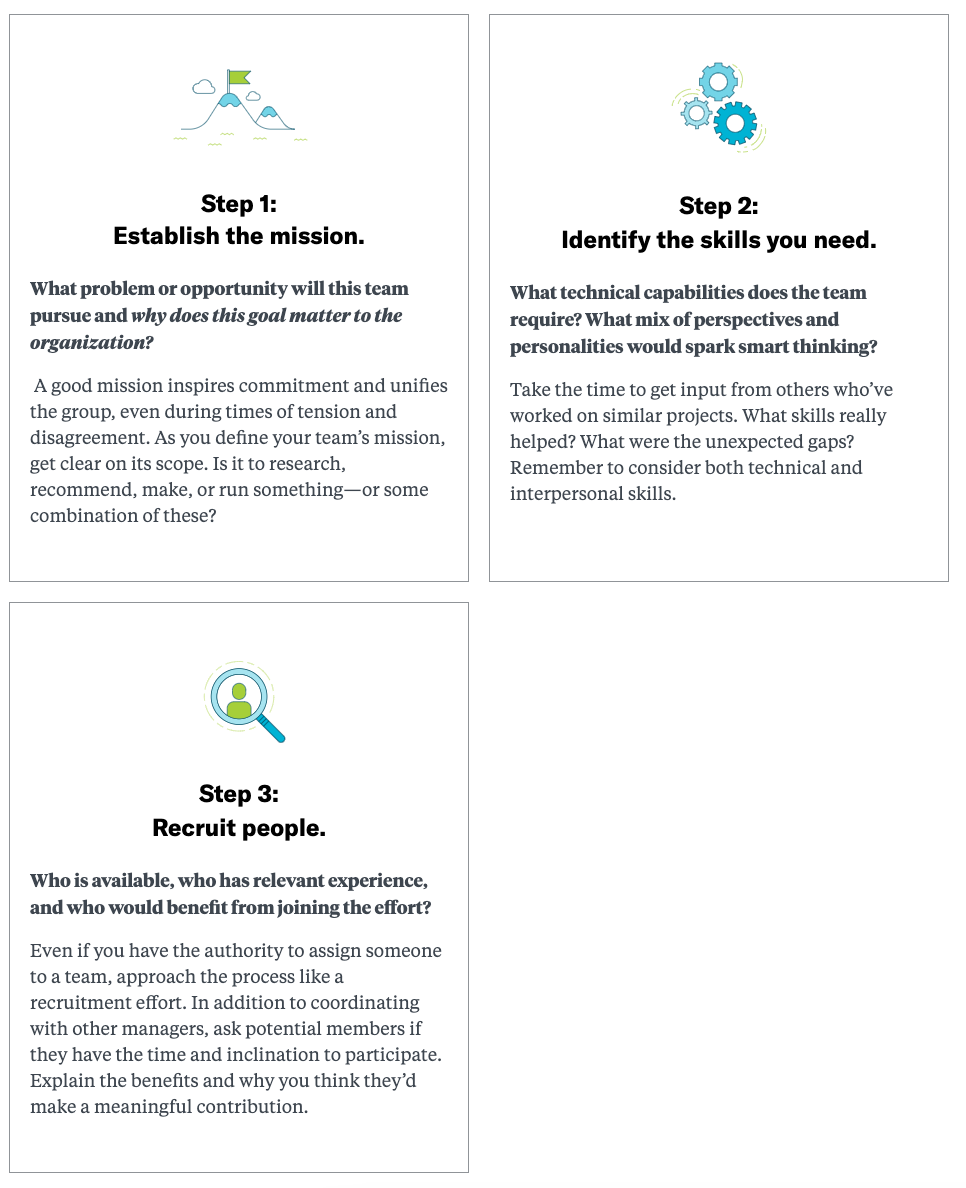
When forming a team, know that less might be more. Research done by the Wharton School suggests that the ideal team size is three to six members. When groups get bigger, it’s harder for everyone’s voice to be heard, and people’s motivation tends to slide."The Ideal Team Size at Work May Be Smaller Than You Think," by Jaime Potter. Forbes, April 27, 2020
第 4 节
Often, when leaders assemble teams, their first instinct is to turn to familiar faces, such as coworkers they’ve worked with in the past. That approach has its advantages; a group where trust and rapport are already established often gets up to speed quickly.
But when leaders rely on the same small circles of people, they can end up with teams that become insular and, over time, underperform.
People mistake harmony and easy consensus with excellence, but research shows that constructive conflict and broader perspectives remove blind spots and drive innovation.
Each time you put together a team, ask yourself:
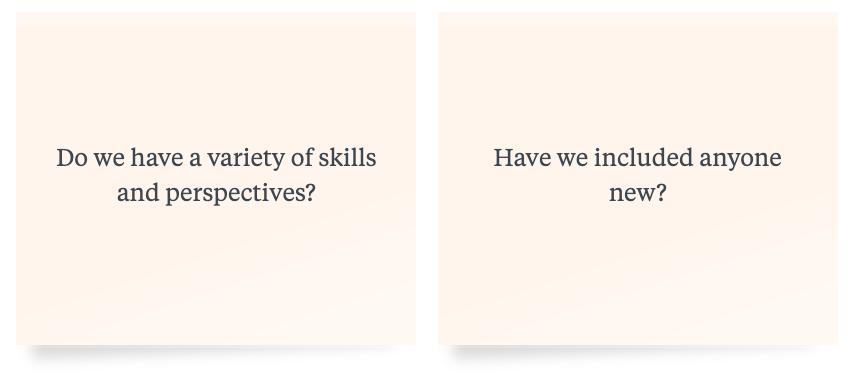
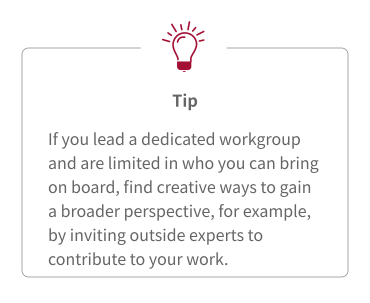
You want breadth in professional and life experiences, thinking styles, personality types, and skills. Each member you recruit should add something useful to the mix.
Make a Connection
第 5 节
Once your team is in place, it’s time to launch the work. But first, touch base with each team member to find out their preferences for work hours, locations, and technology platforms. This is especially critical if your team is virtual or hybrid. Let people know that this information gathering is a starting point, not a commitment to accommodate every preference.
Then, plan and schedule a team kick-off meeting.
In designing your meeting, focus on what people really need to know and how you want them to feel afterward, ideally, motivated and ready to roll!
Communicate that your team and its work are valuable, and that everyone’s role is important.
A kick-off meeting should cover:
Here, Agile project manager Danielle Eldridge explains why each of these elements is important to team success.
成功地组建一支新团队 Successfully Launch a New Team
哈佛教授讲授视频逐字稿
Let’s go into introductions and norms in a bit more detail.
Launch a New Team
第 6 节
Make time in your launch meeting for everyone to introduce themselves to the team.
Introductions are an important way for people to connect with others and establish their credibility, especially for anyone who might be perceived as an outsider.
That includes members of minority groups and people who are new, junior, part-time, or contract.
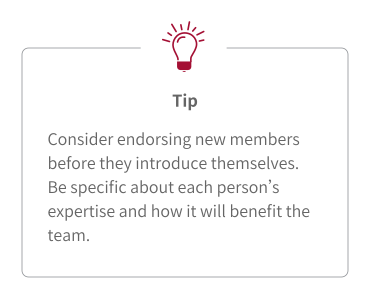
Ask team members to consider what they’ll say beforehand so their comments are thoughtful and creative, not rote. Encourage them to include a memorable fun fact or personal detail.
If everyone on the team already knows each other and has worked together in the last three months, ask them to give brief personal and professional updates rather than full introductions.
第 7 节
Don’t assume everyone knows “how things are done around here.” A lack of clarity about unspoken expectations can cause confusion down the line.
In your launch meeting, lead the team in creating guidelines on topics such as:
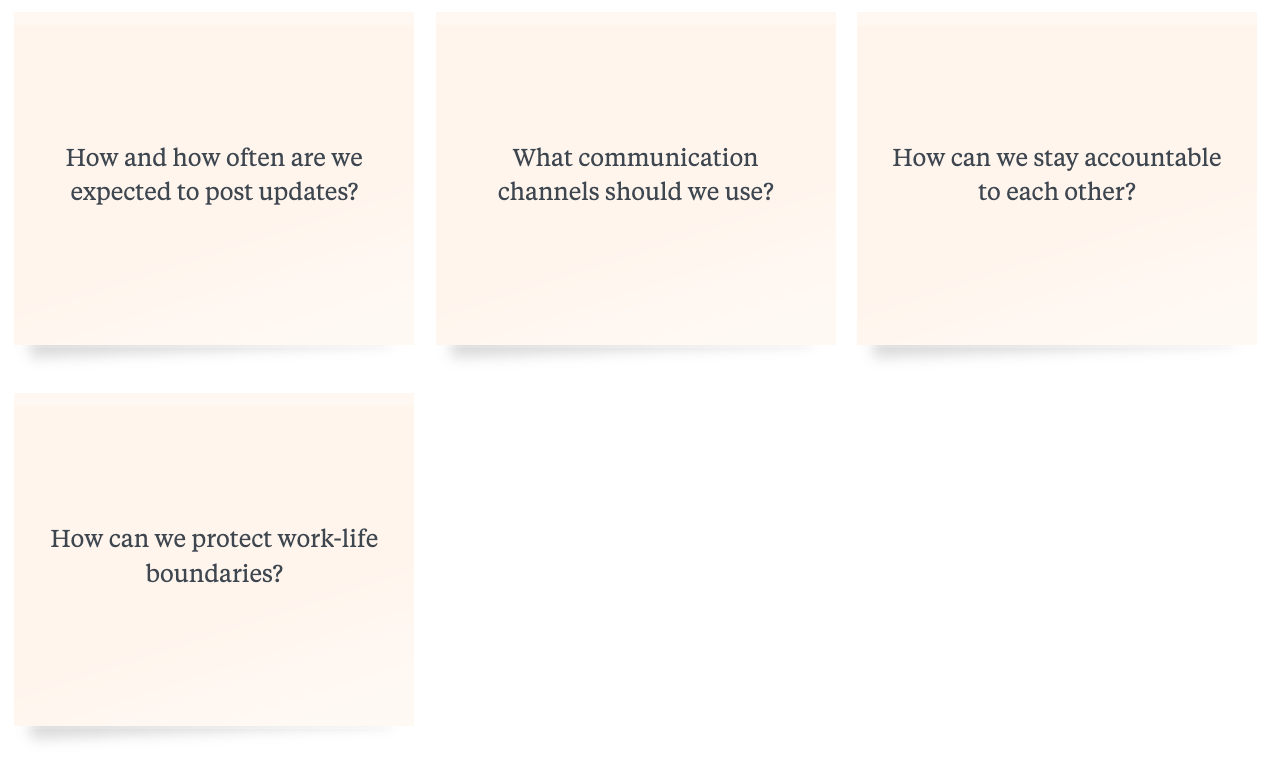
Also consider suggesting tips to help team members manage their relationships, such as:
-
Talk through thorny issues face-to-face or over video call, not by chat.
-
Don’t get too attached to your initial ideas; invite input from others.
-
Offer balanced feedback using this formula: “What I like about this is… What I wish about this is…”
-
Don’t multitask during meetings.
Make a Connection
第 8 节
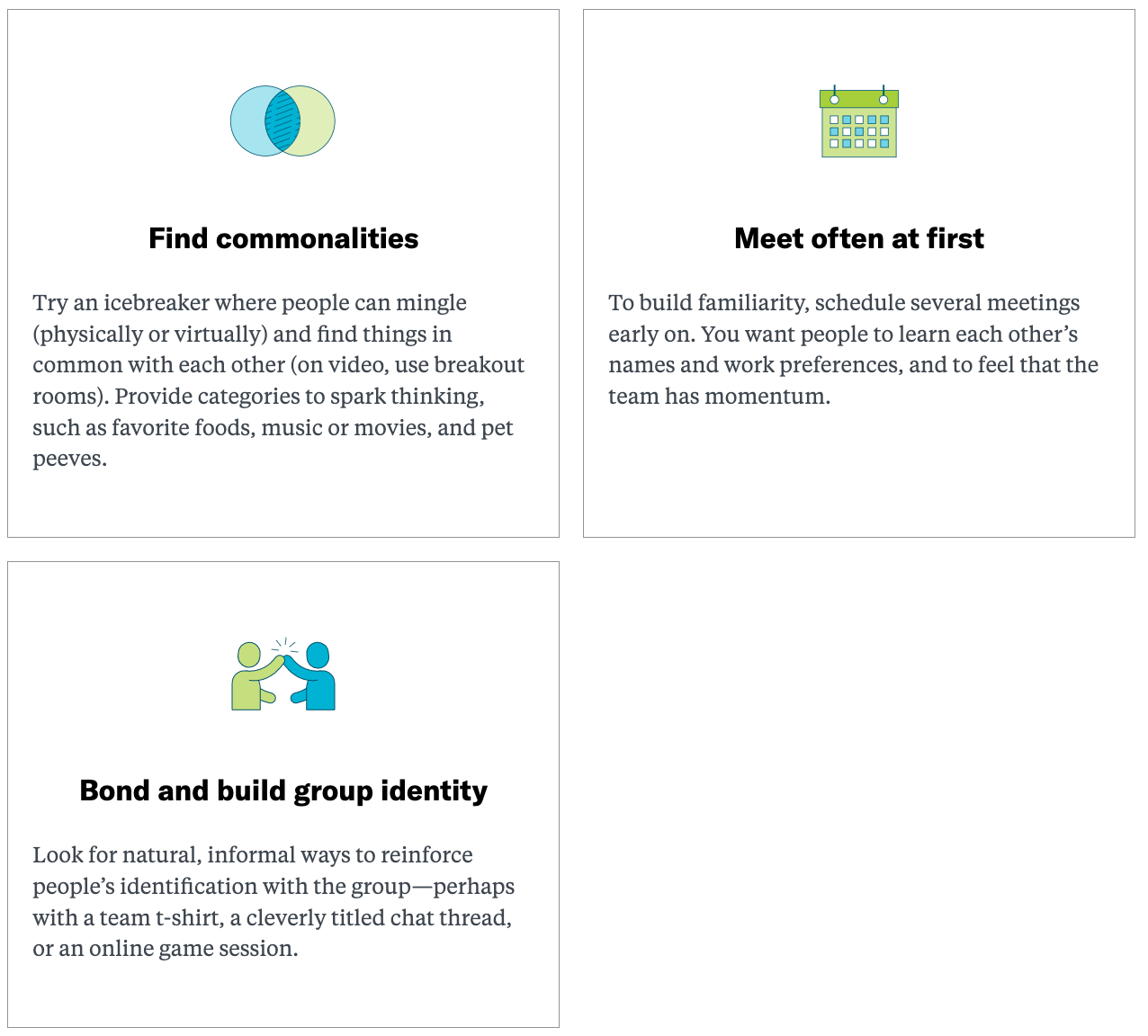
On teams where members don’t know each other well, quickly establish a sense of trust so people are willing to share information and rely on each other.
Here are a few practices:
If your team already has well-established relationships, consider whether any roles need to be explicitly reset. This can be especially helpful in allowing junior members to expand their responsibilities. For instance, you might say, “Demi has managed the project timeline for the last two cycles. I’m excited to announce they’ve been promoted to compliance. For this project, Albert has agreed to take over the timeline task.”
Avoid “us” and “them” dynamics—for instance, between headquarters employees and branch office staff or established members and newer members.
If you see cliques developing—such as a few team members meeting without inviting the others—reiterate the group’s communication standards or mix up work assignments so different people get a chance to work together.
Tips for Building Trust on Your Team
-
Complex projects require teams: groups with a shared identity, complementary skills, and the ability to collaborate well.
-
To form a team, establish the mission, identify the skills you need, and recruit people.
-
A good mission inspires commitment and unifies the group.
-
Even if you have the authority to assign someone to a team, approach the process like a recruitment effort.
-
Aim for diversity of thought, personalities, skills, and perspectives. Try to include some new players.
-
For teams that aren’t well established, take steps to quickly build trust.
-
Create team etiquette guidelines rather than assuming everyone knows “how we do things around here.”
Take Action
第 9 节
Reflecting on your learning helps you apply relevant concepts to your job.