Pocket Leadership口袋领导力

Managing Your Boss

Manage a Difficult Boss 查看中文版

第 1 节

Bosses can be difficult in a wide range of ways. For instance, they may constantly change their minds, be unavailable, or micromanage every aspect of their people’s work. Some might even verbally abuse employees or manipulate direct reports with promises of promotions that never materialize.

If you have a difficult boss—no matter what kind—there are some basic tactics you can employ to manage the situation:Silverman, David. “Managing Your Bad Boss.” HBR Blog Network, August 21, 2008.

  • Understand your boss’s objectives. Identify your boss’s objectives (such as “climb the corporate ladder” or “stay put until retirement”) and determine how they differ from yours. Assess how such motivations might affect your boss’s behavior. Then use that knowledge to figure out the best strategy for supporting those objectives without compromising your own.

Manage a Difficult Boss - example 1

Joi's boss, Ryan, seems to want to advance his own career aggressively. Joi observes that he tends to respond defensively when she interacts with his manager and other higher-ups in the organization. So whenever Joi wants to communicate with Ryan's boss—for instance, to compliment her on a successful conference presentation—she checks with Ryan to make sure it's okay with him. Manage a Difficult Boss - example 1
  • Show how you’ll support your boss. Focus on helping your boss with the tasks he or she is weakest at—but take care not to criticize.
  • Head off confrontations. If your boss does something that angers you, take a deep breath and give yourself some time before responding. When you do respond, keep your manner professional.

Manage a Difficult Boss - example 2

Julius is on vacation, lying on the beach, and he decides to check his email. His inbox is filled with messages his boss, Sandra, sent that morning. Julius resists the urge to immediately shoot back an angry, terse reminder that he's off duty. Instead, at the end of the day, he sends a calm, professional reply to Sandra saying that he'll respond to her messages as soon as he's back from vacation. Manage a Difficult Boss - example 2
  • Document your job requirements. List all the projects and tasks your boss expects you to do. If your boss keeps coming up with more and more things for you to handle, bring out your list. Then explain how you’ll need more staff to take on the additional to-dos.
  • Get advice from your boss’s former employees. Contact someone who used to work for your boss. Explain that you’d like his or her insights about working with and learning from your boss. Frame the meeting as a tutorial for you, not a complaint session. Keep in mind that anything you say could make its way back to your boss, so edit yourself accordingly.
  • Take care of yourself.Gallo, Amy. “Dealing with Your Incompetent Boss.” In HBR Guide to Managing Up and Across. Boston: Harvard Business Review Press, 2013. Having a difficult boss can be bad for your health. To avoid stress-related health problems, focus on what makes you happy about your job, not miserable. Choose to pay attention to the people you’re glad to see at work, and concentrate on the work you enjoy. Whenever possible, take on projects that let you spend time in other parts of the organization or with other leaders. Identify one or more mentors who can give you things you aren’t getting from your boss, like feedback, instruction, and encouragement. Try not to let this one person ruin your day, job, or career.

In addition to these basic strategies, you can tailor your approach to the specific type of difficult boss you’re dealing with, whether they are:
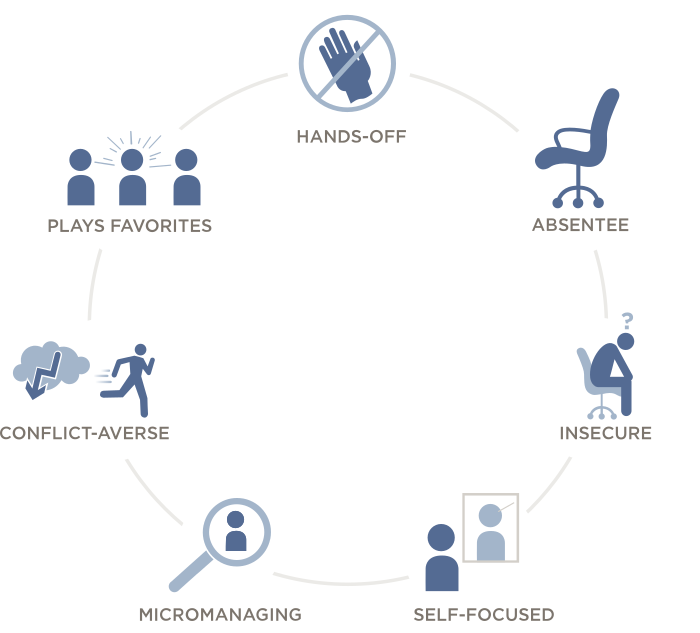
  • Hands-off

  • Absentee

  • Insecure

  • Self-focused

  • Micromanaging

  • Conflict-averse

  • Plays favorites

改善你与“问题上司”的关系Improve Your Relationship with a Difficult Boss

哈佛教授讲授视频逐字稿
Have you ever quit a job because of a difficult boss? If so, you are not alone. According to a 2017 Gallup study, at least half of all employees have left positions to get away from a stressful manager. Unfortunately, escaping a problematic relationship with a supervisor isn't always feasible. In fact, you may even find yourself going from a bad situation to a worse one. So what can you do when you find yourself in this kind of dilemma? Here are three steps you can take to improve your relationship with a difficult boss. Be empathetic. Most challenging bosses aren't bad people. They're often individuals who respond negatively to high-pressure situations. When you make an effort to consider the stresses and frustrations your manager is facing, you may realize that their attitude toward you isn't personal. And when you approach your boss with empathy—for example, by acknowledging the pressure they are under—they may learn to reciprocate. Look at your own behavior. Consider how your approach or actions might conflict with your boss's style or expectations. Ask a trusted coworker to share insights about ways you might be unintentionally sabotaging your relationship with your supervisor. You may even want to take steps to make your boss look good to their superiors—something bound to improve your standing in their eyes. Initiate a candid conversation. If the friction between you and your boss continues, request a meeting to discuss your concerns. It's best to conduct the conversation in a neutral space away from the office, perhaps over lunch. Frame the meeting as a time for the two of you to build a more productive working relationship. If you take these actions, your relationship with your boss is likely to improve. If, however, the troubles persist, it may be time for you to explore other jobs. In the end, you don't get to choose your boss, but you can choose to leave.

Worksheet for Dealing with a Difficult Boss

附件:worksheet_for_dealing_with_a_bad_boss(docx · 1125 KB,本地副本)

Make a Connection

1. Think about someone you know who has found working with their boss difficult. What two or three suggestions can you share to help them manage the situation?

第 2 节

If your boss has limited knowledge of the details of the business, is uninterested in the status of your projects, and doesn’t follow up to ensure that agreed-upon actions have been taken, you’ve got a hands-off boss.

Having a hands-off boss can have both advantages and disadvantages. On the plus side, though your manager is less engaged than you prefer, you likely have significant autonomy in managing your workload and making decisions. On the minus side, you may feel a lack of support when problems or questions crop up.

Here are strategies for dealing with different kinds of hands-off managers:

Your Boss Your Response Is overwhelmed or unable to focus Accept that they may not be able to improve. Find ways to be of assistance, and determine how you can get the help you need from others. Is a “big-picture” person who doesn’t attend to details Talk with them about how you can draw attention to areas where you need help or guidance. Seeks to empower you and your peers Express your appreciation for your boss’s trust, and mention that you would appreciate additional guidance. Spends more time managing up than managing down Recognize that when your manager has a well-developed network, you are likely to benefit. Focuses on certain areas to the detriment of others Knowing that your boss doesn’t see your work as a priority, gain their attention by scheduling regular meetings.

Try to avoid complaining about your boss to others; it won’t improve the situation or your relationships within the organization. Instead, accept that your boss’s behavior isn’t ideal, and make the most of the freedom you have to take the initiative on your own.

第 3 节

If your boss is never around, seems psychologically distant, and doesn’t meet with you regularly to fill you in on critical decisions in the organization, you’ve got an absentee boss.

This disconnect could have a number of causes. Maybe your boss is busy with other projects, is feeling burned out, or has become bored in his or her current role. Whatever the reason, having an absentee boss could make it hard for you to get the information and resources you and your team need to meet business goals.

Manage your absentee boss with these tactics:

  • Schedule time together. Try asking your boss to meet with you more often or to give you more feedback.
  • Make the most of meetings. Be prepared and efficient when you do get together.
  • Keep your boss informed. Provide your boss with regular, brief reports. When something important comes up, send him or her a short note that outlines the issue.
  • Build relationships. Network with colleagues and with others outside your organization so you can exert the influence needed to advocate for your team in ways that your boss is not.
  • Get to know your boss’s support staff. You can often get responses to questions through them.
  • Volunteer. Offer to take on tasks your absentee boss doesn’t enjoy; you’ll help him or her out as well as develop your own skills.

第 4 节

Ideally, bosses and the people they manage work in partnership, with all parties feeling competent and confident in their position on the team and in the organization. But some managers are insecure in their roles and uncertain about their abilities. They may act defensively in response to people’s opinions or suggestions, regardless of how respectfully those are presented.

A manager who is reluctant to seek your input, ignores your ideas, or punishes you for speaking up is likely insecure. Your boss may take employee suggestions as personal criticisms and aggressively stifle good ideas because of his or her own insecurities.

To manage an insecure boss:

  • Understand the cause. Evaluate any external factors that may be causing your boss stress, such as looming deadlines or pressures from senior management. Make a point of striking a collaborative tone in your interactions.
  • Build trust. Alleviate your manager’s fears and gain his or her confidence by sharing as much information as possible.

案例

Tanya was surprised when her manager, Stefan, started snapping at her and making unreasonable demands. A colleague told Tanya that Stefan suspected Tanya of going behind his back to cultivate relationships with clients who Stefan had brought to the firm. Tanya solved the problem by submitting her expense report to Stefan every month, so he could see who she did—and didn’t—take to lunch. As a result, Stefan’s negative behavior stopped.
  • Give feedback carefully. Insecure bosses find constructive criticism threatening, so before providing your manager with feedback, highlight his or her positive qualities and accomplishments. Also, reduce your manager’s defensiveness by offering your comments in private rather than in front of other team members.  
  • Emphasize potential gains. If you are recommending any kind of change, underscore the potential gains. Avoid implying that your boss caused the problem you are seeking to solve.

第 5 节

Self-focused bosses are so career-oriented that they may see others simply as tools for advancing their own agendas. Some may even take credit for others’ achievements, or hold others back so they can get ahead.

Such bosses often spawn people problems in their teams, like low morale, burnout, and erosion of engagement and motivation. And if such team problems arise from other causes, a self-focused boss might not notice them or care about resolving them.

To manage this kind of boss:

  • Own the problem. Rather than seeing yourself as a victim, take responsibility for improving your relationship with your boss and getting your own career needs met.
  • Look for alternative explanations. Consider whether there might be other explanations for what you perceive as negative signals from your boss. For example, if your boss excludes you from meetings, it may be that he finds smaller meetings to be more efficient, not that he’s intentionally keeping information from you.
  • Suggest ways to balance people and projects. Embrace his or her goals, while offering periodic reminders and recommendations about people issues that need addressing.

Manage a Difficult Boss - example 4

Carla's manager, Josh, has been driving the group harder than usual over the past six months to complete a project that's critical to his boss. Carla and others on the team are at risk of burnout. During a weekly meeting with Josh, Carla expresses her concerns and points out the dangers to the project if people became too exhausted to work on it further. She suggests ideas for helping people restore their energy—such as expressing appreciation for their hard work so far and organizing some lunch breaks at a fun restaurant nearby. Manage a Difficult Boss - example 4

Set an example. Treat your boss as you’d like to be treated.

Manage a Difficult Boss - example 5

Ricardo and his boss, Joanna, have just secured a favorable agreement with a key supplier. While waiting for the rest of the team to gather for a status update meeting, Ricardo tells Joanna's boss what a masterful job Joanna did in negotiating the terms of the agreement. Manage a Difficult Boss - example 5

Speak up. If you haven’t managed to subtly change the dynamic with your manager, engage her in a constructive conversation. Set a positive tone by indicating that you want to find better ways to support her. Also indicate how you hope she can help you in gaining new skills and experience.

改变棘手的工作关系Change a Difficult Work Relationship

哈佛教授讲授视频逐字稿
I had been hired by this family practice of physicians to help them work through a conflict that had been polarizing their team of physicians, and in fact, jeopardizing patient care to a certain extent. One of the pieces of this was a behavior profile that I asked each of the physicians to fill out. And I had already met with all of the others, and this was my last meeting. The first thing I noticed about this one was that the doctor was 25 minutes late. And I waited in the waiting room, and an assistant came to get me. I walked down a long hallway, saw him at the end. When I finally got there, I said hello. He said nothing, just turned around and walked into his office, sat with his back to me at his desk. I got concerned because I started to feel frustrated, a little bit upset. And if I start to have those feelings, I know that this isn’t going to go in the right direction. I did not want this to develop into an adversarial relationship, but I thought that maybe he thought it was. And I realized that if this was going to change, that I was going to have to be the change agent. I went to the office door, opened it, went out into the hallway, found a chair, brought it into his office, closed the door, went to his desk, and set up my chair catty-corner to his chair at his desk, [I] put the profile on the table, and before I even started showing it to him, I began to ask a few more questions so that I could find out where he was really with this whole process, because I wanted to get him talking about what he wanted and what would be helpful. He was paying me. We were, in fact, on the same team. And so I was a little thrown at the beginning, but I gradually started to get us back into being partners in solving a problem rather than opponents. There was no need for that. So that was fine. And I think with time, and with my listening and acknowledging, he gradually saw that we were on the same page. He saw that I wasn’t there to criticize him, expose him, make him look bad in front of his peers. And it was a nice feeling to see him turn around. There were a lot of things I learned in this first interaction, and one of them was the sort of malleable nature of relationship, especially where bosses are concerned--bosses, clients, anyone in a position of authority over us. It’s very easy to become intimidated or powerless in their presence. We think we have no power. And we actually have more power than we think. We have power maybe not to change them, but we have power to change ourselves. And when we change, the relationship changes. They can’t relate to us in the same way. They can’t fight with us when there’s no one to fight with. So just to keep in mind that these kinds of conflicts can be teachers. And the difficult people in our lives, they’re our biggest teachers.

第 6 节

If your boss constantly scrutinizes and criticizes your work, he or she is micromanaging. This kind of boss is not only annoying; the seeming lack of faith in you could make you doubt yourself and stunt your professional growth.

To deal with this type of boss:

  • Keep your boss up to date. Understand that micromanaging often stems from internal anxiety and a need to control situations—so keep your boss informed of your progress, take your ideas to him or her before sharing them with others, and bring him or her any news you hear.
  • Be reliable. Earn your boss’s trust by succeeding in dimensions he or she cares about most, such as on-time delivery of projects.
  • Seek guidance. If your boss is micromanaging because he or she has high standards or because you do, in fact, need to make improvements in specific areas of your job, treat it as an opportunity to learn from you boss.
  • Create ground rules. Agree with your boss up front about how he or she will be involved in projects, what role each of you will play, how you’ll measure success, and what the high-level guiding principles for the work will be—not the details.

Manage a Difficult Boss - example 6

Carvina meets with her boss, Henry, to discuss an upcoming marketing campaign. She keeps the talk focused on the message the campaign will need to send, not the font she should use. Manage a Difficult Boss - example 6

Free up your boss. Tell your boss that he or she is better off not getting involved in the details of a project, because “Your time and effort are more important and valuable for the big picture.”

我可以帮你分担工作吗?What Can I Take Off Your Desk?

哈佛教授讲授视频逐字稿
In my mid-20s, at my first major corporate job in a corporate communications department, things were going wonderfully for me. I had a great manager who was a champion, who really saw in me the person he’d been ten years earlier. And he left for a job on the other coast. And I had a new manager come in from another company. A manager, also, about eight to ten years older than I who had lost his previous job due to a hostile takeover. And there he was, new in my organization as our leader. And he didn’t know the team. I think we both had a lot of stake, given where we were in our careers. His career really coming into its own, but in a new organization. And me, being a person in his mid-20s eager to prove himself. Suddenly, my status seemed to decline with his arrival. I sensed from him a skepticism, maybe—I wouldn’t say an active distrust, but certainly a reticence to give me the work I was capable of doing. And I felt my status deflate in the organization. And I had to do something about it. I ultimately decided I would simply visit him every day and offer to take something off his desk. I’d say, "There has to be something on your desk that you can give me. I’ll take it away. I won’t bring it back, it’ll simply be done." He was someone who worked earlier than anyone else and later than anyone else. I would say, admittedly, on his own terms, he would say that he was a workaholic. So the need for him to be a better delegater was obvious to me and to everyone. I was persistent. I delivered time and again. There was a hiccup once where he called my house at, I think, before 5 o’clock in the morning to tell me I needed to get into the office right away because we were going to make an announcement about merging with another company. And I said, "You know, I think you agree that I was very helpful on this. But I could have been more helpful if you had told me sooner. I would have kept the secret. I know that’s my job. I know that I would have to protect organization by telling no one the information that you shared." And eventually, it seemed to get through to him that I had a real understanding of all of these issues. And by the time he was promoted to another job several years later, I was his obvious choice to succeed him in the job. And I would say that today, years after we’ve worked at the same place—in fact, decades—it’s one of the strongest relationships I have with a former boss.

Strategies for Dealing with a Difficult Boss

附件:strategies_for_dealing_with_a_difficult_boss - en.pdf(pdf · 145 KB,本地副本)

第 7 节

If you have a conflict-averse boss, he or she might avoid advocating for you and your team with others in the organization. As a result, you don’t get the support and resources you need. Your manager might also avoid difficult conversations, even if they’re about important issues—such as serious interpersonal conflicts in your team—that need discussing. As a result, such issues remain unresolved.

To manage your conflict-averse boss:

  • Make conflict more comfortable for your manager. Express disagreement using gentle language such as “This may sound like a crazy idea, but...” and ease into awkward conversations by talking about something neutral first.
  • Ask “what if” questions. Propose different scenarios to get your boss thinking about how dealing directly with a conflict could help serve business needs.

Manage a Difficult Boss - example 7

Colin is concerned that the printing company his team uses has been struggling with quality-control issues. He wants to explore other possible vendors, but he knows his boss, Elena, is sensitive about offending the current vendor. He asks her, “What if our printing company keeps having quality-control issues? Would it be worth investigating other options now, just so we have some alternatives in place in case we need them?” Manage a Difficult Boss - example 7
  • Strike a neutral tone. Focus difficult conversations with your boss on problem solving, not the personalities involved.

Manage a Difficult Boss - example 8

The weekly team meeting that Lina's manager, Craig, leads has turned into a complaint session for team members. Lina volunteers to start creating agendas and distributing them before the meetings. She tells Craig, “I know you’re busy with other things, so why don't I poll everyone for agenda items for this week's meeting?” Manage a Difficult Boss - example 8
  • Provide documentation. Gather supporting evidence to help your boss advocate for resources your team needs.

Manage a Difficult Boss - example 9

Ben asked his manager, Kamala, to request a bigger budget for his team. She hasn't done it. Ben gathers information on each team member's goals and the resources they need to achieve them. He highlights how meeting these goals will contribute to the unit's overall strategy. He gives all the information to Kamala. With this data in hand, Kamala approaches senior management with greater confidence that she can get the resources. Manage a Difficult Boss - example 9

第 8 节

Maybe your boss has a favorite employee—someone who gets the most interesting assignments and special perks. She invites this person to social events, confides inappropriately in him about “problem” colleagues, and acts like they're old friends.

Favoritism—especially shown to an average performer—can demoralize you and the other members of your boss's team and cause you to miss out on valuable resources and attention. But because your relationship with your boss is key to your success, it is important to put effort into improving it.

Here's what to do about it:

  • Use a sounding board. If you feel that your boss isn't treating you fairly, find someone outside the organization to talk to who can help put things in perspective. Avoid complaining to your coworkers—it won't change things and may create a negative tone on your team.
  • Take the high road. Don't take your frustrations out on your boss's favored employee. That person isn't the source of the problem. Instead, focus on your own successes. Look for ways to boost your career and your connections to others in the company.
  • Watch and learn. Observe your boss's favorite in action and make note of how he or she interacts with your boss. You may want to adopt some of his or her behaviors—but only if doing so feels authentic to you.
  • Build bridges. Create goodwill by getting to know your boss and his or her favorite better. Ask the favorite for advice on how to improve in your job. Regularly check in with your boss to discuss his or her priorities and progress you've made on them. Ask for more challenging assignments, and volunteer for tasks that others don't want to take on.
  • Seek out mentors. If you're not getting the career guidance you need from your boss, identify other managers who can provide you with feedback and coaching.
  • Move on. If your relationship with your boss doesn't improve and you're not getting the opportunities and guidance you want, consider looking for another job. It's not worth staying in a situation that drains your energy and keeps you from growing in your career. Continue to contribute to the best of your abilities while pursuing other options.

Surviving a difficult boss: What would you do?Adapted from Silverman, David, Gini Graham, Brad Gilbreath, and Lauren Sontag. “Surviving the Boss from Hell.” Harvard Business Review Sept. 2009.

David is a high-performing project manager with a talent for creating process-performance dashboards. He likes his work but is frustrated by his self-absorbed, micromanaging boss, Thaddeus. Thaddeus continually talks about the high points of his own (now stalled) career. He calls unnecessary last-minute meetings. And he often tries to one-up his direct reports by taking credit for their achievements. Meanwhile, David has managed to impress Irving, an executive vice president in the company's Latin America division. In fact, Irving recently offered David a job. But it's a lateral move with no increase in pay. What should David do? Experts in managing a difficult boss present three possible options David might explore: Option 1: Stay where he is for now. Taking the job with Irving would be equivalent to announcing, “This is the level where I'm supposed to be.” Also, Thaddeus might see a lateral move within the organization as a personal slight. The resulting bad feeling could follow David to his new position. Instead, David could form a supportive network of colleagues, explore interests outside work, and even attempt—subtly and non-confrontationally—to get Thaddeus to change some of his annoying behavior. David might describe (in an email or face-to-face meeting) what he thinks Thaddeus wants from him and offer ideas on how to achieve it. That would place the focus on David's work, not on Thaddeus's actions. If he can't tolerate working for Thaddeus any more after trying to improve the dynamic, he should look for an opportunity outside the company. Option 2: Accept the job with Irving. Research shows that difficult bosses' behavior can lead to high blood pressure, depression, and other health problems in their subordinates. Continuing to work for Thaddeus could ultimately take a toll on David's psychological well-being and physical health. So taking the job with Irving might be the best way to deal with the situation. Although this lateral move would not advance David's career, David could frame it as an opportunity to broaden his experience with global business. Option 3: Carve out a new role for himself. David might dread discussing what's bothering him with Thaddeus. But having that difficult conversation could dramatically improve Thaddeus's behavior. Still, staying with Thaddeus (whose career is stalled) might be more of a dead end than accepting Irving's lateral offer: If your boss isn't moving up, you probably aren't either. So David should consider carving out a new role for himself that capitalizes on his expertise in creating useful dashboards. He might even propose setting up a dashboard "center of excellence" to serve both Thaddeus and Irving, and adding a junior employee who would report to him. That way, he could meet both their needs and advance in his career. If you were in David's position, what would you do? Surviving a difficult boss: What would you do?Adapted from Silverman, David, Gini Graham, Brad Gilbreath, and Lauren Sontag. “Surviving the Boss from Hell.” Harvard Business Review Sept. 2009.

第 9 节

Test your understanding and reinforce what you’ve learned.

Try it Out

1. Your manager is often unavailable for discussions about your project, but then he criticizes any plans and schedules that you develop on your own. What would be the least effective strategy in this situation?
答案与解析

A. Take steps to understand your boss’s motivations.
You should identify your boss’s objectives and determine how they differ from yours. Assess how his motivations might affect his behavior and then use that knowledge to figure out the best strategy for supporting those objectives without compromising your own.

B. Talk to your boss’ former associates and employees about how best to deal with him.
You should contact someone who used to work for your boss and ask for insights about his work style. Frame the meeting in terms of a tutorial for you.

C. Confront your boss immediately so you can clarify your feelings about the situation.(正确)
Try to head off confrontation. Give yourself some time before responding to a frustrating situation, and then reply in a calm professional manner.

D. Figure out the best way to help your boss in his weakest tasks.
You should focus on helping your boss with the tasks that he is weakest in—but avoid offering any criticism.

第 10 节

Reflecting on your learning helps you apply relevant concepts to your job.

Take a Moment

1. 1. What new insights do you have that could benefit you or others in your workplace?
2. 2. What are your biggest opportunities for applying concepts from this Lesson in your workplace?

Further reading

在新上司手下取得成功的关键
频繁的领导层变动已成为现代组织的一个显著特征,这既为员工带来动荡,也带来机遇。许多人在新上司到任时选择被动“观望”,但这…
当你的老板反复无常
为一位总是反复无常、不断改变主意的领导工作,是一种让人抓狂却又极其常见的经历。当战略总是在不停地变动时,你很难对今天“潮…
工作需要被正确设计
我在《星际迷航》系列里最喜欢的情节之一是星舰学院学员的测试科目——“小林丸号”测试。这套模拟训练…

Top 3 in the source platform's original order