Effective managers build and maintain multiple networks, each serving a specific purpose. To excel as a manager, you need to use all your networks effectively. Consider the following examples.
Strategic networks
Strategic networks are all about succeeding in the future. You use them to find out what opportunities and challenges the future will bring—and to prepare for succeeding in that longer-term, emerging landscape. To get the most from your strategic networks, you can use them to:Herminia Ibarra and Mark Hunter, “How Leaders Create and Use Networks,” Harvard Business Review, January 2007.
Figure out how you and your organization can capitalize on important opportunities or surmount tough challenges—, such as bringing in new types of talent, changing suppliers, or overhauling crucial business processes.
Identify and enlist people needed to attain those goals—including recruiting stakeholders, lining up allies, and brokering conversations among unconnected parties.
Marshal information, support, and resources from one part of the network to achieve results in another.
Exert indirect influence; for example, persuading one person in the network to encourage someone outside of the network to take a needed action.
1
Joe, a rising star at an investment bank, has built a great strategic network that includes: colleagues focused on other financial offerings, who can help him deliver more comprehensive financial solutions to customers; coworkers in other geographies, who can help him sell to global clients; and board-level leaders at key accounts, who can introduce him to decision makers at client companies and influence their purchasing decisions.
He draws on this network to help his company achieve growth goals. For instance, he identifies counterparts in his company’s Asian and European operations who have relationships with clients he focuses on. Joe schedules regular calls with them to coordinate efforts. In some cases, these interactions help him identify opportunities that he can propose proactively to clients. In others, it enables him and his counterparts to present a more coordinated impression when they’re competing for business against other banks.Rob Cross and Robert J. Thomas, “Managing Yourself: A Smarter Way to Network,” Harvard Business Review, July-August 2011.
1
在新兴市场,构建人际关系网络尤其重要 Emerging Markets
哈佛教授讲授视频逐字稿
I work with entrepreneurs in developing countries — in particular, helping them to develop their business plans. Developing a business plan in an emerging economy is not too different from developing a business plan in a place like the U.S., except in some really important ways. Probably the most important way is getting the information that you need. In a place like the U.S. or Europe, we have databases, we have small business associations, we have governmental organizations, that go out there and find data that you can use, and it’s not necessarily a difficult thing to put it together. Analyzing it, that is one thing, but just getting the data is not hard.
It is an entirely different matter if you are in certain other countries of the world. There, getting the information that you need that is so critical—making sure that you’re sizing the marketing properly, understanding the customers, knowing how they’ll use products, knowing if they’ll use products—really comes down to doing a lot of networking and finding the right people. They could be in government, they could be in business, and they could just be out in a village somewhere.
It really comes down to networking and getting out there, feet on the ground, doing a lot of work yourself. I think that is probably the critical difference, and it makes it a much more daunting challenge to start a new business—an ambitious new business—in a new country. On the other hand, doing that work is what’s going to ensure your success.
Operational networks
Herminia Ibarra and Mark Hunter, “How Leaders Create and Use Networks,” Harvard Business Review, January 2007.
Your operational networks help you accomplish your everyday tasks efficiently and effectively. In a great operational network, members all know and trust one another. To make the best use of your operational networks, you can draw on those qualities to foster the cooperation, collaboration, and problem solving needed to get work done.
2
Mariah manages a central publications group for a global management consulting firm. Her principal everyday responsibilities include getting thought leadership pieces posted on the company’s website or printed. She depends on many people to do this: consultants from different practice areas who want to publish pieces they can share with prospective clients; internal and freelance writers, editors, and graphic designers; printing companies; the in-house digital team that manages the public website; and marketing managers from each practice area.
To get the most from her operational network, Mariah stays in regular contact with its members and does what she can to make their jobs easier. For instance, she leads a monthly phone meeting attended by all in-house and freelance personnel to discuss and address any challenges, such as process bottlenecks. Mariah also creates and regularly updates a detailed publications guide that goes out to everyone in her network and serves as a handy reference source for everyone involved in publication projects.
2
借助人际网络做正确的事,并把事情做对 Do the Right Things, Do Things Right
哈佛教授讲授视频逐字稿
One day, one of my mentors told me, "If you want a great network, you need to work on it." So this story is exactly it. So two years ago, I was asked to do the startup and commissioning of a brand-new smelter—$5 billion project in British Columbia, Canada. And at that time, I was quite excited about the challenge but I was also scared a little bit for one reason: I had never done that before. At that time, we were quite a young management team, including myself. And I was looking for some key people with the experience to help us to do the right things, but also to do things right.
So I asked my boss at the time if he knew some key guys that have done that before. Of course, he did. So I contacted them, started to connect with these two, three key individuals. And, in fact, we developed a relationship—they came on site on a frequent basis, I was talking to them almost every week, they were coming and helping the team.
And the big benefit that we had to using these people was always to challenge our ideas, make sure that we don't fall into the traps. And the results, at the end, were amazing. We had a very successful startup in terms of safety, quality, efficiency. And we wouldn't have that if we wouldn't have had that kind of network with some experienced people.
So at the end of that venture, there's two things that we learned. First one, it's a great leadership skill to be able to ask for help when there's things that you've never done or if you want also to get challenged and make sure that you do the right thing. The second one is, once you extend your network, you need to sustain it. So if we would only have talked to these key experienced people just a few times, we wouldn't have all the benefit that we ended up with at the end.
Developmental networks
Linda Hill and Kent Lineback, “The Three Networks You Need,” Harvard Business Review, March 2011; and Herminia Ibarra and Mark Hunter, “How Leaders Create and Use Networks,” Harvard Business Review, January 2007.
Your developmental networks are a place to explore personal and professional opportunities for growth. To maximize their value, you can use them to gain access to important referrals, information, stretch assignments, and support such as coaching and mentoring.
案例
Daniel wants to strengthen his presentation skills. For several years, he has stayed in touch with Noelle, his former supervisor, who is now semi-retired. During a recent lunch with Noelle, Daniel mentions his interest in sharpening his ability to give effective presentations. Noelle mentions an evening class that another former colleague took that she found helpful. Noelle also suggests that Daniel find a local public-speaking club where he can practice giving talks and using presentation software in a safe environment and get feedback he can use to improve.
Savvy use of your various networks can help you achieve a wide range of professional and personal goals. But perhaps three particularly important areas that are part of most managers’ jobs are: leading change, fostering innovation, and boosting your team’s effectiveness.
Let’s take a closer look at each of these through the lens of leveraging your networks.
Poll
Poll
第 2 节
As a manager, you’ll often find yourself needing to lead change efforts aimed at supporting your organization’s goals or improving your team’s performance. But change is hard.
Your networks are potent change leadership tools—especially when you consider which network “shape” might best support the type of change you’re leading (for example, “cohesive” or “bridging”), and each of these shapes can lend itself to leading specific kinds of change efforts. While this isn’t a hard-and-fast rule, thinking about network shapes can help you work out the best ways to use your networks for change initiatives you’re leading–for example, to help adjust your communication approach, or manage any resistance.
For example:
Network shape
Consider for this type of change
Why
Cohesive: You’re connected to people who are connected to one another.
Nondivergent: Builds on existing norms, values, and practicesExample: A corporate travel department adds several new policies and procedures to its existing expense management system.
A high degree of social cohesion can reinforce mutual trust and support. This can encourage members to trust your intentions, so change efforts may proceed quickly and smoothly.Information can be corroborated through multiple channels.Communication and coordination between network members tends to come easily. Any skeptics may be pressured by others in the network to cooperate with the change.
Bridging: You’re connected to people who aren’t connected to one another.
Divergent: Disrupts existing norms, values, and practicesExample: A retail organization restructures its operations to support a major strategic shift from in-store to online sales.
You might serve as a bridge between disparate individuals and groups. Unconnected resistors could be less likely to form coalitions against the change.You may get access to novel information and knowledge.You’re more likely to be able to control what, when, and how you communicate with other network members.You can vary the timing and framing of messages about the change for different audiences, tailoring your communication to their priorities.
Developmental
…helping you grow professionally and personally?”
…doesn’t have enough people who will give you honest feedback on the interpersonal skills you need to improve.
3
Frances, a nurse at a city hospital, sees numerous advantages in transferring some patient-discharge authority from doctors to nurses. This would be a divergent change, because doctors traditionally hold all the power in this health system. Frances uses her bridging network—which includes managers, other nurses, and doctors with whom she has connections but who aren’t closely connected with each other—to build support for her idea. She decides to meet separately with key groups of stakeholders so she can customize her message to their interests and needs.
First, she meets with hospital managers to secure their support, explaining how nurse-led discharge would help reduce waiting times for patients—a key government-defined target. Second, she convinces other nurses of the importance of having more of a voice and showing that they can support organizational goals. Third, she explains to doctors how the new process will reduce their workload and thus enable them to focus on complex cases. Ultimately, these separate groups of stakeholders embrace Frances’s idea, and the change is implemented.
3
Smart use of your networks can help you foster innovation in your team and organization. Network diversity plays a key role here: When you interact with people from different educational, professional, and ethnic backgrounds and people who come from different countries and industries, you gain unique knowledge and fresh perspectives. These can spark new ideas that ultimately lead to valuable innovations—including breakthrough products or services, new business models, or improved business processes.
快速实现创新的四个关键要素 Four Keys to Fast Innovation
哈佛教授讲授视频逐字稿
It was a Saturday in April when Nathanial Whittemore, a social entrepreneur from San Francisco, called me up. And it was one day after the Icelandic volcano whose name nobody can pronounce, I guess still, erupted.
And he was like, "Hey, Chris we don't know each other yet, but given that we're part of the same community, namely Sandbox, I was thinking I would ask you for a small favor." I was like, "Sure, yeah. Tell me what you need." And he was like, "Well, look, I have a problem. My flight just got canceled, I'm stuck in London here, and the problem is that most of the people who went with me to Skoll World Forum and to other events around London all are stuck in London now, and all of them have no idea what to do here. So why don't we turn that into something, and why don't we turn it into a conference?" I said, "Well, that sounds really interesting."
So within 30 hours, Nathaniel organized a "TEDx Volcano," where he brought together 300 attendees from across the world, speakers like Jeff Skoll and others, a live stream with a recorded 10,000 viewers watching it live, and a central location in London.
So the question was, how could he make that happen? When we think about it, he basically didn't have any time to build relationships, but he tapped into communities in order to directly get things done there. So he went to TED and he was like, "Well, I need speakers and I need the brand." He went to Sandbox and was, "I need resources, I need volunteers." And he went to the Hub and said, "I need a local space."
And what that did was, it comes back to what a lot of innovation communities show us, where I believe there are four core pillars or four core elements which organizations can adapt in order to help make ideas happen [for] people like Nathaniel.
The first one is a framework of trust. Nathaniel didn't need to build relationships with other people because he could directly tap into these existing communities, because he went through the same selection process, there were shared experiences, and he was associated with organizations which had reputed names. So people trusted him from day one.
The second one was the connected decentralization. He was able to go to people who on the spot could decide, "Yes, we want to help you." There was no feedback process needed within the organizations.
Three, the diversity. There was a curated diversity...he didn't really know what he needed. When he started in the morning, he was just thinking, "Well, I want to organize something, but I don't know how that looks." And that's probably the case with a lot of innovation. At the beginning, you never know what you will need in the end. So if you can curate diversity, that is something which enables innovation to flourish.
[The] fourth aspect was an action-driven purpose. He had a very clear idea of why he wanted to organize it and inspire people to really join him in that endeavor and to be part of it.
And then, last but not least, technology. Which is, he used social media, particularly Twitter and Facebook, in order to create buzz around the event and to get 300 people to the event and then, in the end, 10,000 people watching it.
And I believe what we can learn from that for organizations is that of course all of us don't want to organize last-minute conferences, but we want to assist people to make their ideas happen within organizations. So I believe building innovation communities within organizations will become a core competence in the next years to come. So in a way, you want to facilitate these communities to make things happen faster and better, because in the end, I believe organizations don't have that much time anymore for pure innovation. Only for progress.
To tap into your networks’ diversity with an eye toward innovation, try these tips:
Interact with people in unfamiliar places. Whenever possible, interact with people in your network who come from unfamiliar places—inside your organization (such as other functions) and outside your organization (such as other enterprises, industries, and cultures). Be open to learning as much as you can from them. Such interactions can lead to conversations that trigger ideas for innovations.
案例
Jasmine works in the health and nutrition industry. During visits with associates in a foreign country, she learns about a local fruit that supposedly helps boost energy and reduce inflammations. She asks a medical researcher friend to look up scientific research on the fruit’s health benefits. Her friend finds numerous studies indicating benefits associated with compounds that the fruit contains in abundance. Jasmine then uses her contacts in the health and nutrition industry to launch a venture centered on production of a successful new product: juice made from this fruit.
Tap outside experts facing problems similar to yours. Reach out to experts in fields of knowledge different from yours. People in other fields who have grappled with a problem you’re dealing with could offer insights that lead to innovative solutions to your problem.
案例
Carl is a manager in the advanced materials industry. He wants to solve a problem relating to a ceramic composite that his company makes: how to disperse materials needed for its production in a uniform way. He knows that photographic film manufacturers face a similar manufacturing uniformity challenge. So he identifies a senior polymer expert from a film manufacturer who has solved the problem, and arranges to meet with her. Their conversation triggers ideas for how Carl’s company could use a similar process to strengthen its ceramic composite.
Gather information from people who are different from you. Individuals who differ from you in such terms as expertise, backgrounds, seniority, and location in the company can bring insights that spark ideas for innovation.
3
Alana is a manager at a global mining company. She wants to get more insights from her network contacts to formulate ideas for how the company can improve different aspects of the business. So she starts inviting her more junior-level contacts—informal opinion leaders in the company—to lunch. During the lunches, she asks them open-ended questions about their experiences in the company and their observations.
At one of these meetings, Martin tells Alana about an idea he has read about for identifying process bottlenecks in underground mining operations and has been advocating for months. But because of his more junior status, he hasn’t been able to get the right people—decision makers with the power to approve projects—to listen to him. Alana helps Martin connect with the right people. He convinces several decision makers of the benefits of the idea, and ultimately it is implemented.Rob Cross and Robert J. Thomas, “Managing Yourself: A Smarter Way to Network,” Harvard Business Review, July-August 2011.
3
Attend idea-sharing events. Conferences on topics outside your direct industry and field of expertise can be valuable for gaining new perspectives that could drive innovation in your organization.
Get together with your “creative confidants.” Identify people in your networks who supercharge your creative thinking whenever you interact with them. They may be individuals who always seem to have fresh ideas of their own, and they’re not afraid to challenge yours. Whenever you’re with them, you find yourselves building on one another’s ideas, and you feel energized. Commit to meeting regularly with these creative confidants to discuss challenges you’re each facing, share ideas, and identify trends or developments that could present innovation opportunities for your organization.
颠覆性创新者的五项技能 Using Networks to Jump-Start Innovation
哈佛教授讲授视频逐字稿
SARA GREEN: I'm Sara Green. I'm here today with Jeff Dyer, whose latest book is "The Innovator's DNA," coauthored with Hal Gregersen and Clay Christensen. Jeff, thanks so much for being here.
JEFF DYER: It's a pleasure. Thanks for inviting me.
SARA GREEN: In the book, you talk about the five skills of disruptive innovators. How did you settle on these five skills? What are these five skills?
JEFF DYER: Well, we started about 10 years ago, trying to figure out—where do disruptive business ideas come from? And we decided the best way to figure it out was, let's go study business innovators and figure out exactly where and when they came up with these disruptive business ideas. So we talked to dozens of innovators, and we found that one group of them were often asking questions. They were questioners. And they wanted to know a variety of things about a problem, an industry, a company. So for example, Peter Thiel and Max Levchin of Paypal were asking, "How can we 'beam' money to other people?" And this led for them to come up with the idea that maybe they could attach money to an email, and this led to the emergence of Paypal.
Others were observers. For example, Howard Schultz took a trip to Italy. He began observing espresso bars. He loved the romance, the coffee, and he said, "I've got to take this back to America." He adapted it, brought it back, and here we have Starbucks.
Others were networkers. Mike Lazarides, who started Research in Motion, maker of the BlackBerry, was listening to a fellow talk about how Coke machines could wirelessly tell the distribution center "I'm out of Coke, and I need to be refilled." And he thought—wouldn't it be cool if everybody had an interactive pager device that could wirelessly send information to others that they wanted to send it to? So networking was the catalyst for the new innovation and the idea.
And finally, others were experimenters. So Michael Dell was an experimenter, taking things apart, putting them back together—especially computers during his high school days. And what he learned as a part of taking them apart and souping them up and putting them back together, is he could do it for 30% less than IBM could provide an off-the-shelf computer. And so the Dell Direct model was born.
So those four behaviors—questioning, observing, networking, and experimenting—were behaviors that triggered "associational thinking." This is a cognitive skill where we're able to sort of connect new things together to create something new. So for example, when Steve Jobs attended some calligraphy classes and learned about beautiful typography, he then took those ideas and associated them with creating great typography on a computer, and voila--we had the Macintosh and desktop publishing.
So these are behaviors that actually trigger creative ideas, and we found that those behaviors, if mastered, can help anyone to improve their creativity and their ability to be innovative.
第 4 节
Many teams today are operating in an environment characterized by flatter organizational structures; interdependent tasks and teams; fast-changing work processes, technologies, and customer demands; and escalating complexity.
To excel, they need to solve complicated problems that cross organizational functions. And they have to coordinate resources across diverse parts of their organization and with external organizations. So making smart use of networks is just as important for teams as it is for individual managers.
外部人脉比团队内部因素更影响团队绩效 Outward-Looking Teams Are Most Effective
哈佛教授讲授视频逐字稿
When I first started doing research on team effectiveness, the dominant paradigm that was in existence really focused on internal team dynamics. And what I mean by that is looking at what goes on inside a team's boundary. And that would mean things like clear goals, clear roles, trust among members, an ability to coordinate, an ability to communicate. And all of those things are really important. And so what we did was do a survey, and do a survey looking at the performance of 100 teams in the telecommunications industry to test whether or not this dominant paradigm not only held in the laboratory, where most of the research had been done, but also in real teams and organizations.
It turned out that those variables—clear goals, clear roles, et cetera—were related to the satisfaction of team members, and they were related to whether or not team members thought that they were high performers. But those same variables had zero—no relationship whatsoever with the revenue that was brought in by these teams. And so that finding actually pushed me and many other researchers to say, what does make a difference?
And what we found, in studying those sales teams, was that external networks make a huge difference. So the teams that were able to bring in great revenue were the ones who could, for example, have a good liaison with the folks that actually installed the telecommunications equipment. And very often, the installation folks would say, "We don't have time" or "We can do it in a month" when a customer really needed it now. And so having people on your team who could negotiate with those folks in installation made a huge difference.
Since that time, we've done many, many different studies with this external perspective, which shows that teams that are much more externally active are the ones that are higher performers. So one mantra to keep in mind is "Out before in." Do your external work before you build those clear goals and do that internal work.
Engage with contacts outside the team
Your team can achieve important goals by engaging with contacts beyond its own borders:
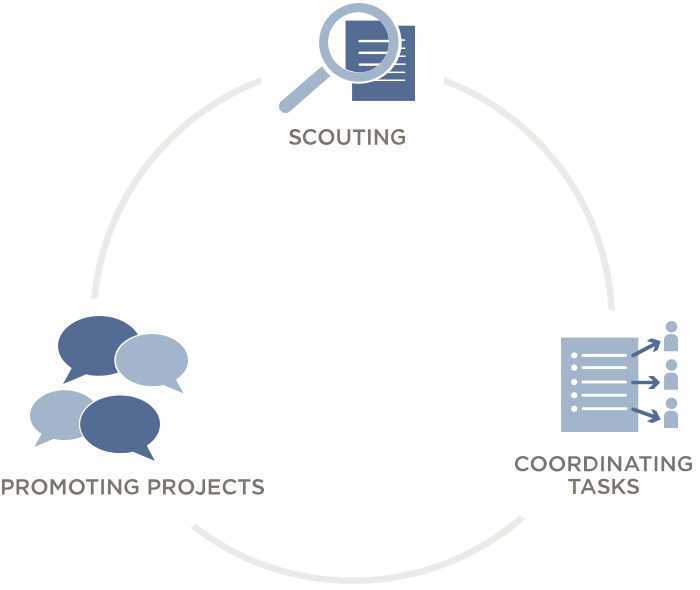
Scouting. Your team can use networks located throughout your organization and in the industry to scout information on key issues relevant to the team’s work. Such issues may include trends in markets, technology, or competitors’ activities.
1
Nicki manages a product team at a consumer electronics company. She and her team believe that developing a new tablet computer that uses a revolutionary design could boost sales. Nicki’s team needs to come up with design ideas for their proposal.
Samuel, a member of Nicki’s team, has a friend who works for a small consulting firm. He takes the friend to lunch and asks for her impressions of how consumer preferences are changing in the tablet computing market. Taj, another member of Nicki’s team, has a cup of coffee with a former college professor and solicits his thoughts on how new technologies are opening up opportunities for novel product designs. The information and insights that Samuel and Taj gather help inform ideas for the new product’s design.
1
Coordinating tasks. Your team should manage lateral connections across functions and interdependencies with other units in your organization. By doing, so team members can negotiate with other groups, trade services, and motivate other groups to follow through on commitments so the team can keep work flowing.
案例
Nicki’s team needs to check some new components for the tablet design quickly. But they discover that the testing equipment is already booked by another team. Members from both teams meet to explore potential solutions for keeping the work on track. Ideas include swapping time on the testing equipment with another team, using the equipment at night, and using equipment available through other sources.
Promoting projects to decision makers. Your team can use its network contacts to “market” projects to decision makers, lobby for resources, and link the team’s work to key strategic initiatives in your organization.
案例
While Nicki and her team believe strongly in the new tablet design, the company’s operating committee wants only a product upgrade. Nicki and several key members of her team meet with Harold, a decision maker on the operating committee. She explains how developing the tablet would benefit the company. Her team eventually gets permission and funding to launch the design effort.
To be effective, you need a blend of strong and weak ties in your own networks, and the same is true for your team. There is an increasing need for teams to be able to work across functions, on multiple projects and initiatives, with external contractors and organizations, and sometimes with changing team membership depending on the task. So your team needs both weak and strong ties with others outside its own boundaries—and sometimes outside the organization—to excel. For instance:
Strong ties—especially valuable to foster close cooperation and the easy transfer of complex knowledge within the team and between it and other teams.
案例
Several of Nicki’s team members have close working connections with colleagues in the company’s manufacturing function. These connections help smooth things over when it’s time to transition the product from design to production.
Weak ties—especially valuable when your team needs to gather useful knowledge and expertise from distant parts of the organization as well as from outside the organization. Deliberately cultivating weak ties can help a team by bringing in different perspectives for group problem-solving and decision-making.
案例
Nicki has hired Mamta straight out of graduate school for a senior position on the team. Over time, Mamta has maintained a wide range of ties to experts at prestigious academic institutions. Though weak, these ties are extensive. They thus help the team gain access to valuable information about technological and other trends important to the team’s project.
不同的观点会促成更好的决策 Different Perspectives Lead to Better Decisions
哈佛教授讲授视频逐字稿
Having broad and diverse networks is critical to our professional success in many different ways. One of them is when it comes to improving our own decision making. Having a broad and diverse network allows us to reach out to people outside of the friends or colleagues who are close to us in the office. It might mean getting out of the office, walking down to a different department or unit, talking to people who are going to have a different background, a different role, who can provide a different perspective, a different opinion on the problem and decision that we are facing.
But it doesn't come naturally to us. We are all different, but at the same time, we share the fact that we are human beings, and we like people who are similar to us. So when it comes to making decisions, we tend to go to colleagues who are usually very much thinking the same way as we do. That's why it's so important to go to people that are a little bit more distant, a little bit more different from us and our team members, to make sure that we really exploit that diversity in opinions, that diversity in perspective, and be more creative when we solve problems and better at making important decisions in our work.
Support your team's networking
To help your team effectively use its networks, you need to create the right supports. Encourage your team to actively consider their own network connections when problem solving or working toward specific goals. For example, if you’re recruiting for a new position, your team members may have the potential to be “talent scouts” to refer suitable contacts within their extended networks.
Foster information sharing and learning in your team. Ensure that team members always have access to valid, up-to-date information. And establish structures enabling them to gather widely dispersed knowledge.
案例
Nicki asks team members to write reports after completing each phase of the design project, documenting issues that arose and lessons learned. She also has the team maintain a “know-who” database, which contains names of experts in various fields important to the project and explains the team’s historical relationship with those experts. In addition, she asks past team members to confer with her team as needed to share lessons gleaned from previous projects.
第 5 节
Test your understanding and reinforce what you’ve learned.
Try it Out
1. 1. Claudia runs the research department of a major international law firm. Her work brings her into contact with wide range of researchers, lawyers, and consultants. Claudia has developed a strong operational network within the firm. How is she most likely to interact with this network? She...
答案与解析
Uses it to find out what opportunities and challenges the future will bring. This is more a feature of a strategic network. Strategic networks are all about succeeding in the future.
Stays in close contact with members and works hard to make their jobs easy.(正确) Operational networks help you accomplish your assigned, everyday tasks. To get the most from an operational network, stay in regular contact with its members and do what you can to make their jobs easier.
Seeks out distant network members who can see beyond her circle of work. This is a feature of a strategic network. Strategic networks should include members who can serve as "outposts" operating at the edges of your everyday world.
Uses it as her major source of trusted career advice. This is a feature of a developmental network. Developmental networks comprise individuals with whom you can explore opportunities for growth and can turn to for advice.
Try it Out
1. 2. A medical devices company is suffering from falling sales. Managers believe the problem is a lack of new products. They ask Jocelyn to do whatever she can to boost innovation in her department. What is the best way for Jocelyn to use her networks to foster innovation?
答案与解析
Draw mostly on the expertise of insiders who know the industry best. Whenever possible, interact with people in your network who come from unfamiliar places一 both inside your organization (such as other functions) and outside your organization (such as other enterprises, industries, and cultures).
Hire new people with similar experience who can quickly fit into the team. Individuals who differ from you in such terms as expertise, backgrounds, seniority, and location in the company can bring insights that spark ideas for innovation.
Make stronger connections with people close to the team's daily work. While stronger connections are always helpful, Jocelyn should try to interact with people in her network who come from unfamiliar places—both inside her organization (such as other functions) and outside your organization (such as other enterprises, industries, and cultures).
Increase her interactions with people who may have little to do with her industry, but who are facing similar challenges.(正确) Whenever possible, interact with people in your network who come from unfamiliar places一 both from inside your organization (such as other functions) and outside your organization (such as other enterprises, industries, and cultures). Such interactions can lead to conversations that trigger ideas for innovations.
第 6 节
Reflecting on your learning helps you apply relevant concepts to your job.
Take a Moment
1. 1. What new insights do you have that could benefit you or others in your workplace?
2. 2. What are your biggest opportunities for applying concepts from this Lesson in your workplace?