To strengthen your networks, you need a clear idea of what they look like—such as who’s in them and how the members are connected. To that end, it helps to first map your networks. Through mapping, you create a visual representation of where the contacts in a network are located; how they’re connected; and how often you interact with each contact.
By allowing you to see the kinds of connections you already have, a good map can also be the first step toward strengthening your networks. When you strengthen your networks, it means you enhance their value. In some cases, that might mean adding new contacts, but in others, it could mean reducing the number of people in one of your networks so it includes only those most important to the network’s purpose.
Ultimately, you know your networks are functioning well if they’re helping you meet strategic, operational, and personal and professional goals through the exchange of information, resources, and support among contacts.
第 2 节
Strengthening any network takes careful thought, time, and effort. Why make the investment? The answer is simple: Enhancing your network improves your ability to meet important goals.
For instance, you might decide to strengthen one of your networks to:
Gather a wider range of ideas for improving an existing product line.
Make contacts in a new market so you can learn what its customers need and what its competitive landscape looks like.
Launch a change initiative, such as making a process more efficient, strengthening customer loyalty, or boosting your team’s creativity.
Gain access to resources you need—such as personnel, equipment, funding, or work space—to accelerate execution of projects in your team.
Build a team tasked with solving a specific business problem.
1
Mika heads an IT team at a multinational agribusiness company. She has drawn on the expertise of members in her global strategic network to standardize IT infrastructure across the many geographies where the company has operations. The work has resulted in valuable cost-saving efficiencies.
But Mika now needs to tackle an additional technology challenge: determining best practices for leveraging local software applications in the company’s different locations. With this goal in mind, she identifies additional IT experts in her network who she thinks might have ideas for surmounting this challenge, and meets with them to discuss it. She introduces them to other members of her strategic network.
Thanks to insights gained from these conversations, she and her team are able to design a process for relating new applications to desired business outcomes in specific locations where the company operates.Adapted from Rob Cross, Peter Gray, Shirley Cunningham, Mark Showers, and Robert J. Thomas, “The Collaborative Organization: How to Make Employee Networks Really Work,” MIT Sloan Management Review, Fall 2010.
1
第 3 节
Each network has its own purpose and exists in its own unique organizational setting. So there’s no one “right” number of contacts, “right” types of contacts, or “right” set of connections that will apply to all networks. Those characteristics will all differ depending on the network and organizational setting in question.
But there are several dimensions of networks that can always benefit from deeper analysis to ensure they’re as effective and valuable as possible. They include diversity and relationship quality. Regardless of a particular network’s purpose and organizational setting, the network can deliver value only if it’s diverse and comprises high-quality relationships.
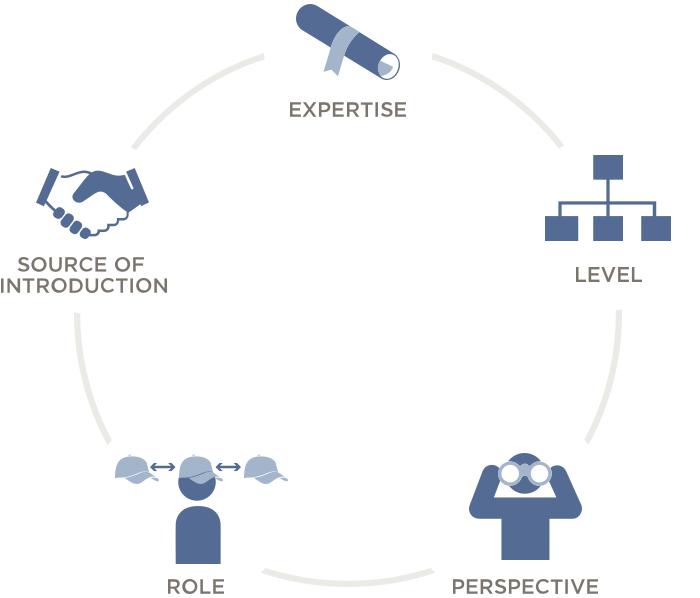
In addition to demographic differences such as age, gender, and ethnic background, diversity also means differences in expertise and perspectives, network members’ level and role in your organization, and ways in which you and your contacts initially met.
Additional Forms of Diversity
With that in mind, assess the degree of diversity in your network’s composition. For instance:Brian Uzzi and Shannon Dunlap, “How to Build Your Network,” Harvard Business Review, December 2005.
How you met: For each contact in your network, ask yourself how you first met. If someone introduced that person to you, write down the introducer’s name. If you met the contact yourself, write down “me.”
Me, me, me: Count up how many “me’s” are in your list. If you’ve introduced yourself to most of your contacts, your network may not be diverse enough. That’s because, in making network contacts, most of us choose people who resemble us. For instance, maybe many of the network contacts you’ve introduced yourself to have the same experiences, backgrounds, and worldviews as you. They may even be the same age and gender and come from the same level as you in the organization, or from the same part of the enterprise. If that’s the case, you may not be getting access to the diverse ideas, viewpoints, skills, and information essential for strategic thinking, creativity, and problem solving. Instead, you’re operating in a kind of “echo chamber,” where everyone keeps exchanging the same ideas.
Superconnectors: Count up how many times the same person introduced you to contacts in your network. If someone’s name appears often, he or she is a “superconnector” or “power connector.” Such individuals play an important role in bringing variety to a network. Though they’re seldom in positions of formal authority, they have networks that are rich with critical resources (such as control over funding, information, connections, opportunities) and can help themselves and others achieve professional and personal goals quickly.Judy Robinett, How to Be a Power Connector: The 50+50+100 Rule for Turning Your Business Network into Profits, McGraw Hill, 2014.They share their diverse contacts, so every network can benefit from including at least a few superconnectors.
You as a connector: For each contact in your network, write down people you introduced him or her to. Consider what this suggests about how well you’re helping to connect others and expand diversity in your network.Malcolm Gladwell, The Tipping Point, Little, Brown, 2000.
When you have limited control over network diversity
You may not have complete control over the degree of diversity in your networks’ composition.
For instance:
A network whose purpose is to implement a special project might be less diverse than others in terms of contacts’ skills and backgrounds. That’s because membership would be prescribed by the task at hand.
Your organization or even industry may not be all that diverse in demographic terms. In that case, you might have little opportunity to ensure that your networks reflect such differences.
If you’re a new manager, you may not yet have had plentiful opportunities to connect with a wide range of people who are different from you. That’s okay. The key is to be aware of the benefits of diversity in your network contacts, and to proactively seek to build it into your networks as you advance in your career. Remember: Even if you’re limited by circumstances, you’ll still have opportunities to bring a wide array of ideas and opinions into your network.
When you have limited control over network diversity
多元化的人际网络让工作既高效又有趣 Mentor Moment: Diversity
哈佛教授讲授视频逐字稿
Wherever you are in your career—whether you're starting out or you're managing a project—there's real value in bringing in different perspectives, talking to different groups to help your work and your projects be as successful as possible. In fact, research proves that to be true. But you know what? As human beings, we like things that are similar. We're comforted by things that are similar. So we'll probably stick more to ourselves, people in our same department. We think the same way. That's great.
But it may not be great for your project. And a lot of us think, "That's just so much work." But it really doesn't have to be. It could be really little things you do that make a big difference to get that different perspective. Maybe it's about not just sticking in accounting, but actually going and talking to the product manager, the supply chain person, to understand why the number is the way that it is. And your analysis will actually be that much more effective in the end.
So what does that look like? Perhaps it's picking up that phone and talking to your counterpart, emailing them with that question that you're thinking you can’t do on your own. Maybe asking someone out for lunch and talking about the project. And maybe even talking more about their families, and how they got to where they are in their work. What's really interesting is that research shows that when you reach out, your work will be more productive. But you know what? Reaching out to diverse people, getting diverse ideas, may actually also make work that much more fun.
The quality of the relationships in a network makes all the difference to its effectiveness and value. And relationship quality is determined by several different factors.
For instance, to take stock of the quality of relationships in one of your networks, ask yourself whether your network is characterized by high levels of trust and reciprocity. When network members trust one another and give to as well as take from the network, they’re more likely to communicate openly, build long-term bonds, and feel they can rely on each other. As a result, they’re more willing to freely exchange information, support, resources, and other forms of value. That makes it easier for network members to support their organization’s strategic goals, get everyday work done, or foster one another’s professional and personal growth.
In some networks—such as large ones where all members don’t necessarily know one another or interact frequently—there may not be many close relationships. Striving to foster such relationships throughout this kind of network would be time-consuming and impractical, but it’s vital that members who are most important to a network’s purpose trust one another and reciprocate in their interactions. Think of the people in your networks who have the most critical information, knowledge, skills, or resources required to get work done or understand the trends shaping your industry. With these individuals especially, you’ll want to take steps to ensure high levels of trust and reciprocity.
Of course, you have limited control over the behavior of others in your network. But you can control your own behavior so that others trust you and reciprocate with you.
What builds trust?Linda A. Hill and Kent Lineback, “Weave Your Own Web of Influence,” in Being the Boss: The 3 Imperatives for Becoming a Great Leader, Harvard Business Review Press, 2010.
Trust is the foundation of influence in any network. When contacts in a network trust each other, they feel they can count on one another to do the right thing.
How might you earn your network contacts’ trust? How do you know whether you can trust particular members of your networks? Understand the ingredients that foster trust.
In simplest terms, trust arises from a person’s:
Competence: Network contacts trust one another when they believe that each has valuable knowledge (such as technical expertise or wisdom about how things can get done in the organization) and a track record of accomplishment. When you view someone as competent, you believe that he or she knows not only what to do but also how to get it done.
Character: People are perceived as having good character when they consistently deal with others honestly and respectfully, show that they care about others, help others achieve important goals, and fulfill promises.
What builds trust?Linda A. Hill and Kent Lineback, “Weave Your Own Web of Influence,” in Being the Boss: The 3 Imperatives for Becoming a Great Leader, Harvard Business Review Press, 2010.
In addition to being characterized by trust and reciprocity, networks with high-quality relationships:Rob Cross, Peter Gray, Shirley Cunningham, Mark Showers, and Robert J. Thomas, “The Collaborative Organization: How to Make Employee Networks Really Work,” MIT Sloan Management Review, Fall 2010.
Include people who are “energizers.” In any network, energizers are people who always see opportunities, even in challenging situations. They create room for others to contribute. In addition, they leave people feeling good about themselves and inspire highly skilled workers to bring their best to the organization each day. If you’ve got enough energizers in your network, you’re more likely to successfully achieve goals by leveraging your network.
Help you draw satisfaction from your work. When your networks have high-quality relationships, you gain a deeper sense of satisfaction in your work life. That’s because you feel a greater sense of personal support and a deeper sense of purpose or worth. And thanks to these qualities, you may also feel that you have a healthier balance between your work and personal life.
多与正能量的人相处会让你变得更棒 Mentor Moment: Energy Enhancers
哈佛教授讲授视频逐字稿
Every day at work, there's a range of individuals that we interact with. Sometimes they're in our teams. Sometimes they're in other organizations. But we all have a network of people that are part of our work.
Think about the people that are part of your network. I bet you, in that group, there are some that just make you feel great. They make you feel like "I can definitely do this. I can't wait to try this. It may feel hard, but I'm actually really motivated." They cheer you on. They support you. They help you. They're the people that we call "energy enhancers." They enhance the best of who you are.
On the other hand, there are others that somehow drain your energy. You feel a little more negative when you're with them. And when you leave, you don't feel like you're the best version of yourself.
Take the time to find more time with those individuals that are energy enhancers—those that make you feel fabulous, who can help you be the best of who you are because that will make you and your day the best that it can be.
Worksheet for Assessing the Quality of Network Relationships
1. How diverse is your professional network? How might it benefit from new members with different experiences, background, and worldviews from you?
第 4 节
Use the insights gained from examining your network’s diversity and relationship quality to assess how you can strengthen it. Depending on how your network needs to be improved, you may want to strengthen it by adding people, removing or spending less time with certain people, changing how people in the network interact—or a combination of these moves.
Consider these examples:
If your network ...
Try this ...
Isn’t helping you reach important professional and personal goals
Find people within and outside your organization—even outside your profession—who have information and expertise, support and influence, or feedback essential for your network to fulfill its intended purpose. For example, they might help you:
Craft and execute strategies for supporting your organization’s goals.
Perform daily work efficiently or effectively.
Grow personally and professionally.
Is not diverse enough
Determine ways in which your network should be more diverse—in terms of expertise, perspectives, knowledge, skills, backgrounds, or types of ties. Identify people you could connect with to improve your network’s diversity in these ways.
Lacks superconnectors
Look within and outside your organization for people who are great at linking others and who are aware of or control resources valuable for reaching goals. Determine which of these individuals would make the most valuable superconnectors for your network.
Doesn’t enhance your job satisfaction
Identify people who can provide the personal support, sense of purpose or worth, or sense of work/life balance you need to feel more satisfied with your job.
Is draining you and others of energy
Add people who embody the defining characteristics of energizers and who seek to give more to their networks than they take. Spend less time interacting with “de-energizers”—people who only point out obstacles, show little concern for others, are rigid in their thinking, or fail to fulfill commitments.
If too many people in your network are involved in overly frequent or irrelevant meetings and unrelated decisions—and are exhausted as result—find ways to lighten the load. For instance:
Ask a less overloaded person to attend certain meetings.
Document projects thoroughly so others don’t have to interact too often with the project leader.
If network members are leaning too heavily on someone with a particular kind of technical expertise, cultivate a broader group of go-to people.
Whatever your goal in strengthening one of your networks, there are some simple tips to keep in mind as you plan your next steps:
Keep in touch once you have made a new connection—it’s about building a lasting relationship, not a single transaction.
Remember that network relationships should be reciprocal—be sure to consider how you can be of service to others.
Think strategically about how best to connect with a potential contact—whether a peer or someone who is more senior to you.
拓展人际网络的四大禁忌 Networking Do’s and Don’ts
哈佛教授讲授视频逐字稿
We all know that it's important to build and sustain your professional networks, but there are some common pitfalls that trip up even the most experienced professionals. Here are four things that you should avoid when it comes to your networking.
The first is failing to follow up. This seems so basic, and yet a lot of the discourse around networking is about collecting business cards, meeting new people. And, fundamentally, that's misguided. It isn't just about acquisition; it's about developing long-term relationships. If you don't stay in touch with people, within a few months, they're going to forget you ever met. You need to build and sustain the relationships.
Second, a common problem is that sometimes people ask for favors too soon. And if that happens, you essentially blow up the connection because the person feels that you're less interested in a relationship and you're more interested in a transaction. I actually advise people to wait an entire year before asking for a favor from a new contact.
The third mistake that people often make when it comes to networking is making the other person do too much work. And what I mean by this is that a current vogue in networking is to conclude the meeting by saying, "And so how can I help you?" And that's a lovely sentiment, but, unfortunately, the person has just met you. They don't know what your connections are. They don't know what your skills are. If you really want to be helpful to someone, it actually pays for you to do the work instead and to perhaps make a specific offer to them about a way that you might be of service.
Finally, a way that people often go wrong when it comes to networking is misunderstanding the power dynamics in a given situation. If you're trying to network with a peer, it's a perfectly fine thing to do to invite them out for coffee or suggest that you get lunch. But if you're networking with someone that is very senior, very powerful, you can't necessarily do that. They are inundated with requests, and yours is going to look like just another person wanting something from them. What you should instead be doing is trying to think strategically about ways that you can be of service, whether that is a question of you helping them with a particular project or perhaps you have knowledge or skills that they might value, and you can help them with that.
If you avoid these four common pitfalls, you can develop lasting, meaningful relationships.
第 5 节
If you’ve mapped one of your networks and crafted a plan for strengthening it, revisit your network map and use it to visualize how your network would look once you activate your plan. In this way, your network map can serve as a handy resource for updating your network as the contacts and connections in it change through your improvement efforts.
To put your improvement plan into action, you can use face-to-face interactions as well as digital tools and technologies to forge new connections or improve existing ones.
Brian Uzzi and Shannon Dunlap, “How to Build Your Network,” Harvard Business Review, December 2005.
You can forge new connections or enhance existing ones by taking advantage of opportunities to interact with others face-to-face. Examples include attending conferences and professional association meetings or other events related to specific aspects of your work or career.
Networking with people outside your industryDorie Clark, “Start Networking with People Outside Your Industry,” Harvard Business Review, October 2016.
If you’re like many managers, the vast majority of people you know probably work in the same field or industry as you. That could give you a myopic view of what’s happening in the wider business arena. To gain exposure to more diverse perspectives, viewpoints, and insights, start networking with people outside your field or industry.
Try these tactics:
Think of past colleagues or friends who work in different fields and whom you haven’t spent much time with. Reach out to them and propose getting together.
Make an effort to have coffee or lunch once a week with someone outside your industry.
Ask people at the farthest edges of your network to recommend people in other industries they think you should meet. For instance, “I’d like to know more about how companies in your industry are handling new forms of competition. Who else do you think I should connect with? Would you be willing to introduce me?”
Networking with people outside your industryDorie Clark, “Start Networking with People Outside Your Industry,” Harvard Business Review, October 2016.
You can also engage in shared activities outside of work that let you connect with a wide range of other people. Such activities might include sports, community service ventures, cross-functional projects, volunteer efforts, and participation in nonprofit boards and charitable foundations.
建立外部人际网络的价值 The Virtuous Cycle of Networking
哈佛教授讲授视频逐字稿
I feel that building networks outside my organization is just as important as building networks within the organization. I currently serve on the boards of two NGOs. I've been lucky enough to have been, early in my career, on exchange programs for professionals. They've taken me to different countries—fellowship program that took me to Thailand, where I met incredible people. And all these opportunities have come to me through networks that I've built externally.
And when I was invited to join the boards of the NGOs, I really didn't see it as added work, although I know it may seem like added work. But for me, on the NGOs that I serve, they are people with diverse skills and interests, and I get to meet all sorts of sometimes eminent personalities who are also giving their time, who have worked a lot of years in their career. And I find that building these relationships is so important externally because they bring a certain perspective to you—to me as a professional that I would not have gotten otherwise if I had simply built networks only in my organization.
But by expanding my sort of sights—my horizons—through all the networks that I have externally, it's been very useful in building me as a leader, as a manager, to be able to not only contribute to my organization but help my team members be the best they can be as well. I find that it's continuous. It's a mutual thing. And it builds, and my company benefits. I benefit as a person, and the society benefits as well. So it's a vavaluable thing to have
Shared activities become powerful network-improvement vehicles when they:
Evoke passion in the participants—so people find time for the activity.
Require participants to depend on each other—so they build trust quickly.
Bring together diverse individuals around a common point of interest—so they can respond to unexpected events in an unscripted way, further building trust.
Have something important at stake—so participants have opportunities for celebration or commiseration, which generate bonds of loyalty.
Enable participants to break out of prescribed roles defined by their formal title or workplace reputation (such as boss, subordinate, “tech whiz,” or finance guru)—so they gain deeper insight into one another’s character.
案例
Tobias, a client development executive for a nonprofit firm, meets with potential donors through shared activities outside the typical business setting. With one prospective donor—Jenna, who has a passion for competitive waterskiing—he accepts an invitation to take some lessons with her. Through this activity, Tobias demonstrates a can-do spirit that wins Jenna’s trust and signals to her that he will put her investment to proper use. As a result, she shares some personal experiences that help Tobias revise his original proposal to secure a contribution from her.
Digital tools and technologies
Andrew L. Molinsky, Thomas H. Davenport, Bala Iyer, and Cathy Davidson, “Three Skills Every 21st-Century Manager Needs,” Harvard Business Review, January-February 2012.
Your company may have or support use of a number of digital tools and technologies that can help you strengthen your networks. These include internal online networks and blogs, or online tools such as enterprise social networking or team collaboration services.
How can you get the most from such virtual networks and tools? Enhance your:
Reputation: To get people you’ve never met to seek you out, share information, and collaborate with you, offer interesting content. Draw attention to your online effectiveness, such as your web presence. And motivate others to circulate and act on your ideas.
Specialization: Demonstrate deep knowledge of your areas of expertise. Establish links with other experts, inside and outside your organization. Commit to learning from these experts. And be willing to offer relevant information and referrals to others.
Network position: Position yourself as a bridge between otherwise unconnected groups. Use this position to identify potential collaborations between previously separate groups. Use it to also gather information and feedback you need to achieve goals or solve problems—such as finding top-notch candidates for an open position or solving a tough technical problem you’re facing.
用可信的网络品牌吸引他人与你建立联系 Build a Strong Digital Presence
哈佛教授讲授视频逐字稿
I have this saying that connections are the new wealth, and isolation is the new poverty. If you want to be a success, it's almost important—necessary—that you have good connections.
Another necessary condition for being successful is identity. Today, when people are assessing whether to connect with you, they don't make random connections. They actually check you out first.
In fact, it's changed the social fabric today. The minute you meet somebody, the first thing you go back home and do is check this person out. In fact, it's become so bad that if you don't have an online presence, some people don't take you seriously. They'll say, "This person doesn't even have an online presence!"
So I'll give you an example of how this came about clearly to me. I think it was about seven or eight years ago when Mike Volpe, who used to work for HubSpot, showed up at Babson. He was talking about the new economy and identity and notions—things like that. And some of the students, because this company is a really interesting company to work for, had their resumes out and came to Mike and said, "Would you take my resume? I would like to work for HubSpot."
Mike said, "No, no, no—hold on a second. You didn't get my message. You don't come to me. You get found by me." And they were all puzzled. They said, "What do you mean?" He said, "Remember, the whole idea of HubSpot is inbound. What that means is that you build your reputation by putting content out there online, and I read about it. And then I figure out you're actually a perfect fit to work for my company, and I come and find you."
So if you're interested in an area, here's what you do. You build your credentials in that area. Don't try to be everything for everybody—be very focused, and build a credible identity. You've got to show proof or examples of the fact that you made investment in that new area before you go seeking those careers.
And this is what I mean by establishing your digital presence and creating these different channels of opportunities for you, which begins with your digital identity that you establish.
By strengthening your reputation, specialization, and network position, you can also test proposals and strategies inside and outside your organization.
For instance:
Float an idea to the network. See how many “likes” your idea gets and what kinds of comments, questions, and concerns people offer in response.
Direct certain groups of people to an online survey. Then use the results to persuade your boss, a prospective client, or other decision maker to embrace your point of view on a course of action you’re advocating.
Create an internal blog or use other available online tools to foster the exchange of ideas and solutions to a pressing problem.
案例
Michelle, an enterprise community manager at a large company that desperately needs to cut costs, uses her internal blog to explore solutions to the cost challenge. She offers suggestions in her blog posts and encourages colleagues to submit their own ideas. The post gets tens of thousands of views and generates hundreds of cost-saving ideas, many of which the company implements. Meanwhile, Michelle gains visibility at every level of her company. Equally important, managers and employees throughout the organization all feel a sense of team spirit in getting the company through a serious crisis.
Manage overlap between your social and workplace networks
Many people use personal social networks to engage in work-related networking, such as finding talent, job hunting, and posing work-related questions. Social networks tend to comprise mostly friends, family members, and acquaintances. But they may also include current or former colleagues and other contacts initially made in a professional workplace setting.
Use of social networks for professional networking purposes thus blurs the line between the two types of networking, as some contacts may overlap across the social and professional spheres.
Using your personal social networks in this way can be beneficial. But social networks are more loosely defined than professional networks developed by employees and managers in a workplace setting. What’s more, social networks tend not to be a strategically managed like professional networks. So if you use your personal social networks for work-related networking, think about the kind of content you post and how you interact with your various contacts online.For instance, consider:
How content will be perceived: If your posts (such as photos or responses to others’ posts) would be perceived negatively by people you hope will help you achieve professional goals, your social network might not prove as useful for work-related efforts as you’d hoped.
Whom to share content with: Ask yourself whether it makes sense to post content in a targeted way to specific contacts, as opposed to mass posting to all your contacts. For example, to manage the boundaries between your personal social network and your professional contacts, you might post work-related content in ways that only your professional online contacts can see and respond to.
Manage overlap between your social and workplace networks
Strengthen Your Networks
Strengthening your networks can help you reach your important strategic, operational, and developmental goals. Use this activity to diagnose the key dimensions of one of your networks and identify ways to strengthen it that will enhance its value.
To start, choose one of your operational, strategic, or developmental networks as the focus of this activity. Be sure to pick a network that has a manageable size (no more than 12 people); or for a larger network, select up to 12 key contacts to focus on.
Try it Out
1. Build your reputation
2. Demonstrate knowledge of your areas of expertise
3. Position yourself as a bridge between otherwise unconnected groups
第 6 节
Test your understanding and reinforce what you’ve learned.
Try it Out
1. 1. Samantha has an established network of contacts to support her day-to-day work. After mapping her network, she realizes it has some gaps, and she is keen to take steps to strengthen it. What is the most effective thing she can do?
答案与解析
Make contacts mostly by introducing herself. If you've introduced yourself to most of your contacts, rather than having been introduced by a variety of other people, your network may not be diverse enough.
Add as many new people to her network as possible. "Strengthening" doesn't mean simply expanding your networks by adding more people to them. Instead, it means enhancing your networks' value.
Concentrate on finding contacts who share her perspectives. If the members of your network are too similar, you may not be getting access to the diverse ideas, viewpoints, skills, and information essential for strategic thinking, creativity, and problem solving.
Look for potential new contacts who are already good at linking others.(正确) "Superconnectors"—people who are great at bringing others together and have many ties to diverse contacts—can help strengthen a network by increasing access to resources, information, and support.
Try it Out
1. 2. To expand one of his networks, Luther decides to organize a community service event involving colleagues as well as people who are not in his industry. What can he do to ensure that the event also acts as a powerful way to strengthen this network?
答案与解析
Create a common point of interest.(正确) To build a strong network, it's helpful to bring together diverse individuals around a common point of interest, So they can respond to unexpected events in an unscripted way, further building trust.
Encourage independent activities. It is better to require participants to depend on each other, So they build trust quickly.
Avoid anything unexpected as much as possible. It's good to have some unexpected events so participants can respond in an unscripted way, further building trust.
Make sure the event is structured around people's roles at work. Encouraging participants to stay within their prescribed work roles can be limiting. Breaking out of job roles allows people to gain deeper insights into others' character and interests, and helps build the trust essential to strong networks.
第 7 节
Reflecting on your learning helps you apply relevant concepts to your job.
Take a Moment
1. 1. What new insights do you have that could benefit you or others in your workplace?
2. 2. What are your biggest opportunities for applying concepts from this Lesson in your workplace?