Leveraging Your Networks
Understand Networks 查看中文版
第 1 节
What are networks?
In your personal and professional life, you've probably used the words “network” and “networking” often, as well as heard others mention them. But what do they mean, exactly? If you haven't paused to think about this, you may be missing out.
By taking a closer look at what networks are and why they're important, you'll gain valuable insights that can help you capitalize on networking's true power. So let's start with some definitions:
A network is ...
... a web of mutually beneficial relationships with individuals and groups inside and outside your organization that you and your team need to succeed.Linda A. Hill and Kent Lineback, “Weave Your Own Web of Influence,” from Being the Boss: The 3 Imperatives for Becoming a Great Leader, Harvard Business Review Press, 2011.
And networking is ...
... the process of building and maintaining such webs.
第 2 节
Why networks matter
Why is the ability to build and sustain networks so important? It’s how work gets done in today’s business environment. And it has become more crucial than ever because of how organizations are changing.
For instance, many organizations:
- Have replaced top-down reporting hierarchies with matrixed or flat reporting structures.
- Get work done through cross-functional teams whose members come together to tackle specific projects then break up and move on to other teams and projects.
- Have defined increasingly specialized jobs.
- Face more complex challenges that require multiple functions and perspectives to surmount.
- Operate in an environment characterized by high levels of volatility, uncertainty, complexity, and ambiguity.
- Are collaborating in new ways with external parties to develop innovative products and services.
- Are navigating a landscape reshaped by digital technologies that present new challenges as well as new opportunities for people to connect with others—anywhere and anytime.
Under these conditions, people throughout an organization depend on one another more than ever. To succeed, they need to exchange knowledge, ideas, information, resources, and support. And no one can do that alone; it’s possible only through effective networking.
为什么要构建人际网络 Why Network?
哈佛教授讲授视频逐字稿
The world is changing. We live in a globalized economy, and organizations are operating across borders everywhere. They're also facing complex new opportunities and challenges, like how to succeed in unfamiliar markets and how to survive new competitors.
To navigate this new landscape, organizations must tap into a wide array of expertise and knowledge from multiple sources that can be anywhere. They're creating matrixed or flat reporting structures. They're setting up cross-functional teams and virtual teams whose members work anywhere around the globe. And they're collaborating in new ways with customers, suppliers—even competitors.
How can you excel as a manager in this landscape? You have to build and sustain networks— networks are webs of mutually beneficial relationships with people in groups inside and outside your organization. And, simply put, networking is how work gets done in today's complex world.
To create value for your organization, you have to exchange ideas, information, resources, and support with many different people—not only in your organization, but also outside. You can do all of this only through networking.
When you build networks and use them wisely, you achieve important professional and personal goals. For instance, you can use your network strategically to spot trends affecting the business environment and identify new opportunities and challenges those trends present.
You can also use your networks operationally to accomplish the day-to-day work that supports your organization's goals.
And finally, you can use your networks to foster your own professional and personal development; for instance, to find mentors who can help you grow.
There's no doubt about it—networking counts among a manager's most vital skills. Master it and you'll create unprecedented value for your organization, your team, and yourself.
An effective network will help you:Brian Uzzi and Shannon Dunlap, “How to Build Your Network,” Harvard Business Review, December 2005.
- Access information and resources that may not be available publicly—such as a new product’s release date or the qualities that a particular employer looks for in job candidates.
- Tap into a wide range of technical expertise and interpersonal skills—from people within and outside the organization.
- Connect experts and stakeholders within and outside the organization to stimulate collaboration, explore different viewpoints, and agree on courses of action.
- Learn and thrive by engaging with others and gaining a sense of purpose and worth as you and others exchange support and other resources.
人际网络越早建立越好 From Near-Disaster to Success
哈佛教授讲授视频逐字稿
This was the situation. I found myself in a new company—I had only been there two months—leading on a project where we were expecting a consultant to come and run a series of interviews over five days. There were about 30 interviews we needed to set up. This was a Friday morning. I learned at 10:00 a.m. that not one of those interviews had been set up. Not one of the appointments or the colleagues to be interviewed had been contacted. It was a disaster about to happen.
How was I able to turn something that was a near-certain disaster into success? Through networks. One of the first things I did when I arrived at the company was to identify key people across the business, to meet with them, get to know from them about the company—listen and learn, get to know what was of value to them, what they cherished in the work, the culture of the business, and also how my team could be of support to theirs to help them succeed even more. That turned out to be crucial. I had no idea at the time that it would be so important to me so quickly, but that was what happened. I was in a bind. I got up and got to the phones, worked the phones, and was able to set up all those interviews within a day. It was very important because without that, this project that we've invested a lot of money into could have turned out to be a complete disaster, wasting a lot of money for the company.
Now the issue of why the interviews were not set up is a different story on its own, and I won't go into that. But suffice to say, it went very well at the end of the day. And that, for me, was validation of the fact that building those networks is very important. Not only just building the networks, but ensuring you build the networks quite early. And so it was that when I did need something, people were very willing to help, very willing to support me to succeed, just like I had shown that I was willing to support them to succeed.
So for me, I feel one of the big mistakes that people make as managers and leaders is to underestimate the value of these networks.
When you don't develop networksHerminia Ibarra and Mark Hunter, “How Leaders Create and Use Networks,” Harvard Business Review, January 2007.
If you neglect to build and sustain networks, you could severely limit your effectiveness as a manager and jeopardize your career prospects. Consider these examples: Sophie, a logistics manager, had few relationships with people outside her team, so she hadn’t noticed trends in technology and supply chain management unfolding in the wider business environment. As a result, she missed out on opportunities to use new digital technologies to achieve cost-saving efficiencies in the logistics processes she managed.
Jonah, a department manager at a large company, refused to tap into his extensive network for help when internal adversaries took over key functions of his unit. The loss of these functions cost him the respect and support of his direct reports and coworkers, who hesitated to follow someone they saw as unwilling to defend himself. Feeling that he could no longer be effective in his role, he left the company. 1
When you don't develop networksHerminia Ibarra and Mark Hunter, “How Leaders Create and Use Networks,” Harvard Business Review, January 2007.
Make a Connection
1. List two or three ways you've benefited from networking in your career or personal life.
第 3 节
Misconceptions about networks
Networking offers a wealth of important advantages, but many managers haven't taken the time to master this skill. Why? Common misconceptions get in the way. The table shows some of these misconceptions—and the true state of affairs:Herminia Ibarra, “5 Misconceptions About Networking,” Harvard Business Review, April 2016.
Misconception
Truth
Networking is a waste of time.
The investment of time and effort pays off in multiple ways. In the short term, networking generates the information, resources, and support you need to accomplish day-to-day tasks. In the longer term, it helps you attain strategic goals for your team, your organization, and yourself.
You have to be an extrovert to be good at networking.
Networking is a skill that anyone can learn. You don’t have to force yourself to act like an extrovert to network effectively. You can develop a networking style that works for you and that feels true to who you are.
People should form relationships naturally, with people they like.
Networking only with people we like results in overly homogenous connections, because we tend to like people who like us—and who are similar to us. Diverse networks deliver more value because they expose us to a wider variety of perspectives, ideas, and information.
Our strongest ties are the most valuable.
So-called “weak ties” with people outside our inner circle—those we don’t know well or see often—give us access to a wider range of information and resources.
Networking is just self-serving, political game-playing.
Networking is about reciprocity—giving as much to your network members as you get from them. And it’s about attaining goals important to your organization, your team, and you.
第 4 节
A new lens on networking
A common misconception is that networking is just self-serving, political game-playing. Managers who believe this tend to avoid networking because they see it as contributing to a world where “who you know” is the only thing that matters.
But all organizations have political dynamics—meaning that resources are allocated, decisions are made, and conflicts are resolved through the exercise of influence. You can’t avoid the political side of your organization, but you can—and should—learn to work effectively in it. Building and sustaining a range of networks helps.
For instance, to achieve important business goals, you need to:Linda A. Hill and Kent Lineback, “Understand the Reality of Your Organization,” from Being the Boss: The 3 Imperatives for Becoming a Great Leader, Harvard Business Review Press, 2011.
- Resolve problems arising between your team and others.
案例
Employees in Sanjay’s customer service team have a dispute with the sales department over promises the salespeople have made to important customers. To prevent customers from defecting, Sanjay talks with key customers to learn more about their concerns, and gets people from the two teams to sit down and resolve their disagreement.
- Act as an information conduit between your team, the rest of the organization, and people from other organizations.
案例
Monica learns that her company’s IT department is planning a major infrastructure upgrade. The upgrade will include inevitable system downtime, during a period when she plans to install new design software for her team. She meets with the IT team, members of her own team, and the software vendor to coordinate the installation so it doesn’t conflict with the infrastructure upgrade work.
- Learn about new opportunities and obtain the resources needed to capitalize on them.
1
Tycho is an oilfield operations manager. Jade, a former colleague who recently attended a conference on wireless technologies, forwards some of what she’s learned to Tycho because she’s in a similar field and believes he would find it interesting. Intrigued, he learns more about the technologies and decides that installing a new wireless system would help him monitor oil-well conditions far more efficiently than the current system does.
He identifies all the resources that would be required to set up the system, including funds to purchase the product and facilitators to train field workers on how to use the new system. He presents his business case for the new system to his boss and the head of finance, and they agree on a budget for the project.
1
案例
Chani’s team has failed to hit an important deadline that other teams were counting on. She helps her team find a solution. She then personally meets with the other teams involved to explain the cause of the delay and describe the advantages of the solution, easing their concerns.
1
Peter’s team relies heavily on contractors to manage a wide range of tasks. Senior management issues a directive requiring all contractors to use a highly complicated, confusing, and time-consuming new process for submitting their invoices. After the process is implemented, many of the team’s contractors have difficulty getting paid, and begin turning down new assignments.
Peter meets with his team’s most valued contractors, as well as other managers who also extensively use contractors, and gathers information on problems they are having with the new process. He explains the impact to senior management and persuades those in charge of the new process to simplify it and remove bottlenecks.
1
These scenarios can all be described as “political.” Yet the managers depicted are effectively using their networks to achieve important business goals.
你的人际网络定义了你的职场角色 The Networking Imperative
哈佛教授讲授视频逐字稿
Every knowledge worker today must think of himself or herself as being part of a networked world. And these connections are not restricted to just the organization. It can go much beyond the organization, and it's even not restricted by any geography.
In your current job, they're asking a question about, How do you solve a particular problem in your area of expertise? Turns out that you didn't know the answer to that, but you need the answer to that pretty quickly.
It's not like back in the day, you'd go to the library and hit the books and do research, and then figure it out yourself. Today, you do some of that to improve your ability to understand, but you also to tap into your network and ask questions, post this question to your network. If you've been a good citizen of this network, you'll get answers back pretty quickly, so you had to make some investments.
Now, the other thing is, let's say that you decide for some reason that you want to pursue a different trajectory in your career. You can reach out to a mentor and say, "I'm thinking about this. Is this a wise thing for me?" And your mentor may say, "It's actually very good. And by the way, there's an opportunity in this particular organization that I have a connection with. Maybe I can connect you with them." You can have a conversation and do that.
So the key point here is that we are part of a network, and the network knows no boundaries. It doesn't understand organizations. It transcends organizations. And your ability to navigate in and out of these networks defines the modern-day employee today. And we cannot stay back and say "It doesn't apply to me" anymore. It applies to everybody.
It doesn't matter which industry, which vertical, where you work, even which part of the world you work. You are a global citizen, and you have to be part of these multiple networks in order to be not just successful as an employee, but also to get full potential out of what you have.
第 5 节
Forms of networks
Herminia Ibarra and Mark Hunter, “How Leaders Create and Use Networks,” Harvard Business Review, January 2007; and Linda Hill and Kent Lineback, “The Three Networks You Need,” Harvard Business Review, March 2011.
There are different forms of networks, and each has its own purpose. Together, these networks help you reach your full potential as a manager.
Network form
Purpose
Strategic
Understand what's happening in your organization and its environment. Scan the horizon and help define the right strategic direction for succeeding in the future.
Operational
Efficiently and effectively accomplish the day-to-day work your team must do to support your organization's goals.
Developmental
Enhance your personal and professional growth.
Your three networks don't have to be mutually exclusive. Indeed, some people may be in several of your networks. Your operational or developmental network can also evolve into a more strategically valuable one.
1
Hannah, a manager at a consumer electronics firm, uses her personal passion, sailing, to meet people from diverse professions. Few of her sailing friends work in her industry, but when they spend time together outside of work, they discuss a wide range of topics related to their personal and professional lives.
Hannah discovers that, like her, many of these friends face customer relations issues in their jobs. Hearing about their problems and the solutions they developed has helped Hannah overhaul an important business process to resolve a particular customer service problem in her company. Ultimately, what began as a developmental network has become operationally and strategically valuable to her.
1
你需要构建三种类型的人际网络 Why You Need to Build Networks
哈佛教授讲授视频逐字稿
One of the things that I try to help young managers understand is that a part of leadership is actually managing your network. We're all very dependent upon others to get our jobs done. And it's not just about leading, if you will, the people who report to you. But it's also about thinking about all those people you're dependent on to get your job done, over whom you have no formal authority.
The first kind of network you need to build is referred to as your "strategic network." This is the network you build to figure out what your priorities should be—what you should be working on. And to do that, you need to build relationships with people, because information is power. And unless you're in a relationship with them, unless they think you can be trusted with the information, unless you know them well enough to translate what they're saying to figure out what it really means for your part of the organization, it's not going to be very useful. So you have to build a relationship with these people, so that you can be having those conversations to figure out what you should be working on.
To really be viewed as competent in your organization, you also need to be seen as someone who knows what's really happening in your particular area of responsibility. Do you know what the cutting edge is? Now, the only way you can really know what's the latest and greatest in your area of responsibility is to reach out and probably be having conversations with people outside your organization as well, to know what the competitor is doing, to know what maybe suppliers are able to supply today. And you need to be out there collecting that information, bringing it in, and translating it for your colleagues inside. So the first network is that strategic network.
Once you understand what you should be working on, you also want to build what's referred to as your "operational network." And once you know these are the things we should be working on, then you need to think about "Who am I really dependent on?" Who do I need to know and be in relationship with to build the coalition, to get those things done?" And to do that, you need to, again, build relationships with people, because people aren't going to help you close an opportunity gap that you see or address a performance gap unless they know that they can trust you, they can expect that you will deliver for them, and that they can influence you. And so if they're not in a relationship with you, they're not going to help you take care of those priorities that you see.
Now, the final kind of network that you need to build is referred to as your "developmental network." Unfortunately, we don't learn in school. We really learn from doing. So what you know is really based on what you get to do. And unfortunately, what you get to do is based on who you know, because people are not going to give you access to assignments that are really relevant, where you have a lot of visibility and autonomy to do some things, unless they really trust you.
Now, many people don't like this because it feels very political, but frankly it's only logical. Why would you give someone an assignment that was really relevant, that they had a lot of autonomy and visibility, if you didn't know that person, if you didn't trust them? So when you think about building your developmental network, this network is going to have many, many people in it—junior, senior, peers, et cetera—people who can give you access to opportunity, people who can help you learn from those opportunities. Maybe you'll need some coaching, because there are some new things you're going to need to know to actually do that new kind of assignment.
Maybe you're going to make a misstep if you're trying to innovate. You need people who might protect you if you make that misstep. You also need people who will just accept you, because when you're trying to be a change agent—for instance, if you're trying to pursue something new—sometimes you need someone to just tell you, "Guess what? You're not crazy." We also need role models—people who can give us ideas about how we can behave in new roles in different ways.
So when you think about your developmental network, it's not about finding one person to be a mentor or whatever for you. It's about really putting together your own personal board of directors—people who can help you develop yourself and be competent. You need all three kinds of networks, because you're dependent on other people to get your work done—the strategic network, the operational network, and the developmental network.
第 6 节
Characteristics of high quality networks
By understanding the characteristics of high-quality networks, you can more easily strengthen your networks to get the most value from them.
The best networks have the right:
Structure
-
They are a suitable size for your purpose—not too big or too small.
-
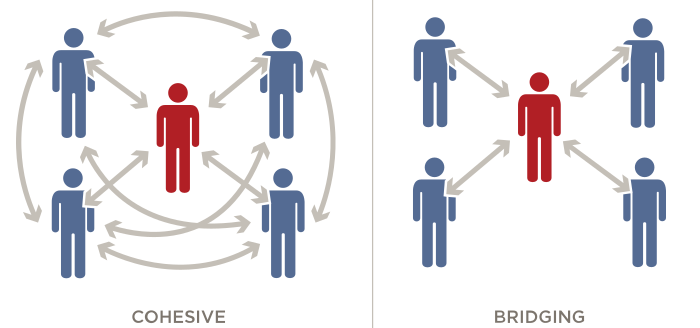
Their “shape” is helpful for your purpose. For example, in a “cohesive” network, you’re connected to people who are connected to each other. In this kind of network, there are high levels of trust and support. Information can be corroborated through multiple channels. And communication and coordination come easily to the network members.
-
In a “bridging” network, you’re connected to people who aren’t connected to one another. You serve as the link between disparate individuals and groups; you can gain access to novel information and knowledge; and you can control what, when, and how you communicate with other network members.
Composition
-
They include people who help serve the network’s intended purpose—whether it’s to define and execute strategies for succeeding in the future (your strategic network), get everyday work done efficiently (your operational network), or help you grow personally and professionally (your developmental network).
-
They are diverse—containing people and teams from different groups and levels within your organization as well as people from other companies outside your organization. They also comprise individuals who have diverse skills and work experience, age, gender, race, ethnicity, and educational and socioeconomic level.
-
They include strong ties (connections with people you know well and interact with frequently) and weak ties (connections with people on the periphery of your daily work with whom you interact occasionally, but who extend your reach to a wider range of information and resources).
-
They may include “superconnectors”—people who aren’t necessarily in positions of formal authority but who share your diverse contacts. These individuals can link independent clusters of contacts in your networks together. They thus give every member of each cluster better access to other parts of the network. And they stimulate collaboration throughout the network among people with diverse, specialized skills and knowledge.Brian Uzzi and Shannon Dunlap, "How to Build Your Network " Harvard Business Review, December 2005.
Relationships
-
The best networks consist of high-quality, mutually beneficial relationships. Members share a high level of trust and offer support, expertise, or resources in a reciprocal way. You never know when and in what circumstances you may need to rely on these relationships, and have others rely on you.
持续投资于建立关系 You Are Always Developing Relationships
哈佛教授讲授视频逐字稿
It's November 2012, and I'm in a conference room on the 32nd floor in Tel Aviv, Israel. My role there—I've been there three months—is to shut down our Israeli operations, or sell it to a third party. I was not well liked.
All of a sudden, I hear sirens—loud sirens—and I don't know what they are. So I look and peek out the conference room door, and I see a stampede of people running. So I go with them.
Everyone is speaking in Hebrew. There's a lot of noise. It's like a large conference room, but with these metal, cement walls. And the TV is going off and showing bombings—it's missiles, it's war.
I look around and look for a face that I recognize. I see no one. I feel alone.
All of a sudden, my phone starts to ring, and it's the CEO of the Israeli operations, who I thought didn't even like me anymore. It was our legal counsel, who had been fighting against me, who said, "Are you OK?" And then a colleague called me—man I'd met one time—and asked me, "Would you like to stay at my house? I know it's a really hard time right now."
So my story's not about war. My story's not about business deals. My story's about the power of relationships and how sometimes when you think that you've broken the trust, or that you're in a tough situation and you're negotiating hard, the relationships that you make are powerful and are something that you should always spend time in investing in.
Take a Moment
1. Think about someone in your company who is skilled at networking. How do they use their networks to achieve important business goals?
第 7 节
REFLECT
Reflecting on your learning helps you apply relevant concepts to your job.
Take a Moment
1. 1. What new insights do you have that could benefit you or others in your workplace?
2. 2. What are your biggest opportunities for applying concepts from this Lesson in your workplace?
Further reading
有抱负的领导者,不要只向上社交有抱负的领导者和高潜力的专业人士往往会把与高层领导建立关系放在优先位置,认为如果能在高层面前获得足够的曝光度,就能获得晋…
你比你想象的更招人喜欢初次交谈会对人际关系的长期发展产生巨大影响。自然而然地,人们常常会在第一次交谈结束时,纠结自己给对方留下的印象:“他们是…
Top 3 in the source platform's original order
