
Align a Global Team 查看中文版
第 1 节
Leading a globally dispersed team is a uniquely challenging type of global collaboration. As in all global collaborations, language barriers, cultural issues, and distance challenges are common. But since members of a global team rely on one another to accomplish common goals—whether developing a new product, rolling out a new service, or solving a customer problem—your team may also fall prey to alignment issues. If left unaddressed, these issues can fracture a team, preventing it from achieving its mission.
Global teams tend to be more susceptible to certain problems than teams that share the same nationality and time zones. Key issues include:
-
Undetected conflict. Imperfect communication, whether due to language, cultural expectations, or technology, can make it difficult for team members to resolve the normal misunderstandings that arise in any team (such as disagreements over strategies and competition for resources). Since global team members are not co-located, conflicts tend to go undetected and unresolved longer than they would in a traditional team.
-
"Us versus them" divisions. When something goes wrong in a global team—a conflict, a crisis—members tend to split up along national lines. Team members from one country may blame colleagues from another country. They also tend to view their compatriots as smarter and more competent—and may view members from other countries as different and therefore less capable.
As a leader, if you detect misalignment among the geographic subgroups within your global team, act swiftly to get your team back on track.
Make a Connection
第 2 节
To prevent misalignment problems such as unhealthy competition, “us versus them” attitudes, and role conflict, take time to clarify your team’s purpose. A clearly stated purpose will help guide your global team members and align them around shared goals.
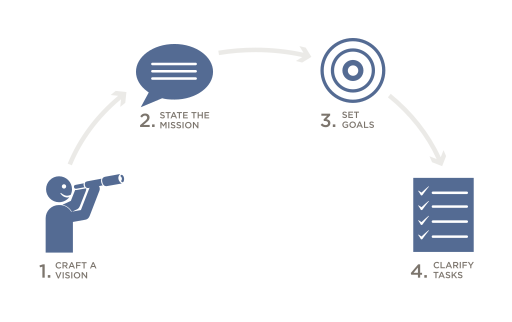
To create a strong sense of purpose, work to build consensus among all team members by following these steps:
-
Craft a vision. A vision is a compelling picture of an achievable, highly desired future: “Our team’s accomplishments will enable our company to claim the largest market share in our industry within Europe, the Middle East, and Asia.”
-
State the mission. A mission is a simple statement of what your global team does: “We develop products that make life better for consumers around the globe.”
-
Set goals. Goals are targets that translate the team’s vision and mission into measurable results: “Our team will develop three blockbuster products by the end of next year.”
-
Clarify tasks. Tasks are actions that team members will need to take to achieve the agreed-upon goals: “Our team will design product features and develop prototypes for market testing to develop the three products.”
整合国际团队的五个指导原则 Position Your International Team for Success
哈佛教授讲授视频逐字稿
第 3 节
Global team members with a shared identity view themselves as part of the larger group, transcending national differences. To foster a sense of shared identity:
-
Monitor group size. Ensure that team subgroups operating in different countries do not differ dramatically in size. Otherwise, the larger groups’ members may view themselves as more “important” than members of smaller groups.
-
Avoid labor inequities. Make sure no geographic subgroups are working substantially longer hours, have less interesting tasks, or have significantly less input during team meetings than other subgroups. Such inequities can stir resentment and intensify “us versus them” feelings.
-
Lead meetings from different locations. You’ll send the message that no single subgroup is more important than any other.
-
Encourage frequent communication and input. Hold weekly teleconferences or Web conferences to discuss next steps as a team. Between meetings, talk with team members individually, whether on the phone or face to face, to ensure that they feel heard and agree with the team’s direction.
Worksheet for Aligning a Global Team
第 4 节
With team members in different geographic locations and time zones, the likelihood that roles and responsibilities will unintentionally overlap increases. Role overlap creates time-wasting confusion and conflict.
To ensure that all team members understand and support each others’ roles:
-
Assess role clarity up front. Do your team members know exactly how they and others contribute to the team mission and goals? Ask them: “How clear are you about your role and responsibilities on the team? How clear are you about other team members’ roles and responsibilities?”
-
Build agreement on roles. Ask team members to define their jobs for the rest of the group. After each team member speaks, invite others to comment. For example, ask: “Do you agree with what the team member just said? Do you have a different perception of this person’s role and responsibilities?”
-
Address overlap. If any overlaps or disconnects arise from team discussions, redefine roles and responsibilities. For example, if several subgroups in a product development team have been assuming that they all will be handling market research, determine which subgroup could be given a different set of responsibilities to avoid overlap.
明确领导职责,实现优势互补 Experimenting with Team Leadership
哈佛教授讲授视频逐字稿
第 5 节
Clarity about how decisions are made and who will make which decisions fosters collaboration and prevents conflict, confusion, and competition within a global team. Work with global team members to establish the following decision-making protocols:
-
Categorize decisions. List all the decisions the team will need to make and group them into categories, such as “staffing,” “budget,” “marketing,” “product launch timelines,” etc.
-
Specify how you will reach decisions. Your team should determine up front how decisions will be made for each category. Be aware of differences in decision-making norms across cultures. For instance, in some cultures, people strongly prefer to make decisions by consensus; in others, the preference is for unilateral decision making. Compromise as needed to ensure that people feel comfortable, but use the opportunity to stretch people in new ways.
-
Decide who does what. Determine who specifically will be making each type of decision. For instance, will the full team make strategic-level decisions, while certain subgroups will take on lower-level decisions?
-
Establish rules. To avoid chaos and conflict, impose rules of engagement regarding decisions. For example: “Once a decision is made, there will be no second-guessing it or trying to get around it.”
Tips for creating a high-performing global team*"Virtual Teams: Paleolithic Insights About the Art of Cyber-managing." Harvard Management Update Mar. 2001.
共同探讨文化差异及应对措施 On the Line
哈佛教授讲授视频逐字稿
In this activity, choose the best strategies for addressing some common pitfalls of global teams.
Try it Out
答案与解析
A. Encourage more frequent communication between team members.
While good communication is important, the team already seems to be communicating well. Ana should explore other factors that may have led the team to split across national lines.
B. Ask people from different countries to lead the weekly team meetings.
Asking people from different locations to lead meetings is a good way to send the message that no single subgroup is more important than any other. But changing the meeting process doesn’t address the root cause of the tension between the two groups on Cedric's team.
C. Adjust the sizes of the two subgroups to make them more balanced.(正确)
Because one group is more than twice the size of the other, the larger group's members are likely more dominant than members of the smaller group, resulting in an us-versus-them attitude. To avoid this possibility, Ana should ensure that the subgroups from different countries don’t differ dramatically in size.
答案与解析
A. Ask team members to define their jobs for the rest of the group.
While asking team members to define their jobs is an important step in the process of building agreement and clarifying roles, it may not provide a useful way to solve the current overlap. Ana needs to move quickly to address the overlap by redefining each subgroup's responsibilities.
B. Ask the subgroups to clarify their roles.
Clarifying roles and responsibilities is useful in uncovering role overlap, but it does not resolve it. Ana needs to be proactive in defining separate roles for each group as quickly as possible.
C. Redefine the roles and responsibilities for each subgroup.(正确)
When roles do overlap, Ana needs to move quickly to redefine them. Determining and then clarifying which subgroup could or should be given a different set of responsibilities should clear up any overlaps.
答案与解析
A. Determine who will make each type of decision for the team.(正确)
Clarity about who will make what decisions—for instance, about staffing, budget, or product launch timelines—prevents conflict, confusion, and competition within a global team.
B. Understand that there are differences in decision-making norms across cultures and avoid forcing global subgroups to compromise on these differences.
While Ana needs to be sensitive to differences in decision-making norms across cultures (e.g., some people strongly prefer deciding things by consensus while others prefer more unilateral decision-making processes), the team needs to have a commonly agreed upon set of norms to avoid conflict.
C. Adapt decision-making rules of engagement to each subgroup's cultural norms.
While Ana needs to be sensitive to cultural differences, setting different protocols for different subgroups may only perpetuate the conflict around roles and procedures. The team needs to be on in agreement about this, so Ana needs to establish a single set of rules for everyone to follow.
第 6 节
Test your understanding and reinforce what you’ve learned.
Try it Out
答案与解析
Establish the largest subgroups in locations that employ the most people.
It is better to ensure that team subgroups operating in different countries do not differ dramatically in size. The larger groups’ members may view themselves as more “important” than smaller groups.
Lead all meetings from one location for consistency.
It is better to lead meetings from different locations. You’ll send the message that no single subgroup is more important than any other.
Develop a mission statement.(正确)
A mission statement—a simple statement of what your global team does—is a powerful way to build consensus among all team members and create a strong sense of purpose.
Assign the most important tasks to the subgroup with the most experience.
It is better to avoid labor inequities. Make sure no geographic subgroups are working substantially longer hours, have less interesting tasks, or have significantly less input during team meetings than other subgroups.
第 7 节
Reflecting on your learning helps you apply relevant concepts to your job.