
Transcend Physical Distance 查看中文版
第 1 节
In many global collaborations, participants are geographically dispersed and rarely reap the benefits of meeting face to face. Often virtual collaboration is the only viable option.
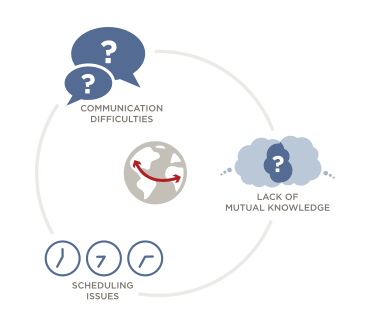
Physical distance poses significant communication barriers. Global collaborations face three distinct types of challenges:
-
Scheduling issues across widely disparate time zones
-
Communication difficulties stemming from limitations of technologies such as email, phone conferencing, and videoconferencing
-
Lack of mutual knowledge about how collaborators do business in their respective locales
Despite these challenges, research shows that virtual teams can outperform groups whose members work side by side. But to make virtual collaborations successful, you need to manage them differently.
Make a Connection
第 2 节
When collaborators live in different time zones, finding a time when everyone can take part in a conference call can be difficult. Being inconvenienced by having to take part in an early morning or late evening call can eventually make collaborators resentful, especially if they are repeatedly asked to extend their schedules.
Clarify assumptions
Call a meeting with your fellow collaborators to clarify assumptions—and even laws—about when it is considered acceptable to conduct business and take part in phone conferences. For example, is it acceptable to call an overseas vendor during evening or weekend hours to discuss issues with the project? Be sure that everyone understands when “evening hours” begin in different parts of the world.
In addition to respecting time-zone differences, be sure to document other circumstances that may affect your collaborators’ availability to conduct business, such as national and religious holidays.
Aim to be fair
Try to schedule each meeting at a time that’s manageable for all participants. If you can't avoid inconveniencing some participants, schedule meetings at different times so the inconvenience is shared equally.
Praveen leads a team of ten electrical engineers in Mumbai. His team is working on a new project with their colleagues in the company’s offices in Sydney and Moscow. Since the deadline is quickly approaching, the three teams have been holding weekly conference calls to discuss progress. To avoid inconveniencing one team more than the others, Praveen schedules the weekly meetings at different times every week to help balance the time-zone inconvenience. For instance, one week the meeting is scheduled for 8:30 a.m. Mumbai time, which is 1:00 p.m. Sydney time and 7:00 a.m. Moscow time. The next week, the meeting is scheduled for 3:00 p.m. Mumbai time, which is 7:30 p.m. Sydney time and 1:30 p.m. Moscow time. The third week’s meeting is then scheduled for 11:30 a.m. Mumbai time, which is 4:00 p.m. Sydney time and 10:00 a.m. Moscow time. This way, no team is always meeting early in the morning or late at night—the inconvenience is balanced and shared.
让远程团队成员平等地承担不便Inconvenience Everyone Equally
哈佛教授讲授视频逐字稿
第 3 节
Thanks to technology, communicating virtually is easier than ever. But it is far from problem-free.
Problems with email
Email can be the source of many challenges when communicating across borders. For example:
-
Version control. Reliance on email can cause collaborators to lose control over circulation of critical documents. Team members end up working from different versions of the same document, spawning errors and confusion.
-
Different protocols across cultures. People have different expectations about processes. For example, Frank sends an email to members of his global team. Maria doesn’t acknowledge receipt of his message. Frank concludes that she’s ignoring his communication. He later discovers that Maria didn’t realize he expected her to acknowledge the message.
-
Overloaded inboxes. Copying everyone on the team on every email message can be overwhelming and may cause people to delete messages without reading them. Yet sending emails directed only to one person may prevent other team members from receiving vital information. Try to strike a balance between overloading people, while informing all who need to know.
Limitations of conferencing
Phone meetings and videoconferencing also pose challenges:
-
Poor audio quality on phone lines and in videoconferencing may lead to missed information. It may also add to the difficulties of non-fluent speakers.
-
The absence of visual cues in phone conferences lead to difficulty figuring out whose turn it is to speak or even who is speaking.
-
Company policies and firewalls can block the use of some videoconferencing technologies, making meetings more complicated for virtual team members.
Create shared workspaces
To compensate for the limitations of audio and video technologies, consider creating a shared online workspace for global collaboration. This password-secure space can be accessible around the clock. Participants can:
-
Post updates on their contributions to the collaboration
-
Conduct online discussions about their project
-
Review one another’s postings in preparation for a virtual meeting
As a manager, your focus should be on communicating the message and educating your team about the benefits of specific collaboration technologies. Even the best technology solution will fail if people don’t engage with it. Behavior will only change once employees start using the new system and recognize its benefits.*Doz, Yves L. and Keeley Wilson. "Improving Receptivity and Communication." In Managing Global innovation: Frameworks for Integrating Capabilities Around the World. Boston: Harvard Business Review Press, 2012.
善用协作工具管理远程团队 Maintain Momentum with Focused Meetings
哈佛教授讲授视频逐字稿
第 4 节
Geographically dispersed collaborators often have difficulty becoming familiar with one another’s ways of conducting business or carrying out tasks and processes.
Siobhan, an account manager for a multinational management consultancy, doesn’t understand that her colleagues based in another country prefer to cultivate relationships before transacting business. She grows frustrated with the extra time her counterparts require to close deals with new clients. Siobhan’s counterparts work much more closely than she does with specific clients based in their country. But they don’t always remember to distribute to Siobhan the additional information they’ve gained about those clients. Thus Siobhan doesn’t have a complete understanding of the clients’ needs, which limits her ability to contribute ideas for serving them.
Establish knowledge-sharing protocols
Work with other participants in your collaboration to arrive at rules governing when and how you will update each other with important information.
Ensure that the whole team agrees on the type of information you will be sharing. For example:
-
Insights about clients you have in common
-
Problems you have solved
-
Lessons learned from mistakes
Encourage informal communication
To close knowledge gaps, create opportunities for collaborators to build rapport and understanding of business practices through informal and spontaneous communication:
-
Foster understanding. Explain to your fellow collaborators how you normally conduct business and carry out the tasks and processes essential to the collaboration at hand. Encourage them to share the same information about themselves.
-
Get people talking. Geographically dispersed collaborators have more difficulty managing conflicts than those who work in close proximity. That’s because their more limited communication makes it difficult for them to establish trust.
培养团队应对文化差异 Educate Your Teams
哈佛教授讲授视频逐字稿
Collaborating globally can present daunting challenges. In this activity, test your ability to overcome these challenges for a successful collaboration.
Try it Out
答案与解析
A. Suggest that all team members use instant messaging to keep each other up-to-date on the progress of the project.
Instant messaging is most effective when team members all work the same hours. With some of Monique's team, it's not likely they will all be on the same work schedule. Thus, some team members would be unable to stay current with messages sent by others in other parts of the world.
B. Create an online roster for team members that shows their photo and contact information and describes both their backgrounds and their interests.(正确)
An online roster can be a powerful tool for establishing trust—an essential ingredient for success in a global team. The roster puts a human face on each team member and gives them a place to seek common ground when they are communicating during work on the project.
C. Charge the London team members with leading all virtual meetings since they are the largest subgroup within the team.
In a global team, giving some subgroups significantly more say in team meetings may cause the other subgroups to become resentful. An “us versus them” attitude can arise. People begin seeing themselves more as members of their own cultures than as members of the team. When this happens, communication and collaboration can break down.
答案与解析
A. Invite the main contact from the Chinese manufacturing company to visit them in Canada so they can meet in person and go over the production process.
While a face-to-face meeting is always valuable, asking the Chinese manager to travel to Canada would probably not be the best way to ensure the project's success. Ideally, Jae would travel to China to observe the first production run and work with local contacts to address any problems.
B. Schedule all phone conferences or online meetings with the main contacts at the manufacturer during times that are most convenient for Jae, because they are the customer.
Though it’s true that Jae is the Chinese company’s customer, scheduling all conferences and meetings at times that might be inconvenient to the team in China isn’t fair and could cause resentment. Instead, Jae and the contacts at the Chinese company should share such inconvenience equally.
C. Clarify assumptions regarding when it's considered acceptable to conduct business or take part in phone and online meetings.(正确)
Clarifying such assumptions is essential to managing the time-zone differences. For example, Jae needs to find out when it's okay to phone contacts at the Chinese company to discuss the project. Jae should also ask them about any upcoming major holidays and office closures.
第 5 节
Test your understanding and reinforce what you’ve learned.
Try it Out
答案与解析
Increase efficiency by scheduling virtual meetings at times that will inconvenience the partner with the fewest participants.
If it’s impossible to avoid inconveniencing some participants, you should schedule meetings at different times so that everyone shares equally in being inconvenienced.
Create rules about when and how partners will update each other on important information.(正确)
Work with the team to create rules governing when and how you will update each other with important information. Ensure that everyone agrees on the type of information you will be sharing.
Copy the whole team on all emails to ensure that everyone is up-to-date on developments.
Copying everyone on the team on every email message can be overwhelming and may cause people to delete messages without reading them. Try to strike a balance between overloading people and informing all who need to know.
Let your partners discover for themselves how collaboration technologies can overcome the problems of physical distance.
As a manager, your focus should be on educating your team about the benefits of specific collaboration technologies. Even the best technology solution will fail if people don’t engage with it.
第 6 节
Reflecting on your learning helps you apply relevant concepts to your job.