Negotiation is always a delicate business. But when the people you’re bargaining with come from a different country, cultural differences can make it even more challenging.
Negotiators from different countries often use vastly different approaches when trying to craft a deal. For example:
In Some Countries, Negotiators Tend to…
While in Others, They Tend to…
Open talks by emphasizing the negative
Open talks by emphasizing the positive
Believe that withholding information gives them power
Believe that sharing information gives them power
Believe it is OK to say “no” outright
Believe it is rude to say “no” outright
Emphasize the details of the deal in the early stages of negotiation
Emphasize relationship building in the early stages of negotiation
Ask questions to determine the other side’s priorities and interests
Present proposals and use the other side’s reactions to discover its priorities and interests
Value flexibility in agreements
Believe that once a decision is made, changing one’s mind is shameful
Use direct confrontation (for example, stating demands more aggressively) to arrive at agreements
Use indirect confrontation (for instance, asking questions) to arrive at agreements
同理心让人敞开心扉 How Empathy Can Launch a Conversation
哈佛教授讲授视频逐字稿
As soon as I joined the World Bank, I was assigned to a trip to Africa to develop business in Africa. One of the first countries that I visited was Ghana, a country in the West Africa that I had no idea on how the culture was or how the banks work. I had a meeting with the CEO of one of the largest local banks in Ghana. The objective was to develop new products designed specifically to banks—short term finance products—for local banks. So I arrived at this bank. And I'm waiting for the CEO in the board room. He is not on time. He made me wait a little bit—10 minutes, maybe 15.
And this person comes. And he's 6'2", tall guy, very strong, very strong. When he shook my hand, I almost cried because he almost broke all my bones. And he told me, without smiling, without showing any emotion, he said, “You are from the World Bank. I don't like the World Bank. As a matter of fact, I think that people that come from developed countries, they are here to just exploit our natural resources and take advantage of it. So I will give you only two minutes, because I don't believe in anything that you will tell me.”
I thought to myself, “Wow. What can I do to break this person and to get him on my side?” So my first reaction was “Well, thank you very much for your two minutes. And I fully understand your concern, because I also come from an emerging market country. And I understand that people sometimes go to take advantage of our natural resources. I come from Brazil. And if you look at the map, Brazil and Africa, South America and Africa were actually connected. So I can tell you that we both come from the same place. We both come from the same land. Historically, we were the same people. So I completely understand your concern. And I'm not here to take advantage of you or of your country or of your natural resources. I'm here because I believe that I have a product that might be of interest to your bank.”
So when I said that, he actually, for the first time, during the meeting, he showed some sign of emotion. I could read it in his body language. And then I got more comfortable. I got comfortable to present my ideas. And he relaxed in the chair. I could feel his emotions on his body. So that two minutes that turned out to be two hours. And after the two hours, he asked me, “Antonio, what are your plans for dinner?” I said, “I don't have any.” “You will be my guest. I will send a driver to pick you up and you are coming to my house.”
He became my very first client in Ghana.
Make a Connection
1. What challenges does your team face when negotiating with groups from different countries?
第 2 节
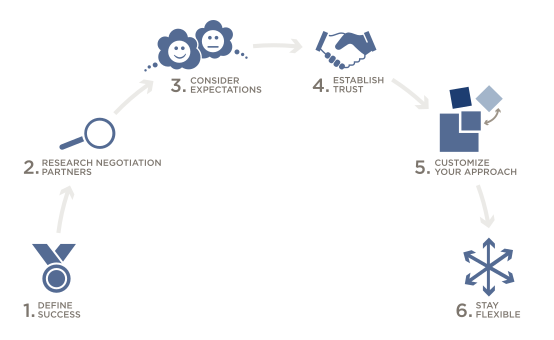
The many different negotiation styles you might encounter when making a deal across the globe may seem overwhelming. Don't be discouraged. The following steps will help you negotiate more effectively with international partners.
Step 1: Define success
Begin by establishing each party’s definition of “success.”
What would a successful outcome look like to you? For example, if you’re negotiating a deal with a vendor from another country, a successful outcome might include a specific date for work completion and an agreed-upon quality standard.
What would a successful outcome look like to the other party? Accept that “success” may not mean the same thing to your negotiation counterpart. For example, the vendor with whom you are negotiating might define success as agreement on a 20% decrease in the cost of raw materials.
Step 2: Research negotiation partners
Rosenbaum, Andrew. "How to Avoid Being the 'Ugly American' When Doing Business Abroad." Harvard Management Communications Letter Dec. 2002; Susskind, Lawrence. "What's Lost in Translation." Negotiation Sept. 2004.
Gaining a basic understanding of your negotiation partners’ backgrounds and biases is a prerequisite for a successful negotiation. To uncover this information:
Research your counterparts. Find out as much as you can about their experience, skills, personalities, and communication styles. Learn about conventions regarding when to socialize and when to talk business, how much haggling over terms of the deal is acceptable, and how people demonstrate trust. Identify the preferred business language, and hire a translator if necessary.
Identify all the players. Learn who typically has a say in business negotiations in the country where your counterpart is from. For instance, in some countries, these “extra players” might include labor leaders, local political officials, or government ministries.
Find out who decides what. For each player you’ve identified, determine which decisions they can make during the negotiation. If your counterpart can't make decisions, find out who can.
Don’t lose sight of the individual. While understanding another culture’s negotiation style is important, don’t lose sight of your counterparts as individuals. People who come from the same culture don’t always behave and think the same. Treat an individual’s culture as background, but also learn as much as you can about the person's personality and communication style.
Six rules for hiring translators
Salacuse, Jeswald. "Negotiation in Translation." Negotiation Oct. 2004.
When language barriers make negotiating difficult, hiring a translator can save a deal. Because translation can complicate negotiation, you should plan and manage hiring a translator as you would any other element in deal making.
Follow these six rules for using translators:
Hire your own translator. Unless you’re negotiating with a trusted partner, do not rely on the other side’s interpreter unless someone can check that person’s translation.
Brief your translator before negotiations start. Context gives your words their meaning, so meet with your translator beforehand and give them background on the nature of your company, its business, and details about the deal you hope to reach.
“Chunk” the conversation. Speak in short chunks, pausing after each one, to give your interpreter a chance to translate. Long statements can confuse the interpreter and lead to inaccurate translations.
Slow down and focus on clarity. Plan each of your statements carefully so that they are clear and devoid of slang, abbreviations, and business jargon. Ask yourself, “How could that statement be misunderstood?”
Give your translator a break. Interpreting is difficult and tiring work—make sure you give the translator opportunities to take breaks during the negotiation. Avoid having your translator work for longer than an hour at a time.
Respect your translator. International translators are professionals—give them the respect they deserve. In addition to translation duties, your interpreter also may provide you with useful insights into the other company’s culture and business practices.
Six rules for hiring translatorsSalacuse, Jeswald. "Negotiation in Translation." Negotiation Oct. 2004.
Step 3: Consider expectations
Sebenius, James K. "The Hidden Challenge of Cross-Border Negotiations." Harvard Business Review Mar. 2002.
You may enter the negotiation only to find that the other party’s expectations are very different from your own. Differing cultural expectations regarding the negotiation’s process and outcome often occur in four areas:
View of process. Some people view the negotiation process as a win-win collaboration, while others may see it as a win-lose competition. Don't assume that your partner shares your view.
Approach to reaching agreement. Different cultures have different ways of reaching agreements. U.S. negotiators often seek agreement on specifics first, building up toward an overall deal. In contrast, Chinese negotiators tend to first seek agreement on the overarching deal, followed by negotiating the details.
Form of agreement. The level of detail required in a negotiated agreement varies by culture. In many parts of the world, negotiators are comfortable with an agreement that focuses on general principles. In contrast, many North American and European negotiators require detailed contracts, which include as many contingencies as possible.
Implementation of the agreement. U.S. negotiators generally expect rigid compliance to the precise specifics of the original contract and avoid renegotiation. In other cultures, an agreement is merely a starting point of an ever-evolving relationship and set of expectations. Renegotiation is common, since the precise terms are expected to unfold along with the relationship.
Step 4: Establish trust
Rosenbaum, Andrew. "How to Avoid Being the 'Ugly American' When Doing Business Abroad." Harvard Management Communications Letter Dec. 2002.
It is essential to establish trust with negotiation partners. Building trust can help you surmount the “people” problems that often arise during a cross-cultural negotiation. To build trust:
Find commonalities. Personal and business relationships are more intertwined in some cultures than in others. In North America, two people don’t have to like each other in order to do business. However, in other cultures it is customary to develop a personal relationship with the other person first before doing business. When negotiating with people from other countries, try to find things that you and the other person have in common, such as hobbies, favorite movies, or music.
Take your time. Don’t talk business right away. That could demonstrate anxiety or disrespect on your part. Show that you’re in no hurry to reach a deal. If possible, invite your counterparts to join you for lunch or dinner. After you’ve spent time getting to know one another, casually bring up the business at hand. Discuss the issues, but don’t push for a quick conclusion.
Get the details right. Many cultures emphasize details when negotiating. In many parts of the world, negotiators will expect you to have extensive knowledge about your specific business area, as well as the financials. If you can’t answer every question they ask about your business or proposition in a negotiation, trust suffers.
Step 5: Customize your approach
Sebenius, James K. "The Hidden Challenge of Cross-Border Negotiations." Harvard Business Review Mar. 2002; Brett, Jeanne and Michele Gelfand. "Lessons from Abroad: When Culture Affects Negotiating Style." Negotiation Jan. 2005.
Adapt your approach to the deal at hand based on what you’ve learned about your counterparts and negotiation practices in their cultures. For example:
If the Preferred Negotiation Process Is…
Do this…
Top down. The process is characterized by a rigid hierarchy. Those at the top make the decisions.
Persuade by acknowledging your partner’s status. For example, if you want to reopen a contract with a customer because of skyrocketing materials costs, meet with the most senior stakeholder possible. In your discussion, express gratitude for the relationship, and say something like, “We need your help.”
Consensus. All decisions require consensus among members of their team, as well as external stakeholders and governments.
Accept that the deal will take time and that counterpart negotiators will likely require extensive information about you and the deal. Shift your focus away from business to interact informally with the other side as it tries to reach consensus internally.
Multistage coalition building. Decisions don’t require the agreement of every player, but require the support of a subset of individuals who can pressure or override those who don’t agree.
Understand interests and options of the players who will be needed as allies in a winning coalition, and those who may block the negotiation. Take a close look at how key players work together. Anticipate opportunities and obstacles, and appropriately sequence your approach.
Susskind, Lawrence. "What's Lost in Translation." Negotiation Sept. 2004.
No matter how thoroughly you prepare for a negotiation, things may not go as planned. Stay calm and learn as you go. Pay attention to the dynamics of the negotiation as they unfold, and make adjustments as needed.
To do this, listen carefully during discussions. Be sure to speak up if you are:
Unsatisfied with the answers you receive. Reframe your questions and try again. For example, if you propose something and get no reaction from your counterpart, try making the proposal more specific.
Unsure about what the other side said. Repeat what you think you heard. Ask if you’ve understood correctly, then listen for an affirmation or a correction from the other person.
以开放式问题推动谈判 The Value of Asking Open-Ended Questions
哈佛教授讲授视频逐字稿
This was early in my career as a training consultant, and I'd just gotten word from a large prospective client that they were interested in a huge rollout of training. I was so excited, particularly since I knew that another long-standing player, another consultant in this field, was probably in the mix. So I felt really great and a little bit surprised that I'd gotten this news. So a few weeks later, we sat down for lunch. And we're sitting, just put in our orders, and the conversation turned to the program. And I realized that they were talking about a completely different area of consulting, a different topic altogether from what we had discussed before. And I was really confused.
I just sat and ate and nodded, took some notes. And when I went back to my office I was thinking, "Something has happened. I don't think I know the full picture."
And when we sat down for the second meeting I just said, "Listen I think something may have happened, that maybe I've missed something. Because when we first started talking, it sounded like this was the type of work you were interested in with me and now it seems like, from the lunch, that you might be interested in a totally different area that's actually not my area of expertise. Can you tell me what happened?" And I just proceeded to try to ask more open-ended questions to try to learn from them what may have transpired from that first, initial phone call when they had reached out to me after my proposal. And it was great, because I actually learned a lot of information I didn't know. So it turns out they actually had contracted with John, the long-term consultant to the organization. And there was a certain body of work that he was committed to doing now. And there was some work that they were interested in having me do as well.
So there's a nice ending to that story, happily. And this has just really struck me, over the years, as a great reminder of the importance of asking good, curious, open-ended questions when you're stuck in a negotiation.
And because I was able to do that, the negotiation resumed and proceeded and in this instance, I was able to do a good amount of work with this client. So I think it's a great reminder for me to always remember to engage in inquiry in your negotiations and to really learn what's important and what's going on with the other side.
第 3 节
Test your understanding and reinforce what you’ve learned.
Try it Out
1. 1. You are part of a team putting together an international consortium to drill for oil in another country. The negotiations involve teams from North America, Asia, and Central Asia, and you want to avoid any cultural misunderstandings. Which strategy is likely to work best?
答案与解析
A. Get agreement on the specifics first and then work toward the overarching deal. Different cultures have different ways of reaching agreements. For example, U.S. negotiators often seek agreement on specifics first, building up toward an overall deal. In contrast, Chinese negotiators tend to first seek agreement on the overarching deal.
B. Make sure agreements are spelled out in detailed contracts to avoid misunderstandings. The level of detail required in a negotiated agreement varies by culture. Some negotiators are comfortable with an agreement that focuses on general principles. In contrast, many North American and European negotiators require detailed contracts.
C. Avoid renegotiating agreements at all costs. Some negotiators expect rigid compliance to the precise specifics of the original contract and avoid renegotiation, which is sometimes seen as a lack of trust. In other cultures, an agreement is merely a starting point of an ever-evolving relationship.
D. Find out as much as you can about each negotiator’s personality.(正确) While understanding another culture’s negotiation style is important, don’t lose sight of your counterparts as individuals. People who come from the same culture don’t always behave and think alike. Treat an individual’s culture as background, but also learn as much as you can about the person's personality and communication style.
Try it Out
1. 2. Your home décor company urgently needs a new distributor in Asia. Senior managers ask you to travel to Asia to work out an agreement with Kai, the director of business development at a potential partner. Before you board the plane, you define what success would look like, research Kai, and consider the cultural expectations he may have. When you meet with Kai, what should you do first?
答案与解析
A. Ask Kai about his favorite type of music.(正确) Personal and business relationships are more intertwined in some cultures than in others. In many cultures, it is customary to develop a personal relationship before doing business. When negotiating with people from other countries, first try to find things that you and the other negotiator have in common, such as hobbies, favorite movies, or music.
B. Present your proposal and gauge Kai’s reaction. In many countries, it is essential to establish trust before doing business. It is better to try to find things that you and the other negotiator have in common first.
C. Find out how quickly Kai’s company could start handling your products. In many countries, it is essential to establish trust before doing business. It is better to try to find things that you and the other negotiator have in common first.
D. Ask specific questions to determine Kai’s strategic priorities. In many countries, it is essential to establish trust before doing business. It is better to try to find things that you and the other negotiator have in common first.
第 4 节
Reflecting on your learning helps you apply relevant concepts to your job.
Take a Moment
1. 1. What new insights do you have that could benefit you or others in your workplace?
2. 2. What are your biggest opportunities for applying concepts from this Lesson in your workplace?