
Foster Inclusivity 查看中文版
第 1 节
In an inclusive workplace, employees are welcomed and respected equally, no matter their age, gender, race, ethnic background, religion, or sexual orientation. Research demonstrates that when a workplace is inclusive, employees are more likely to give their best performance.Waiter, Is That Inclusion in My Soup? A New Recipe to Improve Business Performance. Deloitte Research Report, Nov. 2012: 12 and 17.
What’s one of the best ways to make your culture inclusive? Allow members of your team the flexibility to meet their diverse work/life needs. This demonstrates you are supportive of their many different life situations.Waiter, Is That Inclusion in My Soup? A New Recipe to Improve Business Performance. Deloitte Research Report, Nov. 2012.
Although you’ll need to work within your company’s policies, consider these suggestions as a starting point:
-
Empower workers to set their own hours. One employee who lives farther away from the city might want to come in early and leave midafternoon, to avoid traffic. A divorced employee might want to work longer hours from Monday through Thursday and take Fridays off to travel to spend time with a noncustodial child.
-
Allow remote work. Telecommuting can reduce commute time and allow workers to use that time for other purposes. For example, in the United States, a disproportionate number of minority professionals are responsible for their immediate and extended families. This extra load, combined with demanding professional schedules, can lead to burnout.
-
Support caregiving. Studies show more people will be caregivers than ever before, whether it’s for children or elderly relatives. Allow for personal days and sick time to be used for caregiving tasks and appointments.
-
Measure by results, not “face time.” Track what people accomplish, not how many hours they spend in the office. Offering flexibility about when and how employees complete their assignments can enable them to contribute to their full abilities.Hewlett, Sylvia Ann et al. “Leadership in Your Midst: Tapping the Hidden Strengths of Minority Executives.” Harvard Business Review Nov. 2005.
-
Lobby for benefits. Regularly let your human resources team know which benefits might help your team. For instance, if income is tight for certain employees, could your company offer discounted bus or public transit passes? Could a vacation policy be altered so that a team member could save up days and use them for an extended trip to visit foreign family? Changes like these may not be immediate, but raising awareness is a critical first step.
灵活管理时间提升员工幸福感 Let Employees Work Smart
哈佛教授讲授视频逐字稿
第 2 节
Think about when you first came to your company. Did you feel welcome? Often, experiences in the first few months of employment set the tone for the rest of your time there—either positive or negative.
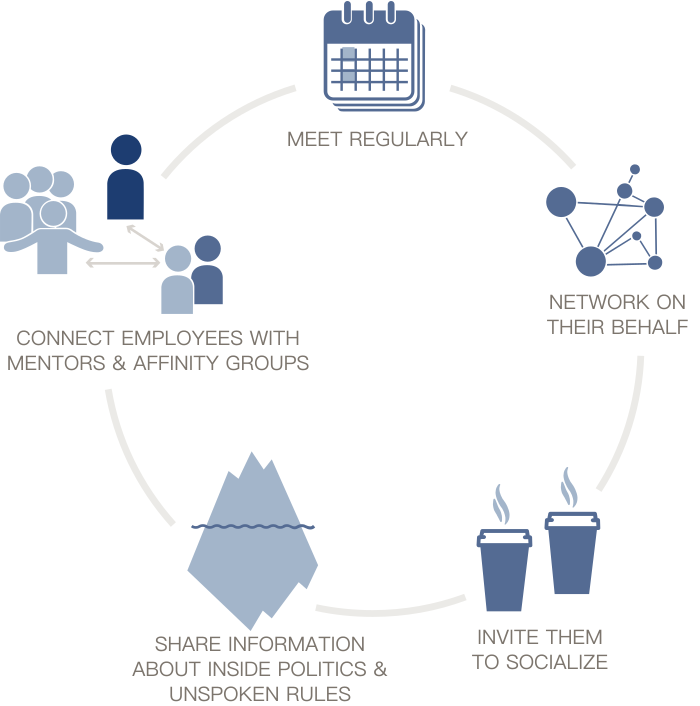
To help new employees feel welcome and valued, be sure to:Adapted from “How to Increase Workplace Diversity.” Wall Street Journal: How-To Guides [no date]; Adapted from Myers, Verna. Moving Diversity Forward: How to Go From Well-Meaning to Well-Doing. Chicago: American Bar Association, 2011: 40-43.
-
Meet regularly with them. Familiarize them with their new job and company culture.
-
Network on their behalf. Introduce your new hires to employees who might have similar interests or who can act as mentors. For example, in one company, each new hire’s manager lists everyone in the organization the newcomer should meet, suggests topics he or she should discuss with each person on the list, and explains why establishing each of these relationships is important.Gratton, Lynda and Tamara J. Erickson. “Eight Ways to Build Collaborative Teams.” Harvard Business Review Nov. 2007.
-
Invite them to socialize with you. Take new hires out to coffee or lunch. Use the opportunity to get to know them personally and professionally. Share some of your own interests and ask about what your new employees like to do. If you talk about work, don’t ask only what they doing, but ask who they are doing it with, what they like about it, any obstacles they’ve had to overcome, etc.
-
Share information about inside politics and unspoken rules. Help your new employees understand some of the complexities of your particular business environment. Success is based on unwritten rules and the ability to navigate underlying cultural norms. Familiarize your employees with these norms. In addition to making suggestions about how to do things, also give warnings such as, “That might not be the best way to do that."
-
Connect employees with mentors and affinity groups. In many organizations, affinity groups—associations of workers with common backgrounds, interests, or other connections—can be a good way for employees to provide support for each other. Affinity groups can be based on ethnic identity, such as a Latino workplace group, or lifestyle, such as a new-parent group.
Is your welcome inclusive? The following example illustrates how people can feel very differently about the same place based on how they are welcomed.
Foster Inclusivity
与新同事融洽相处 Fitting In with New Colleagues
哈佛教授讲授视频逐字稿
Help people feel respected and valued
In an inclusive environment, managers believe that good ideas can come from anyone—and they act in ways that demonstrate that faith.
This is important because individuals whose views differ from those of the majority may not readily share their ideas. It’s not enough to simply ask, “Does anyone have anything else to add?”
To demonstrate that you value contributions from all members of your team:Myers, Verna. Moving Diversity Forward: How to Go From Well-Meaning to Well-Doing. Chicago: American Bar Association, 2011.
-
Seek participation from everyone. During meetings, seek input regularly. When someone makes a point that is different from the mainstream, ask probing follow-up questions to further explore the idea. Or ask a question to solicit reaction—“How can we build on Jai’s thought?”
-
Let individuals know you appreciated their ideas. During and after meetings, acknowledge how difficult it can be to express a different perspective, but how valuable it is to the organization.
-
Vary the ways you receive input. Some employees love to talk in a group—and others don’t. Occasionally, email about an issue to be discussed and ask for written thoughts in advance. Or invite an employee to discuss an issue one-on-one over lunch.
-
Thank employees for their work. When someone does something well, acknowledge what you liked about it. Raise the profile of your diverse employees by putting such positive feedback into an email and copying your manager.Myers, Verna. What If I Say the Wrong Thing? 25 Habits for Culturally Effective People. Chicago: American Bar Association, 2013: 100-101.
-
Show confidence in employees’ ability to meet high standards. Research shows employees rise to positive expectations.
Power up participation
团队协作中,如何避免群体思维? Collaboration by Difference
哈佛教授讲授视频逐字稿
83%. That’s the percentage of employees in a flexible workplace who felt the office was inclusive. “Waiter, Is That Inclusion in My Soup? A New Recipe to Improve Business Performance.” Deloitte Research Report, Nov. 2012: 16.
83%. That’s the percentage of employees in a flexible workplace who felt the office was inclusive.
“Waiter, Is That Inclusion in My Soup? A New Recipe to Improve Business Performance.” Deloitte Research Report, Nov. 2012: 16.
83%. That’s the percentage of employees in a flexible workplace who felt the office was inclusive. “Waiter, Is That Inclusion in My Soup? A New Recipe to Improve Business Performance.” Deloitte Research Report, Nov. 2012: 16.Be fair
Your employees may not like or agree with every decision you make, but they should trust that you are fair, transparent, and honest.
Demonstrate fairness in the following ways:Myers, Verna. Moving Diversity Forward: How to Go From Well-Meaning to Well-Doing. Chicago: American Bar Association, 2011: 41.
-
Review your candidate lists. When you’ve got a project to delegate, a team to organize, or a promotion to give, write down your list and evaluate it for diversity. Are all of the candidates similar to you? Are there others you haven’t thought of who might bring a different perspective to the role?
-
Pay attention to who you include. Are there people you aren’t including in important conference calls, meetings, and emails on a regular basis? If so, ask yourself why. People can’t perform to their highest potential if they don’t have the information they need or if they feel undervalued.
-
Make your standards explicit. Don’t assume that what you have in mind is obvious to everyone. Explain clearly what it will take to be successful on a project or within the organization.
-
Give candid feedback to everyone on your team. Give both positive affirmations and constructive criticism. Offer support and encourage questions. And don’t hesitate to address an employee’s lagging performance because you fear being seen as prejudiced. If someone doesn’t know or isn’t told that his or her performance is inadequate, he or she will fall behind and it will be harder to fix the problem.Adapted from Myers, Verna. Moving Diversity Forward: How to Go From Well-Meaning to Well-Doing. Chicago: American Bar Association, 2011: 127.
-
Keep high expectations. Assume all employees are capable of additional achievement. If a person struggles with a new task, then look for opportunities to coach, train, or provide development experience. This practice will help you overcome any hidden biases about individuals’ capabilities.Myers, Verna. Moving Diversity Forward: How to Go From Well-Meaning to Well-Doing. Chicago: American Bar Association, 2011: 130.
第 3 节
Test your understanding and reinforce what you’ve learned.
Try it Out
答案与解析
Give your team some flexibility in setting their own work hours if the company allows it.(正确)
One of the best ways to create an inclusive culture is to give team members the flexibility to meet their diverse work/life needs. Allowing workers to set their own hours (if the company allows it) demonstrates that you are supportive of their many different life situations.
Expect your team to attend a weekly after-work social gathering.
Expecting everyone to participate would communicate a lack of respect for employees who are not able to attend after-hours social gatherings because of other commitments such as caregiving.
Lobby your human resources group to make sure that your team gets the same benefits aS others in the company.
It is more effective to lobby your human resources group for benefits that would help members of your team based on their individual needs and life situations.
Evaluate everyone by the hours they put in, whether they're in the office or elsewhere.
It is better to measure by results, not "face time." Track what people accomplish, not how many hours they spend.
Try it Out
答案与解析
When he assigns projects, he adjusts expectations to allow for cultural differences.
It's better to keep high expectations and assume all employees are capable of additional achievement.
He gives candid feedback on poor performance, even if cultural difference is involved.(正确)
It is good practice to give candid feedback to everyone on the team. Give both positive affirmations and constructive criticism. And don't hesitate to address an employee's lagging performance because of fear of being seen as prejudiced.
He doesn't expect people from more reserved cultures to speak at meetings.
It is better to seek participation from everyone at the meeting.
When seeking input on key issues, he sticks to the proven method-group meetings.
Because people from some cultures may not feel comfortable delivering input publicly, it is better to vary the ways input is received-for example, using one-on-ones or asking for written input.
第 4 节
Reflecting on your learning helps you apply relevant concepts to your job.