
Develop Your Cultural Competence 查看中文版
第 1 节
Is it hard for you to relate to someone whose life experience is drastically different from your own? If so, you’re not alone. Most people feel some degree of discomfort with difference.
However, as a manager, you have a responsibility to develop cultural competence. Cultural competence is based on:
-
Self awareness about your own biases
-
An ability to learn about and empathize with others’ viewpoints
-
A commitment to use difference constructively in the workplace
-
The development of cross-cultural skills
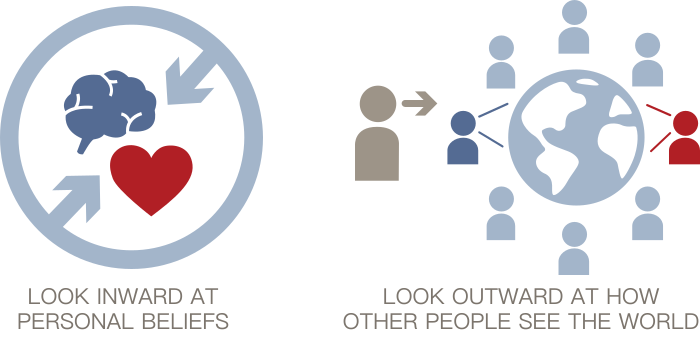
To develop cultural competence, you’ll need to look both inward at your own beliefs and outward at how other people see the world.
Worksheet for Understanding Interpersonal Bias
第 2 节
By nature, human beings tend to group people into categories. Scientists estimate that we are exposed to as many as 11 million pieces of information at any one time, but our brains can functionally deal with only a fraction of that input.“Proven Strategies for Addressing Unconscious Bias in the Workplace.” CDOInsights 2 (5) (Aug. 2008): 3 <http://www.cookross.com/docs/UnconsciousBias.pdf> We make unconscious decisions and notice things based on what feels safe, familiar, or relevant at the time.
However, we need to guard against stereotyping—automatic judgments about people based on their religion, gender, sexual orientation, age, or race. These oversimplified conceptions of particular groups breed discrimination.
Examples of stereotypes include:
-
"Asians are smart and hardworking."
-
"Men love sports."
-
"Germans are efficient."
-
"Americans are pushy negotiators."
Consider what happens to Eric, who has stereotyped a member of his team.
Develop Your Cultural Competence-1
不要让偏见妨碍你识人 Learn, Unlearn, Relearn
哈佛教授讲授视频逐字稿
Reduce your biases
To avoid unconsciously favoring some of your employees over others:Adapted from Myers, Verna. What If I Say the Wrong Thing? 25 Habits for Culturally Effective People. Chicago: American Bar Association, 2013: 12-13.
-
Recognize that you have biases. It takes conscious effort to evaluate your decisions for bias, but it’s important to regularly do so.
-
Think about people who are both similar and different from you. Your biases aren’t limited to people from other cultures and backgrounds. For example, a man might unconsciously assume that a male colleague would be more interested in a sports-related project than a fashion assignment.
-
Challenge your beliefs. Recall individuals you know who do not fit the stereotypes of their ethnic group, age, gender, or other defining characteristic. What is powerful about these people?
-
Consider ways in which you don't fit certain stereotypes. Identify faulty assumptions others have made about you. What did it feel like to be judged based on something other than your talents and interests?
-
Notice when your biases arise. Stressful situations are more likely to trigger biased judgments. For example, the last time a project deadline slipped, how did you react? Was your judgment influenced by biased assumptions you made about some of your employees? How could you avoid a similar reaction in the future?
认识自己的“偏见” Recognize Your Biases
哈佛教授讲授视频逐字稿
Be aware of affinity bias
Unconscious biases don’t just influence how we treat those who are different. We may also favor people who seem familiar to us—a phenomenon known as an “affinity bias.” For example, a manager may instinctively like someone with similar educational background, personal interests, or religion. An affinity bias may become a self-fulfilling prophesy: A manager may give that person additional attention, coaching, and opportunity, thus reinforcing the positive stereotype that "people like me" are best suited for the team.
Consider the following example:
Develop Your Cultural Competence-23
Resist the Urge to Hire People Like You
第 3 节
When you are culturally competent, you’re aware both of how you filter information—and how others do too.
For example, based on your personality and life experience, you may believe that the best way to address a conflict is to be direct and honest. So when you see someone on your team dealing with an issue indirectly, you may view him or her to be disingenuous. But the employee may view being indirect as a polite, less confrontational way to handle the situation.
When you’re culturally competent, you acknowledge there are many successful work and personal styles. Therefore, instead of judging the method or the person, look at the result: Was the issue resolved successfully?
Identify your cultural filters
Your life experiences affect how you behave and what you value. Think, for instance, about the assumptions you make about the “right” way to do things—these are your cultural “filters.”
For instance, you may have been raised in a household where people were emotionally reserved. Employees who are highly expressive might seem uncontrolled and less competent to you. You might unconsciously shy away from them and spend less time giving them coaching and advice.
To identify your filters:
-
Think about your childhood. What did you learn about values, conflict, religion, family obligations, and work? Did you have rules about what to wear to certain venues? Were you expected to speak in a certain way to certain people, such as your friends’ parents or your teachers? What was forbidden? What was encouraged?
-
Reflect on how you live now. Do you hold on to any of these childhood lessons? How does what you learned as a child affect the decisions you make as an adult? In what areas have your ideas shifted since childhood? What factors caused these shifts?
-
Focus on how cultural filters influence your interactions. With whom do you feel comfortable living, working, and socializing? What types of people makes you feel uncomfortable?
Worksheet for Identifying Your Cultural Filters
Learn about your employees’ filters
Investigate how your employees see the world. What you learn about others can add richness to your life and help you develop new interpersonal skills.
-
Learn about each team member. Talk informally with individual employees about their backgrounds and unique experiences. Go beyond discussing work matters and ask them about their interests, their families, their holiday plans, etc. Make the relationship mutual by sharing details about your life.
-
Observe behavior. An employee who comes from a more formal culture may wipe down a break-room table before sitting to have lunch. Another team member may switch to Spanish when talking to relatives on his cellphone. Such things can provide clues about the values and concerns of diverse employees.
-
Consider differing viewpoints. People with varied backgrounds might see the same problem in different ways. You might not immediately agree with someone’s suggestions, but take time to give the person's ideas some thought. After consideration, you might decide that an idea that didn’t seem promising at first might have potential.
-
Investigate other cultures. It is helpful to understand the cultures, customs, and belief systems represented on your team and in your workplace. But be cautious with this information—don’t assume that everyone from that culture will be the same.
-
When you’re unsure, ask. Part of cultural competence is staying in “learner’s mode,” open to what others have to teach you.
As you get to know your team members as individuals, you’ll make the authentic connections that are the foundation of mutual respect.
探索文化差异的两个维度 Compare Cultures to Understand Your Own
哈佛教授讲授视频逐字稿
Worksheet for Learning About Employees' Cultural Filters
第 4 节
Despite your best efforts, you might unintentionally say or do something that offends someone. The key is not to ignore such a mistake. Instead, address it, apologize if necessary, and learn from it.
Consider the following example:
Develop Your Cultural Competence
A “cultural mistake” like the one Michael made isn’t unusual. Research shows that we recognize faces of people who share our racial background more accurately than those of other races.Tanaka, James W. et al. “A Holistic Account of the Own-Race Effect in Face Recognition: Evidence from a Cross-Cultural Study.” Cognition 93 (1) (Aug. 2004): B1ess. These mistakes are more likely to happen when racial groups are underrepresented in a particular setting.
How you respond to a cultural mistake can make the difference between a hostile environment and an inclusive one.
Develop Your Cultural Competence-25
It can feel awkward to pursue cultural competence because it will force you outside your comfort zone. You’re likely to make mistakes. When you do, acknowledge it, think about how you’ll avoid a similar blunder in the future, and continue to pursue cultural competence.
第 5 节
Test your understanding and reinforce what you’ve learned.
Try it Out
答案与解析
Consider ways she might favor people in the office who are similar to her.
To avoid unconsciously favoring some of your employees over others, it is a good idea to think about people who are both similar and different from you.
Resolve to judge people purely on their work style.(正确)
When you're culturally competent, you acknowledge there are many successful work and personal styles. Therefore, instead of judging the method or the person, look at the result.
Think about whether stereotypes apply to her.
To avoid unconsciously favoring some of your employees over others, it is a good idea to consider ways in which you may or may not fit certain stereotypes.
Reflect on how stress affects her judgments of others.
Stressful situations are more likely to trigger biased judgments. It's a good idea to notice when your biases arise to avoid unconsciously favoring some employees over others.
Try it Out
答案与解析
Put your cultural filters to work, to prevent it from happening again.
Cultural filters are the result of life experiences that affect how you behave and what you value. They can lead to cultural misunderstandings.
Let it go to avoid further embarrassment, but learn from your mistake.
It is better to address the mistake, apologize if necessary, and learn from it.
Do some soul searching about your racial attitudes, since this kind of mistake is rare.
A cultural mistake like this isn't unusual. Research shows that we recognize faces of people who share our racial background more accurately than those of other races.
Ask Doris to lunch as soon as possible to get to know her better.(正确)
It is a good idea to invite Doris to lunch to get to know her better. You could look for future assignments to work on with her, based on what you learn about her individual interests and talents.
第 6 节
Reflecting on your learning helps you apply relevant concepts to your job.