Pocket Leadership口袋领导力

Diversity

The Business Case for Diversity 查看中文版

第 1 节

What is diversity?

The word “diversity” commonly brings to mind categories such as age, gender, religion, race, ethnic background, and sexual orientation. People often think the term refers just to these areas.

But diversity is broader than these categories. It also encompasses things like socioeconomic background, personality type, learning style, and many other factors.

Consider the many dimensions that make up you—and how each of these affects how you view the world.Myers, Verna. Moving Diversity Forward: How to Go from Well-Meaning to Well-Doing. Chicago: American Bar Association, 2011: 29. Your coworkers are equally complex. The varied backgrounds you and your coworkers bring to the workplace are essential to your organization’s success.

the mix of experience

哈佛教授讲授视频逐字稿
When I think of diversity, I think in many buckets of diversity. I am a woman, for example, and I recognize that gender is sometimes is looked at as a component of diversity. I am a Hispanic woman or a Hispanic person, and I realize that that is also recognized as a component of diversity. But when I look at diversity, more than a country or a gender, there are other buckets. Diversity comes from: What have been your previous experiences? What type of industries have you worked at before? What type of different bosses you have had over time? What types of different people you have managed over time? And when you put all of those components in a bucket, that’s called diversity. When I hire people or when I try to build a new team or try to reshape an existing team, I look for diversity in all of those buckets: diversity in countries, diversities in gender, diversities in industry experiences, diversity in projects people have worked at. And when I put a team together, I recognize that building a team with all sorts of different buckets of experience actually helps my team to become more successful eventually.

第 2 节

Why build a diverse workforce?

It’s morally right to provide people with equal opportunity in the workplace, regardless of age, gender, ethnic background, or sexual orientation. In some countries, antidiscrimination laws require diverse hiring.

But diversity isn’t just a moral or legal imperative. It’s a performance enhancer too. Companies have discovered that a diverse workforce provides important competitive advantages. Studies show diverse teams generate higher profits, greater innovation, and increased productivity compared with homogenous teams.

Diverse groups are powerful because they:
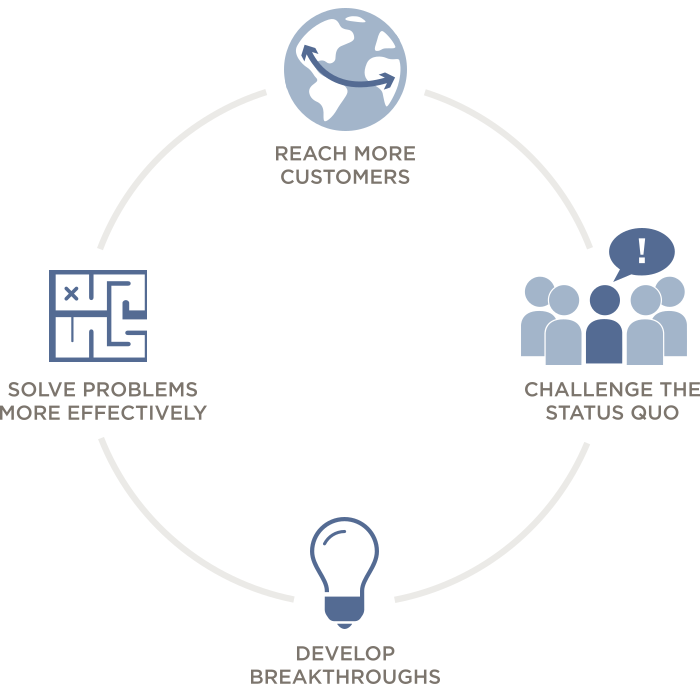
  • Solve problems more effectively. A group of people with different skills and perspectives is better able to anticipate obstacles, make accurate predictions, and find creative solutions than a homogenous group.Myers, Verna. Moving Diversity Forward: How to Go From Well-Meaning to Well-Doing. Chicago: American Bar Association, 2011, p. 76.

  • Reach more customers. A demographically diverse team is more likely to be able to identify, attract, and keep a wider range of customers.Slater, S. F. et al., “The Business Case for Commitment to Diversity.” Business Horizons 51 (2008): 201-209.

  • Challenge the status quo. Teams with diverse opinions challenge “business as usual,” engage in vigorous debate, and consider more alternatives.Passion and Purpose: Stories from the Best and Brightest Young Business Leaders. Boston: Harvard Business School Publishing Corporation, 2012.

  • Develop breakthroughs. Diverse opinions stimulate creativity and divergent thought, which are critical to innovation.Slater, S. F. et al., “The Business Case for Commitment to Diversity.” Business Horizons 51 (2008): 201-209.

团队成员越多元,绩效潜力就越高 How Diversity Fuels Group Emotional Intelligence

哈佛教授讲授视频逐字稿
There are many reasons to value diversity in our organization, but the one that occurs to me has to do with what's called the “group IQ.” The group IQ is the sum total of the best talent of every person on a team contributed at full force. If you see a star-performing team, you're seeing a very high group IQ. But what predicts the actual productivity or effectiveness of a team is not the potential—that is, the best talents of every person. It's how people are valued on that team. It's how people feel that there is harmony. That we get along. That we surface simmering issues. That we take time to celebrate. That we know each person’s strengths and that we step aside when it's time for this person to come forward. In other words, we are a team that has a high emotional intelligence. So when it comes to diversity, you're seeing people who have a range of backgrounds, of understandings, and of abilities. And the more diverse team is going to be the one with the largest array of talents, and so it will be the one with the potential best performance. The research on high-performing teams that's been done by Vanessa Druskat at the University of New Hampshire shows a very direct relationship between the collective emotional intelligence, if you will, of a team and its actual productivity. For example, in a polyester factory where it's team-based productivity, she found that the teams that had these qualities were the ones that produced the most metric tons of polyester. And she's found this in setting after setting, no matter what the appropriate metric is, the same relationship. Why is that? The wider the array of talent, the better the team will be. So the more diverse the members of a team, the better its potential performance will be. This is, I think, a strong argument for diversity.

第 3 节

Focus on inclusion

It’s not enough to hire diverse talent. To reap the benefits of diversity, you’ll need to create an inclusive environment. Such an environment acknowledges and supports differences, rather than pressuring people to conform. In an inclusive environment, people feel:

  • They are treated with respect and fairness.

  • The unique life experience, opinions, and ideas they bring to the group are valuable.

  • They belong within the team and are not “outsiders.”

  • They can be their “true selves” at work. For instance, a Muslim can talk about a friend in his mosque community, and a gay man can bring his partner to a company party.

培养多元化和包容性的关键:重视每位员工 Value Your Employees as Individuals

哈佛教授讲授视频逐字稿
I was invited as a people strategist into a large global organization, 150,000 people. And they invited me in to really help them to understand why it was that their people engagement was not as strong as it could be. So being a positive psychologist, I focused not on what wasn't working but was interested in what was working. And our findings were fascinating. One of them that I wanted to share with you is that we found that business units with outstanding engagement were ones in which leaders shared a core characteristic. This was the ability to treat each person as an individual, to see each person as a person. What was also a fascinating is these results were universal. It didn't matter whether we were interviewing people in the Netherlands, in India, or in America. This was a quality that was important. Now one might think that this was something to do with the leader's personality. But in fact it was not. Some leaders were incredibly assertive and bold. Other leaders were much more quiet and shy and reticent. And yet they shared this common way of being. The lesson to me is clear. So often, organizations want to cultivate diversity and inclusiveness. But to cultivate diversity and inclusiveness, we have to go beyond quotas. We have to go beyond demographics. We have to help our leaders to cultivate a sense of openness and curiosity, and to see the person in front of them as a person. And that, to me, is what inclusiveness is about. It's a quality that we know helps leaders, helps individuals, helps teams, and truly helps an organization.

第 4 节

Barriers to inclusion

Though inclusion is essential, it can be difficult in practice. Some common obstacles managers face include:

  • Employees’ preference for being around others most like themselves

  • Employees’ tendency to mask their differences in order to “fit in”

  • Managers’ tendency to unconsciously stereotype minority employees

Each of these factors can limit the contributions of diverse employees and hinder your team’s performance.

In-groups and out-groups

Though it may be uncomfortable to admit, most people prefer the company of others of the same race, nationality, and religion. We trust them more, cooperate with them more willingly, and feel more comfortable with them in work settings. When a large group of employee has the same values, attitudes, and beliefs, this can form a dominant faction or “in-group.”

In contrast, an “out-group” is often a group in the minority at your organization. It might be members of an ethnic or cultural group. It could be a woman in a field that’s generally male-dominated, or an older worker on a youthful team. Members of an out-group may feel they have less “voice” in the organization because they don’t see many people like themselves as role models in positions of power.

证明自己的实力,需要时间和坚持 Establishing Credibility Takes Persistence

哈佛教授讲授视频逐字稿
I was hired as a systems integration engineer for a major telephone company. At that time, I had just very limited work experience. I had about a year under my belt. And this department was notorious for hiring young talent. So I knew it was the right place to go. But when I joined, I noticed a slightly different treatment between male colleagues and myself. I was young, female, and Hispanic. So it took a long time to prove my skill set. I know that my manager knew what I brought to the picture. He and I would sit down together and troubleshoot issues. I brought a skill set related to problem solving that he liked. He liked the way I approached problems—that I wouldn't jump into the obvious. So he definitely put me in the right projects. So at a point in the project, we encountered a big issue that was blocking the project from moving forward. And we got to a point where the hardware vendor and the software vendor were pointing fingers at each other. So my manager made the decision to fly me to the software vendor location, so I would work with their senior engineer in troubleshooting the problem. When I got there, I again was met with the same credibility issues. They didn't really believe what I was saying and the reasoning I provided. So it took multiple explanations, different angles. And once we sat down, and we looked at my point of view, we were able to troubleshoot the problem. It turned out that I was right in where I believed the problem was. It was a great moment. It felt good. I came back. People congratulated me for unblocking the project. And the senior engineer and I got along so well to the point where he would call me directly to ask questions whenever he encountered a problem. So it felt really good that that barrier came down and I was playing on the same level with my peers. I know barriers exist everywhere in the workforce. And it's just one more sometimes that I have to go through. And whenever young people join the organization, I know they struggle through those barriers. And I make it a point to talk to them, and even sometimes provide a little bit of a coaching moment, where I make suggestions. Because I have been in their shoes, and I want to make sure that they succeed.

The pressure to fit in

Most people want to feel accepted and liked by others. Some adaptation is healthy and appropriate, such as adhering to a company’s dress code or recycling to honor a company focus on sustainability. However, when particular individuals feel they have to cover their true identities in order to be accepted by the larger group, that’s problematic. In those situations, your team is losing the strength of its diversity.Consider the range of changes your diverse employees may be making to fit in:

Type of change Description Example Appearance Individuals alter their clothes, mannerisms, hairstyles, etc. An African woman may straighten her hair to deemphasize her race. Affiliation Individuals avoid behaviors widely associated with their identities. A mother might avoid talking about her children because she does not want colleagues to think that she is not committed to her career. Advocacy Individuals avoid defending a group with which they are affiliated. A veteran might not comment on a denigrating joke about the military for fear of seeming too aggressive. Association Individuals avoid contact with other members of their identity group. A gay man might not bring his partner to a social gathering at work.

Undervaluing employees

Because of unconscious habit or bias, managers may undervalue or marginalize some employees. This not only hurts the affected employee’s morale and undermines his or her talents, it sets a damaging example for the rest of the team.

Managers may undervalue employees when they:

  • Base work assignments on stereotypes. For instance, when a team’s meetings run long, one manager always asks the sole woman in the group to step out and order lunch for the rest.

  • Relegate racial minorities and women to junior status. For example, during a strategy meeting, Horatio, the only Latino in the room, offers a suggestion for implementing a new competitive strategy. The room is quiet until a white male team member echoes the idea. The group manager then responds to the idea, expressing interest and asking follow-up questions.

  • Assume racial minorities do not have a strong work ethic.Myers, Verna. Moving Diversity Forward: How to Go From Well-Meaning to Well-Doing. Chicago: American Bar Association, 2011: 126. For example, Mark, an African-American employee, misses a deadline. His manager takes note and assumes Mark will be unable to handle challenging work assignments in the future. In contrast, when a white employee misses a deadline, his manager assumes it is an aberration.

第 5 节

REFLECT

Reflecting on your learning helps you apply relevant concepts to your job.

Take a Moment

1. 1. What new insights do you have that could benefit you or others in your workplace?
2. 2. What are your biggest opportunities for applying concepts from this Lesson in your workplace?

Further reading

AI 测评工具如何影响求职者行为
在考虑采用 AI 测评工具时,大多数企业关注的是这些工具所带来的效率和质量提升。然而,他们通常忽略了一点—&…
高绩效管理与职场多样性的奇妙联动
在过去的几年里,私营和公共组织纷纷撤回了多元化、权益和包容性(DEI)项目。对于那些致力于推动劳动力多元化的倡导者来说,…
多文化职场“闲聊”指南
想象一下你第一次参加国际会议。你已经签到完毕,在衬衫上贴上了自己的名牌,并步入了举办当晚交流活动的宴会厅。你已经准备好结…

Top 3 in the source platform's original order