
The CEO of HCLTech on Pivoting for the AI Era 查看中文版
第 1 节
When generative AI became widely available, in late 2022, we at HCLTech quickly recognized that it would have enormous implications for our organization and our industry. For decades IT services have operated via linear models, with staffing and revenue growing in tandem. Every major technology wave, from the internet to digitalization to the cloud, created demand for more engineers, more consultants, and larger teams. Advances in AI have changed that equation: Vast amounts of knowledge work can now be completed dramatically faster with much less human effort. The technology is not just improving productivity around the edges; it’s altering the economics of our business.
At HCLTech that understanding has prompted us to consider difficult questions. How do we prepare 227,000 employees for a future in which some current roles may no longer exist and many of the most important ones have yet to emerge? How do we persuade managers that success should no longer be measured primarily by team size? And how do we help clients adopt AI when we know it might disrupt our own revenue streams?
We have opted to embrace AI wholeheartedly, and it has already changed how we operate internally, create value for clients, and measure success. Our AI strategy rests on several important objectives: proactively transforming our services; building differentiated intellectual property (IP) to accelerate AI adoption in enterprises; creating new AI-led services like Physical AI and AI Factory, new AI ecosystem partnerships, and new tools spanning the entire tech stack; and most important, turning our people into AI builders, AI superusers, and human-in-the-loop decision-makers.
Today, thanks to this organization-wide strategy, careful investments in technology and training, and deep partnerships with clients, we are well on our way. And we hope our story will resonate with any organization hoping to adapt its business for the AI era.
第 2 节
A History of Reinvention
HCLTech has a long history of advancing on new frontiers. It was founded in 1976 as HCL by Shiv Nadar and a group of colleagues with a radical vision of building world-class technology from India at a time when few believed an Indian startup could compete meaningfully with global companies. We have continually evolved over the decades, shifting from IT hardware, to engineering and R&D, to services and software. Each transition required us to move aggressively to where technology and client demands were heading rather than protecting the business as it currently existed.
I joined HCLTech in 1994 as a young engineer, worked my way up through the ranks, and served in several leadership roles before being appointed CEO, in 2016. With so many technology changes on the horizon, I understood that leading the company would require an entrepreneurial spirit: the willingness to try new things, learn fast, and adapt to changing dynamics.
In recent years we have been working with some of the world’s top enterprises to deliver advanced engineering and R&D services, which in many respects paved the way for the AI systems reinventing industries today. About a decade ago our big bet was to expand more meaningfully into enterprise software and platforms that helped clients innovate and grow. That work spanned the technologies, platforms, and research initiatives that underpin the next generation of AI solutions. While the pace of progress has been extraordinary, we are still in the early stages of an AI-led transformation that will require navigating new technological, operational, and societal challenges with the same discipline and ingenuity that brought us to where we are now. We believe this is an inflection point and a once-in-a-lifetime opportunity to use technology to amplify both human potential and enterprise value.
第 3 节
Shifting the Mindset
Executing such a large transformation starts with facilitating a mindset shift. Nearly everyone in our business came of age in a world where larger teams meant greater impact and higher revenues. But now teams should adopt AI to increase their output and do more with fewer people.
Speed is also of paramount importance. No one should hesitate because of a desire to preserve the old ways or protect the current cash flow. We need to be comfortable transforming and even cannibalizing parts of our existing business, confident that we are putting ourselves in a stronger position for the future.
As I’ve shared publicly, over the next few years we are targeting a fundamentally different operating model, one in which growth is no longer tied to an increase in head count but is instead driven by enabling our team members to become AI builders and AI superusers, amplifying their potential through AI-augmented, platform-led delivery.
We first announced our intention in February 2025, aiming not to create anxiety but to communicate transparently, bring our people along on the journey, and foster the mindset shift required to succeed. Our objective is to align our teams around a shared vision and, most important, ensure that they are energized and excited to help build that future together.
How did we bring everyone into this new way of thinking? With conviction and communication.
When I realized the power of AI, I chose not to beat around the bush with our teams. That’s why I publicly announced an audacious goal: to double our revenue with half the number of people. The bigger strategic message was that we all needed to prepare for a world in which some current roles would no longer exist, emphasizing the urgency of upskilling. Translating that goal into baby steps, our near-term ambition is to deliver at least 5% revenue growth without having to add more people by enhancing our existing workforce with AI. Of course, incremental revenue growth after that 5% will likely require additional talent. But the message is clear: “We are no longer dealing with business as usual. AI changes everything. And your company is encouraging you to stay ahead of the curve.”
Direct, consistent communication has been key to ensuring that the challenge is well-received. I began by calling a conference of our top 150 services-delivery and corporate-function leaders to make sure they were aligned and willing to help percolate the new thinking through their teams. I then traveled to our global locations to meet all our sales teams (all 1,200 members) to explain the strategy and assure them that the changes would ultimately prove positive for anyone willing to work hard, learn, and adapt. With our board, and externally to clients, the media, and shareholders, my message has been exactly the same. We are aggressively adopting AI across every role, as well as helping customers do so. Some jobs and revenue streams will disappear. Others will be created. AI will operate autonomously in very few areas; most often we will have a human in the loop. The future is employees and AI agents that work together. While we expect certain revenue streams to slow down in the near term, we are comfortable making disciplined investments today to strengthen our long-term growth trajectory and future value creation.
第 4 节
Investment in Tech and Training
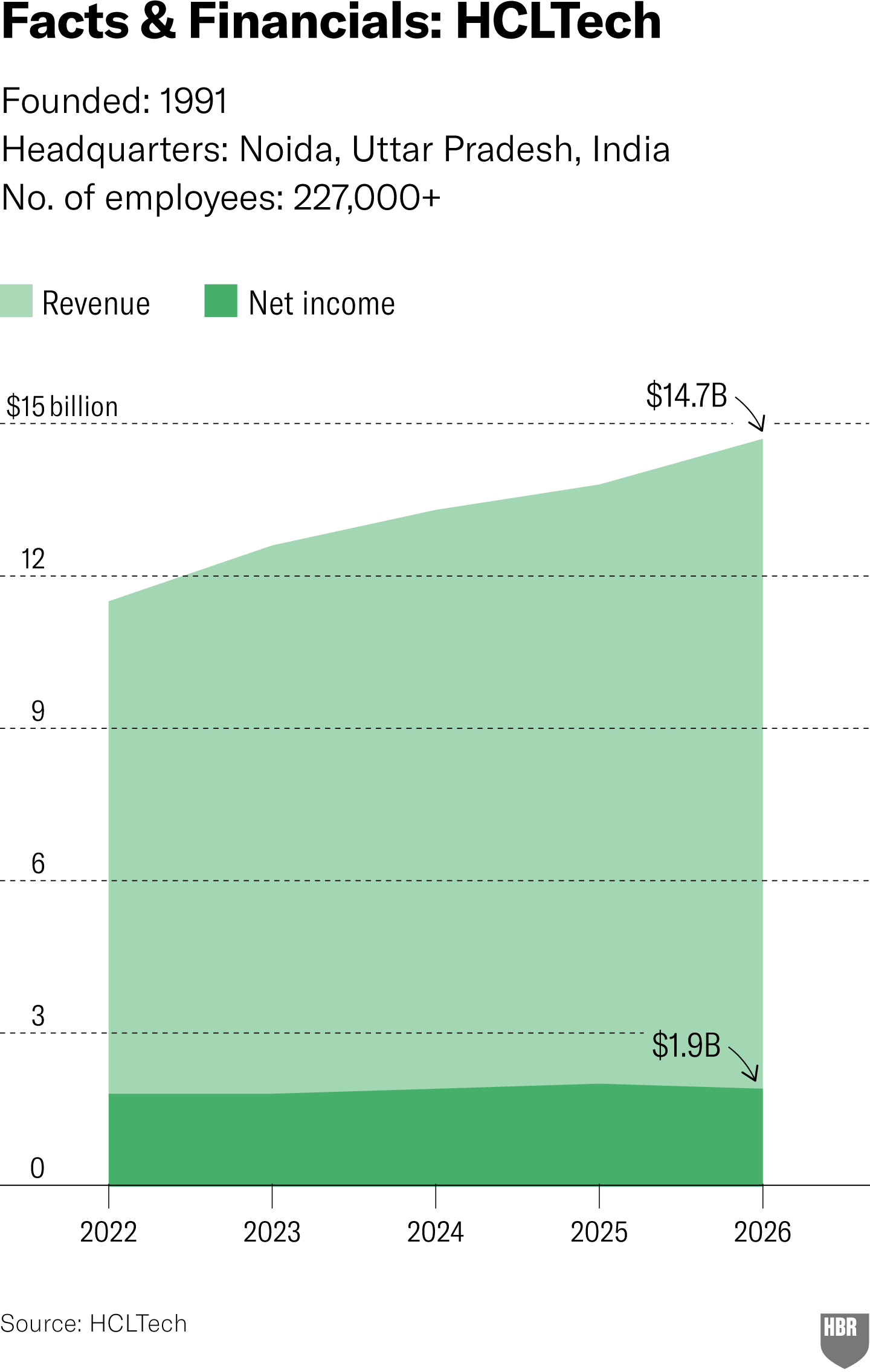
Transformation efforts succeed only when companies devote ample resources to them. We are currently reinvesting part of our profits (see the exhibit “HCLTech”) back into AI technology, the creation of differentiated IP, research and development, and training. We have built a larger team around the chief technology officer and asked him to phase in and scale up initiatives across the organization, starting with broad awareness of the new tools and initiatives and moving into deeper technical and leadership development.
One key platform, AI Force, applies AI to every step of the software-development and data life cycles as well as to both IT and business operations. Many companies currently use AI only to help write code, but we thought it important to build a solution to increase productivity throughout the entire process. Our ability to deploy this service for clients has been a key differentiator in two of our largest wins this fiscal year, one for Guardian Life Insurance and one for a major fashion retailer. Our focus is not only on transforming our services with AI but also on helping our clients successfully transform their business models through AI.
We have also created an office of responsible AI governance and brought in a senior executive to lead it. That group will make sure every platform we build incorporates guardrails so that all AI-enabled decisions are checked for biases and can be traced, reviewed, and reversed if necessary.
On the training front, our expectation is that 5% to 10% of team members will be AI builders who will create new solutions for others to use. We are upskilling our top technologists to fit this category as well as hiring new AI specialist talent. We’re asking the other 90% to 95% of our people to become AI superusers in their respective areas by availing themselves of the tools we’ve built or bought, prompt libraries we’ve created, and programs we offer. Our hope is that all employees can boost their productivity by a factor of three to four.
We recognize that it will take time for all 227,000 of our team members to fully leverage a technology that is still evolving at breakneck speed. But curious, driven employees have been quick to experiment and become adept, and I can confidently say that most of our people now have the motivation and skills to do their jobs more easily and effectively with AI.
I try to lead by example. I use Claude, Anthropic’s AI assistant, for research that I previously asked my teams to deliver, and I treat the AI chatbot as a consultant with whom I can discuss and debate ideas, fine-tune my strategic thinking, or engage in problem-solving. I even created my own revenue-forecasting app. And I keep sharing these examples with my team and the broader organization so that they see that I’m embracing our AI transformation right alongside them.
第 5 节
Partnering with Clients
Of course, HCLTech’s long-term success rests on helping our clients embrace AI technology in the same way we are. So far, adoption has been gradual, for several reasons. I sometimes joke that God was able to create the world in seven days only because he didn’t have an installed base and didn’t have to worry about whether his new systems were compatible with the legacy ones. Companies are rightfully approaching the latest AI tools in a cautious and calibrated manner.
The first mile in our work with them is obtaining all the security, legal, and privacy clearances we need and completing the platform evaluation. Over time, as our own knowledge has accumulated, we’ve learned how to complete this process much more quickly. If it took three months to get approvals for the first client, we’re now able to accomplish it in two weeks. From there we progress to running pilots, most of which have been extremely successful. The last mile is scaling up the new technology across client companies: training their teams, measuring output, and showcasing real velocity increases or cost savings. Again, over time, we have created recipes for different functions and types of organizations.
Some companies have chosen to simply work directly with AI providers such as Anthropic or OpenAI to drive transformation at scale. We believe that view misses how enterprise change actually happens. We work in partnership with technology firms, but the roles are distinct and complementary: They build frontier models while we make those models work inside real organizations, using our deep knowledge of industries, legacy environments, operations, and governance to help embed AI into existing technology platforms securely, scalably, and in a way that is tied to measurable business outcomes.
Some recent client wins have included helping a healthcare system create an AI adviser for clinicians that has increased patient satisfaction and saved 10 minutes of administrative work per interaction; shifting a bank’s trade surveillance from a sampling system to 100% AI; and using AI to optimize cargo packing to increase revenues at an aircraft manufacturer.
We also help some of the world’s leading technology giants speed up AI-led innovation, including advancing robotics capabilities such as full-body robot dexterity and helping semiconductor clients reduce development cycles and accelerate time to market for next-generation products. That traction is reflected in our high-tech services business, which is now among the fastest-growing in the industry.
In our view we will grow our market share by proactively helping our clients embrace AI and further drive innovation.
第 6 节
Measuring Success
Internally, we are evaluating the progress of our AI transformation by tracking adoption, fluency, productivity gains, cost savings, and innovative solutions. While our existing book of business will face a near-term reduction of 2% to 3%, we expect to gain a larger share of wallet with our clients and increase our broader market share. We also see our new AI-led revenue streams gaining momentum. Our advanced AI revenue boasts a \$620 million annualized run rate (as of March 2026), and we expect it to grow 30% a year. With all of that, our revenue per employee continues to show an upward trend.
Externally, our key metrics are the number of clients for which we’ve deployed AI and the extent of deployment in each. If we aren’t making progress with a client, or if we think we could be moving faster, we consider which interventions might get it up to speed. Most important, we are exploring new opportunities with every engagement, helping our clients to capitalize on what is arguably the most transformative technological shift of our generation. While we are encouraged by our strong start, we believe HCLTech is still at the beginning of the journey, with significant opportunities ahead. We are excited about the future and the value we can create for our people, our clients, and all stakeholders.