
LLMs Misunderstand Luxury Brands. Here’s How to Optimize Your Marketing Strategy for AI. 查看中文版
第 1 节
As LLMs and AI agents increasingly displace traditional search and sway consumer decisions, brands face a new challenge: being seen and correctly interpreted by machines. This has accelerated interest in generative engine optimization (GEO) and in what some call “bot psychology,” or how AI systems interpret meaning, authority, and relevance when they generate answers on consumers’ behalf. The general advice has been that brands should structure product data for machine readability, seed authoritative language in owned and earned media, and monitor (as we’ve previously discussed in HBR) their “share of model” across platforms.
But from a content perspective, questions remain as to how to build an AI strategy: How do models perceive brands and ads? How is this different from how humans process information? Does AI favor specific cues over others, and if so, which ones?
In our analysis of how LLMs respond to different stimuli, we found that for luxury brands, in particular, AI systems are prone to misinterpreting and mischaracterizing brand attributes. And their struggle to read the implicit cues leveraged to create desirability—scarcity, heritage, association with art, and even product shape—result in weaker visibility in search. Our research suggests, then, that one-size-fits-all toolkits for AI content strategy can backfire for luxury brands. Instead, we offer a new playbook to help leaders embed the luxury cues they’ve relied on for decades into AI legible content that helps not only surface their brand but properly inform customers turning to LLMs for advice about their next big purchase.
第 2 节
Testing AI Brand Desirability
Across industries, the overarching advice for GEO leans towards the utilitarian and explicit. For example, Google’s recently published guidance suggests that to get surfaced by LLMs, brands should create unique, compelling content and maintain a clear technical structure. Embedding such signals, the advice says, ensures your brand becomes part of the AI conversation. Yet, luxury and aspirational brands are not simply premium-priced versions of ordinary products. Much of their value is conveyed through implicit cues that signal exclusivity. When Hermès leaves white space on ads, or when a Patek Philippe alludes to leaving a legacy rather than boast of technical finesse, brands rely on the human capacity to read what’s not said. Such interpretation is intuitive and often subconscious. The question is: Can algorithms read between the lines too?
The short answer, based on our two experiments, is “no.” In the first one, we compared AI’s perceptions against four research-backed luxury cues pervasively used to boost brand desirability and willingness to pay among humans: higher physical positioning, association with art, spacious display, and slender design and packaging.
These cues pertain to the 4Ps of marketing: product features (e.g. design), promotion (e.g. association with art), placement (physical positioning), and price information. We used the original (or very similar) stimuli from the human-based studies and tested them against three LLMs: ChatGPT 5.1, Claude Sonnet 4.5, Gemini 3 Pro. We sampled each model 150 times for each stimulus, which included luxury items including chocolates, jewelry, tableware, beauty products, watches, and more.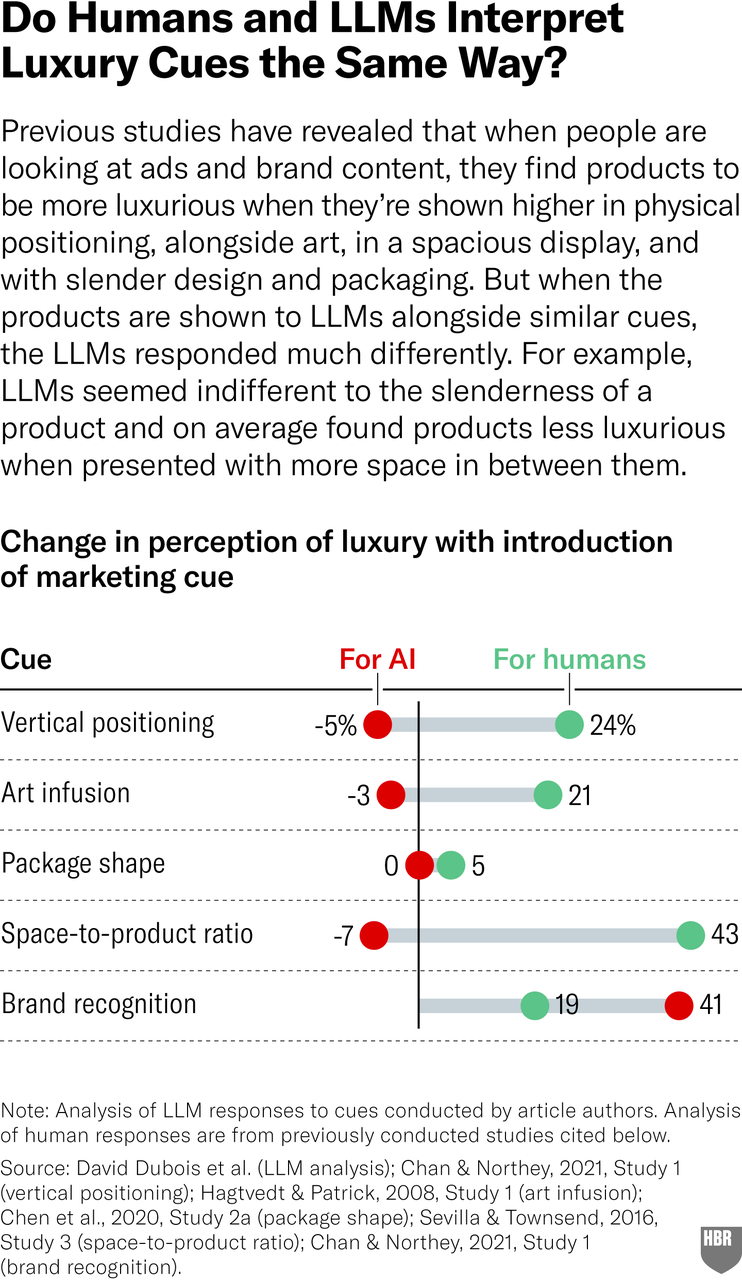
Our results surfaced potential gaps in perceptions between humans and AI. While AI models reliably processed explicit, codified cues (e.g. the brand name itself, or when an ad mentioned “luxury” or explicitly mentioned price), they were far less responsive to implicit or relational signals. Contrary to what’s observed among humans:
-
Products higher in physical placement were not consistently judged as more prestigious.
-
Association with art was less impactful on LLMs than on humans, and AI models seemed to prefer photographs (especially when associated with well-known cues present on YouTube or Reddit, such as movie stars) over paintings.
-
Shape- and proportion-based cues barely registered or were ignored altogether.
-
Sparse, minimalist environments failed to elevate perceived value. While humans associate understatement (e.g. white space) with luxury because it suggests high cost and exclusivity, the LLMs did not and in fact negatively responded to greater white space.
Overall, compared with humans, visibility and recognition seem to play a central role in shaping LLMs’ luxury perceptions.
第 3 节
Explicit Signals Translate, Implicit Meaning Doesn’t
In our second experiment, we wanted to probe AI’s ability to recognize different brand tiers (e.g. premium vs. luxury), its ability to evaluate them depending on how the product was presented, as well as any differences in interpretation across AI models.
To do this, we examined AI models’ willingness-to-pay for six cars (Alfa Romeo, BMW, Ferrari, Mercedes, Porsche, Tesla) displayed before a simple vs. luxurious background. From the 5,400 evaluations generated by the three AI models, we identified important idiosyncrasies between the LLMs. For example, when shown a Ferrari parked by a wall with a Van Gogh painting in a gilded frame (vs. an unadorned wall), Gemini appeared indifferent, ChatGPT exhibited lower willingness to pay, and Claude showed heightened willingness to pay. All the models showed a lower willingness to pay when a Porsche was shown in a luxury context, while Mercedes benefited from this context across models. This suggests that for brands, a luxury context can suppress rather than enhance AI valuation.
Overall, two major takeaways emerge from the data. First, the luxury hierarchy—some brands being higher in value than others—does not register with AI agents As a result, luxury brands may be ranked alongside premium ones (e.g. Ferrari and BMW may be perceived as equally luxurious), reshaping visibility and consideration in AI-mediated brand or product search.
Second, our data suggests that LLMs have unique “lenses” when judging brands in luxury (vs. plain) contexts. The same cue can produce very different outcomes depending on the system: some models reward certain brands, while others discount them or remain neutral. That makes model-level testing essential, because a brand can be legible to one AI and misread by another. A Mercedes ad may read as luxurious to all three models, while a Ferrari or Porsche ad may be rewarded by one model and discounted by another. Brands should thus not assume a single content strategy will travel equally well across models; they need to test the same asset across multiple systems, assess where models agree, where they diverge, and where the context changes the answer—and adjust the cues accordingly.
第 4 节
An AI Content Strategy for Luxury Brands
The central challenge is not whether AI can identify a brand name, but whether it can preserve the meaning attached to that name when consumers ask for recommendations and comparisons. Going back to the 4Ps of marketing that inspired our first experiment, we outline for each attribute where AI misreads luxury and what marketing leaders can do about it.
Product
Our studies reveal that AI favors explicit descriptors over subtle, implicit cues including minimalism, restraint, and empty space. This means a brand can be missed entirely, summarized poorly, or surfaced without its prestige, which is particularly problematic for luxury brands that heavily rely on symbols and implicit cues to build desirability.
Solution: To assess potential risks and preempt misinterpretation, brand executives should stress test their asset inventory—from craftsmanship, provenance, and materials to design intent—and score them for AI readiness. Such efforts should span across your brand’s content ecosystem, including brand language (name, tagline, claims), visual assets (campaign imagery, product photos), channel context (where content sits and what it is adjacent to), as well as tier positioning (competitor set, price, relative status claims, ranking). Given the weight of context in LLM judgments, marketers should develop an AI context strategy brief alongside traditional brand guidelines that specify use cases, descriptions, and content that will heighten brand relevance. For instance, a jewelry brand should heavily emphasize the moments associated with product use (e.g. wedding or engagement, association with Valentine’s Day).
Price
In the second experiment, simple changes to a brand’s context produced wide variation in the LLMs’ willingness to pay. As LLMs and AI agents becoming instrumental in buying decisions, marketers should ensure they perceive price and its connotations accurately.
Solution: By conducting willingness-to-pay experiments, managers can monitor how AI characterizes their pricing. In other words, whether it labels products “premium,” “overpriced” or “good value.” Depending on the AI assistant, the same luxury brand may be valued at radically different price points. Managers can use a similar approach, like that outlined in our second experiment, to identify where the brand is systematically undervalued, where competitors are inflated, and where model-specific corrections are needed.
For example, if one model labels a brand “overpriced” while another calls it “premium,” it’s a clear signal that the cues around the brand and its products should be tweaked, so the model has richer evidence to infer the intended meaning.
Promotion
Brands can risk losing control of meaning when they don’t explicitly anchor functional features to ensure LLMs interpret the products correctly. For instance, in a separate analysis of winter ski brand Atomic, we found that AI interpreted the skis’ rigidity—a core support of the brand’s value and desirability among the skiers’ community—as a negative point weakening LLMs’ likelihood to recommend the brand.
Solution: Identify the descriptors AI currently attaches to your brand across models by probing them. Define the intended brand reading, set up categories such as premium, luxury, value, and mis-categorized and identify likely weak points in the ecosystem. Then focus on using precise, high-status language (like labeling products “luxury” or “exclusive”) in owned and earned media to shape how AI interprets the brand. By building the luxury associations consistently across owned and earned channels, the brand can build meaning, from which LLMs can draw.
Additionally, third-party content such as reviews, mass-market comparisons, and off-brand associations remain indexed long after a brand has moved on strategically and can continue to influence AI evaluation. Managers should conduct a comprehensive audit of existing content and ensure that AI retrieves the most accurate information about the brand when consumers ask for guidance.
Placement
AI does not read a brand in isolation. It infers meaning by averaging signals across the surrounding information environment, comprising owned media, earned media, retailer pages, reviews, and category associations. That is why the same product can be valued differently depending on the context in which AI encounters it. The challenge is therefore not just a content problem; it is an ecosystem problem. For example, in an analysis we ran on LLMs’ sourcing in the beauty category in the U.S., we found that while branded websites account for 20% of LLM citations, the other 80% include e-commerce (24%), news media (21%), specialist blogs (15%), and others.
Solution: Treat third parties, not the brand site, as the front line of luxury positioning. In AI search, retailer listings, review pages, editorial features, Reddit threads, YouTube content, and comparison articles all contribute to shaping brand meaning. After identifying where the brand is systematically undervalued, where competitors are inflated, and where model-specific corrections are needed, managers should then adjust the surrounding content ecosystem accordingly. An example might be tightening marketplace titles and category labels and potentially correcting off-brand comparisons. Repeat this process regularly as AI models evolve.
. . .
Overall, the rise of LLMs nudges managers to adopt a new methodological lens to assess and heighten AI brand desirability across all 4Ps. Luxury brands have invested enormously in building the visual grammar, spatial logic, and cultural associations that make them coveted by consumers. AI systems, by design, do not inhabit these same cultural worlds. They infer meaning from what is explicitly stated and measurable, rather than from what is implied or withheld. As AI becomes increasingly powerful gatekeepers to consumers, aspirational brands will need to reengineer the cues that speak volumes to human audiences to preserve their voice in algorithmic evaluation.