How People Are Really Using GenAI 查看中文版
第 1 节
It’s been a little over a year since ChatGPT brought generative AI into the mainstream. In that time, we’ve ridden a wave of excitement about the current utility and future impact of large language models (LLMs). These tools already have hundreds of millions of weekly users, analysts are projecting a multi-trillion dollar contribution to the economy, and there’s now a growing array of credible competitors to OpenAI.
Yet there’s plenty of trepidation too. Corporate horror stories, policy restrictions, and hallucinations understandably give people pause about deploying GenAI, and general technophobia mean that most people globally have still not tried it. Even amongst the world’s billion knowledge workers, just 10% use ChatGPT (which enjoys 60% market share) regularly. Of those who have, many complain that it’s simply not useful: “Not a single use case in my life comes to mind when thinking of ChatGPT and everyone is going insane about it,” bemoaned one user. Others have been put off that the technology gets things wrong: “It’s so confidently incorrect about enough things for me to cast doubt on all of its answers,” said another.
From dozens of conversations with business leaders and chief learning officers around the world, I’ve gained a strong impression that what’s missing is convincing, real-world, real-life use cases. Are people really using these tools? Have they found ways for generative AI to help them lighten their workloads, increase their productivity, think through problems in new ways? The web is replete with surface-level examples such as “text summarization” or “generating marketing copy” or “code review.” But these sanitized, generic phrases read like items from a feature list and do little to entice the uninitiated. The devil — and delight — is in the details.
To find out more about those details, my company, Filtered Technologies, mined the web to find concrete examples of it being used in the wild. We’ve done this before, with Excel tips and productivity tips. We searched for specific use cases of individuals deriving benefit from LLMs, in business or life. It turns out the real treasure is buried deep in popular online forums (Quora, Reddit, etc.). Reddit, in particular, is a rich source of material for this study, as well as for the LLMs themselves; 10% of the company’s revenue is now generated by selling its user-generated content as training data to LLMs ahead of its mooted IPO.
My team and I filtered through tens of thousands of posts for our report. The volume was important. The detritus you’d expect from mostly anonymous online interactions was abundant: inanity, repetition, jibes, abuse and more. But there were plenty of diamonds in the rough too. By looking for these authentic, rich and often hilarious examples, use-case categories were unearthed, which eventually numbered well over 100. For each category we kept a tally of how many stories we found, and this became a major factor (along with some expert assessment) in ordering the list. We surface a selection of the authentic, positive, illuminating examples for your convenience and curiosity below.
第 2 节
What We Found
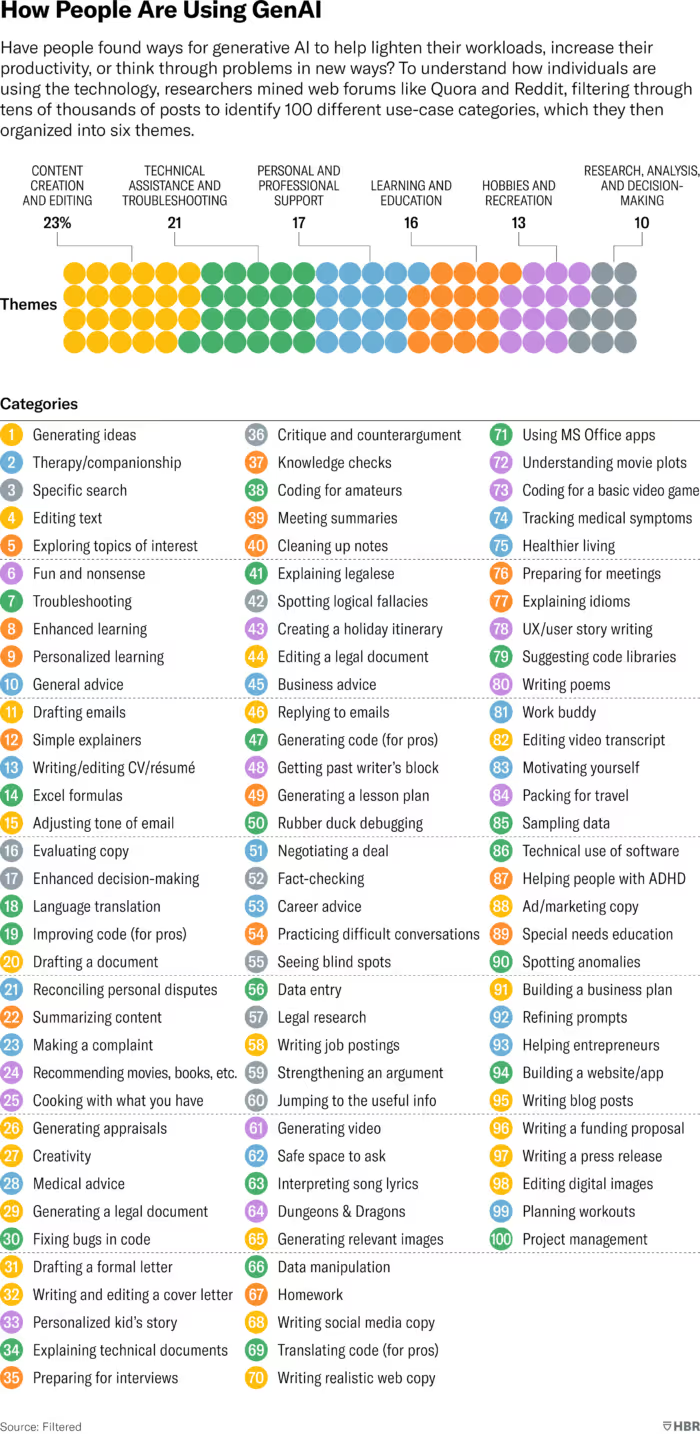
There are many use cases for generative AI, spanning a vast number of areas of domestic and work life. The use of this technology is as wide-ranging as the problems we encounter in our lives. We divided the 100 categories we identified into six top-level themes, which give an immediate sense of what generative AI is being used for:
-
Technical Assistance & Troubleshooting (23%)
-
Content Creation & Editing (21%)
-
Personal & Professional Support (17%)
-
Learning & Education (16%)
-
Creativity & Recreation (13%)
-
Research, Analysis & Decision Making (10%)
The themes provide an immediate demonstration the technology’s broad utility. It can be used for work and leisure. It can be useful for creative as well as technical endeavors. It can be used to help us think, learn, do, solve, create and enjoy.
We found examples that apply to both individuals and organizations.
The list is, of course, compiled from examples of reports from ordinary people who are doing ordinary things better, faster, or more happily using generative AI. Individuals can look up and down the list and notice what grabs their attention (or notice that they’ve found a use beyond what’s listed below). Given the size of the list, you are very likely to spot some uses to bring to your own work or home life.
Businesses can use it too. If you’re one of the early corporate adopters (most likely with the most entrenched supplier, Microsoft and Copilot), you’ll be wanting to encourage engagement from your workforce. If your organization is currently taking a more cautious approach, be aware that many of your employees are using it anyway. Acknowledging and harnessing this latent curiosity — in a way that aligns with your organization’s IT policies — must be better than just simply outlawing the practice. As Noelle Russell, chief AI officer at the AI Leadership Institute points out, “In our second year of generative AI, companies are beginning to ask harder questions that were previously silenced by enthusiasm, about security, accuracy, fairness, and performance. The use-cases drive the understanding, scrutiny, and maturity to achieve enterprise scale.” If you can play a part in the winning of hearts and minds, perhaps the list will help you persuade stakeholders and the powers that be.
第 3 节
What Users Are Doing
Here are some samples from the 100, with one quote for each. The full list is at the bottom of this article.
-
Generating ideas (#1). “I love it for brainstorming because it’s like the perfect teammate. It can keep up with me and doesn’t get hung up on dead-end ideas, and it can summarize what we come up with so it’s easier to present or reference later on.”
-
Specific search (#3). “There was a particular cookie my grandmother used to give me and I really liked the taste and texture, and I had looked at the grocery to no avail until one evening … I decided that it might be fruitful to ask ChatGPT for help … It was SnackWell’s.”
-
Editing text (#4). “I use it to check my own biases with op-eds and speeches and other political stuff. If something makes me feel strongly, I copy it into ChatGPT and ask it to tell me the logical fallacies and possible misinformation in the piece. It is a HUGE gut check!!”
-
Drafting emails (#11). “I work in investor relations and the amount of time I’ve saved using ChatGPT to help me draft emails is almost unquantifiable.”
-
Simple explainers (#12). “It’s also way better at explaining concepts to non-engineers than us engineers are. By default it writes at a 5th-grade level, which is perfect for a lot of people we interact with at work.”
-
Excel formulas (#14). “I have to write a lot of .vb and Excel formulas to reconcile data from less technical people. ChatGPT helps 45-minute tasks take about three to five minutes.”
-
Making a complaint (#23). “A car wash damaged my wife’s SUV and refused to pay, so GPT drafted a demand letter for me, and I took them to small claims court.”
-
Generating appraisals (#26). “I know some managers who use it to help punch up performance appraisal write ups for their employees.”
-
Editing legal doc (#44). “I fed it a long, overly complex service level agreement for a SaaS contract and ask it to rewrite it to make it simpler and easier to digest. It kept the important SLA terms but condensed the language by 70%.”
-
Sampling data (#85). “It’s great for producing demo data. [If you] need a bunch of fake company names or customer names or product codes, ChatGPT is good at deriving stuff like that.”
It’s telling that the most common use case is idea generation. We naturally think of content (text, images, synthetic data) as the output to expect from generative AI — it’s virtually built into the definition. But it seems that out in the real world, people have developed a wider concept of what the technology is generating, and it includes ideas. This is not just semantics. Since ideas are not final outputs, with this use case, generative AI is supporting existing part-automated, part-manual processes rather than replacing them with wholesale automation. This is also true for each of the 15 learning and education use cases in the list. Such human-plus-machine collaboration feels less threatening to the trepidatious majority. Indeed, for almost every single use-case in the list, there’s a human somewhere in the loop to check, approve and utilize the results AI generates.
Our analysis also shows that expensive professional services are now accessible to far more people — 13 items on the list are about the law, coding or medicine. Legal documents can be understood, edited, and drawn up from scratch without appointing a lawyer or incurring fees. Code can be written, reviewed, and generated in seconds. People are bypassing medical experts with generative AI too. Experts are expensive, inaccessible to many, and typically not available on-demand, 24/7. And the web is unable to provide personalized advice and support. So, people are starting to see generative AI as the best of both: cheap, accessible, always-on, instantaneous, and personalized. (Of course, we need to exercise caution here too. These models, while advanced, do not always fully grasp the nuanced, context-specific knowledge and ethical considerations at play, and will therefore sometimes offer oversimplified or incorrect advice and outputs.)
The list has a more-or-less even balance of work and leisure examples. Indeed, for many use cases we find both an example from each, such as for language translation (#18), drafting a formal letter (#31) and fact-checking (#52). Jared Spataro, Microsoft corporate vice president, AI at Work, agrees that non-work examples are important at this early stage. “One of the things we’re learning with our customers is the importance of offering clear and practical guidance on how to get started with AI,” he says. This research goes a long way in helping people understand how to integrate AI into their day-to-day lives so they can enjoy the many benefits it has to offer.
The list of use cases will evolve. The technology is developing and so is the ingenuity with which people apply it. Indeed, one of the main points of this article is to encourage, sensible, safe, tangibly useful experimentation of generative AI. But I also fancy that a good number of the list are evergreen because they support timeless pursuits: learning, communicating, thinking.
. . .
Real people are really getting plenty from generative AI. These examples can help us better understand where it’s actually creating value in people’s personal and professional lives. With any popular new technology, there are many fans and many detractors, like the two skeptics at the beginning of this piece. Who will have the last laugh though? The gleeful celebration of AI tripping up is irresistible and will do the social media rounds, for now. But whereas the appeal of this schadenfreude will fade, the real stories of AI helping human lives will stay and spread. As one enthusiast said “People that don’t find it useful, simply haven’t really understood how to use it.” Another put it more sharply: “The 5% or whatever who use it effectively are going to smoke the others.”