
For Hope to Inspire, It Has to Be Grounded in Organizational Reality 查看中文版
第 1 节
Articulating a vision for a desired future is a central task of leadership. Yet vision alone rarely mobilizes sustained effort in conditions of uncertainty or disruption. In those conditions, which prevail today, the difference between employee engagement and disengagement comes down to whether that desired future feels achievable and worth pursuing. Put simply, does it inspire hope?
People often mistake hope for wishful thinking, because both are aspirational. But hope, unlike wishful thinking, is goal-oriented. It links present action to a desired future, even when outcomes are uncertain and progress is uneven. According to psychological research, it involves two interrelated mental processes: agency thinking (“willpower” that fuels belief in one’s capacity) and pathways thinking (“waypower” that generates routes to desired outcomes). Together, these processes create a positive motivational state that keeps people moving toward their goals even when obstacles emerge.
Hope’s goal-directed quality also distinguishes it from optimism. An optimist believes “things will get better,” whereas a hopeful person believes “I can make things better—and here’s how.” Research demonstrates that employees with a hopeful mindset generate more creative solutions to work problems and achieve higher performance ratings. One study of more than 11,000 employees found that hope correlates with wellbeing and positive morale in the workplace. That translates into fewer sick days, lower burnout and turnover, and higher productivity.
But leaders can’t inspire hope just by talking about it. They have to cultivate it. And to do that, they have to understand something essential about hope: It’s a dynamic force that can take on different forms, some positive and some negative.
Two of us (Alyson and Nele) are behavioral scientists at IMD, a leading executive-education-focused business school, researching leadership, employee well-being, and organizational performance. The third (David) is IMD’s president and works extensively with CEOs. In this article, we draw on our research and work with thousands of leaders across hundreds of global organizations to discuss what forms hope can take, how each can affect your organization, and what steps you can take to ensure that you harness the most productive forms of hope.
第 2 节
A Typology of Hope
We suggest there are two main factors determine the form that hope takes. There’s aspiration, which concerns the future people are invited to work toward, and there’s credibility, which concerns how that future aligns with felt reality. The figure below identifies the different kinds of hope that emerge depending on how these two factors overlap. Some forms can lead to growth, commitment, or forge a sense of stability, while others can erode trust and generate anxiety.
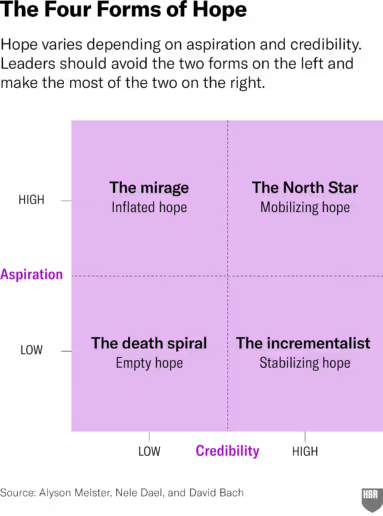
In what follows, we’ll briefly define and discuss each of these four forms of hope.
1. Inflated (high aspiration, low credibility)
Inflated hope emerges most commonly when leaders feel pressure to reassure or inspire quickly but lack the resources or clarity to translate what they say into effective action. This kind of hope looks forward to a desirable future, but the message, or the leader delivering it, lacks credibility. The result is a mirage: Aspirations are articulated without viable pathways, sufficient resources, or acknowledgment of constraints—and with a sense of optimism that feels imposed rather than shared.
Although inflated hope is typically well-intentioned, it creates a gap between what is promised and what people perceive as possible. Over time, that gap widens, eroding trust.
The story of the Indian ed-tech company BYJU’s is a case in point. BYJU’s shot to global prominence after its founder and CEO, Byju Raveendran, grandly promised to make it “the world’s school.” By 2022, having enrolled tens of millions of students via its freemium app, the company had become the world’s most valuable ed-tech firm, with a market valuation of $22 billion.
But the inflated hopes that the company had sold to so many underprivileged learners and investors was a mirage. Raveendran, it turned out, had no way of achieving what he was promising. Reports of unpaid bills, financial improprieties, and massive governance failures soon surfaced, and the company’s value fell to zero.
2. Empty (low aspiration, low credibility)
This form of hope offers neither a compelling future nor a credible account of the present. Communication is vague, procedural, or emotionally detached, leaving people without orientation and motivation. Leaders avoid commitment, rely on technical language, or remain silent during periods of heightened uncertainty. The result is a death spiral in which anxiety is generated rather than dispelled, and motivation fades.
Leaders presiding over struggling legacy business models often resort to empty hope. John Akers’ tenure as CEO of IBM in the early 1990s illustrates the pattern. As the PC revolution dismantled IBM’s mainframe-dominated business model and the company posted its first-ever losses, Akers responded with successive reorganizations that substituted structural change for strategic clarity and a compelling vision. He avoided the question employees and investors were actually asking: Does IBM have a future in this new landscape?
When an internal memo leaked describing Akers lamenting that employees didn’t grasp how serious the situation was, it confirmed what many had already sensed—that he was out of touch with the organization, its employees, and its place in the changing market. Employees were left without a credible account of either the present or the future, and trust collapsed.
3. Stabilizing (low aspiration, high credibility)
Stabilizing hope is deliberately restrained in its future orientation. It’s incremental. Rather than advancing an ambitious or transformational vision, leaders who deploy stabilizing hope ground people in the present. They prioritize the preservation of trust. The emphasis is on realism, care, and psychological safety—on helping individuals and organizations endure uncertainty without projecting optimistic outcomes that can’t yet be substantiated.
Leaders who deploy stabilizing hope admit that they don’t yet have clear answers. They focus on making progress one step at a time. They maintain continuity in core priorities and routines, often in a sea of change and disruption.
When Emma Walmsey became the CEO of GlaxoSmithKline, in 2017, she inherited a company with a stalling R&D pipeline, shaky investor trust, and a culture that had grown bureaucratic. With a consumer-goods background, she also had to build credibility at the top of science-based pharma.
Rather than offering early sweeping promises, she moved incrementally. She brought in a new chief scientific officer, refocused the pipeline on vaccines and specialty medicines, and, five years in, spun off the consumer-health division entirely. What she offered was not an early vision of transformation but something more modest and, for a company in that condition, more necessary—a credible picture of forward motion.
4. Mobilizing (high aspiration, high credibility)
Mobilizing hope is the North Star, in that it combines a compelling vision of the future with credible, grounded delivery. It’s particularly effective when meaningful change or transformation are required and sufficient momentum can be generated.
Leaders who use hope as a mobilizing force articulate why change matters, but they also acknowledge difficulty, uncertainty, and cost. They integrate challenges and constraints into the narrative of progress. They pair aspiration with agency and believable pathways. They name what’s hard while explaining why it’s worth doing. They’re explicit about what is known, unknown, and still unfolding. And they speak with conviction that’s backed by consistent action.
When Lisa Su took over the chipmaker AMD in 2014, the company was near bankruptcy. But Su, a worldclass semiconductor engineer, recognized the company’s potential and promised to turn it around, telling employees during a townhall on her second day that they would soon be building the best chips in the world.
Su had the credibility, in the form of technical expertise and business savvy, to shore that aspiration up—and committed the company to developing a new chip architecture. In the decade that followed, thanks to the mobilizing form of hope she put into practice, the company’s stock rose nearly 30-fold. Describing the nature of her achievement, one of her staff said, “You have to establish your own credibility and your own vision, and bring the entire company, your customers and your investors with you.”
第 3 节
The Path Forward
The four forms of hope are not fixed leadership types. Hope shifts with context, timing, and organizational capacity. Leaders should make it their goal to deliver hope that either stabilizes or mobilizes. In periods of acute disruption, they might opt for stabilizing hope as the most effective response; during moments of renewal, they have to opt for mobilizing hope. In either case, the goal should be to align aspiration and credibility, which requires deliberate calibration. Three practices are particularly important.
Ground the present.
Credibility begins with an honest accounting of current conditions. Naming uncertainty, limits, and competing demands, without rushing to resolve them, signals realism and respect. Leaders need to stay in touch with people’s current perceptions through culture assessments and discussions with trusted partners who provide unfiltered feedback.
Set aspiration that fits the moment.
Aspiration should stretch people without detaching itself from their sense of what is possible. This often means choosing an appropriate time horizon—stabilizing the next quarter before projecting the next five years—and being explicit about what “better” will look like in concrete terms.
Translate hope into agency and pathways.
Hope becomes durable when people can see how effort connects to outcomes. Clarifying who owns what, outlining plausible routes forward, and articulating how leadership will adapt if conditions change all help convert belief into sustained action.
. . .
In uncertain times, the strategic imperatives for leaders are clear: Harness the stabilizing and mobilizing potential of hope. Avoid any drift toward inflated or empty hope. Make clear to how effort connects to outcomes. Clarify who owns what, outline plausible routes forward, and articulate how leadership will adapt if conditions change all help convert belief into sustained action. The leaders who succeed will be those who continuously align aspiration and credibility, ensuring that reality does not extinguish hope, and that hope does not outpace reality.