
How Gen AI Could Change the Value of Expertise 查看中文版
第 1 节
As the deployment of generative AI automates away elements of some jobs and augments workers’ abilities in others, the skills, experiences, and credentials that employers use to evaluate job candidates will change rapidly. Pessimists will argue those changes limit mobility; optimists will counter that they enhance it, by reducing job requirements related to technical, or “hard,” skills.
Who will be right?
The truth is, AI will open doors for some workers while closing them for others. As part of a collaboration between the Burning Glass Institute and the Harvard Business School Project on Managing the Future of Work, we’ve found that approximately 12% of U.S. workers are currently in occupations where gen AI is likely to automate away a significant proportion of the tasks associated with entry-level jobs. That, ineluctably, will lead to a reduction in entry-level hires. It’s already happening: With the advent of Microsoft’s gen AI–powered Copilot, hiring into entry-level software engineering jobs has largely stalled. Conversely, about 19% of workers are in fields where gen AI is likely to take on tasks that demand technical knowledge today, thereby opening up more opportunities to those without hard skills.
Our analysis suggests that, in the next few years, the better part of 50 million jobs will be affected one way or the other. The extent of those changes will compel companies to reshape their organizational structures and rethink their talent-management strategies in profound ways. The implications will be far-reaching, not only for industries but also for individuals and society. Firms that respond adroitly will be best positioned to harness gen AI’s productivity-boosting potential while mitigating the risk posed by talent shortages.
Which occupations are most likely to follow this pattern of empowering experienced workers while narrowing the access for less tenured ones? To answer that question, we looked at something familiar to anyone who has started a new job: learning curves.
第 2 节
Earning Curves and Learning Curves
It’s a simple concept with profound implications. In some jobs, it doesn’t take long to get up to speed, as in the case of ride-share driving. But in a wide array of jobs, from sales to software engineering, significant gaps exist between what a newbie and an experienced incumbent know.
Learning curves capture the differences in the time it takes for workers in different jobs to reach peak productivity. When the productivity of more senior workers in an occupation far outstrips that of their entry-level counterparts, the learning curve is steep. In many such occupations, our analysis indicates that entry-level skills are more exposed to gen AI automation than those of higher-level roles—a sign that barriers to entry-level roles in those occupations are likely to rise.
So, in what occupations will gen AI raise expertise barriers?
To answer that question, and to gauge how the market values differences in learning, we analyzed earning curves within an array of different occupations. (Earning curves are a good proxy for productivity growth over time, because they often reflect the time it takes to learn a discipline.) This allowed us to isolate roles in which experienced workers command significantly higher salaries, implying a significant premium for acquired expertise. We then assessed how skill profiles differ between less-tenured and more-tenured workers within each occupation, drawing from two years of U.S. job-postings data that covered millions of online job ads.
Next, to predict which skills are likely to change in importance, we adapted a model of how gen AI adoption affects tasks within occupations. That allowed us to identify jobs that have a steep learning curve and significantly more gen AI exposure for less-experienced workers than more-experienced workers. As gen AI takes on a significant share of entry-level tasks in those roles, access to the traditional career paths could narrow meaningfully. The top 100 occupations in this category—which include roles such as project management specialist, training and development manager, web designer, and financial risk specialist—currently employ 17.8 million people, or about 12% of the U.S. workforce.
In this chart, we present a small but representative sample of the career categories in our data set.
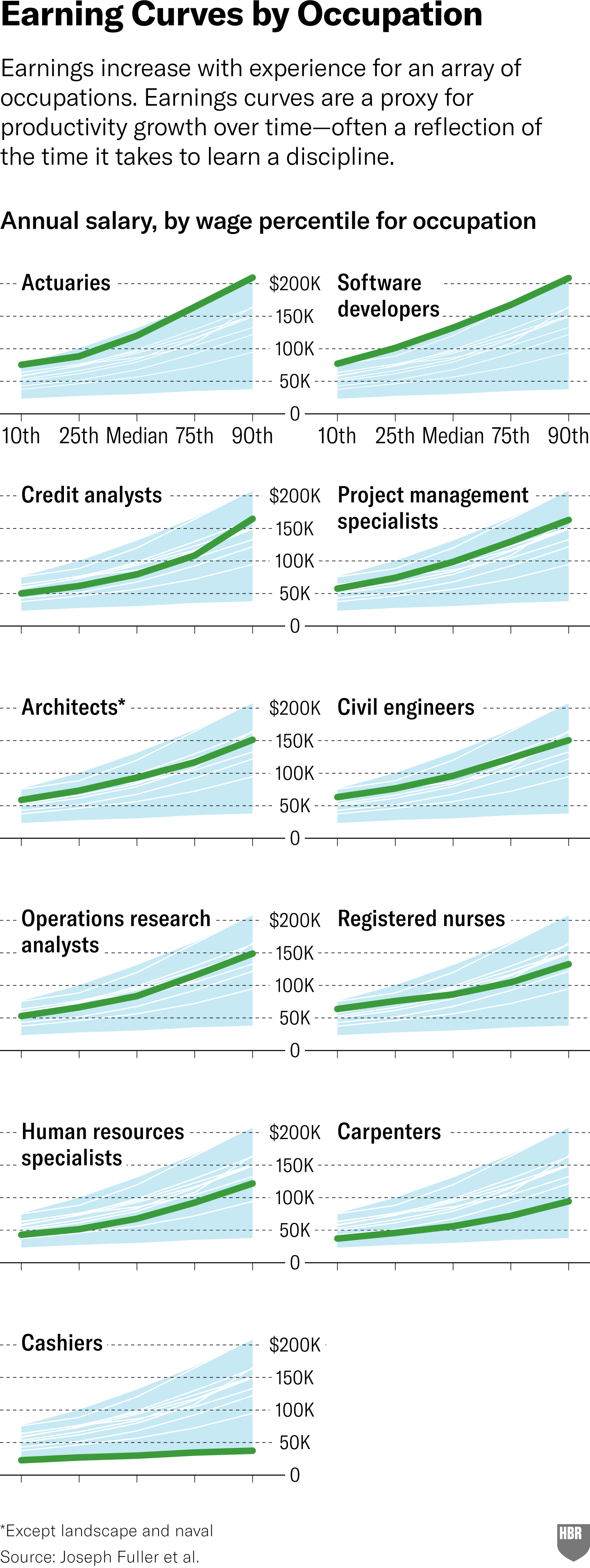
At the top are career pathways with a steep learning curve. In those careers, gen AI’s capabilities could boost productivity of experienced workers while reducing the need for their less-experienced colleagues. For instance, an experienced credit analyst might use gen AI to evaluate the creditworthiness of a business and compare that business’s financial health with peers from its industry, rather than assigning those tasks to subordinates. The role of the credit analysts here shifts: Instead of gathering and integrating information using a tool like Microsoft Excel, and contrasting their findings with their employer’s credit policies, they now explore more varied scenarios, using the findings to revisit the creditworthiness of existing customers or working with colleagues to identify potential new customers that meet their institution’s standards. Importantly, this will also include creating and prompting gen AI agents to perform many of those tasks.
Such a shift threatens to dislocate time-worn progressions from novice to expert. As gen AI takes over tasks that have traditionally served to develop foundational capability, newcomers will have fewer opportunities to gain the experience that allowed their predecessors to advance to higher-level positions. This trend should raise concerns for employers, who may face challenges in developing future talent pipelines.
Compare that to the representative career categories at the bottom of the chart, which offer only a modest premium for experience, because they rely principally on technical skills that you can learn. (You either can operate a point-of-sale terminal or you can’t.) Because gen AI—and technology more generally—will make it easier to learn those skills and refine them quickly on the job, those pathways might be made more accessible.
第 3 节
Widening Access to Jobs
To identify occupations in which gen AI might lower barriers, we again started with our learning curve analysis. In this instance, we focused on occupations with relatively flat early-career wage growth, where we found a distribution that suggests the principal challenge in such an occupation is getting hired initially, rather than mastering it. We then sought to evaluate the nature of expertise required to gain access to those jobs, employing an LLM-based analysis of job requirements to distinguish between occupations heavy on explicit knowledge (which can be learned from books or courses) and those whose requirements represent accrued implicit knowledge (typically acquired through experience). That allowed us to identify occupations defined by high explicit knowledge, where gen AI tools could potentially make required skills more accessible.
The expertise barriers inherent to these types of jobs mean they often face a shortage of qualified candidates. Gen AI could relieve that pressure by making it easier to acquire domain knowledge or other skills (such as writing or language proficiency) that have excluded otherwise qualified workers. We identified 100 jobs in this category, currently employing 28.6 million people, or nearly 20% of the U.S workforce. As gen AI tools simplify skill acquisition, these occupations — among them data warehouse specialist, construction manager, electrical drafter, and network administrator — could become newly accessible to a wider range of workers. In those fields, flattened learning curves, particularly early in a career, could potentially lower barriers to entering high-demand, high-paying jobs. Gen AI is also set to revolutionize areas such as graphic design, programming, writing, and data analysis where sophisticated tasks can increasingly be performed by individuals with less-specialized training.
第 4 节
New Challenges for Organizations
With gen AI reshaping the landscape of work, businesses face a new reality that demands strategic adaptation. The parallel impact of raised and lowered barriers across different occupations will require a fundamental rethinking of organizational structures and talent strategies. Businesses will have to grapple, in particular, with the implications in the following areas.
Organizational structure.
The narrowing of entry-level roles in some fields will fundamentally change what organizations look like. Currently, many operate with a pyramid structure, with multiple entry-level workers supporting each senior role. As gen AI automates entry-level tasks, this ratio could shift dramatically. A structure that once had five entry-level workers for every senior role might evolve to a two-to-one ratio, or even less.
New opportunities and challenges will emerge as gen AI reshapes organizational pyramids in some parts of the firm into more rectangular or diamond-like structures. Such structures may facilitate faster information exchange and more direct communication between organizational levels, allowing more agile decision-making and execution. They may also enable businesses to deploy smaller, more-agile teams. As gen AI takes over many routine tasks and decision-making processes, the need for multiple layers of middle management should also decrease, resulting in more direct connections between senior leadership and more-junior workers. Experienced workers, empowered by gen AI tools, might require less direct supervision, further reducing the need for management layers. As gen AI takes on tasks that rely on deep technical expertise, companies may be able to rotate high-potential talent through more functions to groom them for management positions in the future.
However, flatter, more diamond-shaped organizational structures may also create fewer opportunities for employees to gain management experience. The de-layering enabled by gen AI will reduce the number of promotions, limiting workers’ opportunities to gain the experience required to advance their careers. Companies will need to adjust career paths and devise new ways to reward execution and collaboration skills and expertise.
Talent strategy.
Evolving organizational hierarchies will require companies to rethink how they handle recruitment and career development. Companies will probably focus recruiting efforts on fewer skills providers. Talent-acquisition teams will need to become significantly more agile to access talent pools that align with rapidly evolving technological demands. Moreover, as companies pare down the ranks of entry-level workers, the pool of candidates available for promotion will shrink, which means maximizing the quality of new recruits will be paramount. Growing companies will need to develop new talent pipelines, perhaps in part by recruiting from other industries, while finding new ways to nurture and prepare talent for senior roles.
These dynamics could also lead to increased competition for experienced workers, making talent retention a critical priority — a shift away from a “churn-and-burn” model of talent acquisition and toward one more focused on investing in and retaining workers with scarce expertise.
Training models.
Today, a significant portion of learning and development budgets is devoted to onboarding new workers. As the workforce in some occupations becomes more concentrated around a small pool of experts, initial training may become less important than boosting the productivity of existing employees. Once gen AI becomes widely integrated into the workplace, that will mean identifying and then investing in the skills that will be increasingly important to each role—and that keep those who are most experienced at the top of their game. Diamond-shaped organizations will need to restructure learning paths to facilitate the lateral transfer of experienced workers from other fields and workers whose careers may be disrupted by AI.
Employers will need to adopt new training models that accelerate learning, both to help existing workers adapt and to enable new workers to climb the learning curve more quickly. To avoid delaying the implementation of innovative technologies while they wait for third parties to develop training programs, they will be likely to favor customized, internally-developed programs that are based heavily on firm- and industry-specific knowledge. In a workplace with few entry-level opportunities to learn on the job, simulations are likely to become important mechanisms for enabling workers to gain critical experience in ways that require far less time in the seat.
Company-specific knowledge.
As gen AI automates more-generalized skills, company-specific knowledge is likely to become an increasingly important factor in unlocking worker productivity. Companies will want to focus on identifying and cultivating this knowledge, and on whether and how to build infrastructure to make it more accessible to workers. This will involve decisions about the creation of new knowledge management systems, such as internal wikis and AI-powered learning platforms. Organizations will need to consider how much of a barrier they want company-specific knowledge to be and how to balance the benefits of specialization with the need for workforce flexibility.
第 5 节
Navigating the AI-Driven Talent Landscape
The gen AI revolution is changing not just what but also how we learn. Traditional learning curves are being redrawn, creating new paradigms for skill acquisition and career advancement. This shift demands a fundamental rethinking of how businesses approach talent management and how individuals navigate their careers.
As this revolution unfolds, its effects will evolve in ways that are challenging to predict. Our current analysis provides only a static snapshot based on existing occupations, skills, and AI capabilities. As gen AI widens access to certain high-skill occupations, increased labor supply could potentially put downward pressure on wages in these fields—a possibility not modeled in our study. This represents a crucial avenue for future research. Moreover, as technology advances, the boundary between what must be learned on the job versus through formal instruction is likely to keep shifting, complicating the landscape.
The organizations that thrive will be those that embrace the fluid nature of AI-augmented learning curves. They will view each curve as not a fixed trajectory but a dynamic path that can be reshaped and optimized with the right strategies and tools. In so doing, they won’t be just adapting to the AI revolution. They’ll be helping to shape its course, building a workforce that is more agile, adept, diverse, and productive.