
How AI Can Power Brand Management 查看中文版
第 1 节
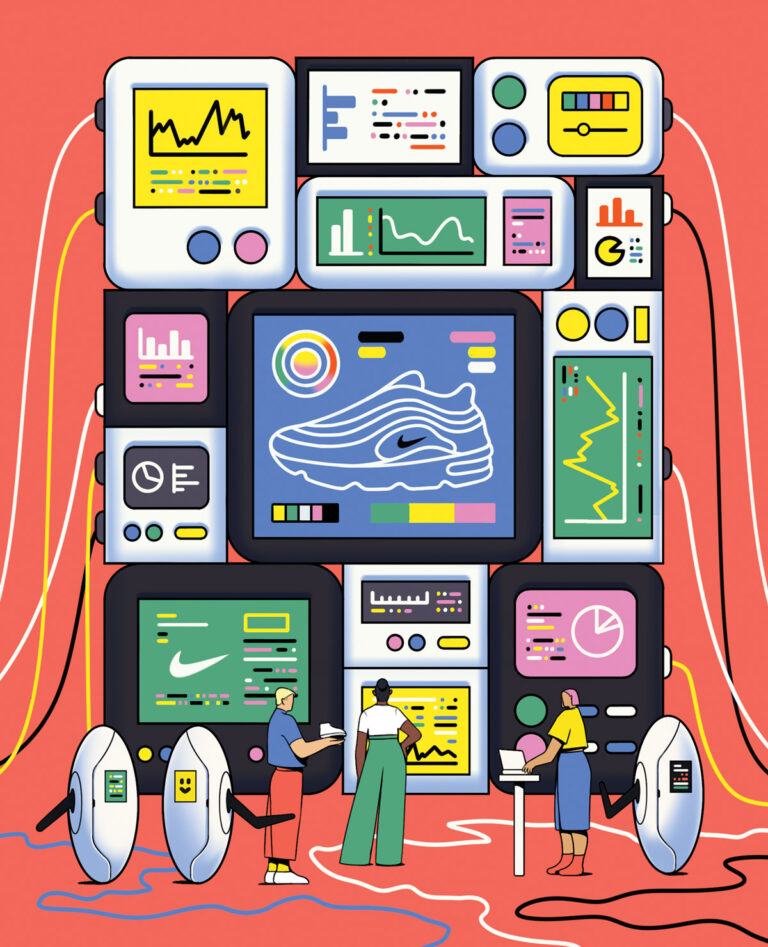
Few brands are more iconic than Nike. From its swoosh logo to its slogan “Just Do It,” the company has mastered the artistry necessary to build a renowned brand. So when Nike asked Obvious, a trio of Parisian artists who make AI-inspired designs, to develop new iterations of the Air Max sneaker in 2020, it wanted to be sure the designs wouldn’t deviate too dramatically from Nike’s signature style. Obvious trained its generative AI model by feeding it pictures of the Air Max 1, the Air Max 90, and the Air Max 97 and used the model to create a vast array of design ideas. Then, drawing on their own knowledge and perception of broader fashion trends along with Nike’s marketing objectives, the trio iteratively tweaked the model until it produced a design that struck the right balance between novelty and staying on brand. The design incorporated many of the stylistic elements of the classic Air Max but blended them with new colors, shapes, and patterns to achieve a fresh, cool feel. The limited edition shoes sold out in less than 10 days.
Unsurprisingly, marketers have begun experimenting with AI to improve their brand-management efforts. But unlike other marketing tasks, such as A/B testing and bidding on search words, brand management involves more than just repeatedly executing one specialized function. Long considered the exclusive domain of creative talent, it encompasses multiple activities designed to build the reputation and image of a business—such as crafting and communicating the brand story, ensuring that the product or service and its price reflect the brand’s competitive positioning, and managing customer relationships to forge loyalty. A brand is a promise to customers about the quality, style, reliability, and aspiration of a purchase. AI can’t fulfill that promise on its own (at least not anytime soon). But it can help shape customers’ impressions of a brand at every interaction. And it can automate expensive and complex creative tasks—including product design.
Mixing brands and automation is a delicate affair. AI has the potential to adversely affect a brand, so successfully implementing it in this context often involves confronting resistance and backlash from both customers and employees. Nevertheless, AI is becoming an integral part of brand management. To succeed with it, you must understand how it is perceived by stakeholders and what can be done not simply to mitigate their concerns but to make them avid supporters. You must be sure not to overautomate by removing any sense of human control or making AI the face of the brand. And you should always keep in mind that AI and creative pursuits aren’t opposing forces.
On the basis of examples from Intuit, Caterpillar, LOOP, and Jasper AI, along with in-depth scholarly research, we propose a framework for thinking about the key roles that AI plays when it comes to managing brands effectively. The most successful approaches blend the best of human and machine intelligence to augment, not replace, human creativity.
第 2 节
The Four Ps of AI’s Brand Impact
AI can improve performance at each stage of the customer-management life cycle, from acquisition to development and even retention. Those performance improvements, in turn, can reinforce and extend a brand’s equity. They can be grouped into four basic categories of impact: Productivity—AI increases the efficiency and convenience of accomplishing marketing tasks, improving the customer experience and driving brand loyalty. Prediction—AI reduces uncertainty, augmenting what the brand can promise and thereby building confidence and trust in the product and the company. Personalization—AI increases engagement and relevance for the firm’s offering by tailoring elements to each customer, thus forging the image of a brand that cares about the customer’s needs on an ongoing basis. Proposals—AI offers new creative solutions and value drivers while staying true to the brand’s essence.
Although new forms of AI are constantly being developed, this framework accommodates the main roles that it can and will play. For example, classification algorithms, like the ones that sort for spam in your email, contribute to each of the first three Ps, whereas generative AI can contribute to all four and is especially suited to personalization and proposals. Brands should use this framework as a simple guide for navigating a complex and expanding industry. If an AI program doesn’t contribute to any of the four Ps, it’s probably not worth the risk to the brand associated with the technology.
Now let’s dig deeper into the framework to see how some companies are already using artificial intelligence to improve their brand management.
1. Productivity
Customer service reps are your frontline brand ambassadors. And, arguably, the most important step in brand management is retaining expensively acquired and developed customers. The risk that a customer will be unable to resolve an issue with a product, a service, or a payment satisfactorily—and will then abandon the brand—is one of the biggest challenges a company faces.
When customers have problems, they contact customer support, and most would rather wait in line for a human agent than get help immediately from a chatbot. Their biggest complaints about bots are a lack of understanding and an inability to solve complex issues. However, unlike chatbots, humans are not eternally attentive, patient, and cheerful—especially when faced with a relentless queue of angry callers. Long wait times and frustrating interactions may corrode a company’s brand and lead customers to depart.
Intuit, a global financial-technology platform that makes software for personal finance, small-business operations, and tax prep, offers products including TurboTax, Mailchimp, Credit Karma, and QuickBooks. At one point it was dealing with a barrage of customer questions and complaints regarding the use of its software. To improve its customer service, Intuit wanted to provide its agents with frequent feedback on their performance. But only about 10% of callers answered customer experience surveys (a typical response rate for call centers), and managers could listen in on only a small subset of calls. So agents had little opportunity to receive robust feedback in a timely manner.
To overcome that challenge, Intuit used transcripts of the calls that customers had rated to train an AI model to detect which interactions were most likely to result in customer satisfaction. Because all calls were recorded and could readily be transcribed, Intuit could use the trained AI model to provide personalized daily feedback to all its agents based on all calls, whether they’d been customer-rated or not.
Thus the company improved customer satisfaction at a fraction of the cost of typical human supervision or expensive training programs for its agents. And because the employees were more effective, they felt more fulfilled. Furthermore, because Intuit engaged employees at all levels and solicited their input on how to design a dashboard to display feedback for them, it eased concern that agents were going to be replaced by AI and ensured that they remained the face of the brand when customers called in to get support.
2. Prediction
Caterpillar, a maker of heavy-duty construction and mining equipment, uses AI to deliver additional value by literally foreseeing the future. Its subdistributor Borusan Cat, based in Turkey, faced this problem: When a customer’s equipment broke down, the repairs were often very expensive because a part had deteriorated to the point where it damaged the rest of the machine. In some cases an engine overhaul was needed, and the downtime to get the necessary parts and conduct the extensive repairs was costly for both the customer and Borusan Cat. Furthermore, when their machinery did break down, customers sometimes turned to unauthorized third-party vendors, resulting in lost business for Borusan Cat. The company believed that it could deliver significant value by detecting part failures before they rendered the equipment inoperable, much the way a medical checkup can detect a clogged artery and prevent a heart attack.
The first step was to establish the infrastructure necessary to harvest data. The company embedded sensors in the machines to continuously harvest information on the state and use of the machines’ parts. After amassing enough failure incidents, the company trained AI to combine signals from various parts of the equipment with past data patterns to predict—with 97% accuracy—which piece of equipment was at risk of breaking down and what the exact problem would be. Using these predictions, the company alerted customers and selectively sent its technicians to validate diagnoses and determine the level of service or repair required. If the customer agreed, the equipment would be repaired with minimal if any downtime and more cheaply than if the customer had waited for the machine to malfunction.
Mojo Wang
However, despite the benefits of the AI-based technology, willingness to pay for its insights was initially lacking. Customers thought that proactive calls from technicians were a marketing gimmick to sell more parts or service. Salespeople were skeptical of the technology, especially when it flagged equipment on a “healthy” site that they had been unconcerned about. And because each repair was a low-ticket item compared with selling equipment, salespeople had little incentive to pursue repairs. For these reasons they were waiting too long to call customers whose machines had been flagged as being at risk of breaking down—thereby failing to deliver on the company’s promise of preemptive maintenance and in the process doing damage to the brand.
After a few twists and turns, management chose to abandon the uphill battle of explaining the capabilities of the technology to skeptical customers. Instead it absorbed the value of the technology into its maintenance contracts. The company guaranteed customers no downtime, or else Borusan Cat would provide replacement equipment. Thus the AI’s predictive capabilities augmented the brand’s promise and also removed the possibility that customers would turn to third parties if their equipment broke down. The company captured the added value provided by the AI without drawing attention to its presence.
That fix also addressed the sales team’s financial incentives. Folding AI insights into the maintenance contracts resulted in a higher-ticket sales item worth prioritizing. Because it was critical that salespeople follow up on AI alerts in a timely manner, the company also created a central, cross-organizational team dedicated to that service.
With those changes in place, the company could finally realize the technology’s potential: to repair parts before they sustained significant damage. In fact, because the parts removed from repaired equipment were often salvageable, they could be refurbished and resold. Effectively providing these added services each time a repair was needed gave Borusan Cat more opportunities to interact positively with customers, increasing the attractiveness of its AI solution while reinforcing its image as a trustworthy brand that cares about customers’ business and long-term success.
3. Personalization
Getting customers through the door is an achievement. But they may make only a single purchase, sign up for the most basic service, or buy a limited quantity of the company’s products. In that case the company generates modest revenues from customers it expended considerable resources to acquire. And customers may become less excited about an offering over time and feel that they are overpaying—severely restricting their lifetime value.
To see how AI can enable a company to provide tailored offerings that keep existing customers engaged with the brand, let’s turn to an unorthodox car-insurance app: LOOP. It doesn’t use several standard insurance-premium criteria, such as credit score, income level, and occupation, which tend to introduce bias against certain minority groups. It can afford to omit them because, as an AI-powered smartphone app, it constantly collects risk-relevant data about where customers drive (type of road, traffic volume, weather) and how (speeding, hard braking, talking on a cell phone). Its unique approach combines that data with extensive information on road accidents to predict, using AI, whether a customer who tends to drive in a particular way on particular roads is at high, medium, or low risk of filing a claim.
Using the AI’s predictions, LOOP makes additional offerings to customers, including much cheaper rates. Just imagine how a LOOP customer feels when she receives a notification like this: “You’re on a roll, Jacky! You’ve unlocked a surprise for driving safe: lower rates!” LOOP further incentivizes safe driving by providing a customized, continually updated driving score (say, 8.18 out of 10), along with safety insights and tips gleaned from its treasure trove of customer and road data combined with what it learns about individual drivers’ behavior. Customers see, on a weekly basis, meaningful feedback and suggestions about how to drive and what roads to avoid—plus actual results in terms of their scores and rates. That goes a long way toward removing any skepticism they may have had about whether an insurance app that eschews many of the conventional measures can accurately assess their risk. Although several competitors offer customers some benefits in exchange for gaining access to their telematics data (typically only driving behavior), these are usually comparatively small discounts—and they employ the data more as an excuse to send users telemarketing communications than to set their rates.
LOOP not only helps create safer roads; it lowers the chances that its customers will get into an accident and file a claim, increasing their lifetime value. In short, AI helps achieve a win-win for the customer and the company while building the image of a brand that is fair and cares about customers’ well-being beyond the initial point of sale.
4. Proposals (Lots of Them)
A brand has a unique tone or personality that cuts across all company communications, from social media and email messages to blogs and other long-form content. A well-defined and consistent brand voice reinforces brand image, fosters a deeper connection with the audience, and helps the brand stand out from competitors.
Many managers have resisted automating brand communications, despite the advent of large language models. First, they worry that using generative AI means surrendering their brand’s unique voice in favor of generic, cookie-cutter output. Second, they are wary of the tendency of large language models to “hallucinate” facts in their responses, hurting a brand’s reputation. Third, they are rightfully concerned that whatever they put into the system will be used to train the models and thus will become accessible to competitors. In short, they see a trade-off between marketing efficiency and staying in control of the brand’s image and integrity.
Consider how Jasper AI, a marketing-content generator, navigates that trade-off. Let’s say you want to create a marketing campaign. You begin by helping Jasper learn your brand’s unique tone of voice. You can upload a style guide or link Jasper to a few examples of previous posts that you believe best reflect your brand. Jasper will learn your brand’s personality (attitudes and feelings about a topic), style (word choice, sentence structure, rhetorical devices), and other aspects of the language you typically use in branded communications. For instance, it can learn that your brand’s tone is more casual than formal, more funny than serious, or more irreverent than respectful. Then you upload information about your company, products, services, and audience, and the goal or objective of the communication.
Jasper will help generate marketing materials for communication campaigns. It will conjure a solid first draft of, say, a blog post that is not only optimized for search engine visibility but is also written in your brand’s unique voice and accurately incorporates facts about your company. Beneath the hood, Jasper leverages a family of large language models (OpenAI, Bard, Stability.ai, and Anthropic) and searches Google for the latest news to ensure that its proposals are up-to-date, because most large language models have been trained on “old” data, perhaps to 2019. Most important, it layers facts about your business with your brand’s distinctive qualities while ensuring that those facts are not used to train the underlying AI models.
You are involved throughout the process. You can ask Jasper to help you edit the blog to better align with your desired brand attributes (for example, “infuse more excitement,” “convey a more upbeat attitude,” “emphasize global appeal”) or to keep generating entirely new blog posts until you see one you like. Jasper can also morph the blog into other types of marketing content for your campaign, such as a landing page, a LinkedIn post, or an email, creating a full gallery that conforms to the format of each asset type while preserving the essence of the brand. And if you need to replicate your campaign for a different product or audience (say, consumers in the developed world), simply upload information for that audience, switch out audiences in a drop-down menu, and let Jasper regenerate all the materials.
In these various ways Jasper can eliminate the trade-off between efficient marketing and controlling your brand identity, allowing you to creatively communicate at scale without losing your brand’s distinctive voice, veering away from the facts, or giving up your trade secrets.
. . .
AI cannot and should not automate all aspects of brand management. Our examples emphasize the importance of integrating it into conventional marketing efforts without making it the face of the brand or relying on it so much that it usurps your control. It should complement rather than substitute for the roles that human brand builders play.
As Nike’s partnership with Obvious proved, managers can combine human intelligence with artificial intelligence to push the boundaries of what their brands can do. Successful brand managers will be those who master bringing out the “art” in artificial intelligence.