
The Chair of Honeywell on Bringing an Industrial Business into the Digital Age 查看中文版
第 1 节
How can you quantify the benefits of a digital transformation? During my recent tenure as the CEO of Honeywell, we spent significant time, energy, and capital on our IT infrastructure—more than the company ever had before. Was the investment worth it? Although it’s hard to estimate exactly how much value we derived from streamlining our systems and improving our internal and external data and analytics capabilities, I have a clear view: There’s zero chance that we would have made it through Covid, inflation, the upswing in geopolitical risk—all the challenges we faced over the past several years—had we not developed a transparent and coherent digital strategy.
Honeywell serves a range of businesses—aircraft, industrial facilities, warehouses, buildings—with connections to automation, the future of aviation, and energy transition. We help clients connect all the devices, products, and sensors in their systems to increase operating efficiency, productivity, and growth. When I was appointed chief operating officer, in 2016, following stints leading our process solutions and performance materials and technologies divisions, I finally got a top-down view of the whole company and quickly realized that our own systems weren’t in a good place. We had more than 150 enterprise resource planning systems (ERPs), some 2,700 applications, 1,700 websites, and no overarching plan for collecting and using data. I knew that to credibly help customers, we would have to become more digitally savvy ourselves.
The question we asked ourselves was “Is it possible to use digitalization to transform a diversified industrial conglomerate into an integrated company?” We wanted to further link our businesses and to change the kind of company we were, not just how we handled data. But to do that we had to reconceive the systems we relied on—both our own and those we offered to customers.
Internally, the goal was to improve productivity, transparency, and agility. Externally, it was to help us harness all the information being generated by the systems we sold and allow us to offer clients a whole new kind of value: a means to track emissions, save energy, improve safety, and more. That capability would help launch a software business within our legacy industrial one.
When I was promoted to CEO, in 2017, I established four priorities: (1) enhance organic growth, (2) continue margin expansion, (3) lean into software as a key part of our value proposition, and (4) deploy capital more aggressively. Digital transformation was essential. We needed to streamline our IT infrastructure down to a manageable number of data sources and to develop centralized, definitive, accurate master databases—one for products, one for customers, one for employees, and several others—all structured in a similar way. We wanted to be able to take all that information, manipulate and analyze it, and actually do something with it—and to help our customers do the same.
第 2 节
Foundational Experience
My background is in engineering, so I’ve always believed in the power of data to improve decision-making. I was also lucky enough to take roles throughout my career that helped me grasp how systems work and how many discrete systems make up a whole, all of which prepared me to lead a digital transformation.
After university, I started at GE Aerospace, working on various engineering teams. In those first few years I was doing hard-core technical and algorithm development, so I got very comfortable with data and analytics and a quantitative approach. My second job was at Booz Allen Hamilton, where my consulting assignments gave me a view inside a variety of industries, companies, and customer issues. There I learned how to think about enterprisewide problems, from where to begin diagnosing them—What information do I need? What interviews should I do? How can I gain access to people and data?—to how to recommend strategy and execution.
Next I joined Ingersoll Rand to work in business development, where I got an education in mergers and acquisitions: How do you assess targets? How does your inorganic strategy match your organic strategy? How do you do transactions? Then, for the following six-plus years, I ran various businesses spanning both services and products, which gave me hands-on experience navigating a variety of business models.
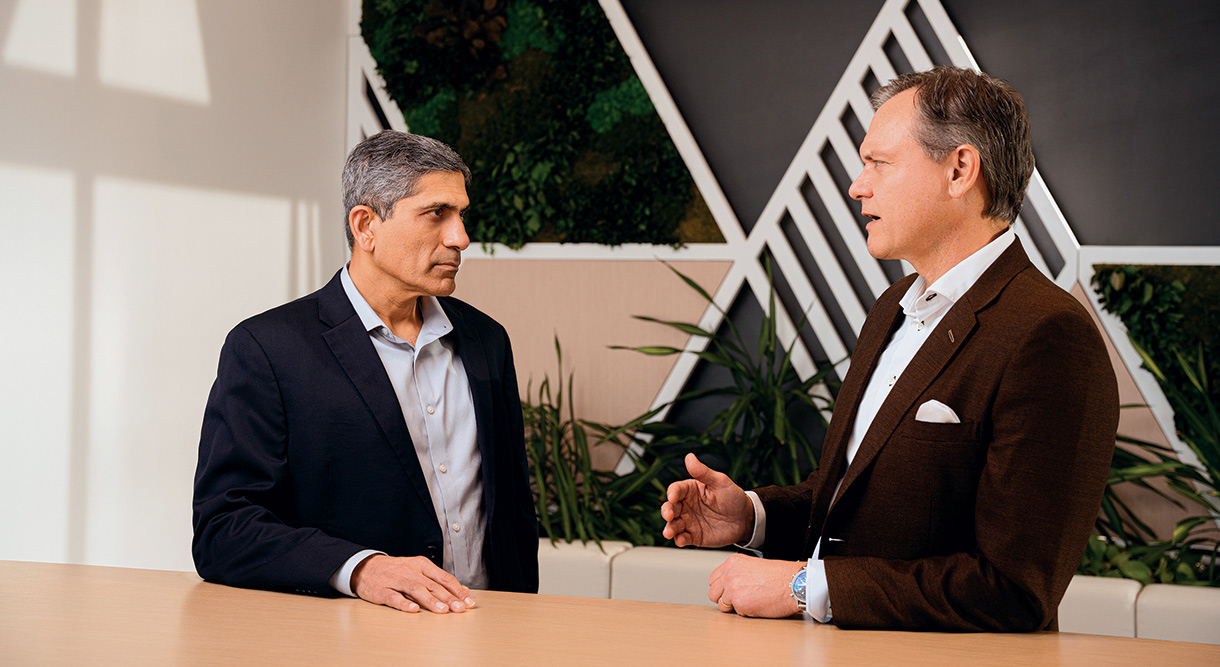
Vimal Kapur (left), Honeywell's current CEO, with Darius Adamczyk Will Crooks
After that I became the CEO of Metrologic, a private company in the IT space with about $300 million in revenue. I didn’t have the same resources I’d had at my previous, much larger employers, but those constraints taught me to be adaptable and to innovate and act quickly or risk being left behind.
After Honeywell acquired Metrologic, in 2008, I cycled through multiple roles, each with a bit more responsibility and scope. Initially I was managing the day-to-day operations of businesses for which a detail orientation was critical. Later, as I moved on to larger P&Ls and teams and couldn’t be as hands-on, I needed to embrace data, processes, and structures. When I became the COO, I realized that the entire company needed to do the same—under a unified strategy. That wasn’t just a problem to solve—it was an opportunity.
第 3 节
A Multifaceted Transformation
Within Honeywell itself, we needed transparency- and efficiency-enhancing systems with centralized data to guide our business decisions. We called the effort to build them Honeywell Digital. Externally, we needed to offer systems that would put our customers’ data to work for them in new ways. We called that effort Honeywell Connected Enterprise.
We divided the internal project into three phases. The first was simplifying and reorganizing our infrastructure: going from 150-plus ERPs to 10; from 1,700 websites to fewer than 100; from 2,700 applications to fewer than 1,000. A glut of software and systems presents technical risks, including obsolescence, and is much more difficult to maintain. Streamlining significantly reduced the budgets needed to keep things operating smoothly.
The second phase was defining master databases for products, employees, customers, and many other things. Without masters, every silo has its own dataset, which may not be current or consistent with what other parts of the business are looking at. To create those masters, though, we had to go through all the competing reams of data and sort out the inconsistencies to figure out what was correct and what wasn’t; format the data so that it could be compiled; and install the systems necessary to house everything in one place—all of which required an enormous data cleanup effort.
The third, most exciting phase was developing a strategy to put the data to work. That part of our transformation has had its own arc. We started small, working within a function—integrated supply chain or HR or finance—to implement the new systems. Once they were in place, we worked to connect data across functions to create visibility into the whole value stream. That process later guided enterprisewide activities such as people planning (How do our budgets translate into staffing needs across units?) and pricing (What do we see on a product level, business unit level, and so on?).
The external effort was more complicated, because we had software businesses within each of our four strategic business groups: aerospace, performance materials and technologies, building technology, and safety and productivity solutions. We needed to actually lift software from those businesses to create Honeywell Connected Enterprise. That group operates across the company horizontally to leverage IT infrastructure and bring appropriate software expertise and vertically to draw on domain expertise and access to customers.
We also created a new technology offering—something we called Honeywell Forge. Industrial and operational systems are complex and are often built for a specific plant or building. Because we were already involved in the hardware and systems layers, we could start offering a cloud-based software-as-a-service layer that captures data from all the moving pieces in an operation, feeds it into a data lake, and then provides analytics with which customers can create value.
For instance, our Forge Connected Warehouse software automates data collection and provides a real-time view of what’s happening along with recommendations for reducing downtime and creating new efficiencies by, for example, identifying bottlenecks. All this is available on a tablet-optimized dashboard.
In another example, Honeywell Connected Enterprise software can be used in buildings to collect real-time data on energy use, occupant experience, and air quality. In our industrial segment it can point to preventive-maintenance needs and emissions levels and guide the creation of digital twins that can provide insights about buildings and systems.
In aerospace Honeywell Forge Flight Efficiency helps companies choose more-efficient routes to save fuel; the Dutch carrier Martinair Cargo credits it with reducing fuel consumption in its fleet of four Boeing 747-400 freighters by more than 540,000 pounds in a single year.
In cybersecurity we offer companies an enterprisewide platform that unifies their security capabilities and makes it easier to manage risk. And our Honeywell Connected Industrial Worker software gives clients visibility on the proficiency, efficiency, safety, and security of employees, no matter where they’re located.
第 4 节
Getting It Done
When you begin a change effort like this, it’s very painful. You always get internal pushback: “Why are we doing this? It’s never going to work.” You have to get over that barrier and secure buy-in.
To ensure the success of Honeywell Digital—our internal effort—I put myself at the center of the operating structure. When you’re the CEO, the organization doesn’t listen to what you say as much as it follows what you do, so you can’t delegate mission-critical strategic projects. By running the monthly meetings and the operating reviews, I sent a message to everyone: I care about this transformation personally, and we’re committed to this path. At the same time, it was important to remain open to ideas and feedback and be willing to query people, processes, and decisions until I fully understood them. Some leaders struggle with this, worrying that people will think they don’t know what they’re doing; but you’re much better off asking obvious questions early than making poor decisions later.
To launch the customer-facing initiative—Honeywell Connected Enterprise, which now houses Honeywell Forge—we held a two-day offsite. Because the project required extracting parts of our existing businesses to create the new one, I anticipated significant concern among my colleagues. So I didn’t want to just deliver an edict. We needed people to believe in and take ownership of the initiative for it to work. We had an open debate about what we wanted to do and why, what would work and what wouldn’t. We wanted to ensure that all the participants could speak their minds and feel heard and to candidly discuss challenges so that we could develop a plan for overcoming them. Eventually everyone agreed that the project had merit and would greatly benefit Honeywell in the long run.
In the end I think we probably underestimated the power of this digital transformation to deliver value for us and for our customers. Some of the change might seem small. For instance, instead of spending days wading through spreadsheets and writing reports, we can now lift data from a central warehouse and automatically populate reports and even PowerPoint presentations in close to real time. We can see in granular detail exactly how each business is doing on things such as pricing, new product launches, and productivity.
Other changes are more dramatic. Honeywell Accelerator, our internal operating system, started as a learning tool. But through the digital transformation process it has become a way to take best practices from our highest-performing businesses (along with external best practices) and standardize them across the company. That includes applying them to slower-growing businesses to improve their performance or to newly acquired companies to rapidly integrate them. Culture and processes used to be very organic; now we’re able to efficiently deploy our operating tools across the enterprise.
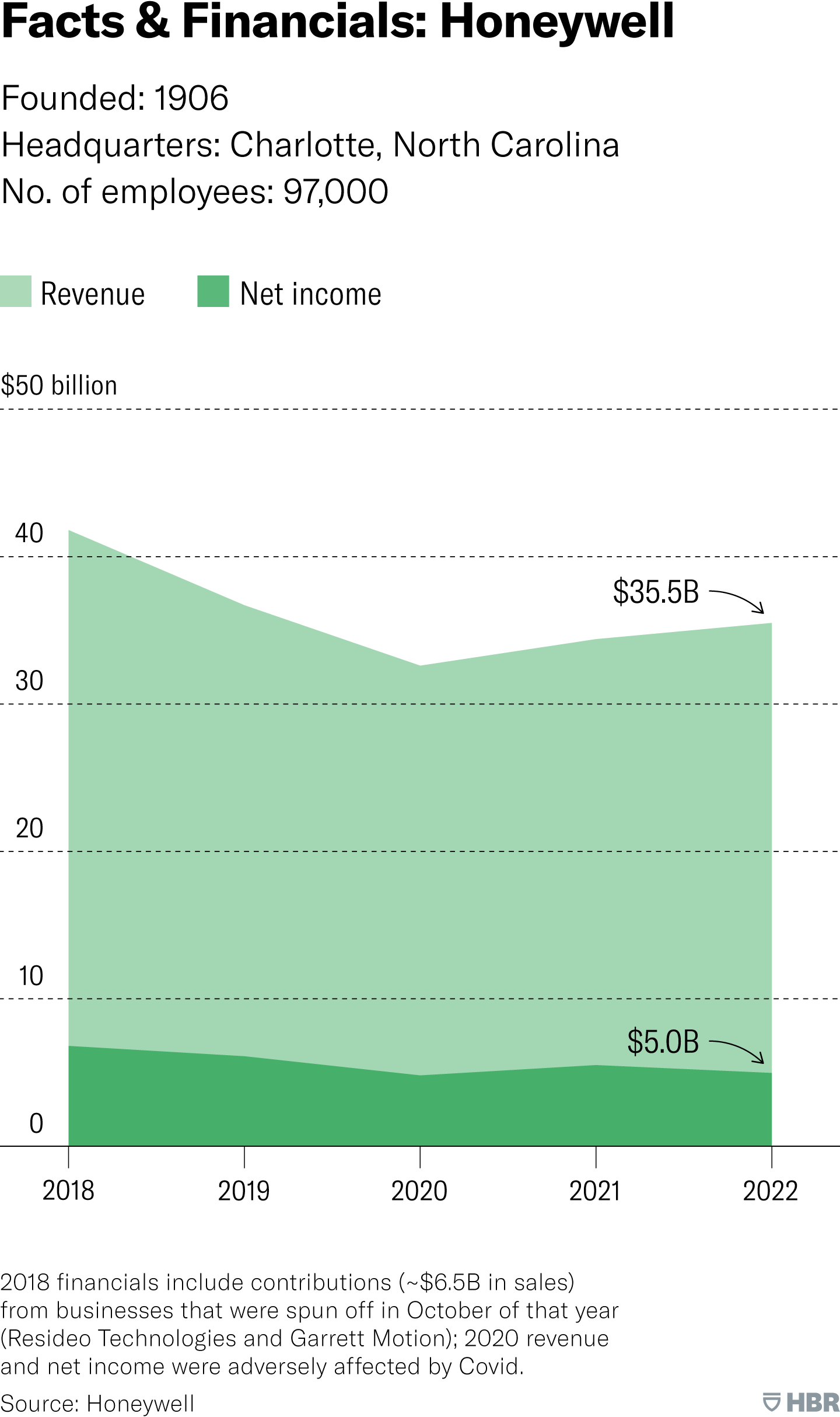
The past few years have tested every company, but they’ve also reinforced how digital transformation has made us more resilient. Take Covid and remote work during the lockdowns: At many companies lots of information was shared face-to-face: An employee would walk down the hall to talk to somebody in the next office. But when the pandemic struck, we had already spent years building our data infrastructure. Trying to run the company without easy access to that data would have been clumsy and inefficient—and we wouldn’t have had the clear view of what was really going on in our businesses that we needed to quickly adapt to the new reality.
The phase of our transformation that we think of as “simplify and digitize” ended in 2022. Since 2016 we had seen our average organic sales growth go from 3.4% to 5%, and our segment margin grow from 18.3% to 21.7%. Additionally, we had interlinked and integrated our four strategic business groups in a way that hadn’t been possible before. Perhaps most important, the digital transformation had laid the foundation for the next phase of the company’s evolution, which we think of as “innovate and grow.”
I stepped back from the chief executive role to become Honeywell’s executive chairman in 2023, but it’s clear that our digital transformation prepared us for the work that my successor, Vimal Kapur, is doing. He recently announced plans to focus on three megatrends: automation, the future of aviation, and energy transition. Honeywell Accelerator and Honeywell Connected Enterprise are central to those plans and to how we’re going to compete and drive growth.
Each of the jobs I had prior to leading Honeywell helped me see a different aspect of how to successfully navigate the challenging task of our simplify-and-digitize transformation. At the core was my training as an engineer and the lessons from my very first job, which instilled in me a belief in the power of using data in decision-making. Each step I took from there helped me understand a new piece of how data is created, shared, and used in companies.
In a way, digital transformation is really a matter of being able to create a system to capture and harness data and then to unleash its power on whatever it is you’re doing. The system you’re building will make sense of huge, complex processes and clarify what’s really happening. But to achieve that, you have to understand all the intricate moving parts that make up the whole. And there’s no better way to do that than to work inside them.